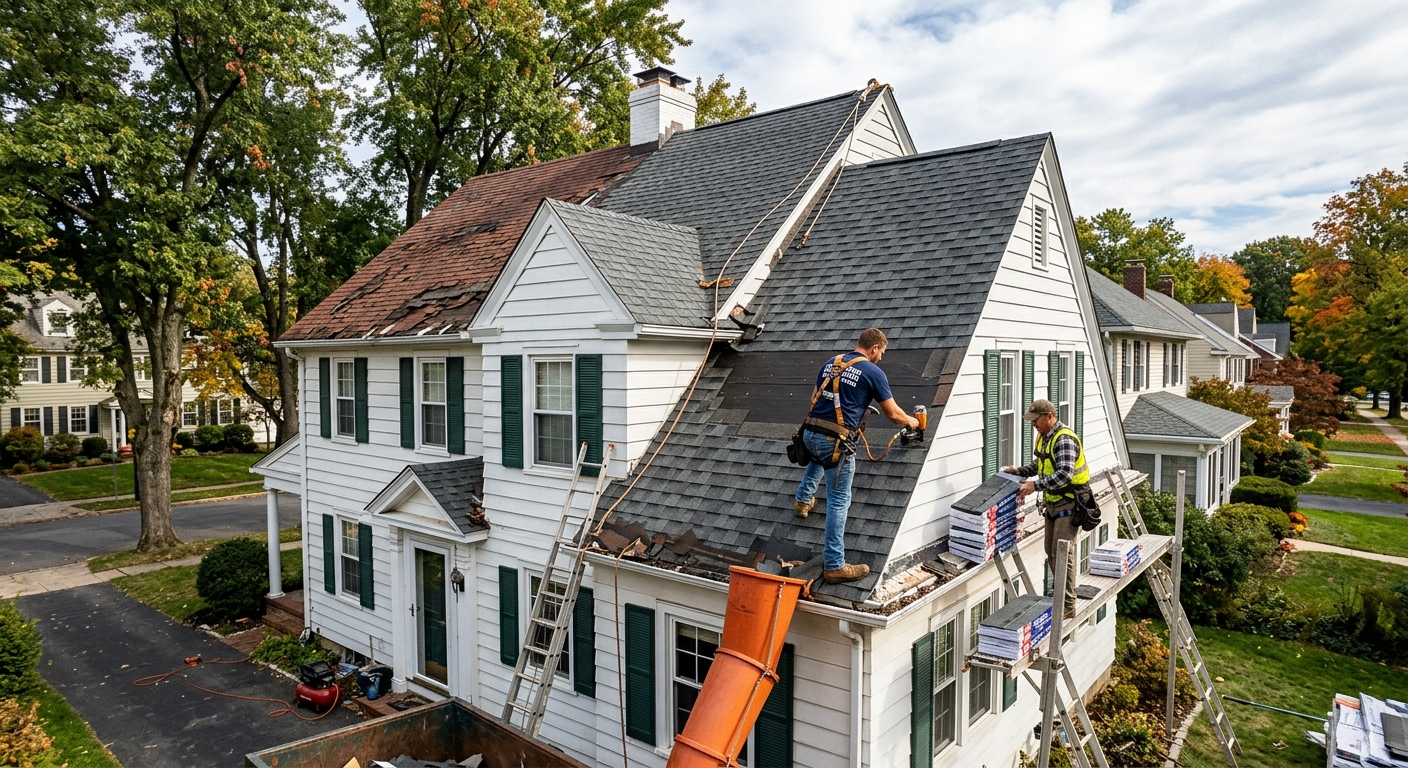
What roof replacement costs in Scott in 2026
Scott’s roofing market is shaped by housing that is mostly owner-occupied and decades old, with a homeownership rate of 63.5% and 78.4% of houses built before 1980 (U.S. Census Bureau, ACS 2024). Most local homes are single-family structures with sloped, shingle roofs, and these tend to show their age—not just at the shingle layer, but often in the roof deck itself, given that Much Allegheny County housing dates 1900–1950, causing frequent tear-offs and deck repairs during reroofing. Here, even a routine roof replacement typically exposes soft boards, outdated underlayments, or layers from past DIY repairs, all common in these older Scott homes where time has layered problems out of sight.
Because architectural asphalt shingles are the norm in Allegheny County and many Scott homes sit on hilly ground with freeze-thaw cycles, costs here reflect not only material but the hidden work: full tear-off, sheathing fixes, and ice barrier details. Metal and flat roofs are less common but present on some split-levels and small commercial properties. Repair jobs cover everything from storm-damaged tabs to scuppers on a flat roof, with price affected by how easily new meets old on these older homes.
| Material / Scope |
Lifespan |
Best for |
Price range (installed) |
| Asphalt shingles — architectural (30-yr) |
25–30 yrs |
Standard single-family roofs, cost/durability balance |
$9,700–$20,500 |
| Asphalt shingles — impact-resistant (Class 4) |
30+ yrs |
Hail/storm exposure, insurance discounts |
$16,000–$20,500 |
| Metal standing seam |
40–70 yrs |
Low-maintenance, upper-end homes, longevity |
$23,500–$41,500 |
| Flat roof — TPO or EPDM |
15–25 yrs |
Low-slope additions, garages, porches |
$12,000–$24,500 |
| Roof repair — leak or isolated section |
n/a |
Small leaks, isolated shingle or membrane fixes |
$500–$1,950 |
Prices are estimates for a typical Scott home and vary with roof size, pitch, decking condition and material selection.
Water management on a Scott roof
In Scott, your roof’s ability to shed water is a system built from not just shingles, but also well-installed gutters, sound downspout runs, drip edge, and proper grading. If you only replace the roof but leave undersized or damaged gutters, you’re inviting problems: water will not drain quickly enough in a typical Ohio Valley storm (known for sudden downpours and wind). Discharge that ends up right at the foundation is a recipe for basement leaks or worse—foundation shifting is not rare in Allegheny County’s clay and shale soils, and gutters are the frontline defense. Some shingle warranties require evidence of adequate drainage, so bad gutters can technically void coverage for water-related damage.
When budgeting for a roof, figure on new seamless aluminum gutters and downspouts for $2,200–$4,000 alongside a full replacement—especially where older homes in Scott have gutter spikes, undersized collectors, or missing sections. Drip edge, which runs the eave and helps prevent water curling under the first shingle course, should be included in any proper job, but is sometimes missed on fast/cheap projects. Don’t accept “reuse existing” unless your gutters are newer and damage-free. Water that’s well-managed at the top stays out of your basement, keeps siding in good shape, and can even reduce ice dam risk in fierce freeze-thaw cycles like Scott sees every winter.
Choosing a roofer in Allegheny County
Start your search by checking that a contractor holds a current Home Improvement Contractor (HIC) registration from the Pennsylvania Office of Attorney General, required for any residential contract over $500. You can verify them online at hic.attorneygeneral.gov. Every legit roofing company with employees must also carry workers’ compensation—confirm their status at WCAIS (wcais.pa.gov) before work begins. Don't accept a handshake deal: under the Pennsylvania Home Improvement Consumer Protection Act, a written contract is mandatory over $500 and you get three business days to cancel, penalty-free.
Proof of registration and insurance isn’t just paperwork. In Allegheny County’s saturated roofing market, especially around Scott, you’ll see legitimate companies competing with out-of-town “storm chasers” who knock on doors after wind or hail. Confirm the address and business longevity: a local landline, not a cellphone, is a good sign. If your home was built before 1978, ask if they follow the EPA Lead Renovation, Repair and Painting Rule (check their certification at certifiedrenovatorsearch.epa.gov).
- Check HIC registration at hic.attorneygeneral.gov
- Verify workers' compensation on wcais.pa.gov
- Confirm written contract will be provided
- Ask for proof of local address/physical office
- Require insurance certificates sent direct from agent
- Demand detailed, line-by-line written estimate
- Ask about permit—will they pull or assist?
- Check online reviews over several years
- Ask about deck repair contingency pricing
- Review warranty: both material and labor
- Know your 3-day cancellation rights
Red flags in Scott’s crowded market: pushy door-to-door reps after storms, any company unwilling to show HIC registration, “too good to be true” lowball offers, large up-front cash demands, and vague quotes lacking specific scope. The sheer number of contractors in the area means scams target storm-affected neighborhoods first.
Reading a roofing estimate line by line
A Scott homeowner should expect any roofing estimate to clearly state the roof’s size (in squares: each square is 100 sq ft), roof pitch (steeper jobs cost more), and exactly what will be replaced. A detailed estimate breaks out the tear-off of old layers, dumpster or disposal fees, specific underlayment type (not just "felt"), and the coverage height of ice and water barrier at the eaves—especially important with the ice dam risk here. Decking replacement should be stated as a per-sheet price so there are no expensive surprises if rot is found.
Good estimates list the exact brand and model of shingle and whether flashing, vent boots, and pipe collars are included. Pay close attention to the warranty section—workmanship and manufacturer (shingle) warranties are not the same thing. A proper payment schedule is also spelled out, with no heavy upfront cash demand. If you see only a lump sum, or vague terms like “replace roof,” that’s a sign of shortcuts or hidden extras later. Line-item clarity makes comparison possible and sets expectations if the crew discovers deck damage or extra labor is needed due to Scott’s many older, layered roofs.
| Line item |
What to look for |
Red flag if… |
| Roof area |
stated in squares, with pitch |
no measurement given |
| Tear-off and disposal |
number of layers, dumpster included |
bundled into one figure |
| Underlayment |
product type and coverage |
listed only as 'felt' |
| Ice and water shield |
coverage height at eaves |
omitted entirely |
| Decking |
per-sheet contingency price |
no allowance at all |
| Warranty |
workmanship years stated separately |
only the shingle warranty |
| Payment |
deposit under 15%, balance on completion |
large upfront cash |
Reading the warranty on a Scott roof
Most Scott homeowners mix up workmanship and manufacturer warranties, and many contractors won’t act to clear up the difference. The shingle or membrane warranty, offered by the manufacturer, covers only material defects and is usually prorated—meaning it pays less over time, especially after ten years. These warranties require proper installation and, for many brands, registration within a set window after the job. Not registering, poor attic ventilation, or “roofing over” old shingles can all void this coverage entirely.
The workmanship warranty is offered directly by the contractor and covers their labor—essentially, whether the roof was put on right. Most local outfits offer five to ten years, though you’ll see some advertising 20 years or even “lifetime.” Be honest with yourself: a 25-year labor guarantee from a business that opened last year isn’t worth what a well-established company puts in writing. Also, check whether either warranty can be transferred if you sell the home, which matters in Scott’s competitive real estate market. Never assume you have coverage or that everything is “lifetime”—read the terms and ask for the transfer process and registration deadlines in writing.
What moves the price of a roof in Scott
Local prices swing widely between bids in Scott, and the main reason ties directly to the age and complexity of Scott’s housing stock. With more than three-quarters of homes built before 1980, it’s very common to uncover multiple shingle layers or rotten decking boards that past owners just roofed over. Each extra layer costs extra to tear off and dispose—from $500–$1,500 per layer not seen from the ground. The price of decking replacement, too, adds up quickly at $75–$150 per sheet, a common need in our older homes where leaks can go undetected for years.
Factors like roof pitch and access are non-optional cost drivers in southwestern Pennsylvania. Steep slopes over hilly terrain require more time, ladders, and harness systems, pushing labor up by 20–30%. The quoted cost will always reflect the home’s roof area, stated in “squares.” For a typical architectural shingle replacement, that means $9,700–$20,500 in Scott, with range tied as much to hidden repairs as to visible surface size. Ice barrier—which is now standard at the eaves because freeze-thaw cycles and ice damming are common—can tack on a few hundred dollars, but leaving it out invites bigger problems and can void manufacturer warranties.
The county’s exposure to spring hail and summer storms pushes many Scott homeowners toward impact-resistant shingles, which cost more upfront but resist Ohio Valley storm tracks that regularly cross Allegheny. If a quote seems much lower than others, it’s likely skipping on quality, experienced labor, or hiding line items you’ll pay for later.
| Factor |
Why it matters here |
Cost impact |
| Roof size in squares |
each square is 100 sq ft of roof surface |
primary multiplier |
| Pitch and access |
steep pitches need harnesses and slow the crew |
+20–30% labour |
| Existing layers to tear off |
two or more layers means full tear-off and disposal |
$500–$1,500 per layer |
| Decking condition |
rot is found during tear-off, not before |
$75–$150 per sheet |
| Ice barrier at eaves |
required where ice damming has a history |
$300–$800 |
| Material grade |
3-tab vs architectural vs Class 4 impact-resistant |
$500–$2,500 |
Permits and code requirements in Scott
Roofing in Scott falls under the Pennsylvania Uniform Construction Code (UCC), which is based on the IRC and enforced in Allegheny County by the Department of Permits, Licenses, and Inspections—especially for Pittsburgh-adjacent municipalities like ours. If you're replacing more than 50% of your roof area, expect a building permit to be needed; minor repairs involving only a few shingles generally do not trigger a permit in Pittsburgh, and this often extends through the county.
Always ask your contractor if they will pull the permit. Contractors working on jobs over $500 must have Home Improvement Contractor (HIC) registration, which you can verify at hic.attorneygeneral.gov. Insurance is just as important: workers’ compensation is mandatory for any roofing company with employees, and you can check their coverage through WCAIS (wcais.pa.gov). Never skip these steps—proper paperwork gives you legal recourse if workmanship or injury issues arise. There’s no special Pennsylvania roofing license beyond HIC registration.
For homes built before 1978, any major surface disturbance (full tear-off, for example) falls under the federal EPA Lead RRP Rule. You can check for certified renovators at certifiedrenovatorsearch.epa.gov. Getting these compliance pieces right from the start means no roadblocks in your job or insurance claim—and you keep all warranty and resale options safe.
Frequently asked questions — roofing in Scott
How many quotes should I get for a roof in Scott?
In Scott, it’s wise to get at least three quotes from contractors who are HIC-registered and verifiably insured. The local market is dense with both long-standing businesses and newer companies, especially after storms. This density keeps pricing competitive but also means bids can span from thorough, line-item estimates to bare-bones offers. Comparing three or more quotes lets you challenge vague pricing, confirm the true scope of work, and catch any attempts to sneak in hidden costs. For instance, the cost range for architectural shingle replacements runs from $9,700–$20,500; if one bid falls far outside this band or simply lumps “roof replacement” into a single line, it’s a red flag. Always read the fine print on decking contingencies, ice barrier details, and payment schedules—these items can tip the scale quickly on price and project quality.
Why do roofs fail faster in southwestern Pennsylvania?
Scott and the wider Allegheny County area see faster roof aging because of severe freeze-thaw cycles, heavy snow loads of up to 30 psf, and exposure to fast-moving Ohio Valley storms. These conditions work together to stress shingles and flashing: winter sees melting and refreezing, creating ice dams and pushing water under the shingles; summer brings high winds and occasional hail, especially with the local storm tracks. Older homes, which make up over 78% of Scott’s housing, often lack proper ventilation or are decked with less durable wood, increasing the risk of early failure. It’s not unusual to need a roof replacement in the lower end of the price range, starting around $9,700, even before the “rated” lifespan on your shingle package is up.
Do I need my own inspection before the adjuster visits?
If you’re filing an insurance claim after storm or hail damage in Scott, getting your own experienced roofer to inspect before the adjuster comes is a good move. Allegheny County homes—especially those 40 or more years old—may have older repairs, multiple layers, or issues not obvious from the ground that could be overlooked in a rushed insurance walkthrough. An independent contractor (not tied to insurance) can identify hidden leaks, missing drip edge, or code issues the adjuster might not document. This thorough documentation could be the difference between a patch and a full roof replacement, which here ranges from $9,700–$20,500 for architectural shingles. Just confirm the inspector isn’t a sales rep pushing unnecessary work; in Scott’s saturated market, some will angle for your deductible.
Do metal roofs shed snow better in Scott?
Metal standing seam roofs do shed snow and ice more quickly than asphalt shingles in Scott’s freeze-thaw-prone winters, reducing weight and the risk of ice dams, especially given our typical ground snow load of 30 psf. This can be a major benefit if you have a low-pitch roof or your home sees heavy drift on the windward side. The downside is up-front cost: a standard metal roof in Scott starts at $23,500 and can reach $41,500. For many, that extra spend makes sense on a long-term home or where insurance discounts apply, especially if you’ve dealt with ice or shoveling damage in past winters.
Does roof pitch affect the price in Scott?
Yes. In Scott, a steeply pitched roof (common in mid-century homes) increases labor time and safety requirements—crews need harnesses and navigate more trips up and down ladders. This can add 20–30% to your base labor cost, as workers move more slowly and fewer squares get covered each day. For a full asphalt shingle replacement in Scott, that difference shows in the band: a low-slope job might run closer to $9,700, while a steep slope ends up at the upper end, around $20,500. Always ensure your quote states the pitch and any resulting upcharges, rather than hiding them under “site conditions.”
What happens if rotted decking is found after tear-off?
In Scott, given the age of most homes, it's not unusual for roofers to discover rotted or damaged roof deck boards once the old shingles come off. A thorough estimate will include a per-sheet contingency price (expect $75–$150 per 4x8’ sheet of plywood or OSB), so you’re not surprised by add-on costs during the job. Failing to replace rotten decking means your new shingles won’t lay flat, and nails might “pop” through over time, leading to early leaks. A real professional will document every additional sheet replaced and discuss options with you before proceeding. If your original bid does not include this contingency and the crew demands cash on the spot for discovered rot, consider that a warning sign.
Do I need a permit to replace a roof in Scott?
For Scott homeowners, replacing more than 50% of your roof usually triggers the need for a building permit, as enforced by the Allegheny County Department of Permits, Licenses, and Inspections. Minor repairs involving just a few shingles typically do not require permitting. Any full replacement—like a new architectural shingle install, which runs from $9,700–$20,500—will almost always require a permit before work begins. Legitimate contractors will either pull the permit themselves or guide you through the process. Always ask for a copy of the permit and keep it for your records, since you’ll need it at resale or for insurance documentation.
Is a metal roof worth the extra cost in Scott?
Metal standing seam roofs are a significant investment in Scott, starting at $23,500 and sometimes topping $41,500, compared to top-tier asphalt at $20,500. The payoff comes in longevity—up to 70 years with almost zero maintenance—and in how well they withstand heavy Ohio Valley winds, ice, and hail. Metal is especially sensible on homes you plan to keep for the long term, or if you’re plagued by ice damming or premature shingle wear every decade. For shorter stays or tight budgets, architectural shingles give good value and performance but won’t match metal for service life. Look hard at your resale plans before writing a check.
What does it mean if my shingles are curling or losing granules?
In a Scott home, curling or missing-granule shingles are signs of advanced roof aging or inadequate attic ventilation—both common in Allegheny County’s older housing stock. Curling usually means the shingle's foundation has been baked and dried by attic heat, or that water has penetrated the lower layers from ice dams or punctures, both accelerated by our dramatic freeze-thaw cycles. Losing granules exposes the asphalt mat to ultraviolet rays, speeding up wear and shortening your roof's expected life. If your roof is showing these symptoms and is more than 15 years old, it’s time to get estimates—expect $9,700–$20,500 to fully replace a worn architectural shingle roof in Scott. Isolated curling or granule loss can sometimes be repaired, but widespread failures are rarely fixable long-term.