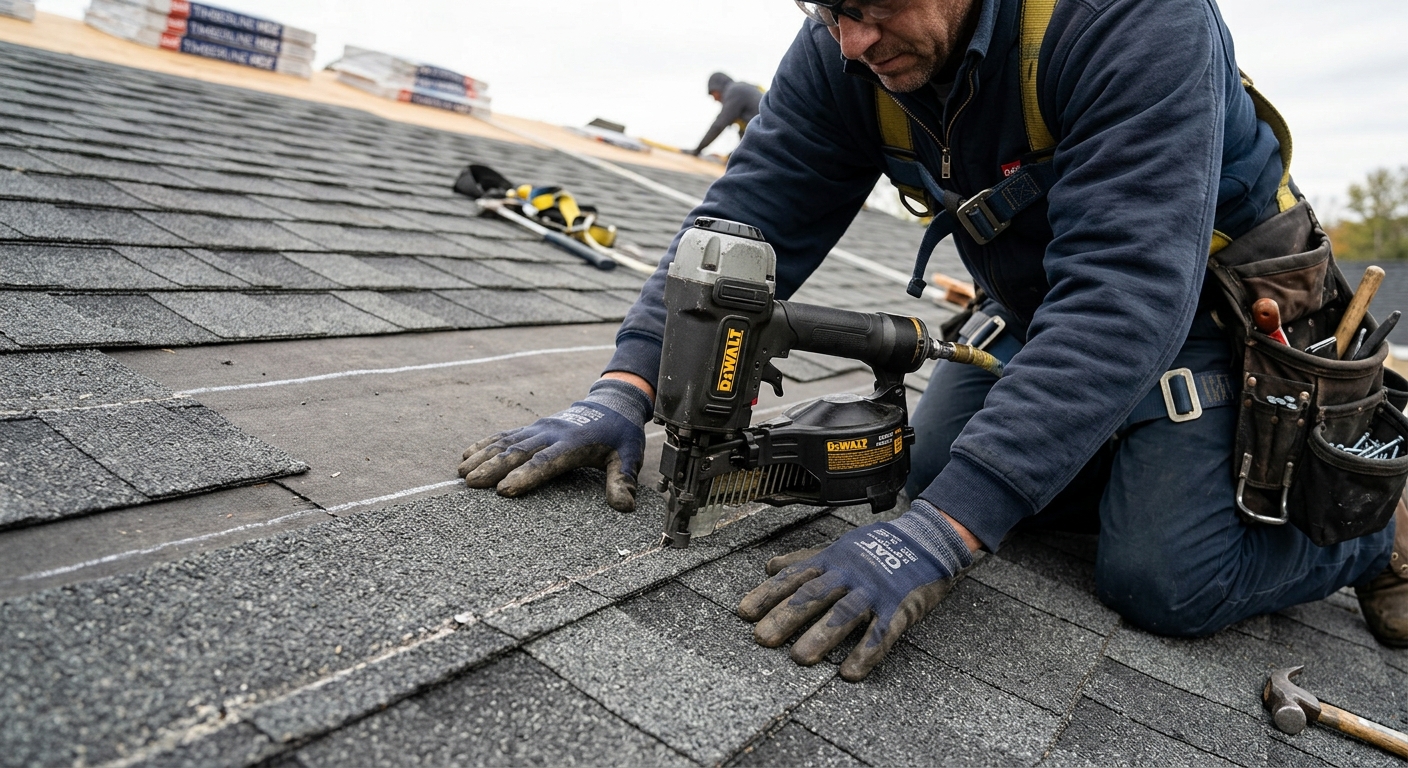
Roofing Replacement & Repair costs in Newtown — 2026
Newtown homeowners know they're not just paying for shingles and nails—they're investing in long-term security for some of the highest-value properties in Bucks County. With a median household income of $141,228 and homeownership rates north of 84% (U.S. Census Bureau, ACS 2024), roof work here often means protecting real estate that owners expect to hold or pass on. Roof replacements in Newtown are also influenced by the aging wave of 1950s Levittown-era homes in neighboring Falls and Bristol townships. That tract-housing boom cemented architectural asphalt shingles as the local norm and means many structures nearby are now hitting their second or even third roofing cycle. For Newtown, that translates directly to frequent tear-offs, decking repairs, and the expectations of a market that's seen plenty of roofs come and go.
Because this is southeast Pennsylvania, sudden thunderstorms and freeze-thaw cycles demand roofing built for abuse, not just curb appeal. With flat-roof basements and additions, asphalt still makes up most pitched replacements, but metal and membrane are rising as owners invest for longevity or on flatter sections. Here are the 2026 price bands you should expect for your next project:
| Material / Scope |
Lifespan |
Best for |
Price range (installed) |
| Asphalt shingles — architectural (30-yr) |
25–30 yrs |
Most pitched Newtown roofs |
$11,500–$24,000 |
| Asphalt shingles — impact-resistant (Class 4) |
30+ yrs |
Storm-prone exposures or insurance incentive |
$18,500–$24,000 |
| Metal standing seam |
40–70 yrs |
Long-term, low-maintenance investment |
$27,500–$49,000 |
| Flat roof — TPO or EPDM |
15–25 yrs |
Low-slope additions & garages |
$14,500–$28,500 |
| Roof repair — leak or isolated section |
n/a |
Flashing, small area leaks |
$600–$2,300 |
Prices are estimates for a typical Newtown home and vary with roof size, pitch, decking condition and material selection.
What gets discovered after tear-off in Newtown
Even with a careful inspection, the true condition of a Newtown roof doesn’t come fully into view until the shingles are off. The most common surprise is rotted or delaminated decking, especially on homes built before 1980, where original plywood or even planking can show water stains, mold, or full sections needing replacement. Every sheet of plywood replaced typically adds $90–$150 per sheet to the bill.
Attic ventilation is another frequent headache for Bucks County. Our climate—with moderate freeze-thaw cycles, a snow load of 30 pounds per square foot, and humid summers—is especially rough on roofs that can’t breathe. Blocked or undersized soffits and missing ridge vents lead to ice damming, which can void a manufacturer warranty and requires upgrades that normally tack on $350–$1,400, depending on the solution.
Flashing is almost always an issue near chimneys, wall joints, and valleys. Rusted or improperly installed flashing may call for custom metal work or full replacement, running $420–$1,250 on most Newtown jobs.
Other routine discoveries include cracked or sun-baked vent boots ($30–$90 each), missing drip edge ($6–$10 per linear foot), and inadequate or missing ridge vent, which will cost another $600–$1,400 on average. If you’re budgeting, allow a contingency—especially with pre-1980 homes and any roof that’s leaked before. The “hidden scope” is usually where a low quote grows legs.
Roofing permits in Newtown: what you need before work starts
Newtown is like the rest of Bucks County in following the Pennsylvania Uniform Construction Code (UCC), built on the International Residential Code. Permit requirements here are enforced by your municipality—most likely the Newtown code office, unless your area has made other arrangements under the UCC. In practice, almost every roof replacement (as opposed to a straightforward same-material repair under a certain size) will require a permit, especially if roof decking is being replaced or if you’re switching materials (such as moving from asphalt to metal). Skip the permit, and you may cause issues with insurance or resale.
The Pennsylvania Home Improvement Contractor (HIC) registration is mandatory for any contract over $500. You can (and should) verify a contractor’s HIC registration directly at hic.attorneygeneral.gov before signing anything. For jobs involving employees, not just subcontractors, they must also carry workers’ compensation insurance—a requirement in Pennsylvania. You can confirm their active status through WCAIS (wcais.pa.gov).
Every roof job over $500 also falls under the Home Improvement Consumer Protection Act, which requires a written contract, a three-business-day right of cancellation, and strictly prohibits any “deal” where the contractor waives your insurance deductible. If your home was built before 1978, the federal EPA Lead RRP Rule applies—always ask for lead-safe certification for any demolition work.
Asphalt, metal or membrane — what suits a Newtown roof
Newtown’s key roofing concerns are dictated by southeastern Pennsylvania’s snow load of 30 psf, the 14°F design winter minimum, and occasional brutal storms blowing across Bucks County. Asphalt shingles dominate—especially architectural grade—because they match typical roof pitches from the region’s postwar building boom and are by far the cheapest up front. Metal standing seam is gaining ground, largely because it sheds snow faster in our freeze-thaw conditions and offers 40–70 years of lifespan, but only makes sense as an investment if you intend to stay long enough to realize those savings. Flat roofs—most common on additions and some split-levels—get TPO or EPDM, since asphalt won’t last with less slope or ponding water.
Asphalt runs this market simply because 1950s–1970s tract homes came with pitches optimized for layered shingles and materials the local trades were already using. The cost to “upgrade” to metal is significant ($27,500–$49,000), and rarely recouped unless you face specific snow or storm-related repairs year after year, or want to dramatically cut long-term maintenance. A 30-year architectural shingle, installed well and properly ventilated, makes the most sense for the vast majority of Newtown homeowners. Membranes are only advisable on low-slope sections where shingles will fail early.
| Material |
Installed cost |
Lifespan |
Cold-climate performance |
Maintenance |
| Asphalt architectural |
$11,500–$24,000 |
25–30 yrs |
Good for local snow and freeze-thaw cycles with proper ventilation |
Annual check of flashing, debris removal |
| Asphalt Class 4 impact-resistant |
$18,500–$24,000 |
30+ yrs |
Extra wind and hail resilience for storm corridors |
Low, similar to architectural shingle |
| Metal standing seam |
$27,500–$49,000 |
40–70 yrs |
Sheds snow; best for larger, hazard-prone roofs |
Minimal—occasional fastener and seam checks |
| TPO / EPDM membrane |
$14,500–$28,500 |
15–25 yrs |
No ice damming; suited for flat or low-slope only |
Seam inspection after heavy storms |
How to compare roofing quotes in Newtown
The truth is, two quotes for a Newtown roof aren’t really apples-to-apples unless you know exactly what’s included. Any reputable contractor will measure your roof’s area in “squares” (100 sq ft each), state the pitch, and show all labor and material breakdowns. Watch for a detailed tear-off line—knowing how many shingle layers are there (many Newtown homes have two or more) and whether hauling and disposal are included. Underlayment and ice barrier should be named by specific brand or grade. The quote should state a price per sheet for new decking and list all required flashings and vent boots. Warranties must separate manufacturer (material) from workmanship coverage, and payment terms should never involve most of the money up front.
If a quote is too vague—no mention of square count, no separate lines for tear-off or disposal, or “lump sum” for all labor and materials—it usually means there’s wiggle room to pass surprise finds straight to you. Detailed quotes force clarity and allow you to compare apples to apples on price, scope, and warranty. Here’s what those line items should look like:
| Line item |
What to look for |
Red flag if… |
| Roof area |
Stated in squares, with pitch |
No measurement given |
| Tear-off and disposal |
Number of layers, dumpster included |
Bundled into one figure |
| Underlayment |
Product type and coverage |
Listed only as 'felt' |
| Ice and water shield |
Coverage height at eaves |
Omitted entirely |
| Decking |
Per-sheet contingency price |
No allowance at all |
| Warranty |
Workmanship years stated separately |
Only the shingle warranty |
| Payment |
Deposit under 15%, balance on completion |
Large upfront cash |
Workmanship vs manufacturer warranty
In Bucks County and across Pennsylvania, the distinction between a manufacturer’s and a workmanship warranty is critical—and easily confused, sometimes intentionally. A manufacturer warranty covers defects in the shingles or membrane itself, often on a sliding (“prorated”) scale, and usually requires the roof to be installed exactly to the manufacturer’s specs. These warranties can transfer at resale if registered within a short period—ask exactly how long you have and if a fee is involved.
The workmanship warranty, on the other hand, is supplied by your contractor and covers installation errors—leaks from bad flashing, missed nails, or improper ventilation that can turn a 30-year shingle into a 10-year headache. But a 25-year promise from a roofing company you’ve never heard of is only as good as their odds of still picking up the phone a decade from now. In practical terms, ten years from a contractor with two decades in the area may offer more real value than a longer term from a one-truck startup.
Coverage can be voided by poor attic ventilation, applying new shingles over old ones, or failing to register the job with the manufacturer within the stated deadline. Read both documents fully—and ask who handles claims (the local rep or a 1-800 number). In Newtown’s market, long-term peace of mind depends on both—don’t skip either one.
Newtown homes and their roof lines
Newtown’s housing stock tells the story of Bucks County’s postwar expansion and continued suburban growth. While only about 18.9% of local homes were built before 1980 (U.S. Census Bureau, ACS 2024), those that remain from mid-century and earlier often feature moderate to steep roof pitches, with original decking typically being solid planks or the earliest plywood. In this era, code did not require ice and water barrier at the eaves—something today’s severe weather patterns make essential—so retrofits must factor in the cost and work of bringing those details up to modern standards.
Most Newtown homes, though, are newer single-family structures from suburb expansion in the 1980s onward. These typically feature engineered trusses, OSB or modern plywood decking, and straightforward gable or hip profiles that make for efficient tear-offs and replacements. In these post-1980 houses, you’re likely facing your first or second full roof replacement, with one or two shingle layers atop a sturdy deck. It’s rare—but not unheard of—for a 1990s home to hide three layers of shingles. For owners, the upshot is: first-replacement roofs here are less likely to reveal serious decay, but extra inspection and a modest contingency are still wise as thermal cycling and wind-driven rain from Delaware Valley thunderstorms make their mark over time.
Frequently asked questions — roofing in Newtown
Will the crew damage my landscaping or driveway?
It’s a legitimate concern for Newtown homeowners, given that many properties here feature mature landscaping and asphalt driveways that aren't cheap to repair. A responsible contractor will use tarps or plywood to shield shrubs, flowerbeds, and driveways, and will always clarify how debris is managed (roof tear-offs create a lot of mess quickly). Dumpster placement and the use of wheeled debris bins are standard best practice. Some damage is possible, especially if your replacement runs several days or follows heavy rain. Communicate clearly with your roofer about where tarps will be placed and ask if their proposal document addresses landscape protection at all. For higher-end homes in Newtown, a small touch-up allowance for the lawn isn’t out of line on a larger job—for example, on a roof in the $18,500–$24,000 range, some crews include basic lawn repair. If your contractor shrugs when asked about damage, look at someone else.
Does attic ventilation matter in Newtown's climate?
Absolutely—it’s critical here in Bucks County. Our moderate winters with a 14°F design temp and hot, humid summers mean your attic can swing from freezing to sweltering. Poor ventilation doesn’t just cost energy dollars; it creates moisture buildup, shortens shingle life, and makes your roof prone to ice dams. That’s why vent upgrades, ridge vents, and improved soffit systems are common post-tear-off line items, especially in older Newtown homes. Expect an upgrade to proper attic ventilation to add about $350–$1,400 to a re-roofing project, but it’s a cheap insurance policy against trapped moist air, mold growth, and even warranty voids. Put simply: if attic ventilation was ignored in your last roof job, your new roof could fail again—fast.
Why is my Newtown roofing quote higher than the online average?
There are a few Newtown-specific reasons: first, this market is saturated, but labor costs and contractor insurance rates are on the high side for the Philadelphia suburbs. Second, many of our homes are larger single-family structures that push up material totals and require more labor. Local demand also spikes after any major storm, driving bids up further. If you see an online estimate for an asphalt roof suggesting $8,000 or $9,000, that figure rarely includes dumpster, tear-off, or code-compliant upgrades required here (like ice shield and ridge vent). For a Newtown home, the realistic installed range is $11,500–$24,000. Always insist on apples-to-apples details, not just a bottom line.
Will filing a roof claim raise my premium?
In Pennsylvania, even one storm damage claim can trigger a premium review—though carriers are less likely to increase rates for events categorized as “catastrophic” (wind, hail). Newtown homeowners do see rate bumps more often for small, preventable leaks, especially when deferred maintenance or multi-layer roofs are to blame. If your roof is older, with several layers or clear wear, expect your insurer to scrutinize even storm claims closely—sometimes sending their own inspector. If the claim is sizable—for a full replacement in the $18,500–$24,000 range—your premium will likely go up at renewal. Always review your policy first, and note: by law, roofers cannot waive your deductible in Pennsylvania.
Are impact-resistant shingles worth it in Newtown?
For many Newtown homes—especially those under the thunderstorm corridors near the Delaware River—Class 4 impact-resistant shingles can be a smart investment. While they cost more (installing in the $18,500–$24,000 band for an average Newtown house), they do hold up better to wind-driven rain and occasional hail. Some insurers offer small premium discounts for these upgrades, but savings often take years to offset the initial extra cost. Also, actual hail events severe enough to damage standard shingles are relatively infrequent here. Unless your property has a history of storm claims or is especially exposed, a high-quality architectural shingle still gives the best blend of price and performance.
How much deposit should I pay a roofer upfront?
In Newtown and anywhere in Pennsylvania, the standard and legally accepted deposit is no more than one-third of the contract price—though the best contractors typically ask for less, often just 10–15% to schedule the project and secure materials. For example, on a typical reroof in the $18,500 range, a deposit of $1,850 to $2,775 is reasonable. The balance is due only when work is complete and inspected. If a roofer asks for 50% or more, or full payment before work starts, that’s a red flag—walk away. The Home Improvement Consumer Protection Act is there to protect you; use it.
Can I install new shingles over old ones in Pennsylvania?
Pennsylvania code allows for one overlay—meaning, you can have up to two layers of asphalt shingles. But for most Newtown homes, a full tear-off is the right call. First, local thunderstorm and freeze-thaw cycles mean double layers are far more likely to trap heat and moisture, shortening roof life and increasing the odds of leaking, curling, and shingle blow-off. Second, as soon as a second layer is present, manufacturer warranties often vanish. Yes, overlay can save money upfront (shaving about $1,500–$2,700 off labor and dump fees), but it’s a short-term fix and often flagged at inspection when you sell. Most reputable Newtown contractors recommend tear-off on every job.
How long should a roof last in Newtown?
With Bucks County’s moderate freezes, humid summers, and the kind of thunderstorms that occasionally dump debris on roofs, a well-installed architectural asphalt shingle roof should last 25–30 years in Newtown. If you opt for a Class 4 impact-resistant shingle, you might see even more—sometimes past 30 years if attic ventilation is right and debris isn’t left to rot in valleys and gutters. Flat roofs (TPO/EPDM) on additions or garages last 15 to 25 years. Metal can go 40–70, but only if it’s maintained. Many local homes that appear to “fail early” do so because of poor detailing or past contractors skipping flashings on those original Levittown-era houses. For typical pitched replacement today, expect a lifespan that matches the $11,500–$24,000 price tag.
How much does a new roof cost in Newtown?
For a standard Newtown single-family home, a full replacement using architectural asphalt shingles falls into the $11,500–$24,000 bracket, depending on roof area, pitch, and whether you’re replacing original plywood. Metal standing seam costs more—$27,500–$49,000—and flat roof membrane jobs typically land between $14,500–$28,500. The typical Newtown homeowner spends about $18,500 on a roof job replacing a 2,200–2,400-square-foot roof with a moderate pitch. Don’t be tempted by any quote that’s dramatically cheaper; it usually means corners are being cut, especially with labor or code requirements like ice and water shield. Get every scope detail in writing before signing.