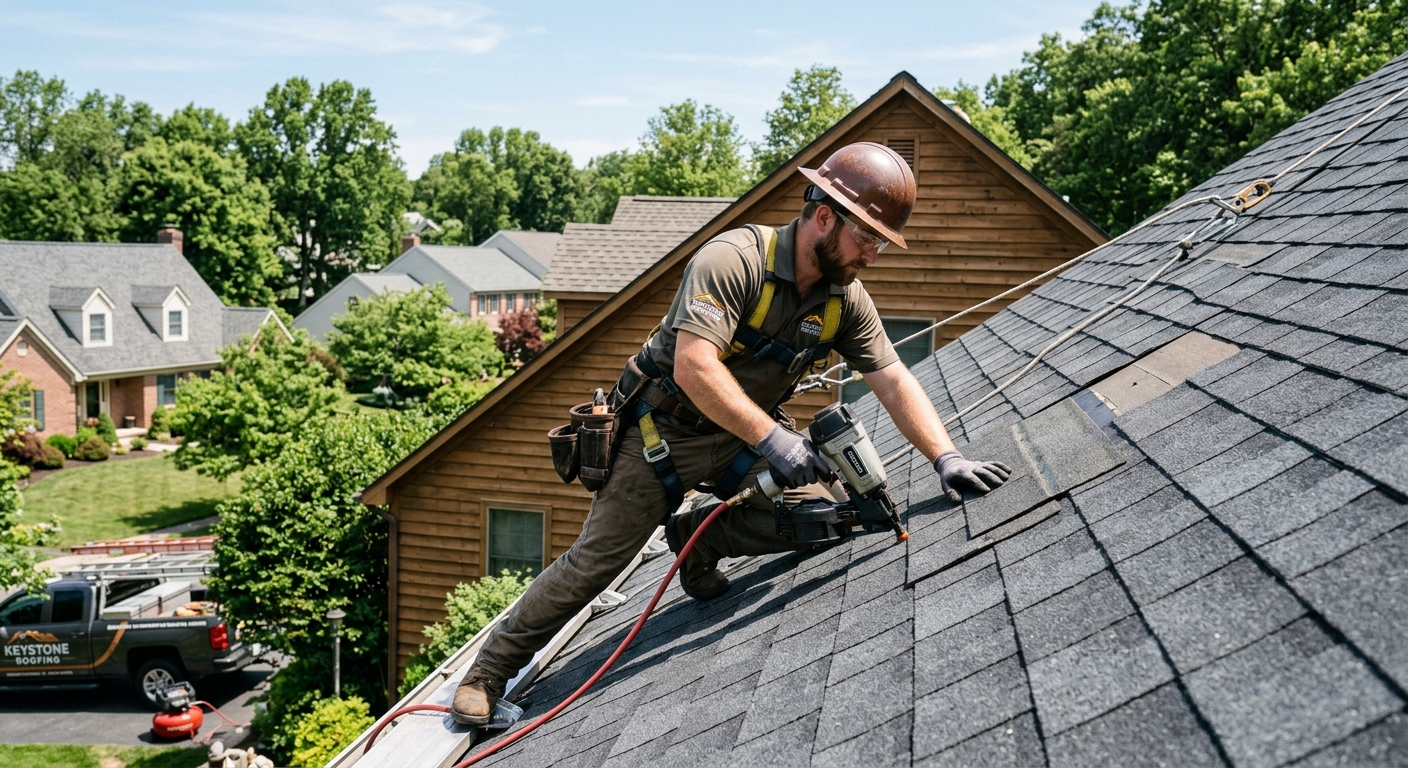
What roof replacement costs in Wilkes-Barre in 2026
Wilkes-Barre’s early-1900s housing stock, with its dense rows and twins, shapes every roofing job here. With a homeownership rate of just 47.9% (U.S. Census Bureau, ACS 2024), most local projects are for owner-occupied homes—frequently old enough to show decades of layered repairs and ventilation shortfalls. The age and design of these homes mean most roof replacements are not just a matter of nailing down new shingles—rot, failed flashing, or decking damage often drives the scope and cost up.
When replacing a roof in Wilkes-Barre or Hazleton, expect to address ventilation upgrades, given how many attics in these homes trap heat and moisture. This isn’t just incidental: older framing and small attic spaces increase the odds you’ll need at least some plywood replaced or new soffit vents added. It pushes costs toward the mid- to high-end of the price bands, especially if you’re swapping buckled boards or upgrading an ancient vent stack.
For owner-occupied single-family homes, here’s what to expect for roof replacement and repair locally:
| Material / Scope |
Lifespan |
Best for |
Price range (installed) |
| Asphalt shingles — architectural (30-yr) |
25–30 yrs |
Most Wilkes-Barre single-families, row homes |
$8,300–$17,500 |
| Asphalt shingles — impact-resistant (Class 4) |
30+ yrs |
Ridge-line wind exposure, insurance upgrades |
$13,500–$17,500 |
| Metal standing seam |
40–70 yrs |
Upper-end row/twin conversions, longevity |
$20,000–$35,500 |
| Flat roof — TPO or EPDM |
15–25 yrs |
Porches, rear additions, flat roof rows |
$10,500–$21,000 |
| Roof repair — leak or isolated section |
n/a |
Singles/rows with active leaks or storm damage |
$425–$1,650 |
Prices are estimates for a typical Wilkes-Barre home and vary with roof size, pitch, decking condition and material selection.
What Wilkes-Barre's climate does to a roof
Wyoming Valley roofs take a beating most Pennsylvanians do not see. The geography here means wind surges along the ridgeline, pulling shingles from the eaves and caps—especially on homes in Wilkes-Barre and Kingston. Those missing shingle tabs look minor, but the next sideways rain can soak the felt and start slow leaks, leading to repairs in the $425–$1,650 range, or worse, deck replacement if water intrusion goes unnoticed for a season.
Another hidden killer: snow load. Luzerne County’s 40 pounds per square foot ground snow load is the number to know. On a typical rowhouse, snow drifts pile at parapet walls and behind dormers. When snow at the eave melts and then refreezes, it forms heavy ice dams. Water back-ups at these ice ridges and pushes beneath shingles—even if there’s no visible storm damage. Locally, this is how many “mystery leaks” start, often requiring both underlayment repairs and interior patching (bringing the second risk of mold if left unnoticed). If you invest in replacement, this is why ice and water shield underlayment—applied at least three feet up from the eave—isn’t optional.
Wilkes-Barre rarely sees big hail, but when it does, smaller diameter hailstones bruise shingle mats without always punching clean holes. The impact can loosen granules, leaving the roof more likely to fail prematurely—especially if you already have a three-tab shingle that's seen a few decades. All told, weather in this zip code chips away at roof life from several angles, pushing the actual replacement cycle to the earlier end of the $8,300–$17,500 shingle band for many homeowners.
Filing a roof claim after a Pennsylvania storm
If you're in Wilkes-Barre and have roof damage from a storm, the first step is to take photos of every damaged area before any cleanup or emergency repairs. Insurance companies expect this documentation as part of your claim—missing it can make repairs like those in the $425–$1,650 range harder to justify. After your photos, call your insurer to open a claim and ask for a written scope of loss when the adjuster visits. The insurer’s payment may initially be based on “actual cash value,” which subtracts depreciation. If your policy includes “replacement cost,” you’ll get the balance after sending proof that the work is complete.
In Pennsylvania, storm claims are covered under the Home Improvement Consumer Protection Act (HICPA). For any contract over $500, written terms are required, and you have a three business-day right of cancellation—do not skip this step, even if a contractor says you need to rush. No one is allowed to offer to waive your insurance deductible here; Pennsylvania law strictly prohibits this, because it can be insurance fraud. If a local or out-of-town roofer says they can “eat” your deductible, that’s your cue to walk away—your claim and personal liability could both be at risk.
If you have to tarp your roof while waiting for the carrier, get a written invoice and keep the photos. The adjuster will want to see the sequence, and you’re much more likely to recover your out-of-pocket emergency costs if you have receipts on hand.
Roofing permits in Wilkes-Barre: what you need before work starts
Any full roof replacement in Wilkes-Barre—including jobs that repair or replace the structural decking—typically requires a building permit. This is mandated under the Pennsylvania Uniform Construction Code (UCC), which is enforced locally by the City of Wilkes-Barre Code Enforcement Office. If your project only involves minor shingle patching totaling less than one roofing square, a permit is generally not required. In Hazleton, this exception for small repairs is also common, though you should always double check with the specific borough office before starting work.
Homeowners should always check that their roofer has valid Home Improvement Contractor (HIC) registration from the Pennsylvania Office of Attorney General, which is required for any job over $500. You can confirm their HIC registration at hic.attorneygeneral.gov. Workers’ compensation insurance is mandatory for all employers and can be verified through WCAIS at wcais.pa.gov. It is worth running both checks—registration shows they’re operating legally, and active workers’ comp reduces your risk if anyone is injured while working on your house.
The key: Never let work start on a Wilkes-Barre roof replacement until you have a copy of the contractor’s permit, verified registration, and proof of insurance in hand. Lack of any one of these is reason enough to look elsewhere.
How to compare roofing quotes in Wilkes-Barre
In Wilkes-Barre, roofing quotes are only as trustworthy as their detail. The best estimates state the roof area in squares (1 square = 100 square feet), explicitly name the pitch, and break down every critical step—tear-off, disposal, underlayment, decking, flashing, and vents. Underlayment and ice and water shield should be listed by actual product and coverage so you know you’re getting materials suitable for the region’s snow and ice loads. Decking must be quoted as a per-sheet contingency, since full replacement only happens when rot is found. Even vent boots and flashing should be itemized, since older homes here often have custom details or multiple penetrations.
Warranty terms matter: manufacturer shingle warranties are not the same as the roofer’s workmanship coverage. They should be listed separately, with clear start and end dates. Payment schedules in Luzerne County usually involve a small deposit, with the majority due when the work is finished and you’re satisfied—never pay a large lump sum up front. If you receive a vague, all-in price with no square count, product details, or individual line items, it’s impossible to compare that quote to another. It may hide shortcuts on tear-off, thin or missing ice barrier, or skim over contingencies like damaged decking.
| Line item |
What to look for |
Red flag if… |
| Roof area |
stated in squares, with pitch |
no measurement given |
| Tear-off and disposal |
number of layers, dumpster included |
bundled into one figure |
| Underlayment |
product type and coverage |
listed only as 'felt' |
| Ice and water shield |
coverage height at eaves |
omitted entirely |
| Decking |
per-sheet contingency price |
no allowance at all |
| Warranty |
workmanship years stated separately |
only the shingle warranty |
| Payment |
deposit under 15%, balance on completion |
large upfront cash |
Flat roof sections: the part most quotes get wrong
Many Wilkes-Barre homes—especially rows and twins—have at least one flat or low-slope section, often over a porch, addition, or rear “pop-out.” These flat surfaces demand a different roofing system than the main pitched roof. Standard shingles on a roof with a 2/12 pitch or less won’t shed water properly, especially in Luzerne County’s snow belt. Instead, TPO or EPDM membrane is the standard because it’s heat-welded or adhered for a watertight seal, preventing ponding and interior leaks that would destroy a shingled low-slope roof in just a season or two.
Drainage must be deliberate—flat roofs here are notorious for ponding if not installed with proper slope and scuppers. A properly installed flat roof system generally lasts 15–25 years, but only if pooling water is avoided. Typical replacement costs for these membranes in Wilkes-Barre range from $10,500–$21,000, depending on access, ponding correction, and whether insulation upgrades are needed below the membrane to reduce ice damming above unconditioned spaces.
If a roofer proposes shingles for a nearly flat section, that signals inexperience or indifference. Don’t sign that contract. Flat sections on Wilkes-Barre homes should get the same membrane systems as any low-slope commercial job—or you’ll end up paying for a full replacement far too soon.
When to book roofing work in Wilkes-Barre
The roofing season in Wilkes-Barre follows the regional climate and heavy contractor demand. Shingle replacements, repairs, and membrane installs ramp up in late March when daytime highs typically climb above 45°F, allowing new shingles to seal properly. Most contractors book out several weeks ahead from April through October, with September and October as peak months since homeowners rush to finish work before winter. In this saturated market—Wilkes-Barre being part of the broader Scranton–Wilkes-Barre–Hazleton metro—expect busy contractors and tight lead times, not the weeks-long gaps found in rural counties.
Emergency leaks in February or early March (when average lows hover well below shingle-sealing temperatures) are much pricier on a per-square-foot basis and may only be temporarily tarped, with permanent work deferred until spring. This means a planned roof project—say, a full shingle replacement at $13,500—can be much more cost-effective than an urgent winter repair sequence that could approach $1,650 just to stop interior water.
For cost and quality sake, schedule non-urgent roofing work between late April and early November. Calling in midsummer gives you more scheduling flexibility than waiting for the September-October rush, when everyone wants on the books before the first snow is in the forecast.
Frequently asked questions — roofing in Wilkes-Barre
What is the difference between TPO and EPDM?
TPO and EPDM are both membrane materials used for flat or low-slope roofing, a common need for many Wilkes-Barre homes with rear additions and porches. TPO (thermoplastic polyolefin) is white and highly reflective, which can help keep those covered back rooms cooler in the summer. It’s heat-welded at the seams, forming a very watertight bond. EPDM (ethylene propylene diene monomer) is a black rubber material, often applied in large sheets and glued at the seams. TPO tends to perform better against ponding and is increasingly popular for new installs, while EPDM is prized for its flexibility and repairability. Either system, properly installed, typically gives you 15–25 years of service, with replacement costs in Wilkes-Barre running from $10,500–$21,000 for most flat roof sections. The right choice depends on exposure, color preference, and budget—your roofer should advise based on experience with similar Luzerne County homes.
What is the difference between replacement cost and actual cash value?
When you file a roof claim in Pennsylvania after wind or hail damage, the insurer will pay based on one of two formulas. Actual cash value (ACV) means you get the roof’s value after subtracting for age and wear—so if your shingle roof is halfway through its lifespan, your payout might only cover half the replacement cost. Replacement cost value (RCV) pays for a full, new roof, less your deductible, as long as you actually complete the work. For example, if your roof replacement costs $13,500 here in Wilkes-Barre and your shingles were twenty years old, an ACV policy could pay out far less than you need to hire a reputable local company. Always double-check which policy you have, and keep all your documentation, as this affects both the claim sequence and your out-of-pocket costs.
How much does a flat roof replacement cost in Wilkes-Barre?
Flat roof replacement is more common than you’d expect in Wilkes-Barre because so many older row houses and twins have porches or rear flat sections. The cost to install a new TPO or EPDM membrane—fully removing the old layers, repairing decking as needed, and ensuring proper drainage—ranges from $10,500–$21,000 for most typical homes in Luzerne County in 2026. This includes the membrane, new flashing, insulation if needed, and correcting any low spots where water ponds. If your flat roof connects to a main shingle roof, expect careful attention to the tie-in—with poor detailing leading to leaks that might not show for months. Always ask your contractor which membrane type they're quoting, how much decking or insulation is included, and how they’ll ensure water sheds properly off the edge or into scuppers.
What does it mean if my shingles are curling or losing granules?
If your Wilkes-Barre roof has shingles that are curling, clawing at the edges, or quickly shedding granules into the gutters, those are warning signs of age-related failure, common on the early-1900s homes here. This is usually not just cosmetic—curling lets wind-driven rain push up under the tabs, which can rot decking and require urgent repairs in the $425–$1,650 range or drive the need for a full replacement. Loosening granules means UV is getting to the shingle mat itself, accelerating cracking or blistering. In Luzerne County’s climate, wind and snow worsen these symptoms, especially for roofs that are already two or three decades old. It’s a sign to get a thorough inspection soon—a good local contractor will check attic ventilation, underlayment, and flashing, not just the visible surface.
Why is my Wilkes-Barre roofing quote higher than the online average?
Many national price averages assume easy access, straightforward layouts, and simple roof shapes—none of which describe most Wilkes-Barre homes. Here, early-1900s row houses, steeply pitched twins, and persistent ventilation and decking problems push the scope beyond a basic install. Steep slopes can mean more labor and safety setup, and the layered repairs found on old homes drive up disposal costs. Competition is high in the local market, but so are code and material standards. For reference, a typical shingle roof replacement here is $13,500, which reflects these added complexities and the need for skilled crews familiar with Luzerne County housing stock. If your quote is higher than some website’s low-end average, it often means your roofer is actually including the vent, deck, and underlayment work you’ll need for a durable result.
Does attic ventilation matter in Wilkes-Barre's climate?
Attic ventilation is not optional for homes in Wilkes-Barre. With 6,100 heating degree days each year and frequent snow load, a poorly vented attic traps warm air that melts snow on the roof. This triggers ice dams at the eaves—and those dams push water back beneath shingles, a major cause of leaks and damaged sheathing. Proper venting (ridge, soffit, or gable) limits these problems and extends roof life. On many of Wilkes-Barre’s early-1900s homes, old venting is absent or blocked, so a quality roof replacement—costing $8,300–$17,500 for architectural shingles—always includes a plan to upgrade airflow. If your roofer’s quote ignores this, they’re not accounting for the realities of our local climate or the housing stock.
What is the best time of year to replace a roof in Wilkes-Barre?
For Wilkes-Barre homeowners, the optimal window for roofing work is from late April through early November. During these months, temperatures allow shingle adhesives to bond fully and crews can work efficiently, reducing the risk of improper sealing and callbacks. Scheduling in spring or early summer can also secure better pricing, since the September-October demand spike often fills local contractors' calendars—delaying non-urgent jobs and sometimes pushing costs higher. Emergency work done in midwinter, such as urgent leak repairs in February, almost always costs more—potentially up to $1,650 for a temporary patch. Plan ahead and book before the autumn rush to avoid waiting weeks for a reputable crew, especially in a metro as busy as Wilkes-Barre.
Is ice barrier underlayment required in Wilkes-Barre?
Given Luzerne County’s 40 psf snow load and frequent ice dam problems, ice barrier underlayment is not just best practice—it’s code-required on roof eaves in Wilkes-Barre under the Pennsylvania Uniform Construction Code. This membrane, usually called ice and water shield, forms a waterproof layer three feet up from the edge to stop melted snow from leaking into the house when it refreezes at the gutter line. Without this detail, you risk hidden leaks and expensive repairs, often far more than the small per-square added cost to install it. On most roofing quotes here—where the overall job runs $8,300–$17,500—you should see ice and water shield specified by both width and coverage. If a Wilkes-Barre roofer omits this, it’s a sign to ask detailed questions or look elsewhere.
Are storm-chasing roofers a problem in Wilkes-Barre?
Storm-chasing roofers do target Luzerne County after major hail or wind events, offering quick roof replacements and occasional promises to “absorb” your insurance deductible. In Pennsylvania, this is illegal—waiving deductibles is strictly prohibited under the Home Improvement Consumer Protection Act. Most Wilkes-Barre homeowners are approached by out-of-town contractors following large claims spikes. These companies may lack valid HIC registration or not carry real workers’ compensation insurance (check them at hic.attorneygeneral.gov and wcais.pa.gov). The fraud risk is real; shoddy work or unfiled permits leave you will little recourse. Even if their initial quote for repair or replacement—say, $8,300–$17,500—looks tempting, the risks far outweigh the apparent savings. Always verify all credentials, require written contracts, and be wary if anyone pressures you to sign on the spot.