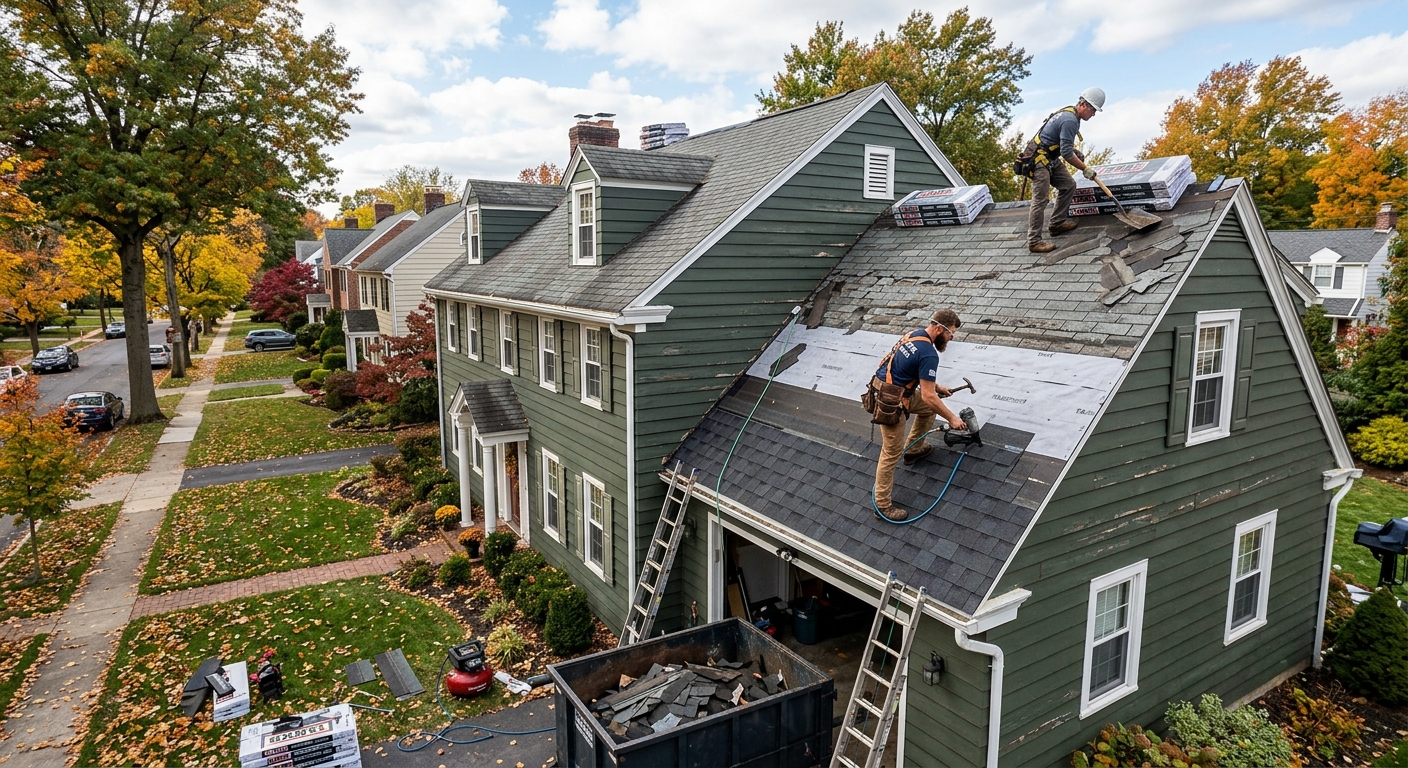
Ross roofing prices by material and scope — 2026
In Ross, Monroe County, roofing costs reflect both the local housing profile and the realities of building in the Poconos. With a homeownership rate of 94.9% and a dominant share of single-family houses (U.S. Census Bureau, ACS 2024), most residents here own the roofs over their heads and bear the full cost when replacement comes due. The market isn’t driven by flips or absentee landlords, so price bands align with solid, long-lasting installations.
Pocono Township and Coolbaugh Township saw significant subdivision growth in the 1980s–2000s. This means that many Ross homes are now hitting their first or second major roof replacement, not teardown-level repairs, which makes architectural asphalt shingles—installed in wide swaths during those booms—the most frequent scope today. When it’s finally time to replace the original roof in these neighborhoods, odds are the job means a full tear-off down to decking and potentially decking repairs, not patching on top of decayed layers.
Storm exposure in Monroe County, particularly along ridge lines, often accelerates shingle aging and raises demand for impact or wind-resistant products. Below are realistic price bands for the most common jobs in the area:
| Material / Scope |
Lifespan |
Best for |
Price range (installed) |
| Asphalt shingles — architectural (30-yr) |
25–30 yrs |
Standard replacement for subdivision and ranch homes |
$10,000–$21,500 |
| Asphalt shingles — impact-resistant (Class 4) |
30+ yrs |
Areas prone to wind or hail, high-value homes |
$16,500–$21,500 |
| Metal standing seam |
40–70 yrs |
Premium, long-life upgrade for steep or complex roofs |
$24,500–$44,000 |
| Flat roof — TPO or EPDM |
15–25 yrs |
Porches, additions, and low-slope sections |
$13,000–$26,000 |
| Roof repair — leak or isolated section |
n/a |
Single leaks or damaged sections without full system failure |
$550–$2,000 |
Prices are estimates for a typical Ross home and vary with roof size, pitch, decking condition and material selection.
The cost drivers behind a Ross roof replacement
In Ross and the surrounding Monroe County area, homeowners often wonder why roofing quotes can vary dramatically from one contractor to another. Several factors lead to this, and it’s not just about the brand of shingle or the shape of the roof. The county's mix of subdivision homes—with their commonly mid-size, moderately-pitched roofs—and challenging climate means quotes need to reflect real local risks and construction realities.
First, roof size is a direct multiplier—each “square” (100 sq ft) drives both material and labor. Most 1980s–2000s subdivision homes in Ross have roof footprints that fall right in the median range for replacement, making them prime candidates for jobs around $16,500 when using architectural shingles. Pitch also matters: Monroe County’s heavy winters (ground snow load is 40 psf) mean steeper roofs, which not only shed snow better but are also more dangerous to work on, increasing labor by up to 30%.
Older homes (nearly 28.4% built before 1980) can hide multiple layers of old roofing. Tearing off extra layers—sometimes two or more—adds direct disposal costs and exposes potential rot in the sheathing. Local building code and climate also require ice barriers at eaves, a must-have in the Poconos thanks to severe ice dam exposure. Below is a breakdown of major cost drivers:
| Factor |
Why it matters here |
Cost impact |
| Roof size in squares |
Each square is 100 sq ft of roof surface |
primary multiplier |
| Pitch and access |
Steep pitches need harnesses and slow the crew |
+20–30% labour |
| Existing layers to tear off |
Two or more layers means full tear-off and disposal |
$500–$1,500 per layer |
| Decking condition |
Rot is found during tear-off, not before |
$75–$150 per sheet |
| Ice barrier at eaves |
Required where ice damming has a history |
$300–$800 |
| Material grade |
3-tab vs architectural vs Class 4 impact-resistant |
$500–$2,500 |
Low-slope and flat roofs in Ross
In Ross, it’s common for homes to have at least one low-slope or flat section, often on a porch, modern addition, or the back of a split-level house. These areas can’t be treated like the main pitched roof. Standard asphalt shingles aren’t designed to shed water effectively below a 3/12 pitch; at 2/12 or less, they virtually guarantee leaks and rapid decay, especially under Monroe County’s snow loads and freeze-thaw cycles.
Flat roofing systems—like TPO and EPDM—form a seamless, waterproof membrane that stands up to ponding, drifting snow, and the pooling water that would quickly wreck any shingle roof. The downside is lifespan: while a 30-year shingle can last that long if cared for, most membranes require replacement in 15–25 years. Installed costs for flat roof replacement in Ross typically run $13,000–$26,000, depending on area and access. If a contractor quotes you shingles for a flat or nearly flat section, that’s a sign they aren't respecting the difficulties of Poconos drainage or the construction standards local to Ross—walk away and find someone honest.
Checking out a roofer in Ross: what to verify
Before signing a roofing contract in Ross, homeowners should check each contractor for compliance and reliability using registers and offices listed in Pennsylvania’s regulatory structure. For contracts above $500, the roofer must hold a Home Improvement Contractor (HIC) registration from the Pennsylvania Office of Attorney General—always verify at hic.attorneygeneral.gov. Insurance is non-negotiable: contractors must have workers’ compensation if they employ even one person, which you can confirm yourself through the WCAIS portal (wcais.pa.gov). Pre-1978 homes should only be touched by firms with a current EPA Lead RRP certification, which is searchable online. And regardless of local licensing gaps (no trade license for roofers in this state), a thorough written contract is legally required. Beware of any company unwilling to provide these upfront or that rushes the process.
- Check HIC registration at hic.attorneygeneral.gov
- Request and check certificates of insurance
- Use wcais.pa.gov to confirm workers’ comp coverage
- Demand a written contract (required by HICPA for jobs over $500)
- Confirm EPA Lead RRP certification for pre-1978 homes
- Review contract for 3 business-day right of cancellation
- Ask who will actually show up on installation day—verify crew employer
- Get a detailed, scope-based estimate (materials, layers, flashing, venting)
- Require address and phone for the contractor’s local office
- Ask for references from Monroe County clients specifically
- Do not pay in full upfront—Pennsylvania law limits deposit size
- Request a copy of warranty in advance, read the exclusions
Red flags to watch for in Ross include: out-of-county firms with no permanent local address; crews that drive door-to-door after every storm; refusal to verify workers’ comp at wcais.pa.gov; contractors pushing for large upfront payments or wanting you to “backdate” any paperwork; and anyone claiming you don’t need a written contract.
What insurance covers on a Ross roof
When storm or wind events hit the Pocono Plateau, roof claims are a fact of life in Ross. If you need to file, start by documenting all damage thoroughly—photos and videos before any cleanup are essential for your insurer’s adjuster. Don’t throw away damaged shingles or decking until you’ve settled with your carrier. Your insurer will prepare a written “scope of loss” after sending an adjuster; read this carefully, as it determines what work will be paid for.
Pennsylvania policies may pay either actual cash value (depreciated amount) first, with replacement cost coverage reimbursing the balance only after you show proof the work was completed. This can lead to confusion if you expect the full amount upfront. Every insurance claim—especially for roofs—requires a tight paper trail: get everything in writing, both from your adjuster and from your roofer. Your contractor should mirror the insurer’s scope, not suggest “hidden upgrades.”
Pennsylvania’s Home Improvement Consumer Protection Act (HICPA) prohibits waiving or “eating” your insurance deductible. If a contractor offers to “cover your deductible” to win your business, walk away immediately; this violates state law and can jeopardize your claim. Always insist on a written contract and don’t let anyone rush you—Pennsylvania gives you three business days to cancel after signing.
Roof age and construction era in Ross
Ross’s housing stock is shaped by two clear waves: a substantial growth phase through the 1980s–2000s in nearby Pocono Township and Coolbaugh Township, and older pockets representing 28.4% of homes built before 1980 (U.S. Census Bureau, ACS 2024). For most subdivision homes in Ross, original roofs installed during these boom years are now reaching the end of their service life. The most frequent scenario is a first roof replacement on a 25–40 year-old structure, not a never-ending patch job on a decaying 1930s farmhouse.
What does this mean for your roof project? Most Ross homes of that era were built with plywood or OSB sheathing, so decking rot is less rampant than in plank-decked prewar houses, but soft spots show up where leaks went unnoticed. Code-mandated ice barrier may have been skipped on early subdivisions, so a proper upgrade matters for the replacement cycle. If you have an original roof, chances are it’s one or two layers—rarely three or more—so tear-off costs usually stay contained. Roof slopes tend to be “builder grade”: 5/12 or 6/12, enough to shed Monroe County’s snow but still walkable for experienced roofers. Expect most of the replacement need today to come from these maturing, post-1980 single-family homes.
Permits and code requirements in Ross
In Ross and elsewhere in Monroe County, residential roofing work is governed by the Pennsylvania Uniform Construction Code (UCC), which is enforced by individual municipalities unless they have opted out. In Stroudsburg Borough, for example, replacing the roof covering over structural decking triggers a building permit, while patching minor leaks in a shingle layer can often be done without a permit. The code authority here is the Pennsylvania Department of Labor & Industry, but in most cases the local code enforcement office handles applications and inspections.
Before hiring a roofer, confirm that they hold a current Home Improvement Contractor (HIC) registration for contracts over $500—this is required by state law and should be verified at hic.attorneygeneral.gov. Insist on proof of workers’ compensation insurance for any non-owner-operator (visit wcais.pa.gov to check status). For homes built before 1978, check the contractor’s EPA Lead RRP certification at certifiedrenovatorsearch.epa.gov, as federal rules for handling lead paint remain in effect.
There is no trade-specific roofing license in Pennsylvania—HIC registration is the only legal requirement for residential roofers. Always get a written contract, as required by the Home Improvement Consumer Protection Act, and remember you have a 3-day right of cancellation after signing.
Frequently asked questions — roofing in Ross
Why is my Ross roofing quote higher than the online average?
Many national roofing price calculators miss the realities of Monroe County’s climate, labor market, and housing stock. Ross homes experience 40 pounds per square foot in ground snow load, requiring both tougher materials and extra labor for safe installation. Labor costs are affected by steep pitches—common here to handle winter snow—and the region’s susceptibility to ice damming. In Ross, architectural shingle replacement commonly falls in the $10,000–$21,500 range, well above some pop-up averages you’ll see online that are based on southern climates with single stories and minimal snow. Factor in travel charges for more rural sites and you can see why local pricing is higher—but it pays for a roof that actually lasts here.
What should a roofing quote include in Ross?
Your quote should spell out every detail: materials (brand, product line, color), installation method, whether all layers of old roofing will be removed, line-item costs for any rot repair, ice barrier materials, flashing, and ventilation upgrades. Make sure costs for full tear-off, dumpster, and disposal are itemized. For a typical Ross replacement, architectural shingles should price out in the $10,000–$21,500 bracket depending on size and pitch. Ask whether permit fees are included if work triggers code. The contract should also specify payment terms, warranty information, work schedule, and who is responsible for cleanup. Finally, verify the contractor’s registration at hic.attorneygeneral.gov and insurance through wcais.pa.gov before signing—and don’t forget your 3-day cancellation right under state law.
Does attic ventilation matter in Ross's climate?
Attic ventilation isn’t optional in Ross—it’s critical. Our heavy winter snow loads and frigid temperatures (average winter design temp is 4 °F) create prime conditions for ice dams if warm attic air melts snow unevenly on the roof. Good ventilation means lower risk of rot, mold, and shingle damage. Most architectural shingle systems (in the $10,000–$21,500 range) include ridge and soffit vent upgrades as part of code-compliant installation in Monroe County. If your estimate doesn’t cover ventilation improvements, get clarity or shop elsewhere; it’s the difference between a roof that lasts and one that fails early due to trapped moisture or repeated thaw cycles.
What is the best roofing material for Ross's climate?
The best material for most Ross homes is architectural asphalt shingle, thanks to its ability to withstand moderate snow and wind at a reasonable installed price ($10,000–$21,500). If your ridge is exposed or you have frequent shingle blow-off, consider upgrading to Class 4 impact-resistant shingles ($16,500–$21,500). Flat areas—porches, low-slope roofs—should be membrane (TPO/EPDM, $13,000–$26,000). Metal roofs last the longest, handle snow best, and shed ice quickly, but are priced for higher-value homes ($24,500–$44,000). The right answer depends on your budget, risk tolerance, and the shape of your home, but shingles are the workhorse here for good reason.
Can a contractor cover my insurance deductible in Pennsylvania?
No—offering to “cover,” “waive,” or “eat” your homeowner’s insurance deductible is illegal in Pennsylvania, under the Home Improvement Consumer Protection Act. This isn’t a gray area. If a contractor tries to entice you with this, they’re openly violating state law. Not only could it jeopardize your claim or put your policy at risk, but it’s also a red flag that their business practices are questionable. For a legitimate roof insurance job in Ross—say, a storm-damaged shingle replacement in the $10,000–$21,500 bracket—you will need to pay your deductible portion out of pocket. Any contractor suggesting otherwise should be crossed off your list.
Do I need a permit to replace a roof in Ross?
If you live in Stroudsburg Borough, all roof covering replacements over the structural decking require a building permit. Minor repairs—like patching shingle leaks—can usually be completed without a permit. For surrounding Monroe County municipalities, check with your local code enforcement office, as each township administers code locally unless they opt out. Your contractor should spell out permit requirements and include all fees in their bid; most reputable firms in Ross handle this as a matter of routine. Don’t let anyone talk you into skipping permits for a full roof replacement (in the $10,000–$21,500 range)—it risks fines and might void your insurance.
How much does a new roof cost in Ross?
Most Ross homeowners investing in a full architectural asphalt shingle replacement can expect a total cost in the $10,000–$21,500 range, with the typical job coming in at about $16,500 for a mid-sized subdivision house. Upgrade to high-end Class 4 impact-resistant shingles, and you could spend up to $21,500. Metal roof replacements start higher ($24,500–$44,000). For small repairs or leak fixes, most jobs stay between $550–$2,000. Pricing depends on roof size, pitch, number of layers, and what’s hiding under the old shingles. Always ask for a line-item estimate—honest firms in Ross will break everything out clearly.
What happens if rotted decking is found after tear-off?
In newer Ross homes built during the Pocono subdivision era, roof decking is usually plywood or OSB, but leaks at penetrations or valleys can still cause rot, usually not visible until after the old shingles come off. If rot is found, the crew will stop, document the affected area, and replace the damaged sheets—usually at $75–$150 per sheet of plywood. Make sure your contract covers “unforeseen decking replacement” and that your roofing estimate spells out the per-sheet price. Reputable Ross contractors will photo-document and seek approval if quantities exceed what’s reasonable. A quality install means starting fresh, and skipping decking repairs always leads to premature roof failure.
Can I inspect my own roof safely?
In Ross, most houses have pitches of 5/12 or 6/12—a steep enough angle to be dangerous for anyone not trained in roof safety, especially with the moss and algae buildup common in the Poconos. Climbs are riskier under the local climate (lots of frost and spring thaw). Binoculars and a zoom camera from the ground, or from a stable attic window, are far safer for most homeowners. For $550–$2,000—the typical repair range—a professional inspection comes with fall protection and decades of experience recognizing subtle issues. Always weigh the cost of an inspection against personal injury risk. If you do get on a ladder, always work with a spotter and stay off the roof surface itself.