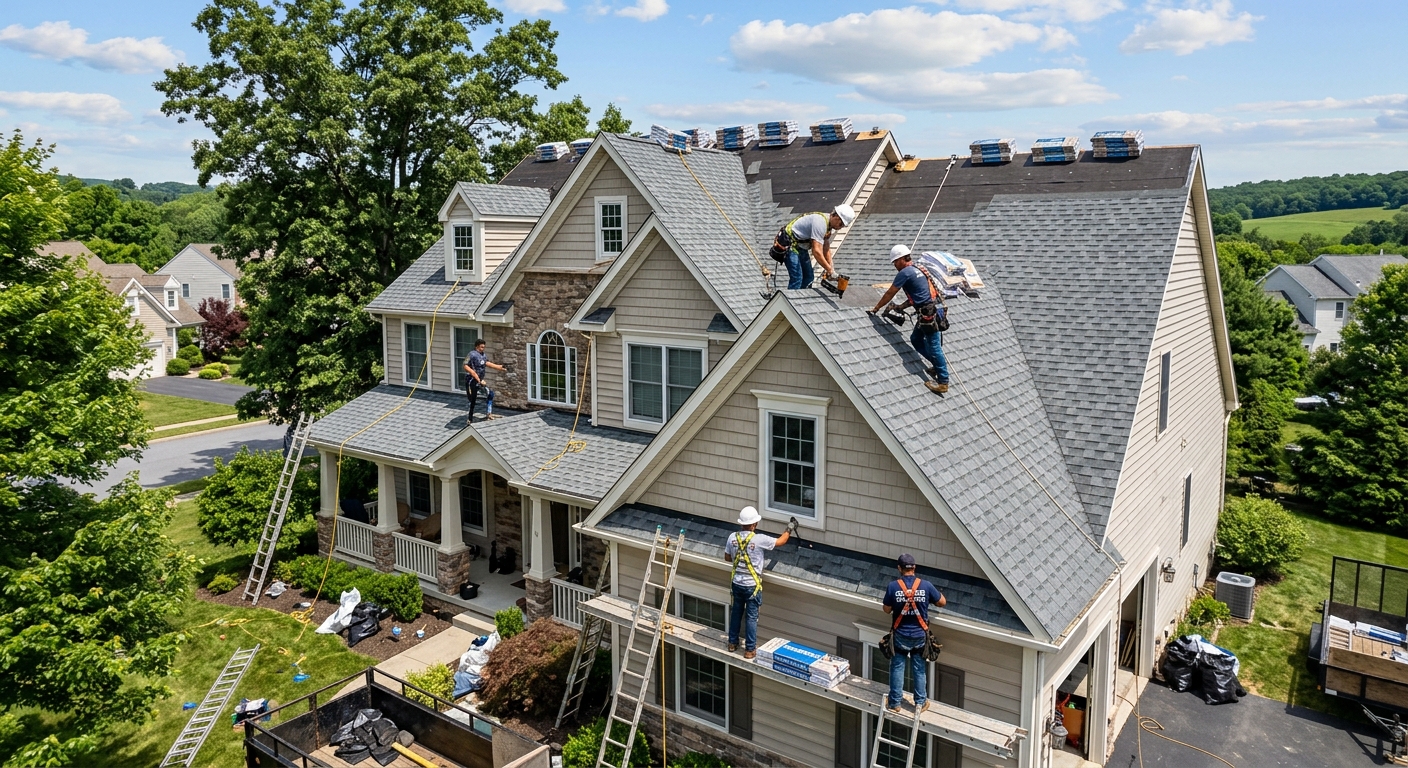
Hatboro roofing prices by material and scope — 2026
Hatboro’s roofing costs in 2026 reflect the characteristics of local housing and the realities of a market just outside Philadelphia. With a homeownership rate near 56% and most properties built before 1980, many Hatboro roofs have aged well past their original life expectancy (U.S. Census Bureau, ACS 2024). For single-family homeowners, typical post-war builds resemble those in Abington or Cheltenham, leading to large numbers of architectural asphalt shingle replacements. Because these homes were built during the post‑World War II housing boom, their roofs tend to be broad-gable types with standard pitches, making full replacements more predictable in scope—most are neither unusually steep nor excessively cut-up, so costs often land in the mid-to-lower range of the price bands below.
In older Hatboro neighborhoods, the share of homes still covered by their original or second roof is high, so repairs can be difficult to justify once multiple leaks are creeping in. Insurers are also more likely to insist on full replacement after a major wind event, especially along corridors exposed to Schuylkill River valley storms. Here’s what to expect for a professionally installed replacement or repair in Hatboro:
| Material / Scope |
Lifespan |
Best for |
Price range (installed) |
| Asphalt shingles — architectural (30-yr) |
25–30 yrs |
Majority of Hatboro single-family homes |
$10,500–$22,000 |
| Asphalt shingles — impact-resistant (Class 4) |
30+ yrs |
Wind-prone areas, storm-claim insurance upgrades |
$17,000–$22,000 |
| Metal standing seam |
40–70 yrs |
Premium replacements, custom builds |
$25,000–$45,000 |
| Flat roof — TPO or EPDM |
15–25 yrs |
Row homes, small commercial buildings |
$13,000–$26,000 |
| Roof repair — leak or isolated section |
n/a |
Quick fixes, minor damage, flashing work |
$550–$2,100 |
Prices are estimates for a typical Hatboro home and vary with roof size, pitch, decking condition and material selection.
Roofing season and lead times in Montgomery County
The main roofing window in Hatboro runs from late March through mid-November. Asphalt shingles require warmth and sunlight to seal correctly, making April through October the ideal months for replacement. July and August present humidity challenges—crews must take steps to avoid tracking shingle grit or damaging soft materials during installation. During winter, especially January and February, it’s not just a cold roof: adhesives won’t cure properly if the temperature dips below 40°F, and snow makes tear-offs risky and sometimes impossible. Emergency calls in February can take longer to schedule and typically cost more, as crews have to contend with temporary heating or even snow shoveling before a repair can begin.
As part of the dense Philadelphia metro, Hatboro roofers book up fast in good weather. By early summer, the best contractors can be booked out 4–8 weeks, sometimes longer if a big storm sweeps through Norristown or Upper Merion. Most local outfits hustle to complete replacements before Thanksgiving; after that, only emergency repairs and storm tarping run through the winter. You’ll get your best scheduling and pricing—especially for a full replacement—if you reach out in the spring or early fall. In this market, calling after Labor Day avoids peak wait times, but don’t wait until leaks appear on a cold November night; rates and lead times spike sharply then.
When a Hatboro roof is worth repairing — and when it isn't
For Hatboro homeowners, knowing when a roof can be repaired versus when to replace is largely about age and leak history. On homes built in the post-war boom, an asphalt shingle roof under 15 years old with a single leak often just needs a carefully executed repair. But if your roof is edging past 20 years—or if the same spot has been patched twice already—replacement is usually the better investment. Patching a 25-year-old roof, only to pay another $1,200 six months later, quickly approaches the cost of a full reroof; after two to three repairs, you’re likely exceeding $3,000–$4,000 in sunk repairs, still facing water damage risk, when a new roof would have guaranteed peace of mind for decades.
Given the age profile of Hatboro homes, repairs make sense for isolated weather damage or newer roofs, but not for widespread leaks or anything over 20–25 years old. If a roof fails as winter approaches, emergency repairs offer breathing room, but don’t put off replacement—freeze-thaw here accelerates damage. For flat roofs, ponding or membrane blisters are rarely a safe repair candidate; replacement is often the only smart choice. See clear recommendations below:
| Situation |
Recommendation |
Typical cost |
Reasoning |
| Under 15 years, one isolated leak |
Repair |
$550–$2,100 |
Shingles and decking likely intact; damage is local |
| 15–25 years, several leak points |
Replace |
$10,500–$22,000 |
Past midpoint lifespan for Hatboro roofs; patching isn't durable |
| 25+ years, any active leak |
Replace now |
$10,500–$22,000 |
Water intrusion spreads fast; repairs waste money |
| Storm damage, wind or hail |
Document, claim, replace |
$10,500–$22,000 |
Insurance likely covers; full restoration ensures warranty |
| Flat roof ponding or blistering |
Replace membrane |
$13,000–$26,000 |
Cyclic leaks, repair never lasts on old membrane |
| Active leak entering winter |
Emergency repair, schedule replacement |
$550–$2,100 |
Buys time, but must act before freeze accelerates damage |
What a proper Hatboro roofing quote contains
A Hatboro roofing quote should allow a homeowner to compare apples-to-apples, with no guesswork over what’s included. Look for the total roof area stated in squares (one square = 100 sq ft), and with the pitch clearly called out. Tear-off and disposal should specify how many existing layers are being removed and if a dumpster is included. Underlayment and ice protection should specify brand or type and coverage area—simply listing “felt” is a red flag. Decking is a big contingency: you want to see a per-sheet replacement price included as a line-item, so you know in advance what happens if rot is discovered. Look for flashing replacement, vent boots, and drip edge—removing and reusing these on old Hatboro roofs only leads to leaks. Warranties should state years separately for the labor and the shingle. A fair payment schedule is a small (under 15%) deposit to reserve material, not a hefty upfront payment before work even starts.
Vague or summed quotes hide shortcuts. A “remove and replace, turnkey, $18,000” with no square count or product spec tells you nothing about quality or what happens if problems turn up. Use this table when reviewing estimates:
| Line item |
What to look for |
Red flag if… |
| Roof area |
stated in squares, with pitch |
no measurement given |
| Tear-off and disposal |
number of layers, dumpster included |
bundled into one figure |
| Underlayment |
product type and coverage |
listed only as 'felt' |
| Ice and water shield |
coverage height at eaves |
omitted entirely |
| Decking |
per-sheet contingency price |
no allowance at all |
| Warranty |
workmanship years stated separately |
only the shingle warranty |
| Payment |
deposit under 15%, balance on completion |
large upfront cash |
Pennsylvania code and Montgomery County permit rules for roofing
Pennsylvania’s Uniform Construction Code (UCC), based on the International Residential Code, sets the building standards for roof structure and re-roofing work in Hatboro and across the county. Code enforcement falls to local municipalities in Montgomery County unless a municipality has opted out, in which case the PA Department of Labor & Industry enforces the UCC. In Norristown, replacing over 25% of an existing roof surface typically requires a building permit. For smaller repairs (under one roofing square), some townships like Lower Merion allow the work without a permit. Always check your municipality’s specific rules before scheduling a re-roof.
Any contractor you consider should be registered as a Home Improvement Contractor (HIC)—this is required for any roofing job in Pennsylvania over $500. You can verify a contractor’s HIC registration status through hic.attorneygeneral.gov. Don’t just take their word for insurance: ask for current workers’ compensation coverage, and verify through the state’s WCAIS system at wcais.pa.gov. Federal lead paint rules also apply to any Hatboro home built before 1978—verify EPA Lead RRP certification for renovations that might disturb old paint.
Checking out a roofer in Hatboro: what to verify
Before signing a contract, verify that your Hatboro roofer is registered, insured, and fully upfront about every aspect of the work. Always check a contractor’s HIC registration number on hic.attorneygeneral.gov, and request proof of current workers’ compensation insurance; confirm this at wcais.pa.gov. For homes built pre-1978, ask for a copy of their EPA Lead RRP certification—there’s no state trade license for roofing, so HIC registration is your minimum standard. Ask to see written contracts for jobs over $500, as required by the Home Improvement Consumer Protection Act. Don’t be shy about requesting recent local references or photos of jobs in Hatboro or similar Montgomery County suburbs. Scrutinize warranties: both labor and material coverage should be clearly stated in writing.
- Check HIC registration status at hic.attorneygeneral.gov
- Verify workers’ compensation at wcais.pa.gov
- Ask for proof of general liability coverage
- Request EPA Lead RRP certificate if your home is pre-1978
- Get a written contract (required for contracts over $500)
- Confirm the deposit is no more than 15% of contract value
- Obtain all warranties in writing, specifying coverage years
- Ensure roof measurement (squares, pitch) is on the quote
- Review product specifications: shingle brand, underlayment type
- Ask for itemized tear-off, decking, and disposal details
- Request at least three recent references in Montgomery County
- Ensure all contingencies are spelled out, especially for decking
In a saturated Philadelphia metro market, beware of door-knockers after storms, companies with no local address, any roofer who pushes for full payment upfront, or those unwilling to sign a detailed contract. “Storm chasers” are common here—if they demand you sign an insurance assignment or promise to “waive your deductible,” walk away.
What gets discovered after tear-off in Hatboro
Tear-off can uncover a range of hidden issues, especially in Hatboro’s older housing stock. Rotted plywood, typically from long-standing leaks or poor attic ventilation, is the most common surprise, often adding $550–$1,200 for every 4x8 sheet replaced. Insufficient or blocked attic ventilation is the next big problem: in southeastern Pennsylvania’s freeze-thaw climate, inadequate venting encourages ice dams, which send water right under the shingles—even on a roof less than 20 years old. Correcting venting can mean adding a ridge vent or upgrading soffit vents, with costs from $900–$2,200 for a typical Hatboro home. Chimney and wall flashing often fail before the shingles, especially if old galvanized steel was used or caulking has separated; replacing these runs $700–$1,500, depending on complexity and masonry repair needed.
Rubber boots around plumbing stacks grow brittle and crack over time, letting rainwater into your attic; boot replacement is usually $75–$125 per pipe, and is best done during shingle replacement. Drip edge, though sometimes omitted from older installs, is now mandatory—adding it runs $650–$1,200 for a full perimeter. Ridge vents are typically included, but costs can add up if the existing roof had none. Every one of these items should be spelled out as a contingency or line item in your contract to avoid surprise bills after the tear-off has started.
Frequently asked questions — roofing in Hatboro
How much deposit should I pay a roofer upfront?
A Hatboro roofer should never ask for more than a 15% deposit before any materials are delivered or work begins. Pennsylvania law requires written contracts for jobs over $500, and limits deposits to reasonable amounts. On a typical asphalt shingle replacement—say $17,000—a deposit under $2,550 is appropriate. The rest should be due only after the job is completed and you’ve inspected the work. If a contractor pushes for full payment upfront or requests a “materials draw” without specifying what will be ordered, that’s a warning sign. For smaller repairs (under $2,100), you may pay in full upon completion, but never before you see the fix. Always get deposit terms in writing, as required by the Home Improvement Consumer Protection Act.
Will filing a roof claim raise my premium?
In Hatboro and across Pennsylvania, filing a claim for storm or wind damage sometimes triggers a premium increase, especially if the whole neighborhood files at once after a widespread event. Insurance companies look at both your personal claim history and weather trends in Montgomery County. That said, a legitimate covered loss—such as hail, wind, or tree damage—can save you the entire cost of roof replacement, often $10,500–$22,000 for architectural shingles. If your adjuster finds clear storm impacts, it generally makes sense to file, but avoid repeated small claims for minor repairs. Always have thorough documentation (photos, bid, storm date) before the adjuster arrives. If in doubt, call your agent first for advice on filing and potential effects on your policy.
Are impact-resistant shingles worth it in Hatboro?
Impact-resistant (Class 4) shingles cost more upfront but can pay off in Hatboro, particularly on homes exposed to severe wind or tree damage, as sometimes happens along the Schuylkill River valley or with mature trees from Hatboro’s mid-century housing era. Upgrading from standard architectural shingles ($10,500–$22,000) to impact-rated options typically increases your bill to $17,000–$22,000. If your insurer offers a discount for Class 4, the extra cost can pay for itself over a decade, but for homes far from tall tree cover or with no history of hail, the upgrade is more about peace of mind. They also stand up better to shingle loss during Montgomery County’s frequent summer thunderstorms. Weigh your risk profile, age of home, and existing deductible before deciding.
Why do roofs fail faster in southeastern Pennsylvania?
Roofs in Hatboro and nearby towns tend to wear out sooner than their 30-year warranty would suggest, largely due to the region’s moderate freeze-thaw cycle and humid summers. The 30 psf snow load and frost depth here don’t sound extreme, but ice damming and wind-driven rain cause leaks and shingle lift. Many Hatboro homes were built before modern ventilation codes, so heat and moisture build up in attics, accelerating shingle aging and reducing their lifespan. That’s why you’ll often see replacements in the $10,500–$22,000 range for roofs just 18–22 years old. Investing in proper ridge venting, ice & water shield, and drip edge during replacement can drastically slow this cycle.
How much does a flat roof replacement cost in Hatboro?
Flat roofs on Hatboro homes—typically low-slope additions or smaller outbuildings—call for a different approach than pitched shingle roofs. TPO or EPDM membrane replacements generally cost $13,000–$26,000 for an average-sized roof. These systems handle ponding water better than old roll roofing, but proper flashing and tie-ins to masonry are critical to prevent leaks in our climate. Factors that can drive up cost include adding insulation, removing more than one layer, or needing structural deck repair. If you see bubbling, ponding, or regular leaks, full replacement is generally necessary, as patching is short-lived here.
What are the signs of hail damage on a roof?
In Hatboro, hail isn’t an annual event, but it does happen—especially during intense thunderstorm seasons along the Schuylkill corridor. Signs include shattered, cracked, or dimpled shingles, granule loss exposing black asphalt, and sometimes soft spots underfoot. Metal surfaces (vents, gutters, drip edge) will show obvious dings. Hail rarely causes visible attic leaks at first, but the damage shortens roof life and can justify a replacement claim. If you suspect hail, schedule an inspection; major hailers sometimes allow a full insurance-funded replacement—architectural asphalt reroof usually running $10,500–$22,000. Always get documentation: photos of shingle bruising and dated, close-up shots of collateral damage (gutters, siding).
How much does it cost to repair a roof leak in Hatboro?
For an isolated leak—such as a blown-off shingle, failed vent boot, or minor flashing issue—a typical roof repair in Hatboro is between $550–$2,100. The exact price depends on accessibility and how far water has travelled below the surface. Emergency winter repairs, especially when involving ice damming or snow removal, trend to the upper end of the band. If multiple leaks or decades-old materials are involved, don’t keep chasing repairs: after two or three visits, you’ll have paid a significant fraction of the full reroof cost (which is $10,500–$22,000)—replacement becomes the logical step.
Are there historic district rules affecting roofing in Hatboro?
Most of Hatboro does not enforce strict historic district roofing rules; however, portions of Montgomery County—especially in older areas of Norristown or Lower Merion—do require specific materials or colors for visible elevations. If you live on a block with notable older homes or within a neighborhood with deed restrictions, always check with your local code office before ordering work. Even on unregulated blocks, it’s smart to verify with your township or borough before installing materials outside the common range (like metal or bright-color shingles). Unapproved changes can result in delays, extra permitting, or forced rework—potentially doubling your project cost from $10,500 to $22,000 if you need to redo materials.
Do I need to leave my house during a roof replacement?
In most cases, staying in your Hatboro home during roofing is safe and common, though it will be noisy. Contractors take safety steps—like protecting driveways and entryways—so you can enter and leave to go about your day. If roof decking replacement is extensive, or if old materials are hazardous (such as lead painted flashing on a pre-1978 home), discuss temporary precautions with your crew. For a standard asphalt shingle replacement—costing $10,500–$22,000—the process typically takes one to two days. If you work from home, you may want to relocate for those days due to the overhead noise, but you do not need to vacate for health or safety unless attic mold or structural issues are uncovered mid-job.