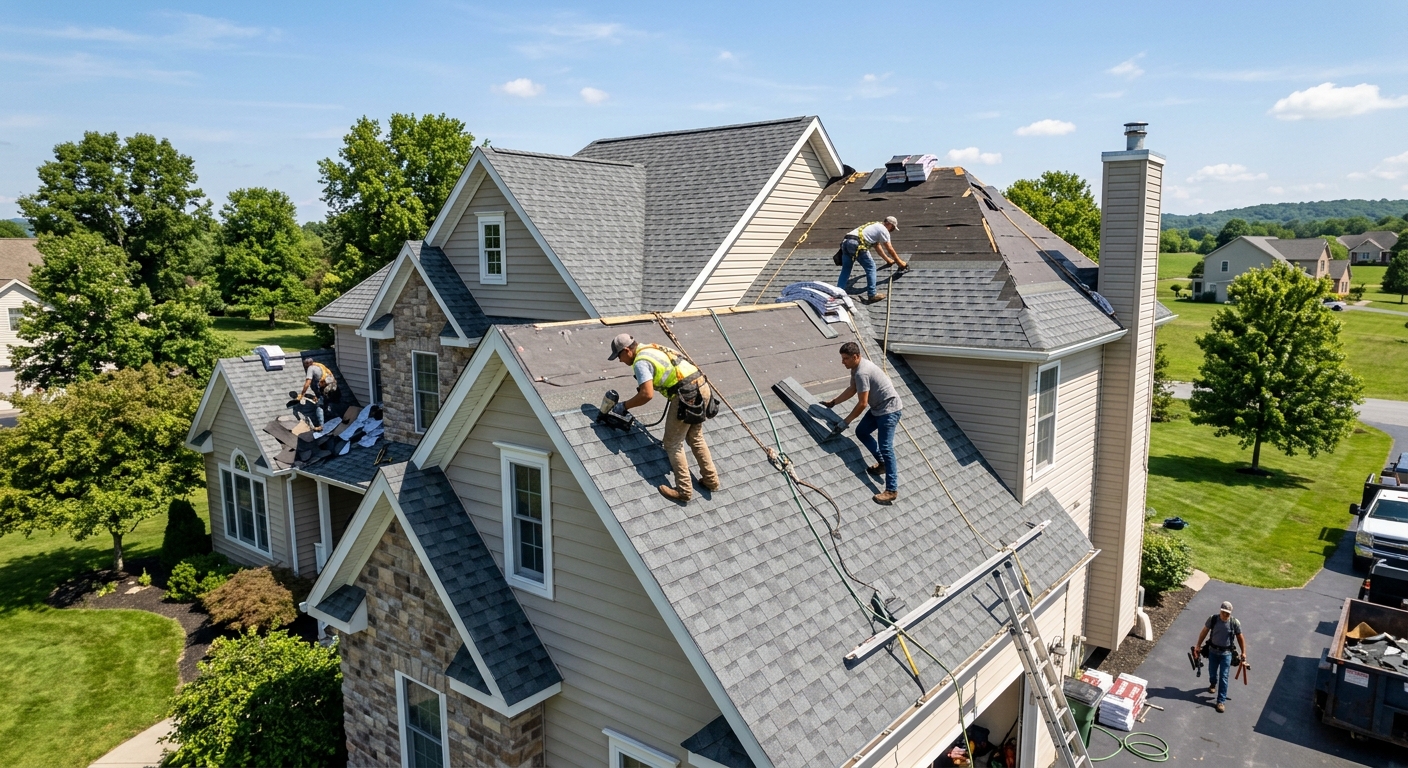
What roof replacement costs in Manheim in 2026
In Manheim, the typical homeowner faces some unique roofing costs shaped by both the town's pre-1980 housing stock and its high rate of single-family homes (U.S. Census Bureau, ACS 2024). With 53.6% of Manheim's homes built before 1980, many roofs here have steep pitches and more than one prior layer of shingles. This means a roof replacement often isn’t just “shingles off, shingles on”—many jobs require full tear-off of multiple layers and close inspection of old decking for hidden rot, driving both labor and disposal costs above what you'd see in newer developments.
The homeownership rate in Manheim is also above 70%, which means replacements here are investments residents expect to last. Asphalt shingles dominate because local Amish and Mennonite crews keep prices competitive and are used to working with steep, tricky roofs. For flat roofs (common on porches and additions), TPO and EPDM can be the more cost-effective options in the long run. Below, you’ll find actual 2026 price bands for Manheim-specific roof work:
| Material / Scope |
Lifespan |
Best for |
Price range (installed) |
| Asphalt shingles — architectural (30-yr) |
25–30 yrs |
Most Lancaster County single-family homes |
$9,900–$21,000 |
| Asphalt shingles — impact-resistant (Class 4) |
30+ yrs |
Homes exposed to Susquehanna wind bursts |
$16,000–$21,000 |
| Metal standing seam |
40–70 yrs |
Historic frame homes and those seeking longevity |
$24,000–$43,000 |
| Flat roof — TPO or EPDM |
15–25 yrs |
Porches, additions, low-slope sections |
$12,500–$25,000 |
| Roof repair — leak or isolated section |
n/a |
Small-area fixes, recent roofs, tight budgets |
$500–$2,000 |
Prices are estimates for a typical Manheim home and vary with roof size, pitch, decking condition and material selection.
Roofing warranties in Manheim: what's actually covered
When you sign a roofing contract in Manheim, you’re actually getting two separate warranties—few homeowners realize this until there’s an issue. The first is the manufacturer’s warranty, which mostly promises that the shingles, metal, or membrane aren’t defective when they leave the factory. These are usually prorated, meaning coverage drops over time, and they rarely cover anything beyond material replacement. Certain shingles require registration within 30–90 days of installation for full coverage—don’t miss that deadline or your warranty defaults to the minimal tier.
The second warranty is from the roofer who installs your roof: a workmanship warranty. This covers mistakes in installation, but only as long as the company is still around to honor it. In a saturated market like Lancaster County’s, where small new roofers come and go, a “25-year workmanship” warranty from someone who’s only been in business for two years is less valuable than a decade from a roofer who’s a fixture in Manheim.
BOTH types of warranties can be voided—and it happens regularly. Common triggers: improper attic ventilation (causing excess heat and premature aging), adding new layers without a full tear-off, and failing to register the warranty after a sale if they're not fully transferable. Always ask whether the manufacturer warranty can be transferred at resale—it’s a detail many skip in older Lancaster homes, costing you down the road.
How south-central Pennsylvania's weather shapes roofing here
In Manheim and broader Lancaster County, what really shapes your roofing needs is wind, not snow. Unlike snowbelt counties north of here, where 50+ psf is normal, our ground snow load is 30 psf, and severe ice events are rarer. The real risk is sudden thunderstorm wind bursts moving up the Susquehanna River valley. These gusts, unique to our area, can rip shingles and metal panels from older, multi-layered steep-pitch roofs, especially when those roofs have seen a few hurried “shingles over shingles” re-dos.
Physically, what happens is this: strong wind gets under a tab or edge—often at a valley or ridge with poor sealing, or along aging eave lines. A shingle lifts, and if the underlayment is weak or missing from jobs decades ago, water intrusion follows. A single exposed seam can lead to repairs running in the $500–$2,000 range, and left unchecked that turns into a full deck replacement at $9,900–$21,000 very quickly.
In winter, while average snowfall is moderate, freeze-thaw cycles every March set up perfect conditions for ice damming. When a poorly-insulated attic lets heat escape, the snow melts and refreezes at the eave, building ice dams that force water backward beneath shingles. This is why code here focuses less on total roof load and more on underlayment and ice barrier at eaves—and why a missing barrier, common in older Manheim homes, can turn what looks like a minor leak into a full underlayment and interior repair job. Hail does hit this area, but bruising (not punctures) is typical—leading to leaks months later, not the next day.
The cost drivers behind a Manheim roof replacement
Roof replacement quotes in Manheim diverge for a handful of very local reasons. The first is the age and steep pitch of Lancaster County's homes—over half were built before 1980, and most of those have seen at least one previous shingle-over. This means a full tear-off is often required, with hidden labor and dump fees that might not appear on a quick estimate. For example, if your roof has two layers to remove, expect to see an extra $500–$1,500 per layer in disposal and labor cost, which adds up quickly for larger homes.
Secondly, our pronounced freeze-thaw cycles and heavy spring storms shape material choices and underlayment requirements. Ice barriers at the eaves, while not mandatory everywhere, are standard practice where ice damming has a known local history—so costs can run an extra $300–$800 for that line item alone.
Competitive pressure from Amish and Mennonite crews pushing volume means material grade is often a key differentiator in quotes. A Class 4 impact-resistant shingle, for example, runs $500–$2,500 more than standard architectural, but might pay for itself in reduced storm repair cycles if your home is highly exposed to Susquehanna wind bursts.
| Factor |
Why it matters here |
Cost impact |
| Roof size in squares |
each square is 100 sq ft of roof surface |
primary multiplier |
| Pitch and access |
steep pitches need harnesses and slow the crew |
+20–30% labour |
| Existing layers to tear off |
two or more layers means full tear-off and disposal |
$500–$1,500 per layer |
| Decking condition |
rot is found during tear-off, not before |
$75–$150 per sheet |
| Ice barrier at eaves |
required where ice damming has a history |
$300–$800 |
| Material grade |
3-tab vs architectural vs Class 4 impact-resistant |
$500–$2,500 |
What a proper Manheim roofing quote contains
Homeowners in Manheim should never accept a one-page, lump-sum quote for roof work. A proper estimate always spells out the basics: the total area stated in “squares” (where one square = 100 square feet), the roof pitch, and the number of shingle layers to be removed. Demolition and disposal should list whether a dumpster is included, as costs double if multiple layers are present on a steep roof. Underlayment and ice/water shield need to be named by make and exact coverage—not just “felt" or "as needed."
Decking replacement is always a contingency, since rot isn’t confirmed until tear-off. The quote should give a per-sheet price, such as $75–$150 per sheet of plywood replaced. Flashing and vent boots may sound minor, but if they're omitted, you’ll pay for leaks later. The quote should name both the manufacturer warranty (which is only for product defects) and the labor or workmanship warranty, with the time period stated clearly.
Lastly, payment: a reputable Lancaster County crew will ask for a modest deposit—never more than 15%—with the rest on completion. If you see a big upfront cash demand, or can’t find square footage in the estimate, move on: vague quotes nearly guarantee cost creep and corners cut.
| Line item |
What to look for |
Red flag if… |
| Roof area |
stated in squares, with pitch |
no measurement given |
| Tear-off and disposal |
number of layers, dumpster included |
bundled into one figure |
| Underlayment |
product type and coverage |
listed only as 'felt' |
| Ice and water shield |
coverage height at eaves |
omitted entirely |
| Decking |
per-sheet contingency price |
no allowance at all |
| Warranty |
workmanship years stated separately |
only the shingle warranty |
| Payment |
deposit under 15%, balance on completion |
large upfront cash |
Roofing permits in Manheim: what you need before work starts
Roofing work in Manheim falls under the Pennsylvania Uniform Construction Code (UCC), which draws from the International Residential Code, with local enforcement by Lancaster County townships. Here’s how that plays out for you: If your roof replacement in Manheim includes new sheathing (the boards under the shingles) or any structural carpentry, a building permit is required. However, if you’re just repairing a minor leak—say, swapping out a few loose shingles on a porch or addition—Lancaster County townships often do not require a permit, as long as no new sheathing or framing is involved.
The Pennsylvania Department of Labor & Industry is the code authority for the state, but in practice, permits for most residential roofing in Manheim come from your local township’s code office. Before hiring anyone, you should verify that the contractor holds a Home Improvement Contractor (HIC) registration (mandatory for contracts over $500). This is checked directly via the Pennsylvania Office of Attorney General’s portal at hic.attorneygeneral.gov.
Contractors employing anyone must also carry workers’ compensation insurance. You can confirm their coverage using the WCAIS database at wcais.pa.gov. Don’t rely on a paper copy from the contractor—always verify it online. If your home was built before 1978, the federal EPA Lead RRP Rule applies, and you can check for certified renovators at certifiedrenovatorsearch.epa.gov.
Patching vs full replacement in Manheim
In Manheim, whether to patch or replace depends mostly on roof age, how many times it’s been patched before, and how bad the underlying decking has gotten. If you’ve got a leak on a roof under 15 years old and the rest looks good, a proper repair in the $500–$2,000 range often makes sense. But repeat repairs on a 25+-year-old roof, especially in homes with several previous layers, usually waste money. It’s all too common in Lancaster County’s older homes—with 53.6% built before 1980 and many steep-pitch roofs—to see repair bills climb past $4,000 over five years, when a full replacement could have solved it for an upfront $9,900–$21,000.
If you’ve got active leaks after a wind event (the kind that strikes along the Susquehanna valley), it’s smart to document the damage for insurance before patching or replacing—the cost will be close to a full replacement anyway. Flat roof with standing water or blisters? Patching won’t last; membrane work starts at $12,500–$25,000 here, and is the only reliable fix. And if you get a leak just before winter? Patching is only buying time until a real replacement can be safely done.
| Situation |
Recommendation |
Typical cost |
Reasoning |
| Under 15 years, one isolated leak |
Repair |
$500–$2,000 |
Rest of roof likely healthy; repair should hold if well done |
| 15–25 years, several leak points |
Replace |
$9,900–$21,000 |
Patching won’t stop recurring failures on an aging roof |
| 25+ years, any active leak |
Replace now |
$9,900–$21,000 |
Multiple layers and wear; repairs just buy you months, not years |
| Storm damage, wind or hail |
Document, claim, replace |
$9,900–$21,000 |
Insurance may pay; repairs rarely last due to underlying issues |
| Flat roof ponding or blistering |
Replace membrane |
$12,500–$25,000 |
Ponding indicates end-of-life; patches won’t bond and fail quickly |
| Active leak entering winter |
Emergency repair, schedule replacement |
$500–$2,000 |
Patching is a temporary band-aid until spring replacement |
Frequently asked questions — roofing in Manheim
Do I need a permit to replace a roof in Manheim?
In Manheim, the need for a roofing permit depends on what exactly is being done. If you’re having a full roof replacement that involves new sheathing or any structural work under the shingles, then a building permit is required by your township, following the Pennsylvania Uniform Construction Code. If it’s a minor repair—like replacing a few shingles on a sound deck—townships in Lancaster County typically don’t require a permit. Always check with your township code office, as requirements can vary even street by street. Keep in mind: for a full replacement running $9,900–$21,000, you want the proper paperwork for resale value and insurance.
Is a metal roof worth the extra cost in Manheim?
For many historic or steep-pitch homes in Manheim, a standing seam metal roof is a long-term investment—especially if you’re planning to stay put. While the initial cost is higher—typically $24,000–$43,000 installed—it offers a lifespan of 40–70 years, compared to 25–30 years for asphalt shingles. Metal is particularly resistant to the thunderstorm wind bursts that hit along the Susquehanna valley, and sheds snow and ice more reliably on older, steeper frames. For budget-conscious homeowners or those not planning on staying long, asphalt might make more sense. But for longevity on a classic Manheim home, metal adds value and peace of mind.
How can I tell if my roof decking is rotted?
Rot in roof decking is common in Manheim’s older homes—especially those built before 1980, which make up over half of the local housing. From the ground, you may see sagging, dips, or soft spots along the eaves or between rafters. Inside the attic, look for dark staining, mold, or spongy spots underfoot. During replacement, any reputable contractor will price decking replacement as a contingency by the sheet, usually $75–$150 per 4x8 panel. If your quote doesn’t name this per-sheet price, be wary: you don’t want surprises that balloon your bill mid-job.
How long does a roof replacement take in Manheim?
A typical asphalt shingle replacement on a single-family Manheim home will run 2–4 days, assuming the weather cooperates and no major deck repairs are uncovered. If the job involves multiple previous shingle layers—common here due to the age of local housing—add a day for tear-off and disposal. Metal roofs will run 4–7 days because of the custom bending and slower installation. Crews in Lancaster County are used to working around quick-moving thunderstorm cells, so jobs may pause for safety. Your contract price, whether $9,900–$21,000 for shingles or more for metal, won’t rise unless rot or code-driven extras are found.
Should I use a local roofer or a national company?
In Manheim, local matters. Most of the area’s best roofing crews have deep roots in Lancaster County and are experienced with our multi-layer steep-pitch roofs and specific code demands. National companies rarely understand the quirks of the old homes dominating Manheim’s neighborhoods—or the competitive pricing set by local Amish and Mennonite crews. A local firm is more likely to respond quickly to leaks or warranty issues, and their workmanship warranty (often included on a $9,900–$21,000 job) is usually more reliable, because word travels fast here when a job goes wrong.
Is metal roofing noisy in rain?
Properly installed standing seam metal roofs in Manheim are typically not “noisy” in rain when there’s solid decking and attic insulation, which is standard practice on full tear-offs here. The echo-chamber effect comes only from metal applied directly over open framing, a method you won’t find on permitted residential work in Lancaster County. While the upfront price is higher—$24,000–$43,000—residents appreciate the durability, and a well-insulated attic will muffle sound even in heavy downpours.
What causes ice dams on Manheim roofs?
Ice dams in Manheim form when warm attic air melts snow on the roof, but the eaves stay cold. Meltwater runs down, refreezes at the edge, and builds a dam that forces water under shingles. This is a real local risk because our winters see frequent freeze-thaw cycles and many homes lack modern insulation—a legacy of the county’s older housing. When a dam forms, leaks appear over exterior walls and can cost $500–$2,000 to repair. Installing a proper ice and water barrier at the eaves is a key preventive step and is often required or highly recommended here.
Does roof pitch affect the price in Manheim?
Yes, roof pitch is a major cost driver in Manheim. Steep roofs, common in our pre-1950 housing, slow down crews and require more safety gear and time—often adding 20–30% to labor costs. For a standard replacement that might otherwise be $9,900–$21,000, that can be a significant upcharge. Flat or low-slope roofs are less labor-intensive, but usually need a membrane system like TPO or EPDM, which starts at $12,500–$25,000. Always ask for pitch to be clearly listed on your quote so you know what you’re paying for.
Will filing a roof claim raise my premium?
In Pennsylvania, one storm damage claim to repair or replace your roof—say a full tear-off after Susquehanna wind bursts—won’t always spike your premium. Insurance companies are more concerned with a pattern of claims, not single weather events. Still, policies and responses can vary by carrier and by your own history. If you file a claim after a windstorm and get a settlement check toward that $9,900–$21,000 job, the insurer may flag your policy for review. Always ask your local agent before filing, and document all damage to support your case—Lancaster County agents deal with these claims regularly and can advise whether it’s worth it.