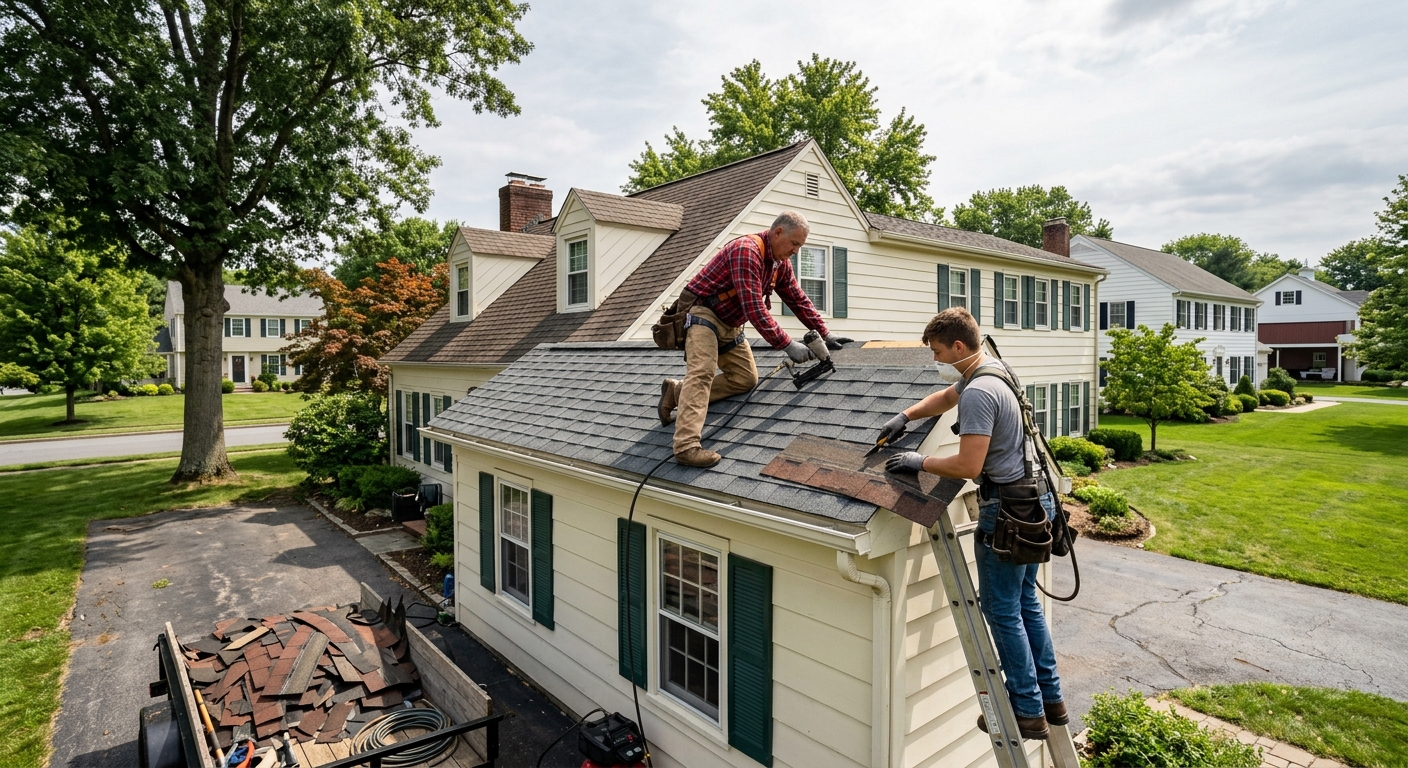
Tunkhannock roofing prices by material and scope — 2026
For homeowners in Tunkhannock, understanding roofing costs means knowing what’s typical for a small town that’s nearly 90% owner-occupied and dominated by single-family homes (U.S. Census Bureau, ACS 2024). Most houses here are traditional stick-built construction, and with only 15.6% built before 1980, much of Tunkhannock’s housing stock is new enough that full tear-off replacements are far more common than framed-overlays. A strong homeownership rate leads to roofs being kept in better condition and replaced more quickly when issues show up.
In the 1980s–2000s, areas like Pocono Township and Coolbaugh Township saw big subdivision booms—something that’s echoed right here in Tunkhannock. This means a significant number of shingle roofs are now reaching the end of their first service life, driving current demand for full replacements rather than small repairs.
Wind-driven storm damage is common on the Pocono Plateau, so insurance claims and repair work often happen on younger roofs that haven’t reached their full life expectancy yet. Below is a table of typical 2026 price bands for roofing jobs in Tunkhannock:
| Material / Scope |
Lifespan |
Best for |
Price range (installed) |
| Asphalt shingles — architectural (30-yr) |
25–30 yrs |
Most Tunkhannock homes built post-1980 |
$9,300–$19,500 |
| Asphalt shingles — impact-resistant (Class 4) |
30+ yrs |
Pocono wind and occasional hail |
$15,000–$19,500 |
| Metal standing seam |
40–70 yrs |
Long-term homeownership, minimal maintenance |
$22,500–$40,000 |
| Flat roof — TPO or EPDM |
15–25 yrs |
Porches, additions, low-sloped sections |
$11,500–$23,500 |
| Roof repair — leak or isolated section |
n/a |
Discrete damage, minor storm issues |
$500–$1,850 |
Prices are estimates for a typical Tunkhannock home and vary with roof size, pitch, decking condition and material selection.
Repair or replace? A decision guide for Tunkhannock roofs
Deciding whether to repair or fully replace a roof in Tunkhannock comes down to age, leak history, and future plans. With so many roofs in town dating from the 1980s-2000s subdivision period, a shingle roof approaching 20–25 years old is often at the tail end of its useful life—even if it looks passable from the street. A small, well-located repair makes sense for a first leak on a younger roof, especially if the deck and underlayment are solid. But once your roof accumulates patch after patch, those repair bills add up quickly.
If you spend $1,150 three years in a row patching recurring leaks, you’ve already sunk $3,450—which is over a third of a typical full replacement at $9,300–$19,500. Most homes in Tunkhannock are single-family (U.S. Census Bureau, ACS 2024), so the full system cost is unavoidable at some point.
On any roof over 25 years old with active leaks, replacement now is nearly always the economical choice—patching does little but push the inevitable a single season. Storm or wind damage? Don’t just patch and forget it, or you risk missing insurance reimbursement. Here’s how professionals view the most common situations:
| Situation |
Recommendation |
Typical cost |
Reasoning |
| Under 15 years, one isolated leak |
Repair |
$500–$1,850 |
Roof isn’t aged out; likely worth fixing without full tear-off. |
| 15–25 years, several leak points |
Replace |
$9,300–$19,500 |
Patching won’t buy much time; core layers are near the end. |
| 25+ years, any active leak |
Replace now |
$9,300–$19,500 |
Shingles and underlayment are likely past design life. |
| Storm damage, wind or hail |
Document, claim, replace |
$9,300–$19,500 |
Claims need thorough documentation for insurance recovery. |
| Flat roof ponding or blistering |
Replace membrane |
$11,500–$23,500 |
Ponding signals end-of-life for the waterproofing layer. |
| Active leak entering winter |
Emergency repair, schedule replacement |
$500–$1,850 |
Quick patch buys time until warm-season tear-off is possible. |
Water management on a Tunkhannock roof
For most Tunkhannock homes, your roof, gutters, downspouts, and ground grading aren’t separate jobs but one system. If your new roof is finished but your gutters are too small, full of debris, or not discharging at least six feet from the house, you’re not just risking wood rot—you might see basement water fast, thanks to our local soil and grade.
On homes here, failing to replace old, undersized gutters alongside a new shingle or metal system is a common false economy. A typical seamless aluminum gutter replacement alongside a full roof runs $2,100–$4,200 for a standard single-family residence. Add guards to prevent northern Pocono maple debris and expect another $1,100–$2,000.
Warranty-wise, some manufacturers actually specify proper downspout discharge and drip edge installation as requirements for full coverage. Cutting corners here can void a ten- or even thirty-year warranty. If a roofer doesn’t check grading, call out gutter issues, or make discharge extensions part of the bid, you’re hiring half the solution to the problems that matter in Tunkhannock.
Roofing season and lead times in Monroe County
Monroe County’s climate shapes the roofing calendar: the main install window is late April through early November. Shingles seal properly only above about 40°F, so March and December jobs sometimes run into problems with wind uplift or delayed adhesion. The Poconos’ high leakage from late snows and freeze-thaw means spring and early fall are peak demand months.
With moderate suburban demand and travel distances between job sites, lead times in Tunkhannock are rarely the “booked for three months” you’ll find in the denser Scranton metro. Instead, you’re looking at 2–4 weeks for most full replacements if you call in spring or summer, while emergencies in February or March typically cost more for both labor and material—expect to add 10–20% to a winter patch or off-season replacement.
If you want a September or October job (the gold standard), book by midsummer. That window’s when the crews are large enough and the weather most predictable, which is key for bigger metal or membrane jobs that need full-day dry stretches. If you wait until the first big September windstorm, expect to chase crews or pay rush rates.
Roofing permits in Tunkhannock: what you need before work starts
In Tunkhannock, roofing work is guided by the Pennsylvania Uniform Construction Code (UCC), enforced locally by the municipality or, in some cases, by the PA Department of Labor & Industry. Replacement of roof covering over structural decking—tear-off and reinstall, in plain terms—typically requires a building permit in Stroudsburg Borough. Minor shingle patching addressing small leaks doesn’t usually trigger a permit requirement, as long as you aren’t replacing a sizable area.
Before signing any contract over $500, Pennsylvania’s Home Improvement Contractor (HIC) registration is mandatory for the company you hire. You can verify a contractor’s registration directly at hic.attorneygeneral.gov, and check their workers’ compensation status through the WCAIS system at wcais.pa.gov. Every contract in this state over $500 must be in writing, with a 3-business-day right to cancel—these aren’t suggestions, they’re Pennsylvania law.
If your house was built before 1978, the federal EPA Lead RRP Rule may also apply; you can verify lead-safe contractors at certifiedrenovatorsearch.epa.gov. Don’t move ahead with any roof project until you’re sure these basics have been covered—you’re footing the bill for any violations if you don’t.
Snow load, ice dams and wind in Tunkhannock
Tunkhannock’s proximity to the Pocono Plateau means your roof has a higher snow risk than most of the state. Our regional ground snow load of 40 psf, combined with winter design temps down to 4 °F, means snow accumulation—and related problems—are routine, not rare. Ridge-line wind events can peel back shingles, dislodge ridge caps, and force water past flashing, all adding extra urgency to a proper installation.
Ice dams here form at the eave line when heat escaping from your attic melts snow above, while the overhang stays frozen. Meltwater seeps backwards under the shingles, rotting the deck and forcing water down the inside of exterior walls. That slow, unseen leak can punch a $9,300–$19,500 hole in a family’s budget, since underlayment and deck both rot out, not just a few courses of shingle. Membrane underlayments (ice & water shield) are essential at the eaves for any Tunkhannock roof, not an upsell—it’s about stalling water intrusion until snow season passes.
Wind in this corridor isn’t just loud—occasional gusts on exposed ridges will break the seal-strip on standard shingles, especially on south and west faces. Even if the roof “looks okay” after a storm, hail can bruise shingles so the asphalt mat shatters months later, when heat and freeze/frost cycles work their way in. That’s why insurance claims here hover at the high end of the spectrum, often topping $15,000–$19,500 for full replacements after wind or hail events.
TPO and EPDM on Tunkhannock homes
In Tunkhannock, plenty of houses have one-story additions, porch roofs, or low-pitched back sections that need something different than standard shingles. Any roof area under a 3/12 pitch (2/12 is common on “shed” and porch roofs here) will eventually leak if roofed with shingles—water moves too slowly, snowpack lingers, and ice-dam overflow can back up under every nail hole.
For flat or low-slope sections, single-ply membranes like TPO and EPDM are the reliable answer. They’re designed specifically for waterproofing where standing water and ponding are real threats. While an architectural shingle roof may last 25–30 years here, TPO/EPDM roofs should be considered for full replacement every 15–25 years due to local freeze/thaw cycling, with membrane system replacements usually running $11,500–$23,500.
If a roofer quotes architectural shingles for a 2/12 pitch, that’s not a gray area—it’s a warning sign that they’re ignoring Tunkhannock’s proven water and snow conditions. Membranes are the only system with a reliable track record here for low-slope roofs, and the difference between a dry living room and an annual leak call comes down to material fit, not just price.
Frequently asked questions — roofing in Tunkhannock
How much does it cost to repair a roof leak in Tunkhannock?
For a typical roof leak in Tunkhannock, you’re looking at a repair cost in the range of $500–$1,850. The exact price depends on what caused the leak—whether it’s a single-tab blow-off, a vent pipe flashing failure, or an ice-dam problem near the eaves. In Tunkhannock, many homes are in the 20–40 year age range, so if your roof is newer and the decking is still solid, a discrete repair is worthwhile. But if leaks are happening repeatedly, those repair bills will start stacking up fast. Most homeowners prefer to address leaks before the first freeze, since winter emergency work can push even basic repairs to the high end of that range. If you have anything more than an isolated, first-seen spot, it pays to get a second set of eyes from a contractor who’s spent time on roofs built around the Poconos.
Can I inspect my own roof safely?
Many Tunkhannock homeowners do spot inspections from the ground using binoculars, but getting on the roof requires caution—especially with steep pitches or after snow and rain have passed through. Ladders should always be secured and placed on firm ground, but high roof lines and dormers on many local houses create risks an amateur might not spot. If you suspect a leak or missing shingle but aren’t comfortable getting up there, spending $500–$1,850 on a documented professional inspection is safer than risking a fall. In Pennsylvania, contractors registering with the state must carry workers’ comp insurance—this protects their team, but it’s worth remembering that you’re uninsured if you climb up yourself. For anything more serious than a quick look, call a professional.
Do I need a permit to replace a roof in Tunkhannock?
If you’re in Tunkhannock and planning a complete shingle or membrane roof replacement down to the structural decking, you almost always need a building permit—as specified by the Pennsylvania Uniform Construction Code (UCC). This is true not just in Stroudsburg Borough (the county seat), but in most Monroe County municipalities that enforce the code themselves. However, small repairs—like patching a leak on a few architectural shingles—typically do not require a permit. Always confirm with your local code office first. Make sure your contractor holds a valid Pennsylvania Home Improvement Contractor (HIC) registration (verify at hic.attorneygeneral.gov), and check their insurance via the WCAIS system. These are requirements under state law, designed to protect homeowners from liability and poor workmanship, and contracts over $500 must be in writing.
What is the difference between replacement cost and actual cash value?
In Tunkhannock, if your roof is hit by wind or hail, your insurance payout depends on whether your policy covers replacement cost or just actual cash value (ACV). "Replacement cost" means your insurer pays what it actually costs to put a new roof on—say $15,000 for standard shingle replacement—minus your deductible. ACV, by contrast, factors in the age and wear of your existing roof, so for a 20+ year-old system, the reimbursement could be just a fraction—sometimes only a third—of full replacement price. Given that most subdivision homes here are now seeing their first replacement cycles, it’s worth checking your coverage before weather hits. If a local storm sends your shingles flying, knowing your policy type upfront can mean the difference between urgent action or stretching things out over several seasons.
Is a metal roof worth the extra cost in Tunkhannock?
Many Tunkhannock homeowners weigh metal against shingles, especially when the time comes for their first full replacement. Metal standing seam systems cost significantly more up front—usually between $22,500–$40,000 installed—but can last 40–70 years with little maintenance. For homes exposed to ridge-line Pocono winds, the extra holding power and resistance to shingle uplift is a strong selling point, and snow-shedding is improved too. If you plan to be in your Tunkhannock home at least 20 more years or want minimal maintenance through the next generation, metal pays out. For those planning to sell soon or staying on a stricter budget, a high-end architectural shingle roof (at $9,300–$19,500) makes more financial sense.
How long do architectural shingles last compared to 3-tab?
In Monroe County and Tunkhannock specifically, most roofs installed in the last 25–30 years are architectural shingles, not the old single-layer 3-tab type. Architectural shingles typically deliver 25–30 years of service life, with some higher-end options rated even longer. Actual lifespan depends on local factors: Pocono wind, snow load, and correct attic ventilation, not just the packaging number. 3-tab shingles rarely last more than 15–20 years here before granule loss, wind lift, or ice-dam damage force a replacement. Although 3-tab roofs can still be found on outbuildings or some porch additions, for a main roof, spending $9,300–$19,500 today on architectural shingles delivers double the longevity and improved resistance to wind-driven storms—a worthwhile upgrade for most Tunkhannock homes.
Should I use a local roofer or a national company?
In Tunkhannock and across Monroe County, the biggest difference comes down to accountability and local experience. Local contractors know which subdivisions have so-so decking, which valleys are prone to ice damming, and have relationships with regional suppliers. They’re usually booked by word of mouth and more likely to stand by their work when a post-warranty issue arises. National companies may offer slicker marketing, but sometimes send out crews unfamiliar with Tunkhannock’s climate or the municipal permitting process. In this market, you’ll pay about the same—say $15,000 for a 30-yr shingle replacement—so all things equal, local knowledge and face-to-face accountability just matter more.
How far ahead should I book a roofer in Tunkhannock?
Because Tunkhannock isn’t slammed with the same dense demand as large metros, most reputable crews can schedule a replacement two to four weeks out for summer and fall jobs. If you want to lock in a September–October spot—the best season for safe installs—reach out by midsummer. Wait until October or after the windstorms hit, and you’ll compete for labor or face premium pricing; a winter emergency repair will typically cost you up to $1,850. For metal or flat roof membrane replacements, expect lead times at the longer end. For smaller repairs, crews may fit you in sooner, but full replacements follow a steady queue once the season ramps up.
How much snow load can a Tunkhannock roof handle?
Tunkhannock roofs are built to northeastern Pennsylvania’s ground snow load of 40 pounds per square foot (psf). For a standard residential roof, that means supporting about 2–3 feet of wet snow before concerns about structural safety. Homes built or substantially renovated under the Pennsylvania Uniform Construction Code (UCC) will meet or exceed this load, while older homes—those in the 15.6% built before 1980 in Tunkhannock (U.S. Census Bureau, ACS 2024)—might not without upgrades. It’s rare to exceed design load, but in a major snow year, heavy ice dams and lingering drifts should be removed promptly. If you do see sagging or leaks after a major event, repairs will run $500–$1,850 at minimum, and a full replacement is sometimes required if structural damage is present.