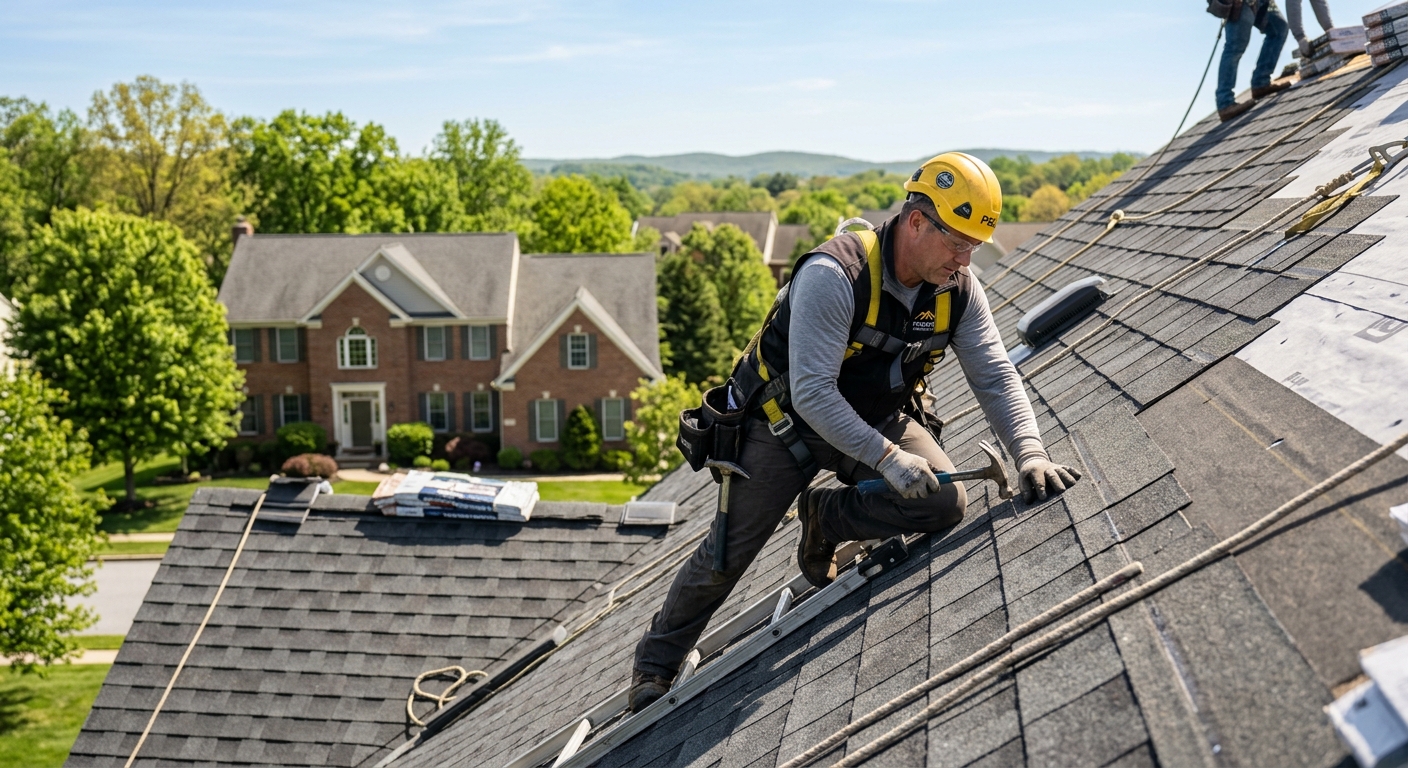
What roof replacement costs in Warwick in 2026
In Warwick, Bucks County, most homeowners are living in single-family homes and own their properties outright (U.S. Census Bureau, ACS 2024). That means investing in a new roof isn’t just about curb appeal or selling soon—it’s about protecting what is likely your biggest asset for the long haul. With a median household income here well above the Pennsylvania average, many Warwick residents choose longer-lasting or upgraded materials that fit their long-term plans.
The broader Bucks County area saw a boom in tract housing during the 1950s, particularly in Levittown in Falls and Bristol townships. Those waves of homes built with economical asphalt shingle roofs are now hitting their natural replacement cycle. In Warwick, while the development pattern is different, those regional trends affect pricing and availability, as many contractors remain set up for large-scale shingle replacements. Materials like architectural asphalt shingles remain standard, but more homeowners here are considering Class 4 (impact-resistant) shingles or even metal standing seam for added durability against our wind-driven storms.
Below are typical price bands for 2026 roof work in Warwick:
| Material / Scope |
Lifespan |
Best for |
Price range (installed) |
| Asphalt shingles — architectural (30-yr) |
25–30 yrs |
Standard replacement on most Warwick homes; balances cost and life |
$11,500–$24,500 |
| Asphalt shingles — impact-resistant (Class 4) |
30+ yrs |
Homes exposed to hail, severe storms, or large trees |
$19,000–$24,500 |
| Metal standing seam |
40–70 yrs |
Long-term upgrades, low maintenance, historic appeal |
$28,500–$50,500 |
| Flat roof — TPO or EPDM |
15–25 yrs |
Additions, garages, or sections with low slope |
$15,000–$29,500 |
| Roof repair — leak or isolated section |
n/a |
Targeted fixes—around vents, chimneys, or small sections |
$600–$2,300 |
Prices are estimates for a typical Warwick home and vary with roof size, pitch, decking condition and material selection.
Checking out a roofer in Warwick: what to verify
Choosing a roofer in Warwick is partly about filtering through a dense field of contractors—many based just across the county line in Philadelphia, all competing for your business. Don’t get distracted by flashy ads or promises; a few simple checks tell you whether a company is operating above-board under Pennsylvania rules.
First, every contract above $500 must be with a contractor registered under the Home Improvement Contractor (HIC) program from the Pennsylvania Office of Attorney General. You can check the HIC number at hic.attorneygeneral.gov. A written contract is required. For insurance, ask for a valid workers’ compensation certificate and verify through the Pennsylvania Workers' Compensation Automation and Integration System (WCAIS) at wcais.pa.gov—don’t just take a copy at face value. For homes built before 1978, the contractor must be EPA Lead RRP-certified; confirm at certifiedrenovatorsearch.epa.gov.
- Verify HIC registration at hic.attorneygeneral.gov
- Check for written contract (required over $500)
- Review insurance and verify workers’ compensation via WCAIS
- Confirm company address is truly local to Bucks County or nearby
- Ask for references from Warwick or surrounding townships
- Require proof of EPA Lead RRP certification for pre-1978 homes
- Read all warranty fine print, especially exclusions
- Avoid contractors who offer to “waive” your deductible (not legal)
- Ensure proper roofing material is quoted (e.g., no 3-tab for architectural spec)
- Get start dates in writing—no vague scheduling
- Compare crew size—not just office staff
- Do not pay large deposits—one-third down is standard if anything
In Bucks County’s busy market, be wary of storm chasers knocking door-to-door after hail or wind events, newly formed companies with no track record, out-of-state tags on work trucks, and unusually low bids that can’t possibly cover quality materials or labor. Any of these should prompt you to look elsewhere.
Workmanship vs manufacturer warranty
In Warwick, as everywhere in Pennsylvania, you’ll receive two types of warranties on a new roof—don’t let a contractor blur the distinction. The manufacturer warranty covers the roofing material itself; this guards against factory defects but almost always comes with prorated terms and rules about registration deadlines. You’ll need to register your roof within a set period after installation, or risk losing the most valuable years of coverage. Material warranties can often be transferred if you sell your home, but check the original terms for transfer fees and formal notice requirements.
The workmanship warranty is a different animal: it’s a promise that the installer will stand behind their labor—how the roof was put together, flashed, and vented. If leaks appear because of sloppy work or shortcuts, the manufacturer will send you packing—the local contractor is the one taking your call. The length and strength of these warranties is only as robust as the contractor’s business. A 25-year workmanship promise from a company that’s only been in business for two years should mean much less to you than a 10-year warranty from a company decades in business in Bucks County.
Workmanship and material warranties can both be voided if you skip required attic ventilation, layer new shingles over old, or use unapproved products. Read terms closely and don’t be afraid to ask for warranty documentation up front.
Material comparison for Warwick homeowners
Warwick’s winters bring a 30 psf ground snow load and design temperatures that can dip to 14 °F, so material choice has real consequences. Metal roofs shed snow efficiently, so they aren’t prone to weight buildup or ice damming, but their upfront price puts them out of reach for many. Asphalt architectural shingles offer solid longevity at a fraction of the cost and perform well here when installed by experienced crews who understand our region’s freeze-thaw cycles. Class 4 impact-resistant shingles are worth considering if your house is under large trees or frequently catches the brunt of Delaware River valley storms.
Flat or low-slope sections—in additions or garages—typically get TPO or EPDM membrane; these are a necessity, not a luxury, where water can’t run off quickly enough for shingles to work. The dominant use of architectural asphalt shingles throughout Bucks County is mostly thanks to the sheer volume of postwar construction, especially in Levittown and similar suburbs. Developers chose asphalt because it was affordable, easy to install, and well-matched to pitched tract roofs. That standard persists in Warwick today because it’s a sensible balance of price, durability, and climate suitability for most homes.
If you’re not planning to stay in the house more than a decade or two, paying for a metal roof isn’t likely to pay off in added value. In our climate and local resale market, upgraded asphalt does the job for the majority of owners.
| Material |
Installed cost |
Lifespan |
Cold-climate performance |
Maintenance |
| Asphalt architectural |
$11,500–$24,500 |
25–30 yrs |
Handles snow load and freeze-thaw well if installed correctly |
Periodic inspection, moss and debris removal |
| Asphalt Class 4 impact-resistant |
$19,000–$24,500 |
30+ yrs |
Extra wind and hail resistance, resists cracking in cold snaps |
Minimal, but should check for broken tabs after storms |
| Metal standing seam |
$28,500–$50,500 |
40–70 yrs |
Sheds snow, prevents ice damming, nearly immune to hail |
Annual check on fasteners and sealants |
| TPO / EPDM membrane |
$15,000–$29,500 |
15–25 yrs |
Performs best on properly pitched flats; seams need attention |
Inspect seams and flashing yearly |
When to book roofing work in Warwick
Warwick’s roofing season swings in with the warmer weather. Most full roof replacements take place between late March and early November. That’s because architectural shingles seal best when daytime highs regularly hit 50 °F, letting their adhesive strips bond properly against wind-driven summer storms. Crews ramp up in spring but get absolutely packed as the school year ends; summer and especially September see the highest demand for both replacement and repair.
If you call after Labor Day, expect available dates to be snapped up fast, especially with Bucks County’s oversaturated contractor market—everyone fights for the same dry weeks before the winter chill. Emergency work in February, on the other hand, is a different world: frozen shingles can’t be properly worked, snow and ice rentals drive up labor time, and material costs can spike for last-minute supply. For a patched roof leak, prices run $600–$2,300 any time of year, but full tear-offs outside warm months will come with a premium or a long wait.
Booking your project in early spring or toward the tail end of fall can unlock better attention from established crews, sometimes even at a lower price if they’re looking to fill their calendar between big jobs. Don’t be rushed by aggressive sales tactics—there’s always another roofer calling.
Roofing permits in Warwick: what you need before work starts
Roofing in Warwick comes under the Pennsylvania Uniform Construction Code (UCC), which is based on the International Residential Code. The code authority for enforcement is the PA Department of Labor & Industry or your local municipal office—most Bucks County townships, including Warwick, operate their own code offices rather than opting out.
A permit is generally required for full roof replacements, significant flat roof work, or for changing roof structure or decking. Small repairs or shingle replacement—without modifying structure—often get exempted, but it’s smart to check with your municipal office before work begins. Only contracts over $500 require HIC registration, which can be verified through the Pennsylvania Office of Attorney General’s database at hic.attorneygeneral.gov.
For insurance, require up-to-date workers’ compensation coverage and check it yourself using the Pennsylvania Workers' Compensation Automation and Integration System (WCAIS) at wcais.pa.gov. If your home dates to before 1978, the contractor must present EPA Lead RRP credentials; you can confirm a current listing and avoid federal fines at certifiedrenovatorsearch.epa.gov.
There’s no roofing trade license in Pennsylvania—registration is the requirement. Any company unwilling to share documentation is not worth your trust, especially in such a competitive market.
The cost drivers behind a Warwick roof replacement
Roofing in Warwick isn’t immune to rising prices, but not every quote should leave you scratching your head. The first and biggest driver is job size—crews measure in “squares” (100 sq ft each). A mid-sized single-family home common to Warwick will often need 28–34 squares, so even small differences in surface area can push the bill by thousands.
Longer-lasting materials or premium upgrades, like Class 4 shingles, add real value against storms but come at a legitimate cost jump: a full roof in impact-resistant laminate will run $19,000–$24,500 compared to base architectural. Metal standing seam goes higher—excellent for snow and storm durability, but only worth it for owners committed long-term. The region’s frequent freeze-thaw cycles and snow load mean crews can’t cheap out on underlayment or ice barrier, a must along eaves in older Bucks County homes plagued by ice damming histories.
Another hidden factor is deck condition. Bucks County’s postwar housing can surprise you here, especially if chronic leaks have rotted the roof boards under two or more layers of old shingles. Full tear-off and deck replacement is charged per sheet—budget an extra $75–$150 each, plus disposal.
You’ll also see labor and safety surcharges tied to pitch—steeper roofs take longer and require more equipment, thanks to our moderate winter temps and snow load. Cheap quotes often fudge on these, only to come back asking for more after day one.
| Factor |
Why it matters here |
Cost impact |
| Roof size in squares |
Each square is 100 sq ft of roof surface; most Warwick homes need 28–34 |
Primary multiplier |
| Pitch and access |
Steep pitches need harnesses and slow the crew; typical in mid-century Bucks County builds |
+20–30% labor |
| Existing layers to tear off |
Two or more layers mean full tear-off/disposal, common in older Warwick homes |
$500–$1,500 per layer |
| Decking condition |
Rot from old leaks and freeze-thaw cycles is often hidden till tear-off |
$75–$150 per sheet |
| Ice barrier at eaves |
Required where ice damming has a history—older homes or minimal attic insulation |
$300–$800 |
| Material grade |
3-tab vs architectural vs Class 4 impact-resistant; material upgrades for storm/hail |
$500–$2,500 |
Frequently asked questions — roofing in Warwick
Why do roofs fail faster in southeastern Pennsylvania?
The freeze-thaw cycles in southeastern Pennsylvania—Warwick included—are tough on roofing. We regularly get cold snaps to 14 °F then quick warmups, which can cause shingles to expand, contract, and eventually crack or lose adhesion. The 30 psf ground snow load adds weight, potentially stressing trusses and pushing water under old flashing. Wind-driven rain from Delaware River thunderstorms finds any weak point and makes a small problem big fast. Even a mid-grade architectural roof that would last 28–30 years in the Carolinas may see a shingle replacement closer to 22–25 years here. Repairing storm leaks costs $600–$2,300 depending on extent, but proper installation and attic ventilation can push roof life back toward the upper end.
What warranty should a Warwick roofer offer?
You should expect two warranties in Warwick: a manufacturer warranty (covering the shingle or metal system against defect) and a clear workmanship warranty (covering leaks or failures due to how the roof was put on). Don't be swayed by promises of “lifetime” from a roof installer who just got a mailbox in Bucks County. A reputable company will offer at least 10 years on workmanship and should have the track record to back it up. Manufacturer warranties typically run 25–40 years for architectural asphalt, though coverage may drop off (prorate) after the first decade. If you’re installing a premium shingle in the $19,000–$24,500 range, verify both warranty documents are in your contract package—and ask what voids them (ventilation errors or unregistered roof).
How much does a new roof cost in Warwick?
A full replacement roof for an average-size Warwick home built post-1950, using architectural asphalt shingles, will typically run $11,500–$24,500 as of 2026 prices. If you upgrade to Class 4 impact-resistant shingles—smart if your property takes hail or heavy branches—you’re closer to $19,000–$24,500. Metal roofs start much higher. The best way to get a real price is with an on-site inspection; costs are shaped by roof size, pitch, any needed deck repair, and current labor conditions in Bucks County’s crowded market.
Are there historic district rules affecting roofing in Warwick?
Warwick township itself is mostly comprised of modern suburban developments, with limited historical restrictions compared to some older boroughs in Bucks County. Still, certain areas or homeowners’ associations might require pre-approval for material or color changes. If your home is in a zone with any preservation overlay or within sight of historically designated structures, check with the township’s code office before scheduling work. Regardless, all replacements have to meet the Pennsylvania Uniform Construction Code. For historic-sensitive areas, expect some pushback on switching from shingle to metal (which can cost $28,500–$50,500), but most modern architectural shingles are approved as long as color is consistent.
Can a contractor cover my insurance deductible in Pennsylvania?
No legitimate roofer in Pennsylvania, including Warwick, can “cover,” waive, or rebate your homeowner’s insurance deductible. The Home Improvement Consumer Protection Act (HICPA) prohibits this; any contractor making that offer is breaking state law and risking your claim being denied. Some companies disguise the rebate with freebies or inflated estimates, but it exposes you to insurance fraud. If your insurance claim is authorized for a covered loss (say, replacing storm-damaged shingles with a cost of $11,500–$24,500), you must pay your deductible directly. Avoid anyone pitching otherwise—it’s a warning sign.
What does it mean if my shingles are curling or losing granules?
Curling or missing granules almost always signals that your Warwick roof is at or past the end of its intended lifespan, or it’s suffered from overheating and poor attic ventilation. Our humid Bucks County summers, with high heating/cooling degree days, speed up shingle wear. Once you see large bare patches or “potato chipping” curls, water intrusion is next—it’s past the time for repair ($600–$2,300) and soon time for replacement ($11,500–$24,500). Sometimes hail does localized damage; otherwise, age and weather are the main culprits. Accurate diagnosis by a trusted roofer is your next step.
Is a metal roof worth the extra cost in Warwick?
Metal roofs start around $28,500–$50,500 installed, which is a big jump from even premium architectural shingles in Warwick. The payoff: you’ll never worry about replacement for 40–70 years, and metal performs better against our region’s snow load and wind-driven weather. It sheds snow, won’t rot or crack, and stands up to hail. That said, the investment isn’t justified unless you’re planning to own your home for at least 20 years, or if you just want the peace of mind and reduced maintenance. For typical resale timelines in Bucks County, most homeowners stick with architectural or Class 4 asphalt.
How long does a roof replacement take in Warwick?
A standard architectural shingle roof replacement in Warwick takes one to three days, depending mostly on roof size and pitch. Unforeseen issues, like rotted roof decking found only after tear-off, can add a day (and $75–$150 per sheet replaced). Weather plays a role: heavy rain or cold temperatures below 40 °F can halt work. In the busy summer months, add a week or more for scheduling with reputable companies due to Bucks County’s dense market. Emergency winter replacements take longer and cost more. For flat roofs or extensive decking repair, expect the upper end of the timeline.
What is the best roofing material for Warwick's climate?
Architectural asphalt shingles remain the top choice in Warwick for one reason—they provide solid performance against snow, rain, and freeze-thaw cycles at a realistic price ($11,500–$24,500). Class 4 impact-resistant shingles add durability if you worry about hail or branch impact. Metal excels at shedding snow and resisting ice damming but makes sense mostly for long-term owners or historic farmhouses. TPO/EPDM membranes are best reserved for flat roofs and aren’t ideal for the classic pitched single-family homes that dominate Bucks County. For most Warwick homes and budgets, architectural asphalt still wins.