Roofing Replacement & Repair costs in West Brandywine — 2026
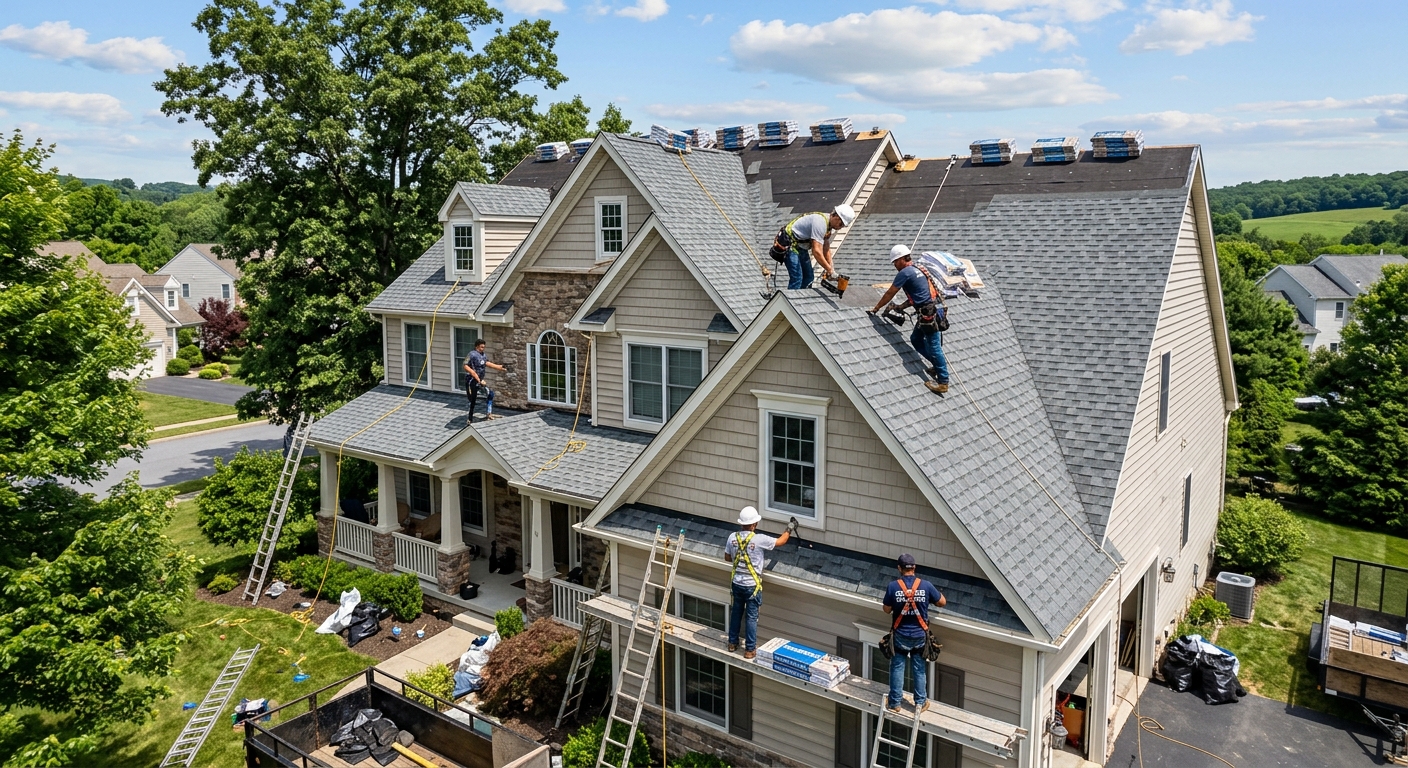
In West Brandywine, roofing projects are shaped by the realities of local neighborhoods, home ages, and client priorities. With a homeownership rate exceeding 90% (U.S. Census Bureau, ACS 2024), and most residents in single-family homes, roof replacement is a major event, not a stopgap repair. These are investments measured in decades. West Brandywine sits in a belt where architectural asphalt shingles have ruled since the big subdivision waves of the 1970s through the 1990s—meaning a large percentage of homes are hitting the age where full roof replacement is a must. When clients here call about a new roof, it’s rarely their first; the original subdivisions in Uwchlan and West Goshen started needing their first replacements a decade ago, and now that pace has reached West Brandywine’s own neighborhoods. The scale is quite different from rural Chester County or new-construction-heavy areas.
For a typical West Brandywine home, architectural asphalt shingles remain the most common choice, blending HOA requirements and proven durability. Metal roofs are less common—but occasionally requested for their longevity on higher-end properties or additions. Flat TPO/EPDM roofing turns up on additions, porches, and some custom homes. Repairs, on the other hand, are common after windstorms sweeping over the South Valley Hills, where leaks at eaves and ridges expose weaknesses in older installations.
| Material / Scope | Lifespan | Best for | Price range (installed) |
|---|
| Asphalt shingles — architectural (30-yr) | 25–30 yrs | Most West Brandywine homes | $10,500–$22,000 |
| Asphalt shingles — impact-resistant (Class 4) | 30+ yrs | Upgrading for higher wind/hail resistance | $17,000–$22,000 |
| Metal standing seam | 40–70 yrs | Premium homes, additions, or long-term owners | $25,500–$45,500 |
| Flat roof — TPO or EPDM | 15–25 yrs | Porches, additions, modern designs | $13,500–$26,500 |
| Roof repair — leak or isolated section | n/a | Targeted fixes, storm or isolated aging | $550–$2,100 |
Prices are estimates for a typical West Brandywine home and vary with roof size, pitch, decking condition and material selection.
The cost drivers behind a West Brandywine roof replacement
West Brandywine roofing bids span a wide range, and the reasons are easy to spot if you know the township’s housing stock. With a roof replacement base price of $10,500–$22,000 for architectural shingles, most cost jumps come from specific factors—many tied to how homes were built in the largest subdivisions. For instance, a roof in a mid-1980s tract home may have a steeper pitch and simple layout, keeping access reasonable, while a custom home with complex angles may jump costs by 20–30%. Those 70s–90s developments often have the original deck and sometimes a hidden second layer of shingles, both of which add to labor and disposal fees when you need a full tear-off or rotten wood replacement.
Central Chester County, including West Brandywine, faces ridge-line wind events that can rip shingles on exposed homes. This history means insurance may require installing ice barriers at eaves and valleys, adding $300–$800. Another surprise: snow load requirements here (30 psf) push up the need for robust attic ventilation and, sometimes, deck repair. It’s not uncommon to find bad sections of decking, especially around chimneys and valleys—at $75–$150 per 4x8 sheet, that adds up on homes where leaks went unnoticed. Material selection also swings the numbers; a Class 4 impact shingle adds $500–$2,500 to the tab, but it pays back for owners on the windier hilltops.
| Factor | Why it matters here | Cost impact |
|---|
| Roof size in squares |
Each square is 100 sq ft of roof surface—subdivision homes average 22–32 squares |
Primary multiplier |
| Pitch and access |
Steeper pitches need harnesses and slow the crew; older homes may lack clear driveway access |
+20–30% labour |
| Existing layers to tear off |
Two or more layers means full tear-off and disposal—common on pre-1990 homes |
$500–$1,500 per layer |
| Decking condition |
Rot is often found during tear-off, especially at valleys or eaves |
$75–$150 per sheet |
| Ice barrier at eaves |
Required where ice damming has a history (older attics, valley homes) |
$300–$800 |
| Material grade |
3-tab vs architectural vs Class 4 impact-resistant—Class 4 sometimes justified by storm history |
$500–$2,500 |
Roofing warranties in West Brandywine: what's actually covered
Every West Brandywine roofing job comes with two warranties, but they are never the same thing. First, the manufacturer’s warranty covers shingle material defect, which is almost always prorated after the first decade. If shingles fail due to a manufacturing flaw—not installer error—this limited coverage applies. However, if a roofer installs new shingles over a second layer, or if the attic isn’t ventilated to code (a risk in older tract homes), the manufacturer's warranty is typically void. Most manufacturers require product registration within 30–60 days and proof of proper installation on bare decking.
The second warranty is on workmanship. This is a promise from the roofing company that their install won’t leak due to poor practice, usually ranging from 5 to 25 years. The catch? That guarantee is only as good as the company’s survival—so a “lifetime” warranty from a new outfit is less reliable than 10 years from a contractor who’s worked here since the 1990s. Homeowners frequently mix these two types of coverage, but they’re separate both in practice and value.
Most warranties here are transferable if you sell your home, but often only once and only if you file the correct change paperwork with the manufacturer. Any shortcut—unventilated attic, second layer, unregistered install—jeopardizes coverage. Ask for confirmation in writing, never verbal promises.
What insurance covers on a West Brandywine roof
After a windstorm or hail in West Brandywine, the first rule is to document all damage before making repairs or cleanup. Take photos of missing shingles, interior leaks, debris, and all affected areas—even before you call in a roofer for assessment. When you notify your insurance carrier, they’ll send an adjuster to prepare a written scope of loss. If you receive two checks—one for “actual cash value” and a later check for the “replacement cost”—remember you only get the full amount after showing proof of completed work. The replacement of a typical architectural shingle roof here, potentially $10,500–$22,000, is usually covered for sudden, accidental storm damage, not age or maintenance issues.
In Pennsylvania, roofing contracts over $500 require a written contract, with a 3-business day right to cancel—key protections under the Home Improvement Consumer Protection Act (HICPA). Importantly, state law also forbids any contractor from waiving your homeowner’s insurance deductible. If anyone offers to “cover your deductible” or “work the price down” to match your out-of-pocket, that’s a red flag—walk away. This rule protects you from fraud and helps keep insurance costs stable for everyone. Always get a detailed written scope, communicate with both your adjuster and roofer, and keep records for both your insurer and your own peace of mind.
When a West Brandywine roof is worth repairing — and when it isn't
For West Brandywine homeowners, whether to repair or replace often comes down to the age of the roof and a little math. On a roof under 15 years old with a leak or two—usually from wind-lifted shingles or flashing failures—a repair at $550–$2,100 makes sense, and the patches are likely to last. But once you reach 15–25 years (common for roofs installed when the 1980s–1990s subdivisions went up), even a few leaks can signal a failing system, and repeated repairs soon outpace a replacement. For example, two or three repairs over several years might run $1,350 each, totaling over $4,000—money better spent toward a full roof with a 25–30 year guarantee.
Flat roofs are sometimes worth patching if minor ponding hasn’t progressed, but blistering or large-scale ponding justifies membrane replacement at $13,500–$26,500. Any roof older than 25 years in West Brandywine—especially those original to Uwchlan or West Goshen tract homes—should be on a replacement schedule at the first sign of leaks. And if a leak starts just as winter sets in, it is worth paying for an emergency repair immediately, then booking replacement for spring, to avoid attic or interior damage.
| Situation | Recommendation | Typical cost | Reasoning |
|---|
| Under 15 years, one isolated leak |
Repair |
$550–$2,100 |
Likely storm or flashing issue; rest of roof is still sound |
| 15–25 years, several leak points |
Replace |
$10,500–$22,000 |
System nearing end of life; repairs delay the inevitable |
| 25+ years, any active leak |
Replace now |
$10,500–$22,000 |
Shingles and flashing past lifespan; risk of interior damage |
| Storm damage, wind or hail |
Document, claim, replace |
$10,500–$22,000 |
Insurance may cover full replacement after inspection |
| Flat roof ponding or blistering |
Replace membrane |
$13,500–$26,500 |
Underlying issues rarely solved by patching at this stage |
| Active leak entering winter |
Emergency repair, schedule replacement |
$550–$2,100 |
Quick repair prevents further damage while planning for full job |
Pennsylvania code and Chester County permit rules for roofing
Pennsylvania residential roofing in West Brandywine follows the Pennsylvania Uniform Construction Code (UCC), based on the IRC, as enforced throughout Chester County. While every municipality manages its own permit regime here, the norm in this part of the county—just as in West Chester Borough—is that a building permit is required when a roof replacement involves any structural deck repair. Like-for-like shingle repair under one roofing square does not trigger a permit requirement in West Chester Borough; practices are similar through the townships around West Brandywine, but check locally if your home is right on a boundary.
Roofers must hold Home Improvement Contractor (HIC) registration, issued by the Pennsylvania Office of Attorney General, for all contracts exceeding $500. Homeowners can (and should) verify a contractor’s registration status at hic.attorneygeneral.gov, and confirm that workers’ compensation coverage is valid and active through the WCAIS system at wcais.pa.gov. Insurance and written contracts are state-law requirements if your project exceeds $500. There is no specific state trade license for roofing in Pennsylvania; registration and permits are what matter. Always get written proof of both insurance and registration before work starts—and if a contractor is vague about either, move on to someone established in Chester County’s demanding market.
Roof age and construction era in West Brandywine
West Brandywine’s subdivision boom in the 1970s–1990s left a lasting signature on both roof style and replacement cycles. About 31% of local homes were built before 1980 (U.S. Census Bureau, ACS 2024), but the majority fall into that newer suburban wave—tract homes with steep-pitch roofs, stick-framed attics, and plywood decking. Most of these homes got their first asphalt architectural shingle roof right at construction; now, 25–45 years on, the original roofing is almost always at the end of its lifespan if it hasn’t already been replaced.
Early tract homes from this era in West Goshen, Uwchlan, and West Brandywine itself typically have one or two layers of shingles. It’s uncommon to find plank decking or cedar shingles—instead, it’s almost always plywood or OSB, with the rare double-layer. Where code once neglected ice barrier, today’s replacements add it along the eaves and valleys, reflecting lessons learned as shingle life and winter storm frequency have both increased. For homeowners, this means new roof jobs are much more straightforward than on older village stock, but the real difference is timeline: most 1990s homes are due for first replacement now, not two decades from now. If your home is original to one of these subdivisions and you haven’t replaced the roof yet, you’re sitting squarely in the “due now” group, with newer code and material upgrades available for the coming decades.
Frequently asked questions — roofing in West Brandywine
Does roof pitch affect the price in West Brandywine?
The pitch (steepness) of your roof absolutely impacts price here in West Brandywine. Many homes built in the 1970s–1990s subdivisions have moderate to steep pitches, which demand full harness setups, roof jacks, and sometimes even scaffolding for safe access. That slows down the crew and increases labor, sometimes by 20–30% over a low-slope roof. On a typical architectural shingle replacement—running $10,500–$22,000—a steep two-story roof can nudge the cost well past the low end of the range. Steeper pitches can also be harder to inspect for hidden damage until tear-off, so factor in some contingency if you’re comparing quotes on homes in the hills or with a more dramatic design.
What is the best roofing material for West Brandywine's climate?
The majority of West Brandywine homes use architectural asphalt shingles, which remain the right pick for our climate’s blend of humid summers, moderate freeze-thaw cycles, and occasional coastal storm remnants. These shingles balance cost, proven longevity, and HOA acceptance—plus, they’ve reliably lasted 25–30 years on subdivision homes here. For those on exposed ridges or looking for extra wind resistance, an upgrade to Class 4 impact-resistant shingles is smart, raising the job into the $17,000–$22,000 range but adding real value if you plan to stay put. Metal can be great for longevity but is less common outside of higher-end builds. The right choice still comes down to your home’s pitch, budget, and long-term plans, but for most, asphalt architectural shingles fit West Brandywine’s needs best.
What happens if rotted decking is found after tear-off?
In West Brandywine, rotted roof decking is most often discovered only during tear-off, especially around chimneys, valleys, or skylights. Reputable contractors will show you photos or offer to let you see the rot in person before they proceed. Each 4x8 sheet of replacement decking typically adds $75–$150 to your bill, depending on plywood thickness. On most single-family homes here, you might need anywhere from a couple sheets to over a dozen, if leaks have gone unnoticed for years. It’s never about padding the job—replacing soft or rotten wood is required by both Pennsylvania code and common sense. If your quote has a “contingency” line for decking, don’t panic; just ensure it matches the price range and that you’re only charged for what’s replaced (and have photos as backup).
How much does a flat roof replacement cost in West Brandywine?
Flat roof replacements—usually TPO or EPDM membrane—are less common in West Brandywine than pitched asphalt, but do turn up on additions, porches, and custom builds. The 2026 band for a flat membrane replacement here is $13,500–$26,500, depending on size, insulation, and whether the job includes new decking or coping metal. Aging flat roofs often start having problems with ponding and splitting after 15–20 years, especially if poorly maintained. Replacing with a modern membrane system gives you a 15–25 year new life cycle, and is strongly advised if you’re already seeing interior leaks or surface blisters. Always check that your contractor uses a membrane rated for the specific freeze-thaw cycles we get in Southeast PA.
Does homeowner's insurance cover roof replacement in West Brandywine?
Homeowner's insurance in West Brandywine will generally cover roof replacement if the loss is caused by a covered peril, like wind or hail—common events with our occasional ridge-line storms. However, it won’t pay for normal aging, poorly maintained roofs, or leaks that progressed over months. When damage is storm-related, document everything before any temporary repairs, and get an adjuster’s written estimate. Insurers settle on “actual cash value” first, with the balance for “replacement cost” released once the work is done. Expect a covered replacement to fall in the $10,500–$22,000 range for architectural shingles. Ignore any contractor who offers to “waive your deductible”—Pennsylvania law prohibits it, and it’s a hallmark of fraud.
How many quotes should I get for a roof in West Brandywine?
Three written quotes is the gold standard for West Brandywine homeowners seeking roof work. Because Chester County has a densely competitive market, with contractors based in and around West Chester, prices can range widely even on the same home. For a typical architectural shingle job (around $17,000), you may see differences of several thousand dollars—often explained by company size, warranty length, and the thoroughness of the quote details. If a bid seems too low, check for proof of Home Improvement Contractor registration and full insurance. The best quote isn’t always the cheapest, but the clearest one—you want every layer and possible decking charge spelled out.
How long should a roof last in West Brandywine?
Most architectural asphalt shingle roofs in West Brandywine last 25–30 years, thanks to our moderate winters and generally good attic ventilation in subdivision homes. If your house was built in the 80s or 90s, and your roof is original, it’s likely overdue—even if it looks okay from the curb. Metal roofs can last 40–70 years, but are less common except on higher-end properties. If you invest in Class 4 impact-resistant shingles, expect a bit better lifespan for $17,000–$22,000 per replacement. Always ask your installer about ventilation upgrades and ice barrier to reach these lifespan numbers—they’re both key in our climate.
Do I need a permit to replace a roof in West Brandywine?
In West Brandywine and Chester County generally, you’ll need a permit for roof replacement that includes structural deck repair—which is almost all “full tear-off” jobs, not just small patching. Minor like-for-like repairs under one roofing square usually don’t require permitting, but always check with your municipality, especially if you’re right at a township line. Your contractor must be registered as a Home Improvement Contractor with the state (check at hic.attorneygeneral.gov), and they’re required to carry workers’ compensation insurance—verify this at wcais.pa.gov. You should never agree to work without written proof of both. Roofing doesn’t require a trade license in this state, but registration, insurance, and permit paperwork are non-negotiable.
Does West Brandywine get enough hail to justify Class 4 shingles?
While West Brandywine isn’t in a severe hail alley, our region’s exposure to coastal storm patterns and the occasional ridge-line wind event means impact-resistant (Class 4) shingles are still a smart upgrade for some homes, especially those on open lots or high ridges. The cost jump to Class 4 is about $17,000–$22,000 for a full replacement—up to $2,500 more than standard architectural. Insurance usually doesn’t discount your premium much, but you’ll see less damage and longer shingle life after storms. If your home has a history of blown-off shingles or exposed valleys facing the South Valley Hills, consider Class 4 as insurance for the roof itself, not just a code luxury.