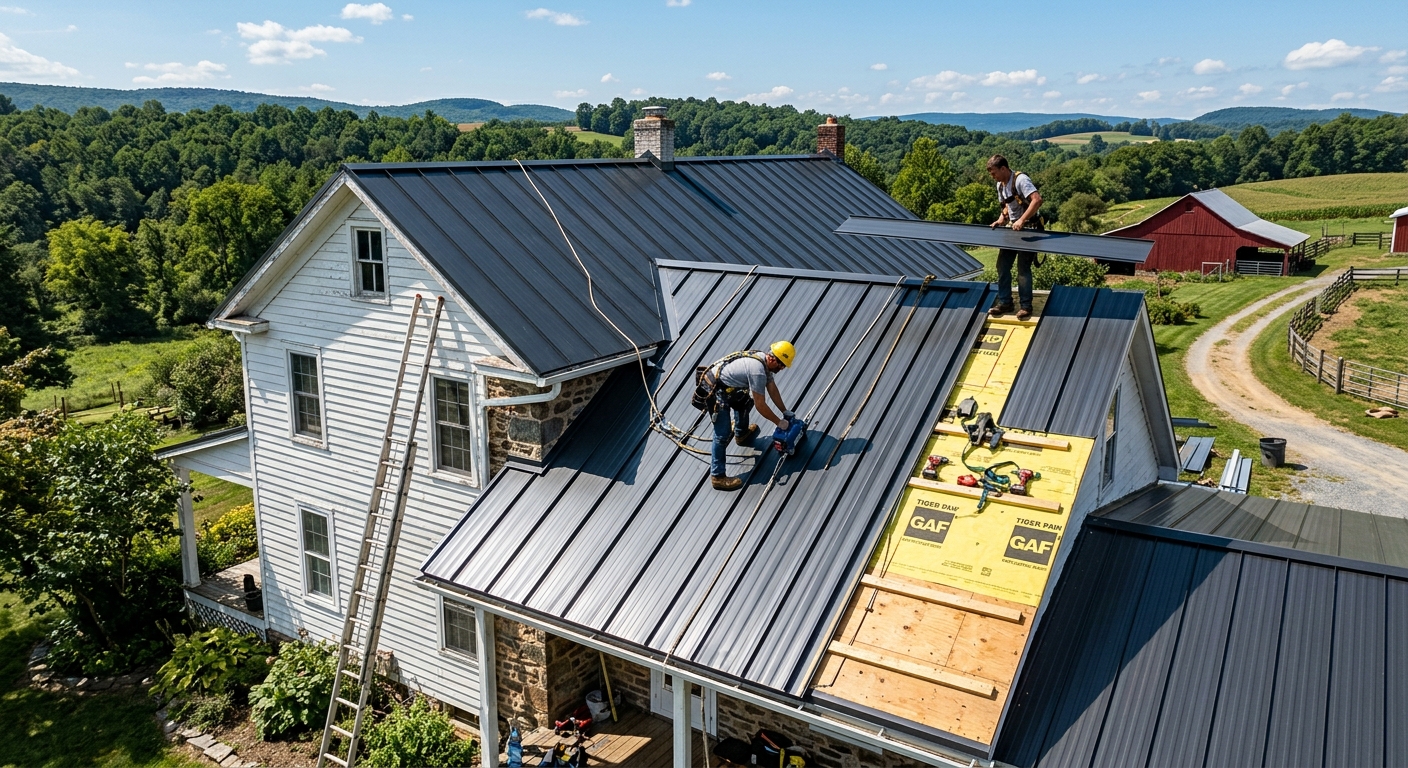
What roof replacement costs in Whitehall in 2026
Whitehall sits in the heart of Lehigh County’s post-war suburbs, where most homeowners are working with houses built before 1980 (U.S. Census Bureau, ACS 2024). With 62.7% homeownership in town, roof replacement isn’t just a maintenance issue — it’s a fact of life for the majority of households here. These neighborhoods, especially in South Whitehall and Upper Macungie, are filled with large tracts of similar, mid-century homes. Most use architectural asphalt shingles, and when these reach the end of their 25–30 year life, replacements tend to come in waves — neighbors notice when one roof gets done, leading to multiple projects along a block in quick succession.
Because Whitehall homes share similar roof layouts and materials, replacements are more predictable than in mixed-era or urban housing. Labor and material pricing tends to cluster tightly around average project sizes: a typical architectural shingle tear-off and install lands right near $15,500. Upgrades, repairs and flat roofing on porches and additions are also priced locally, so families don’t face large outlier quotes unless their property is truly unique. Here’s what you’ll see for 2026 re-roofing and repairs in Whitehall:
| Material / Scope |
Lifespan |
Best for |
Price range (installed) |
| Asphalt shingles — architectural (30-yr) |
25–30 yrs |
Suburban single-family homes |
$9,400–$20,000 |
| Asphalt shingles — impact-resistant (Class 4) |
30+ yrs |
Storm/wind-prone areas, long-term ownership |
$15,500–$20,000 |
| Metal standing seam |
40–70 yrs |
Upscale homes, low maintenance, durability focus |
$22,500–$40,500 |
| Flat roof — TPO or EPDM |
15–25 yrs |
Additions, porch roofs, low-slope sections |
$12,000–$23,500 |
| Roof repair — leak or isolated section |
n/a |
Local damage, spot leaks, shingle replacement |
$500–$1,900 |
Prices are estimates for a typical Whitehall home and vary with roof size, pitch, decking condition and material selection.
Low-slope and flat roofs in Whitehall
Many Whitehall houses, especially those built before 1980, include a flat or slightly pitched section — most often a rear addition, porch, or garage. These areas need a completely different roofing approach than the main sloped roof. Standard asphalt shingles rely on gravity shed; they simply don’t work on low-slope surfaces, as water backs up, seeps laterally, and penetrates the system. Putting shingles on a roof with a 2/12 pitch or less is asking for leaks. That’s why trained roofers will always spec a membrane system — usually TPO or EPDM — for these parts.
Flat roof membranes are built to handle ponding water and form a single continuous barrier. But they don’t last as long as the main shingle roof: a typical TPO or EPDM install runs 15–25 years before the heat, UV exposure, and ponding start to degrade seams and flashings. You’ll see replacement costs between $12,000–$23,500 for most Whitehall add-ons; repairs cost much less, but patching a worn-out membrane is just a temporary fix.
If a roofer quotes shingles for a flat or near-flat section, it’s a sign they don’t understand (or are willing to ignore) basic roof water management. You won’t get the promised life, and leaks are just a matter of time.
The cost drivers behind a Whitehall roof replacement
Whitehall homeowners often ask why re-roofing prices run wide even among similar houses. In this part of Lehigh County, sheer roof area is the starting point — nearly all post-war homes share simple gable and hip layouts, but actual square footage varies block to block. Each “square” is 100 square feet, and even a difference of five squares raises the average architectural job by thousands.
Pitch and accessibility are direct cost factors. Steeper roofs or those with limited drive-up access require more labor hours and safety equipment. For example, a steep split-level on a tight cul-de-sac takes longer than the same roof on an open ranch layout, pushing the price from the lower to upper end of the $9,400–$20,000 band. Tear-off complexity is another: many older homes here still have two or more shingle layers, left over from a time when codes allowed nail-overs. Each layer adds bulk to remove and dump, tacking on $500–$1,500 per extra layer.
Deck condition is often the wild card. Rot shows up after stripping the old roof, especially on homes left with leaks over winter. Local snow loads (40 psf) test the integrity of decking — any sheet found soft will need replacing, often at $75–$150 per sheet. Also, ice barrier (ice and water shield) is a must along eaves here due to frequent ice damming. It protects against meltwater backup but runs $300–$800 added to the job.
| Factor |
Why it matters here |
Cost impact |
| Roof size in squares |
Each square is 100 sq ft of roof surface |
Primary multiplier |
| Pitch and access |
Steep pitches need harnesses and slow the crew |
+20–30% labour |
| Existing layers to tear off |
Two or more layers means full tear-off and disposal |
$500–$1,500 per layer |
| Decking condition |
Rot is found during tear-off, not before |
$75–$150 per sheet |
| Ice barrier at eaves |
Required where ice damming has a history |
$300–$800 |
| Material grade |
3-tab vs architectural vs Class 4 impact-resistant |
$500–$2,500 |
When a Whitehall roof is worth repairing — and when it isn't
Deciding between repair and full replacement is much easier if you know the age, material, and leak pattern of your Whitehall roof. For homes built before 1980 (the majority here), if the roof is under 15 years old and you see just one leak (especially after a recent storm), a repair in the $500–$1,900 range makes sense. But as a roof nears 20–25 years, especially with multiple leaks, repair dollars quickly surpass the value of replacement. Two or three $1,200 repairs in as many years put you right at the bottom of the replacement range, without solving the underlying problem.
Once a shingle roof is over 25 years old or leaks as winter approaches, repairs are almost always wasted money — water intrusion at this age signals failure across the system, not at just one shingle. Flat roof ponding, blistering, or visible membrane damage means a patch will last only until the next snowmelt. Don’t be penny-wise and pound-foolish; most Whitehall roofs fail in similar patterns and on similar timelines.
| Situation |
Recommendation |
Typical cost |
Reasoning |
| Under 15 years, one isolated leak |
Repair |
$500–$1,900 |
Material is young; targeted repair holds up |
| 15–25 years, several leak points |
Replace |
$9,400–$20,000 |
Multiple leaks signal end of shingle life |
| 25+ years, any active leak |
Replace now |
$9,400–$20,000 |
Systemic failure; repair is wasted money |
| Storm damage, wind or hail |
Document, claim, replace |
$9,400–$20,000 |
Insurance claim covers full replacement when warranted |
| Flat roof ponding or blistering |
Replace membrane |
$12,000–$23,500 |
Membrane failure can’t be patched long-term |
| Active leak entering winter |
Emergency repair, schedule replacement |
$500–$1,900 |
Stop water damage until full project can be scheduled |
Permits and code requirements in Whitehall
Every roofing project in Whitehall is subject to the Pennsylvania Uniform Construction Code (UCC), based on the IRC. Local municipalities enforce these standards unless they’ve opted out — in Allentown, for example, the Bureau of Building Standards & Safety handles permitting. For Whitehall Township, the separate township code office is your authority. In these Lehigh County municipalities, any structural roof replacement or adding a new roof over existing layers typically triggers a building permit requirement. Small spot repairs, like swapping a few shingles, are generally done without triggering a permit.
Pennsylvania requires contractors to hold a Home Improvement Contractor (HIC) registration, issued by the Office of Attorney General, for jobs over $500. You can (and should) verify a roofer’s HIC registration at hic.attorneygeneral.gov. For worker safety, all employers must maintain workers’ compensation insurance — check their coverage status directly via WCAIS (wcais.pa.gov) before signing. State law prohibits waiving your insurance deductible. Always insist on a detailed written contract; this is your right under the Home Improvement Consumer Protection Act for jobs above $500, along with a three business-day cancellation period.
Gutters, drainage and roof longevity in Whitehall
Roofing and gutters are a single system protecting your home’s structure and its foundation. Gutters catch runoff from each slope and channel it away, through downspouts, to a safe discharge area — ideally five feet or more from the foundation. If you neglect gutters during a replacement, you risk undermining even a brand new roof: water can pool at the foundation, especially with Whitehall’s post-war construction and shallow grading around many slab homes. That’s a recipe for basement leaks or worse, and it’s one reason some shingle warranties require proof of working gutters with correct drip edge installed.
If your existing gutters are rusted, pulling away, or undersized for a new roof’s overhang, have them replaced at the same time. Typical costs for gutter replacement alongside full roofing in Whitehall are $2,000–$3,800 depending on linear footage and material. Add leaf or debris guards, and you’ll see up to another $700–$1,200. Addressing drainage correctly is the only way your roof — and basement — will live out the full predicted lifespan.
When to book roofing work in Whitehall
Timing your roof replacement in Whitehall means balancing weather, shingle performance, and metro-wide contractor demand. The best roofing work is done between late April and early November, when daytime highs are consistently above 45°F — crucial for shingle sealing and adhesives to bond properly. September and October are the sweet spot: materials lay flat, there’s no summer backlog, and you get ahead of the winter freeze/thaw cycle, with most local companies able to fit you in within four to six weeks. As the Lehigh Valley market is dense and competitive, Whitehall residents benefit from multiple seasoned crews available, but peak months book up early, especially after a wind event funneling along South Mountain or Trexler Hills.
Emergency work in January or February always carries a premium — the crew faces hazardous conditions, and cold slows the process. Expect to pay more (both for repairs and full tear-offs), and don’t expect long-term shingle jobs to be scheduled before spring. If your roof starts to go in late autumn, get on a list for early spring and consider temporary repairs to protect your interior. For planned jobs, September is the ideal window in Whitehall, striking a balance between cost, product performance, and scheduling flexibility.
Frequently asked questions — roofing in Whitehall
What does roof replacement cost per square in Whitehall?
In Whitehall, roofers typically price full replacements by the “square” — 100 square feet of roofing surface. For architectural asphalt shingles, expect to pay between $470–$660 per square installed, factoring both labor and material. This range reflects the local Lehigh County market, where most homes are of similar size and age, often requiring strip tear-offs. If your roof is steeper or has more layers to remove, you’ll trend toward the higher end of that range. More specialized roofs — such as standing seam metal — generally start above $1,100 per square and can go higher depending on technical details. Always seek a line-item quote so you understand labor, material, and removal separately, especially if your decking may need work. Most Whitehall roofs fall clearly within these per-square rates unless you have an unusual design or a particularly large house.
Do I need my own inspection before the adjuster visits?
In Whitehall, it isn’t legally required to bring in your own roofer or public adjuster before your insurance company’s adjuster inspects storm damage, but it’s often smart. Many local contractors, including reputable roofers in Lehigh County, offer free initial storm or damage assessments. They’ll photograph damage and can point out details the adjuster might overlook — especially for wind or hail events common along South Mountain. This can be the difference between an approved full replacement in the band of $9,400–$20,000 and a patchwork repair that leaves you exposed next storm season. It doesn’t lock you into anything, and a second set of eyes never hurts. Just be wary of pushy door-knockers after storms; stick with local Whitehall pros who know the difference between cosmetic shingle loss and real, claim-worthy damage.
How do I find a reputable roofer in Whitehall?
Your first check for any Whitehall roofer should be Pennsylvania’s Home Improvement Contractor registry — available at hic.attorneygeneral.gov — to make sure their registration is current. Next, ask for proof of workers’ compensation coverage, which you can verify on WCAIS (wcais.pa.gov). In the Lehigh Valley, most established roofers have been replacing architectural shingle roofs in Whitehall’s post-war neighborhoods for years, so reputation matters. Ask neighbors about their experience; you’ll often find the same contractor has covered several blocks. A trustworthy roofer will issue a written contract for any job over $500 — that’s your right under state law, along with a three-day cancellation period. Don’t be afraid to walk away from anyone unwilling to provide credentials before quoting or who pushes for cash-only deals.
Is metal roofing noisy in rain?
This is one of the most common questions in Whitehall, especially as interest in standing seam metal roofing rises. Properly installed metal roofs are not significantly noisier than asphalt shingle systems because local code requires a solid plywood deck beneath them, as well as underlayment. In post-war homes throughout Lehigh County, the actual difference in sound is minimal — many homeowners report it’s slightly louder in heavy rain, but not disruptive. If you want extra quiet, specify an additional insulation layer under the panels. Remember, the tradeoff is longevity: metal roofs here can last 40–70 years, which easily offsets the cost. Expect a full standing seam roof in Whitehall to run from $22,500–$40,500, so it’s a long-term investment as much as a design decision.
What is the best time of year to replace a roof in Whitehall?
For most Whitehall homes, early fall — September and October — offers the best mix of weather and contractor availability. Shingle sealing relies on mild temps (above 45°F), and late summer/early autumn avoids both the spring rain delays and the winter storm premium. In our local market, roofing crews are busiest after a summer storm or if wind has hit the ridges near Trexler Hills. Avoid scheduling in winter unless it’s an emergency; cold slows the work and may add costs for temporary protection, pushing even a standard repair toward the upper end of $1,900. For planned projects, book early and choose a time when you and the roofer can work at a measured pace, with no weather rush.
What causes ice dams on Whitehall roofs?
Ice dams in Whitehall are primarily caused by the region’s cold winters (design temp as low as 4°F), plus the heavy snow loads of 40 psf in Lehigh County. Heat loss through the attic melts snow near the ridge, which runs down and re-freezes over cold eaves, backing up under shingles. In older Whitehall homes, poor insulation and air leaks make this far more likely. The result is water trapped above the eaves, which can drive leaks inside. The right approach: upgraded attic insulation, ventilation, and a code-required ice and water barrier at eaves (often a $300–$800 upgrade on a standard roof replacement). Don’t skip this — it’s the difference between trouble and peace of mind when next winter comes.
Are there historic district rules affecting roofing in Whitehall?
Unlike downtown Allentown or Bethlehem, Whitehall Township is not subject to a historic district overlay with unique exterior guidelines in the supplied facts. Standard residential work here falls under the Pennsylvania Uniform Construction Code (UCC), enforced by the township office. You are free to install architectural shingles, Class 4 impact-rated materials, or even standing seam metal without facing architectural review, unless your HOA stipulates otherwise (not covered here). Costs for standard shingle roof replacement still range from $9,400–$20,000, and there’s no historic material upcharge in the local code framework. Always check your property paperwork, but for most in Whitehall, there are no historic restrictions holding up re-roofing.
How much does it cost to repair a roof leak in Whitehall?
Roof leak repairs in Whitehall generally run from $500–$1,900 for an isolated problem — missing shingles after a storm, exposed flashing, or a nail pop that’s let water in. The price depends on whether decking or insulation beneath has been damaged. Keep in mind that if your asphalt shingles are more than 15–20 years old, one repair often turns into the next: after two or more fixes, you might as well replace the roof for $9,400–$20,000. But for quick, targeted repairs on younger roofs (under 15 years), the low end of the band is usually all you’ll spend. Avoid full tear-off unless your roofer tells you repair is just buying time on a worn-out system.
Can I inspect my own roof safely?
In Whitehall, plenty of homeowners give their roofs a visual once-over from the ground using binoculars — and this is both safe and often helpful. But walking the roof, especially on older homes with steeper pitches or questionable decking, is another matter. Slips are common, and post-war Whitehall homes often have brittle sheathing that gives no warning before failing. Instead, use a ladder to inspect gutter edges for shingle grit or check attic decking for signs of leaks. If your roof needs closer inspection, especially after a storm, hire a professional — most local roofers will do an assessment for free or a small fee (usually $100–$200), and you avoid risking a hospital bill much higher. Leave full walk-arounds and steep climbs to the crew with insurance and safety harnesses.