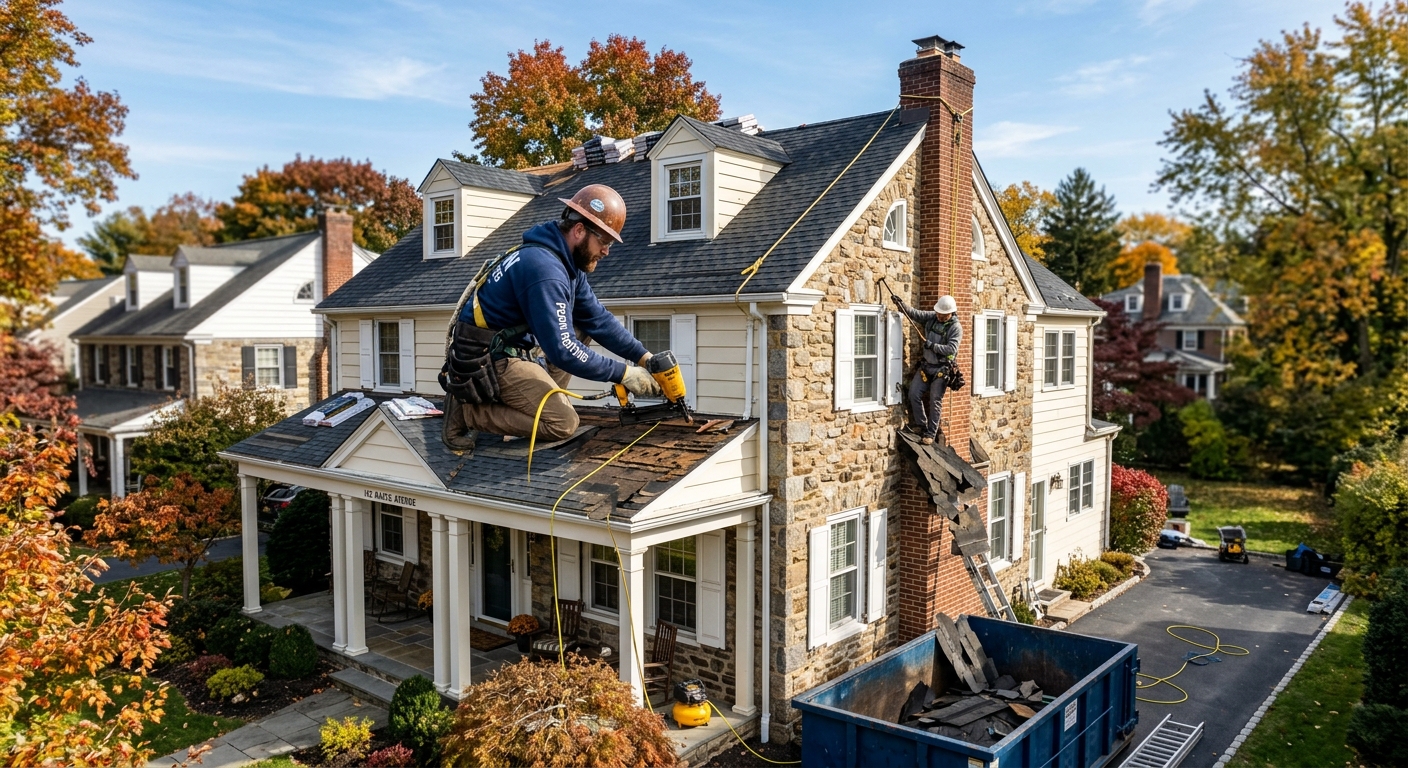
Wright roofing prices by material and scope — 2026
In Wright, where nearly all homes are single-family and homeownership is very high according to the U.S. Census Bureau (ACS 2024), most roofing jobs involve owner-occupied residences rather than investor flips or rentals. With more than half the local homes built before 1980, you’ll see more deck repairs and ventilation upgrades during roof replacements than in a development of new builds. Much of Wilkes-Barre and Hazleton’s housing are early-1900s row and twin homes, and Wright’s stock lines up: that means steeper pitches, old deck boards, and attic ventilation that often needs to be brought up to modern code with each install. This increases the complexity and cost of what looks like a "basic" re-roof because you’re probably not just swapping shingles—you’re rebuilding the system to handle today’s snow loads and ice exposure.
Material choice, roof pitch, and how much old decking needs replacing all influence pricing. Below is a clear range for what you should expect for local roofing projects in Wright.
| Material / Scope |
Lifespan |
Best for |
Price range (installed) |
| Asphalt shingles — architectural (30-yr) |
25–30 yrs |
Standard pitched roofs, original wood framing |
$9,700–$20,500 |
| Asphalt shingles — impact-resistant (Class 4) |
30+ yrs |
High-wind lines, hail risk, insurance discounts |
$16,000–$20,500 |
| Metal standing seam |
40–70 yrs |
Long-term owners, snow shedding, steep slopes |
$23,500–$42,000 |
| Flat roof — TPO or EPDM |
15–25 yrs |
Low-slope porches, dormers, flat additions |
$12,000–$24,500 |
| Roof repair — leak or isolated section |
n/a |
Storm damage, single slope fixes, flashing leaks |
$500–$1,950 |
Prices are estimates for a typical Wright home and vary with roof size, pitch, decking condition and material selection.
Storm damage and insurance claims in Wright
If your Wright roof takes damage from a storm, act quickly but don’t rush. Before cleanup or temporary tarping, document everything thoroughly—photos, video, and written notes—because insurance claims rely on this evidence. Next, request a written scope of loss from your adjuster so you know exactly what your policy covers and how it’s valued. In Wright and the rest of Luzerne County, claims are usually paid on an “actual cash value” (ACV) basis first, with recoverable depreciation released after the work is done, assuming you have “replacement cost value” (RCV) in your policy. You’ll likely see an adjuster visit to confirm the damage and compare it to your contractor’s estimate.
Pennsylvania law requires a written contract for any roofing job over $500, which you’ll encounter in almost every storm repair here. There’s also a three-day right of cancellation, giving you time to review your agreement. One frequent consumer-pitfall: some contractors offer to waive or absorb your homeowner’s insurance deductible. In Pennsylvania, waiving a deductible is illegal—it’s a violation of the Home Improvement Consumer Protection Act and a red flag for insurance fraud. If anyone offers this, walk away and report them. Your policy is clear: paying the deductible is your legal obligation, and reputable Wright contractors will insist you do so.
Once your claim is processed, pick a contractor with experience navigating Wright’s storm exposure—especially those ridge-line winds and shingle blow-off risk in the Wyoming Valley. They’ll know how to properly document, repair, and deal with adjusters for the most common local claim types.
How to compare roofing quotes in Wright
Reading a roofing estimate in Wright starts with the details: the roof area should be stated in “squares” (one square = 100 square feet) with the pitch spelled out. Jobs in this area often involve old layered shingles, so tear-off and dumpster costs should appear as their own line. Underlayment needs more than “15 lb. felt”—you want a specific brand or spec, especially for eave protection in ice-dam zones. Ice barrier (ice and water shield) coverage is crucial, considering our 40 psf snow load and frequent freeze-thaw cycles; on a Wright house, this underlayment should rise at least 24 inches past the interior wall line. Decking replacement—always a risk in homes built before 1980—should be priced per sheet, not left as a vague “if needed” line.
Watch for red flags: any quote that fails to spell out the number of squares, or bundles disposal into a generic “labor” line, is hiding margins and may lead to disputes. Paperwork should list the labor/workmanship warranty apart from the manufacturer warranty. Payment structure matters: a deposit over 15% is unusual here due to consumer protection rules, and you should never front most of the cost before work starts.
| Line item |
What to look for |
Red flag if… |
| Roof area |
stated in squares, with pitch |
no measurement given |
| Tear-off and disposal |
number of layers, dumpster included |
bundled into one figure |
| Underlayment |
product type and coverage |
listed only as 'felt' |
| Ice and water shield |
coverage height at eaves |
omitted entirely |
| Decking |
per-sheet contingency price |
no allowance at all |
| Warranty |
workmanship years stated separately |
only the shingle warranty |
| Payment |
deposit under 15%, balance on completion |
large upfront cash |
Choosing a roofing material for Wright's climate
When you’re picking a new roof in Wright, think first about our actual climate. With a 40 psf ground snow load and 4 °F winter design temp, roofs here must handle serious snow, ice dams, and sharp freeze-thaw cycles all season. Metal standing seam roofs are great for snow management—snow slides off instead of piling up—but they command the highest upfront investment. Asphalt shingles dominate locally for one big reason: they’re relatively affordable, well-proven on early-1900s Luzerne County homes, and every supplier and crew is set up to do them. In fact, this dominance is as much about the framing and architectural style of existing Wright homes as price alone; most roofs here have the pitch and structure that matches shingle installation, and local contractors are set up for fast, cost-effective shingle jobs.
Asphalt Class 4 impact-resistant shingles can make sense if your home sits on a ridge or is exposed to frequent wind gusts, but their premium isn’t always justified outside those spots. TPO or EPDM roofing isn’t worth the extra spend on a steep primary roof—they’re essential for flat porches or additions but don’t outperform shingles for most Wright homes. In summary: don’t spend on metal or membranes unless you have a clear need; architectural asphalt remains the clear winner here for cost and code fit.
| Material |
Installed cost |
Lifespan |
Cold-climate performance |
Maintenance |
| Asphalt architectural |
$9,700–$20,500 |
25–30 yrs |
Good for snow and freeze-thaw cycling; ice barriers needed at eaves |
Gutter clearing, shingle repairs as needed |
| Asphalt Class 4 impact-resistant |
$16,000–$20,500 |
30+ yrs |
Handles hail and wind; performs like architectural for ice/snow |
Routine inspection; few wind-blown tabs |
| Metal standing seam |
$23,500–$42,000 |
40–70 yrs |
Sheds snow efficiently; best for high-pitch roofs |
Check fasteners/seams every 5 years |
| TPO / EPDM membrane |
$12,000–$24,500 |
15–25 yrs |
Prevents ponding/freeze splits on low-slope roofs |
Annual inspection of seams and drains |
Pennsylvania code and Luzerne County permit rules for roofing
Roof work in Wright falls under the Pennsylvania Uniform Construction Code (UCC), which is based on the International Residential Code. In Wilkes-Barre, full roof replacements, especially those involving structural deck repair, need a building permit issued by the City of Wilkes-Barre Code Enforcement Office. In Hazleton and similar nearby boroughs, smaller repairs—like patching less than one roof square—are usually done without a permit. Every municipality in Luzerne County either runs its own permit office or, if they have opted out, the Pennsylvania Department of Labor & Industry steps in as the enforcement authority.
Before signing a contract, verify your contractor's Home Improvement Contractor (HIC) registration at hic.attorneygeneral.gov—state law requires this for work over $500, which applies to almost every local re-roof or major repair. Confirm current workers' compensation coverage through the WCAIS system at wcais.pa.gov; this protects you from liability if someone is injured on your job. By state law, every contract must be written (not verbal) for work over $500, and you have a mandatory three-day right of cancellation in Luzerne County. Never hire any contractor who can't give you their HIC number or who won't provide proof of valid workers’ compensation insurance.
Roofing season and lead times in Luzerne County
Roof replacement and major repairs in Wright and the rest of Luzerne County are typically scheduled from late March through early November. Shingles need consistent daytime temperatures above 40 °F to seal properly and avoid wind blow-off, so most contractors pause new installs during deep winter. Summer and fall—especially September and October—see the highest demand as homeowners try to beat winter weather and get on a reliable contractor’s schedule. During these peak months, lead times stretch from 4 to 8 weeks, especially with so many regional contractors busy in the Scranton–Wilkes-Barre–Hazleton metro market. This market saturation gives you options, but also means top-rated installers often book out the fastest.
Emergency repairs or full roof replacements during February or early March do get done, but you’ll pay a premium for cold-weather labor and tarping, and installers may need to return to finish details like sealant when the temperature rises. If your job can wait, you’ll save by booking for late summer or early fall, when product supply issues have eased and crews can work without weather delays. Planning ahead is worth it: in Wright, a little flexibility gets you better pricing and quality on major investments like a full roof replacement.
How northeastern Pennsylvania's weather shapes roofing here
Wright sits in the Wyoming Valley, where storm-driven winds funnel across the ridgeline and regularly strip shingles from homes in Wilkes-Barre and Kingston, both factors that set us apart even from some neighboring counties. This unique wind exposure lifts edges on standard shingles, so local replacements almost always include upgraded starter strips and nailed-down ridge caps—each adding a few hundred dollars, but cutting your risk of shingle loss and frequent repairs in half. With a ground snow load of 40 psf, heavy snow accumulation is the local winter reality; roofs that lack proper ice and water shield at the eaves are prime candidates for ice dams. These dams form as attic-heat melts snow at the peak, which refreezes lower down, creating a block that backs up meltwater under shingles. When this happens, water finds nail holes and gaps, leading to leaks that require repairs in the $500–$1,950 range—or new decking if the damage goes unchecked.
Hail isn’t rare here, but our more common issue is wind-driven rain and ice, which bruises shingles without punching visible holes. These bruises weaken the granules’ bond, shortening roof life and requiring spot repairs or earlier replacement at $9,700–$20,500 for shingles. Because older homes in Wright often lack continuous soffit/ridge ventilation, you’ll see more ice-dam leaks and condensation issues in attics, adding both cost and urgency to any re-roof. Local roofs battle more than just precipitation—they earn every year of their lifespan dealing with unique northeastern Pennsylvania weather cycles.
Frequently asked questions — roofing in Wright
How much snow load can a Wright roof handle?
Most roofs in Wright are built to withstand a ground snow load of 40 pounds per square foot, in line with northeastern Pennsylvania’s building code requirements. This standard matches the Pennsylvania Uniform Construction Code and keeps up with what local winters actually deliver. If your home was constructed before 1980, it may not have been engineered to this standard, so an inspection before a replacement is wise. Upgrades during a modern re-roof, like reinforced decking or additional trusses, can boost capacity and safety. If a structural issue is found, solutions usually slot in line with the midrange of a local shingle replacement (for example, $16,000); larger framing repairs will raise the price. Always ask your contractor to specifically address your roof’s load capacity during an estimate in Wright.
Is ice barrier underlayment required in Wright?
Yes, for almost all significant residential roofing jobs in Wright, ice barrier underlayment is expected at eaves to deal with severe ice dam risk. Luzerne County’s roofing code, under the Pennsylvania UCC, requires eave protection up to at least 24 inches inside the exterior wall line on homes with a heated interior, as this prevents meltwater from infiltrating old decking during freeze/thaw cycles. Most homes here—especially those built pre-1980—never had proper ice shielding originally, so new installs absolutely should include it. The cost, baked into a modern roof replacement (for instance, within $9,700–$20,500 for architectural shingles), is small compared to what you’d pay for recurrent ceiling leaks or rotted wood. Always check your quote for this line item and ask if coverage extends to all eaves and valleys.
What should a roofing quote include in Wright?
A proper Wright roofing quote should break out several key items: area stated in squares and pitch, how many layers of old roof will be torn off, type and extent of underlayment (be sure ice and water shield is shown for eaves), per-sheet cost on any wood deck replacement, and detailed line-items for new flashing and vent boots. Workmanship and manufacturer warranties should be listed separately, and the payment schedule should follow Pennsylvania’s rules—no big upfront deposits. The cost for an average job can run $9,700–$20,500 for an asphalt shingle roof, so requiring a written, detailed contract not only protects you under the Home Improvement Consumer Protection Act, but also avoids any pressure or confusion in Wright’s busy market.
How do I know if my Wright roof needs replacing?
Wright homes, especially those put up before 1980, show clear signs when it’s time for a roof replacement: frequent leaks even after repair, shingle granules piling in gutters, tabs missing or curled by ridge-line winds, and attic staining or damp decking are key clues. Specific to this market, look for ice dam leaks around eaves if your roof lacks modern ice barrier underlayment. If your roof is over 25 years old and you start seeing problems, patching usually becomes false economy. A new roof here runs $9,700–$20,500 for asphalt, but waiting too long risks de-lamination, mold, and costly structural repairs. Get an inspection from a contractor who knows the local housing stock—someone used to working on Wright’s row and twin homes will spot ventilation issues others miss.
What is the difference between TPO and EPDM?
TPO (thermoplastic polyolefin) and EPDM (ethylene propylene diene monomer) are both membrane roofing materials for low-slope or flat roofs, common for porches and additions in older Wright homes. TPO is usually bright white and reflects more sunlight, which helps with cooling in summer but isn’t much of a factor in Wright’s relatively mild summers. EPDM is typically black, absorbs some heat, and is extremely durable in freeze-thaw cycles—making it a long-lasting pick for the winter conditions here. Installed cost on either membrane falls between $12,000–$24,500, with maintenance mostly limited to seams and drain checks. Bottom line for Wright: pick TPO for visible, high-sun areas; EPDM for back porches and where you want a bit more stretch and cold-weather tolerance.
How far ahead should I book a roofer in Wright?
In Wright, you’ll generally want to book your roofer four to eight weeks in advance if your job is between April and October. Summer and fall bring heavy demand as homeowners try to get ahead of winter, especially with so many contractors servicing the Scranton–Wilkes-Barre–Hazleton metro. Wait times are shorter in spring and late fall but expect a premium for emergency work in mid-winter. For example, a roof replacement in peak season can run $9,700–$20,500, but if you wait until the first snow, you’ll sometimes see extra labor or heating charges. Your best bet: line up estimates while there’s still summer daylight left—flexibility pays off in both price and quality in the local Wright roofing market.
Do I need my own inspection before the adjuster visits?
If your Wright home is hit by a storm and you plan to file an insurance claim, having a knowledgable contractor do a walk-through before the adjuster arrives is smart. Local contractors know the key signs of wind damage and ice dam leaks common to this part of Luzerne County and can make sure the adjuster doesn’t overlook hidden issues—like bruised shingles or suspect decking—which could affect the scope and value of your insurance claim. Many local roofers offer this inspection as part of their repair estimate, especially if you’re getting quotes for work in the $500–$1,950 range. It isn’t required, but a competitive quote and a second set of eyes is unlikely to cost extra and might catch a coverage gap your insurer would otherwise miss.
Does roof pitch affect the price in Wright?
Absolutely—pitch is a big price driver in Wright, especially since early-1900s homes often have steep roofs. Steep pitches require extra safety measures, more labor per square, and may need additional material (like starter strips or ice barriers run higher up the slope). That bumps up both time and cost, with the average architectural shingle job landing toward the higher end of the $9,700–$20,500 band on a steep roof. If your roof is flat or low-slope (common on porches or dormers), you’ll see membrane costs like $12,000–$24,500, but the labor’s less intensive. Always ask your contractor to specify both the pitch and square count—and don’t sign a quote that doesn’t clearly include both, especially in Wright’s housing stock.
How much does it cost to repair a roof leak in Wright?
In Wright, the typical cost to repair a roof leak falls between $500–$1,950, depending on the location and extent. For example, fixing a small leak at a flashing or boot usually stays toward the lower end, while repairing a valley or replacing damaged decking and multiple shingles lands at the upper end—especially on older homes built before 1980. Emergency repairs during snow or ice events might include a temporary tarp, which adds cost and complexity. Get a written contract, and always have the leak traced from the attic side to avoid being upsold—there’s no need to replace the entire roof unless the deck or a large section of shingles are beyond repair. An honest local contractor used to Wright’s older homes can pinpoint what actually needs to be done without overselling.