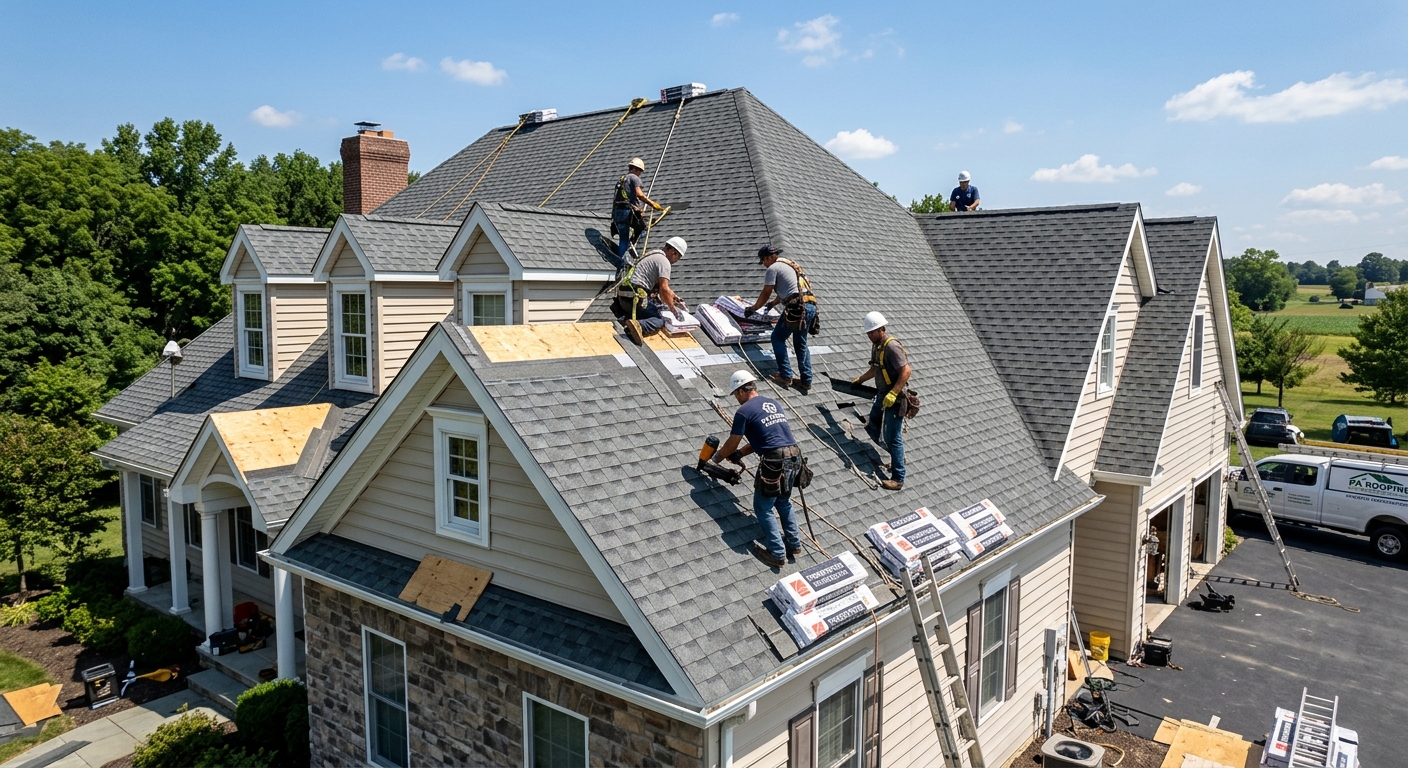
What roof replacement costs in Pottstown in 2026
Pottstown’s roof replacement decisions are shaped by its unique housing mix and market pressure. With just over 4,900 owner-occupied households and nearly nine out of ten homes built before 1980 (U.S. Census Bureau, ACS 2024), most Pottstown roofs are well past their second or even third covering. That translates to an outsized demand for full replacements, especially on homes that still have their original deck. Aging post-war tract homes in Abington and Cheltenham have a direct spillover effect: here in Pottstown, similar ranches and Cape Cods set the standard for 30-year architectural asphalt—owners are often facing entire tear-offs rather than just a couple of new layers.
If you’re living in one of these older Pottstown homes, the typical roof replacement won’t just be shingles—wood repair, updated flashing, and improved attic ventilation are likely needed. These factors, combined with the Philadelphia metro contractor competition, result in wide price bands. Architectural asphalt shingles remain the most common due to HOA and neighborhood styles that align with nearby townships like Upper Dublin. Below is a rundown of realistic costs for 2026 jobs in this area:
| Material / Scope |
Lifespan |
Best for |
Price range (installed) |
| Asphalt shingles — architectural (30-yr) |
25–30 yrs |
Suburban single-family homes |
$9,900–$21,000 |
| Asphalt shingles — impact-resistant (Class 4) |
30+ yrs |
Homes near tall trees or with past hail |
$16,000–$21,000 |
| Metal standing seam |
40–70 yrs |
Long-term ownership, low maintenance |
$24,000–$42,500 |
| Flat roof — TPO or EPDM |
15–25 yrs |
Rowhomes, garages, commercial |
$12,500–$25,000 |
| Roof repair — leak or isolated section |
n/a |
Single leaks, small area fixes |
$500–$2,000 |
Prices are estimates for a typical Pottstown home and vary with roof size, pitch, decking condition and material selection.
How to compare roofing quotes in Pottstown
Reading a roofing estimate in Pottstown requires patience and a sharp eye. The first sign of a quality quote: your roof area measured in “squares” (100 square feet each), with pitch clearly stated. Don’t accept a lump sum—contractors here should specify tear-off and disposal, noting how many old layers are coming off and whether a dumpster is provided or if it’s extra.
A proper quote names the exact underlayment brand (synthetic or felt) and how much ice and water shield is being installed at the eaves, which is essential for this region's freeze-thaw and storm events. It’s normal to see a “per sheet” price for any plywood that needs replacing if rotten wood is found after tear-off—this should be a contingency, not a surprise. Look for line items on flashing and vent boots, which often aren’t detailed in vague proposals. Contractor warranties and material warranties are separate (labor versus material failures), and good estimates spell out the years for each. For Pottstown, expect a deposit under 15% (as required), with the balance due only on job completion.
If a quote skips these details or can't be lined up apples-to-apples with another, you’re being set up for extras come the final bill.
| Line item |
What to look for |
Red flag if… |
| Roof area |
stated in squares, with pitch |
no measurement given |
| Tear-off and disposal |
number of layers, dumpster included |
bundled into one figure |
| Underlayment |
product type and coverage |
listed only as 'felt' |
| Ice and water shield |
coverage height at eaves |
omitted entirely |
| Decking |
per-sheet contingency price |
no allowance at all |
| Warranty |
workmanship years stated separately |
only the shingle warranty |
| Payment |
deposit under 15%, balance on completion |
large upfront cash |
Gutters, drainage and roof longevity in Pottstown
A working roof in Pottstown is only part of the battle—without a functional gutter and drainage system, you’re leaving wood rot, ice dams, and basement water on the table. Gutters team up with drip edge, downspouts, and yard grading to move water from your roof out past the foundation, not just down the walls. Too many Pottstown homes with new roofs skip gutter work, creating a perfect scenario for water to work into basements—especially important here, where high humidity and coastal storm remnants routinely hit.
Some extended warranties from roofing manufacturers depend on proper drainage. Miss this, and that big spend on shingles can be for nothing if water backs up and voids your coverage. Upgrading or replacing 5" K-style aluminum gutters alongside your roof install usually runs
$2,200–$3,800 for the typical Pottstown home. Tack on gutter guards and you’re closer to
$3,500–$6,000 depending on brand, but this can protect your investment and save annual clean-outs.
Don’t cut the job halfway—bad drainage is the root cause of many “roof” issues that show up as wet basements or failed fascia years after the new shingles go on.
Roofing permits in Pottstown: what you need before work starts
In Pottstown, roofing work falls under the Pennsylvania Uniform Construction Code (UCC), administered by the PA Department of Labor & Industry and enforced by local municipalities unless they’ve opted out. For most homes, replacing more than 25% of your existing roof surface typically means you’ll need a building permit—this is the rule in Norristown, Montgomery County's seat, and nearby townships have similar approaches. Minor shingle repairs under one roofing square might not require a permit, but for a full replacement, always check with your local code enforcement office.
Before signing a contract over $500, Pennsylvania requires the contractor to have Home Improvement Contractor (HIC) registration, issued by the Pennsylvania Office of Attorney General. You can confirm a roofer’s HIC status for free at hic.attorneygeneral.gov. Workers’ compensation insurance is mandatory for all employers in this state, and you can look up coverage directly on WCAIS at wcais.pa.gov. Don’t take anyone’s word—verify both the HIC and insurance before work begins.
While municipal offices issue the permits themselves, a legitimate contractor knows your township’s process and should handle submission. Insist on seeing proof of registration and coverage as part of your estimate package—otherwise, you may have little recourse if something goes wrong.
Choosing a roofer in Montgomery County
Choosing a roofer in Montgomery County means filtering out the noise. First, check for Home Improvement Contractor (HIC) registration at hic.attorneygeneral.gov—don’t just accept a PA number on a business card. This is required by state law for any roof contract over $500. Next, verify active workers’ compensation coverage yourself using WCAIS (wcais.pa.gov). Ask for a certificate, but always confirm it in the database.
A serious roofer will provide a detailed estimate, proof of insurance, examples of recent work in your township, and will not dodge supply questions about workers or subcontractors. Here’s your practical checklist:
- Verify HIC registration at hic.attorneygeneral.gov
- Check workers’ compensation through WCAIS
- Ask for local job references (not just photos—drive by if you want)
- Demand a line-item scope (materials, square footage, tear-off layers)
- See proof of liability insurance
- Ask about subcontractors and who’s on-site
- Get warranty years in writing (separate for labor and materials)
- Expect a contract—state law requires it over $500
- Review payment schedule (never over 15% deposit up front)
- Check recent reviews specific to your part of Montgomery County
- Look for jobs done on homes with a similar era and roof type
- Ask how cleanup, nails, and magnets will be handled
Red flags for Montgomery County: out-of-town plates (especially after a storm), quotes that appear only as one line (“replace roof”), no HIC license number, large requested cash deposits, and high-pressure tactics common in the dense Philadelphia metro market where door-knocking after wind or hail is rampant.
The scope items Pottstown homeowners don't budget for
In Pottstown, the quoted price on a roofing estimate often leaves out what actually needs to happen once old material comes off. The biggest surprise? Rotted decking, which shows up after tear-off on nearly any home built before 1980. Budget for replacement plywood at
$90–$150 per sheet installed—sometimes 2–8 sheets depending on leak history. Most Pottstown roofs from this vintage originally had little or no attic ventilation, so a modern attic fan or ridge vent might be added for
$550–$1,100, which is necessary for passing final inspection and to avoid shingle warranty denials due to excess heat or ice damming.
Flashing is another hidden scope—chimney, wall, or step flashings often need new custom-bent metal ($200–$800 per feature) if they’re rusted through, which is common where winter freeze-thaw cycles have worked water behind the old tin. Don’t forget vent boots, which usually run
$85–$200 each and should be changed every time the shingles go. Drip edge installed to current code (and for roof warranty compliance) is another
$8–$11 per linear foot, depending on profile.
In our climate, poor attic airflow means trapped moisture and repeated freeze-melt cycles that can leave even “new” roofs with leaks and blistered shingles. Expect these scope items to hit the final tally unless you see them in your proposal—and if in doubt, ask about every hidden corner before you commit.
What Pottstown's housing stock means for your roof
Pottstown’s roofs reflect a deep inventory of pre-1980 housing (89.1% built before 1980), which brings several realities to any roof job. Most of these homes were built before OSB was common on roofs, so expect a mix of 1x6 plank or early plywood decking. That means the first layer of shingles may have been original in the 1970s or before; your current roof could be atop a second or even third layer in some Pottstown neighborhoods, especially where past owners tried to save by shingling over, not tearing off.
Typical roof pitches are 6/12 to 8/12—a moderately steep roof that can handle Pennsylvania’s 30 psf ground snow load but also makes tear-off and handling materials a bigger job. Ice water shield was not mandated under the codes when most of these homes were built, so unless the last reroof added it, those eaves are likely unprotected—a risk for ice dams and interior leaks.
With this age stock, expect the surprises that come with old flashings, failed vent boots, and sometimes uneven decking when you open a quote. Your best approach is to insist on full tear-off, decking inspection, and code-compliant ice barriers. Cheap second layers may seem tempting, but they do little to address old wood, missing ventilation, or the insulation gaps typical of homes from this era.
Frequently asked questions — roofing in Pottstown
What happens if rotted decking is found after tear-off?
Once the old shingles come off your Pottstown roof, any rotted or delaminated decking must be replaced before new underlayment and shingles go down. In most homes built before 1980, it’s common to find a few sheets that need work, especially near chimneys, valleys, or edges where gutters have overflowed. Most reputable contractors price replacement decking per sheet (4’x8’), so if rot is discovered, you’ll see an add-on for each new sheet needed. The typical charge in our market runs $90–$150 per sheet installed. It’s essential—skipping this step leads to a soft roof and voided shingle warranties. A clear contract will say exactly what you’ll pay if rotten decking is found, with before-and-after photos for proof.
How can I tell if my roof decking is rotted?
Signs of rotten decking in a Pottstown home often show up inside long before a full tear-off—look for sagging spots in the roof, ceiling stains in corners, or a spongy feeling when walking on the roof. Gutters that regularly overflow or downspouts that dump water too close to the foundation are prime suspects. Most pre-1980 homes here weren’t built with modern ice and water shield, so corners and eaves are vulnerable. True confirmation comes only during tear-off, when bare wood is exposed; your contractor should walk you through any bad sections. Replacement costs typically run $90–$150 per sheet. Reputable roofers show you photographs or invite you up on a ladder to see decking issues before they install new materials.
What is the difference between replacement cost and actual cash value?
If your roof is damaged in a Pottstown storm and you file a claim, your insurer may settle using one of two methods. “Replacement cost” means the insurer pays what it takes to install a brand-new roof of like kind and quality, minus your deductible. “Actual cash value” deducts for the roof’s age and wear, so the older the roof, the less you receive—sometimes a fraction of a new install. For context, a new architectural asphalt roof in Pottstown can run $9,900–$21,000, but a 20-year-old roof with actual cash value coverage may trigger a payout less than half that, leaving you to cover the difference. Always ask your agent how your policy handles older roofs before disaster hits.
What does roof replacement cost per square in Pottstown?
In Pottstown, per-square pricing is tied directly to the market’s demand for full tear-off and the labor needed on older homes. For architectural asphalt shingles—the most common roof here—expect installed costs for a typical job to fall into the $440–$650 per square range in 2026, with extensive woodwork or steep pitches pushing higher. Metal roofs will price much higher per square, often exceeding $1,100 per square installed. Always insist on a quote that breaks down your roof’s actual square count rather than a lump sum. That’s the only way to compare apples to apples when collecting estimates in Montgomery County.
Can I install new shingles over old ones in Pennsylvania?
In Pennsylvania—and Pottstown specifically—you can often legally install a second layer of shingles provided the deck is sound and there’s only one layer in place. However, this is almost never recommended on Pottstown’s pre-1980 homes. Multiple roofing layers trap heat and moisture, cover up decking issues, and may void manufacturer warranties. Local codes (per the Pennsylvania Uniform Construction Code) limit total layers, and new ice and water barriers can’t be installed properly over old shingles. In terms of price, adding a second layer might save a few thousand dollars up front compared to the full tear-off price of $9,900–$21,000, but hidden costs in the form of structural or warranty problems outweigh the savings for most homeowners here.
Is a metal roof worth the extra cost in Pottstown?
A metal standing seam roof in Pottstown ranges from $24,000–$42,500—far more than architectural shingles, but for some owners, the investment pays off. Metal roofs excel against the region’s freeze-thaw cycles, last decades longer, and shed snow better, all of which matter in this climate. They also boost resale value on certain homes. However, on most tract or cape houses with low-to-moderate home values (median household income here is $57,647), it can be tough to justify the upfront cost unless you plan to stay for decades or need maximum storm resistance. In neighborhoods with strict HOA or historic district guidelines, metal may not even be allowed—check before you buy.
How much snow load can a Pottstown roof handle?
Pottstown homes are generally built to handle a ground snow load of 30 pounds per square foot, reflecting the requirements of the Pennsylvania Uniform Construction Code for this climate zone. This is adequate for most southeastern Pennsylvania winters, where wet snows alternate with ice storms and occasional coastal remnants. While you won’t usually see catastrophic roof collapses locally, older homes (especially pre-1980s stock) can have sagging or underbuilt rafters if prior modifications were done without permits. If you’re re-roofing, your contractor should confirm existing framing meets current standards, since a higher-end product like metal is heavier than current asphalt shingles. Always clear large snow accumulations to prevent ice dams and prolong roof life, especially if you’ve just invested $9,900–$21,000 in a new system.
What is the difference between TPO and EPDM?
Both TPO and EPDM are modern flat-roof membranes suited to Pottstown’s flat or low-slope roofs, such as those on rowhomes and garages. TPO (thermoplastic polyolefin) is white, reflects sunlight, and is popular for energy efficiency; EPDM (ethylene propylene diene monomer) is a black rubber membrane known for flexibility and durability. TPO reflects more summer heat, so is a good choice in neighborhoods prone to sweltering summers, like Montgomery County’s. Cost-wise, both are in the same ballpark for a full replacement—typically $12,500–$25,000 installed. The best choice depends on your building, sun exposure, and whether you want to minimize heating or cooling bills. Get the installer’s take based on what lasts longest here, not just up-front price.
How many quotes should I get for a roof in Pottstown?
In a saturated market like Montgomery County—where contractor competition is high thanks to proximity to the Philadelphia metro area—three quotes are the minimum to make a smart decision. Fence sitters get taken advantage of here more than in rural markets; after any big storm, you’ll see a rush of trucks offering “free inspections.” Genuine comparison is only possible if each estimate details square counts, tear-off, contingency charges, and warranty years. For architectural asphalt, the bands run $9,900–$21,000, so beware of any bid way outside that range. More quotes may be justified if you’re considering metal or flat roof membranes, as installer skill varies widely. Always compare apples to apples before handing over a deposit.