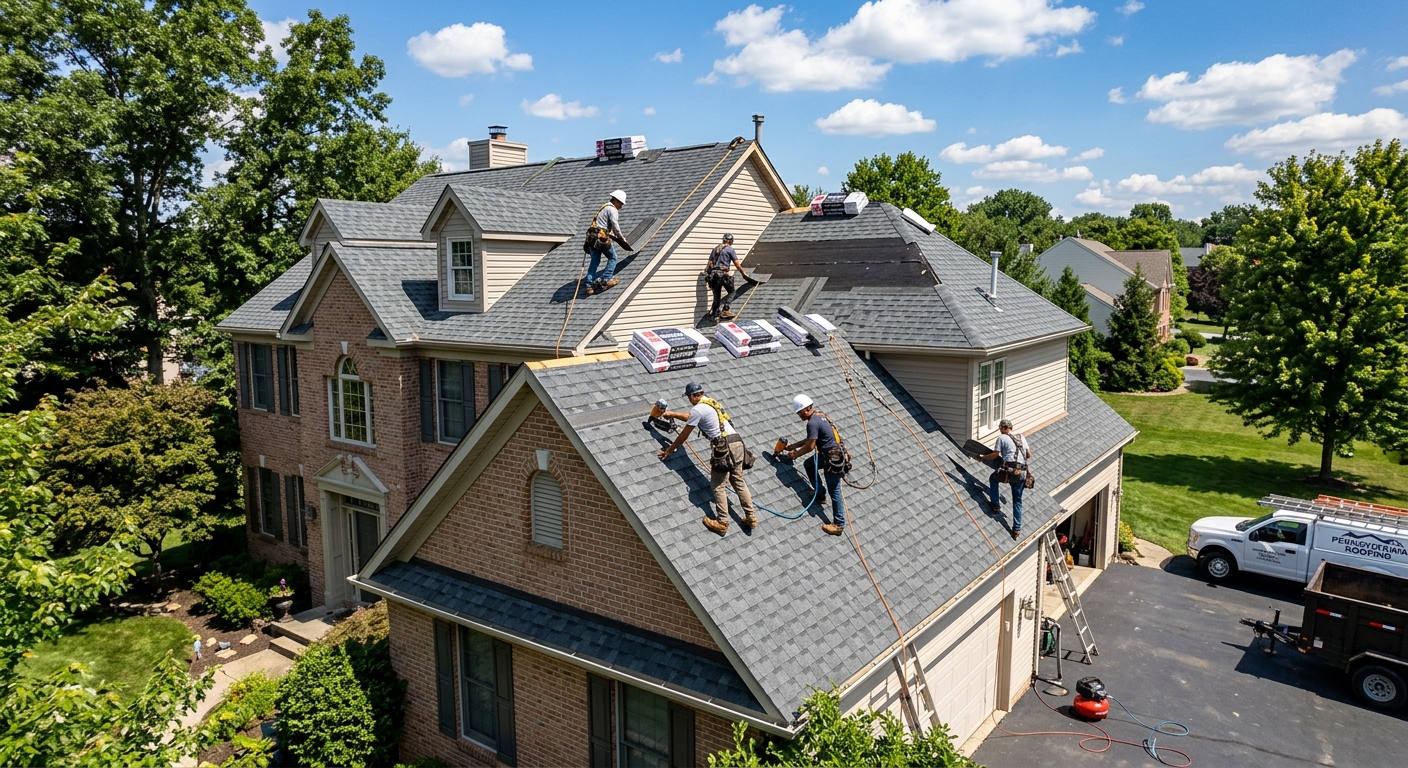
Chartiers roofing prices by material and scope — 2026
Chartiers stands out from neighboring communities due to its heavy concentration of single-family homes, with a homeownership rate over 92% and nearly 8,800 residents (U.S. Census Bureau, ACS 2024). Most houses aren’t just old—they predate 1980, creating steady demand for replacement roofing rather than only new builds or minor patching. The post-1960 building booms in Peters and North Strabane left Chartiers dotted with split-levels and ranches, which typically mean larger, low-pitch roofs with simple lines. For many local roofs, that translates to full tear-off jobs rather than layering, and larger overall roof areas—shifting most Chartiers jobs into the upper end of regional replacement costs.
Architectural asphalt shingles rule here because developers and suppliers anchored themselves along the I-79 corridor and in Washington city, making this material the default for replacement even as metal and flat roof options gain traction. Hail and wind exposure are bigger risks in Washington County than east of the rivers, so impact-resistant (Class 4) shingles and better underlayments see real demand—and you’ll see the price difference. For flat roofs over porches and small additions (very common throughout Chartiers), TPO and EPDM give the longest runs for the dollar, as shown below.
| Material / Scope |
Lifespan |
Best for |
Price range (installed) |
| Asphalt shingles — architectural (30-yr) |
25–30 yrs |
Most Chartiers single-family homes |
$10,000–$21,000 |
| Asphalt shingles — impact-resistant (Class 4) |
30+ yrs |
Homes in Ohio Valley hail/wind corridor |
$16,500–$21,000 |
| Metal standing seam |
40–70 yrs |
High-value homes and low-maintenance preference |
$24,500–$43,500 |
| Flat roof — TPO or EPDM |
15–25 yrs |
Porch roofs, low-slope additions, small outbuildings |
$12,500–$25,500 |
| Roof repair — leak or isolated section |
n/a |
Spot leaks or minor storm-related damage |
$550–$2,000 |
Prices are estimates for a typical Chartiers home and vary with roof size, pitch, decking condition and material selection.
What Chartiers's climate does to a roof
The western end of Washington County, including Chartiers, gets battered by the Ohio Valley’s storm belt—a stretch that delivers more hail and wind exposure than Greene or Fayette counties. That’s not just an insurance phrase: hail in this corridor often bruises architectural shingles and impact-resistant shingles alike. What’s critical is that, unlike a puncture, a hail bruise often leaves the shingle looking intact from the curb, but the mat beneath is crushed and granules come loose, speeding up UV decay. Even if you only notice shingle bruising after a storm, the cost can pile up fast, with repairs routinely hitting $550–$2,000 for an isolated patch and total replacement jumping to $10,000–$21,000 if multiple faces are impacted.
Chartiers is built for winters, but our local roof load requires a 30 psf ground snow load and sees a winter design temperature of just 8 °F. Repeated freeze-thaw cycles on a sloped asphalt roof push water up under shingle tabs at the eaves—especially where attic insulation is thin—leading to ice damming. When that water backs up under the shingle mat, it rots the decking and soaks insulation. If your eaves lack proper ice/water underlayment and drip edge, even a single ice dam can escalate a simple leak repair ($1,250 typical) into replacement work or substantial carpentry bills.
That same clay-heavy soil and the region’s hilly lots don’t help drainage. Heavy precipitation, combined with the shape of our roofs and yards, means water will find its way inside if not managed from the shingles, through the gutters, and away at the ground.
Water management on a Chartiers roof
In Chartiers, the roof alone can’t protect your house if the water coming off it isn’t moved well away from foundation walls. A full system means the shingles, gutters, downspouts, and even the grading at ground level must work together. If you replace a roof but leave leaky, undersized gutters in place, you may buy yourself a different kind of trouble—water pooling too close to the house slab, which in this clay-rich region leads straight to wet, musty basements and slab cracks.
Gutter guards help if you have trees near the house, but the most useful fix here is always to make sure every downspout moves water at least 5 feet from the foundation—especially on the walkout basements common to split-levels, or on older Chartiers homes where footing drains are shallow or missing. Many manufacturers won’t honor warranties if water isn’t managed away from roof edges and the system isn’t up to code. Tying new seamless aluminum gutters into your roof job adds about $2,200–$3,800 for a typical ranch or split.
Don’t cut corners here—insurers and code inspectors in Washington County have seen enough claims tied to poor drainage to take it seriously every time.
TPO and EPDM on Chartiers homes
Plenty of Chartiers homes feature a flat or low-slope roof over a back porch, family room, or a decades-old addition. These sections can’t handle the same roofing system used for the pitched main roof. On slopes below 3/12, asphalt shingles won’t shed water fast enough, so wind-driven rain or melting snow will sneak beneath the tabs and rot the deck. If someone’s quoting shingles for a 2/12 porch, they’re either not local or not someone you want up there.
Flat roofs here demand a welded thermoplastic (TPO) or fully adhered EPDM membrane. The big reason is drainage—Chartiers properties see rapid thawing and heavy downpours, so ponding water and blistering tear through cheap rolled roofing in a season or two. A proper membrane holds up 15–25 years if installed right, versus as little as 7 years for a poorly done rolled roof.
Full membrane replacement runs $12,500–$25,500 depending on size, edges, and penetration details, as most add-ons and original porches in Chartiers fall at 200–600 square feet. The outlay’s higher than some hope, but spreading small “patch and go” repairs year after year adds up quickly once a membrane starts failing.
Roofing permits in Chartiers: what you need before work starts
In Chartiers and throughout Washington County, all major roofing replacements that involve a tear-off almost always require a building permit, especially in the City of Washington. Some boroughs may waive permits for minor shingle patching on a single-family home, but if you’re pulling off old roofing material and replacing it, expect to need the paperwork before work begins. The code enforced is the Pennsylvania Uniform Construction Code (UCC), based on the IRC, and it is administered by either the local municipal building code office or, for municipalities that have opted out, by the PA Department of Labor & Industry.
Before signing any contract, you can verify a roofing contractor’s Home Improvement Contractor registration (HIC) with the Pennsylvania Office of Attorney General at hic.attorneygeneral.gov—required for jobs over $500. For insurance, all employers must carry workers’ compensation, which you can check through the WCAIS system at wcais.pa.gov.
If anyone offers to waive your insurance deductible or skips required contracts, that’s a violation of the Home Improvement Consumer Protection Act—not a favor to the homeowner. Stick to the registries and never rely on a business card alone. For projects involving pre-1978 homes, EPA Lead RRP certification must also be checked at certifiedrenovatorsearch.epa.gov.
Reading the warranty on a Chartiers roof
Most Chartiers homeowners see “lifetime warranty” in a roofing ad and assume they’re totally covered. But every roof has two different warranties: the manufacturer’s, which covers the actual shingles or membrane against material defects (often prorated as the roof ages), and the contractor’s, which backs their workmanship.
Material warranties are only as strong as the paperwork—they’re usually transferable to a new owner if you register within the manufacturer’s window, which varies from 30 to 90 days after installation. Contractor workmanship warranties in Chartiers can claim 5, 10, or even 25 years, but if the company itself folds or disappears, it won’t matter. Honestly, ten years from a crew that’s worked in Washington County for decades is worth more than a flashy 25-year promise from a business that started in 2022.
Common ways Chartiers roofs lose warranty protection include poor attic ventilation, layering new shingles over old (not allowed by code here), or failing to send in the manufacturer’s warranty registration. Any one of those will void your coverage when you try to claim.
When a Chartiers roof is worth repairing — and when it isn't
In Chartiers, it rarely pays to keep patching a 1960s or 1970s roof past the 20-year mark. Most homes here are old enough that repeated repairs mean you’re deferring, not avoiding, a full replacement—especially once multiple leaks show up or when an insurance claim for wind or hail damage arises. If you’ve already spent $1,500 for two leak repairs in consecutive years, one more call this winter could have you halfway to a new roof. On anything over 25 years old, repairs become band-aids at best.
The only time spot repairs make sense is when your Chartiers roof is relatively young—under 15 years, with a single leak due to an isolated event. If your home falls in the 15–25 year window and leaks are multiplying or spreading, replacement makes better financial sense. For low-slope roofs, signs like recurring ponding or alligatoring on the membrane generally call for full replacement, as patching over deteriorated rubber is temporary and water tracks under the seam.
| Situation |
Recommendation |
Typical cost |
Reasoning |
| Under 15 years, one isolated leak |
Repair |
$550–$2,000 |
Most material lifespan left; cost-effective if damage is limited |
| 15–25 years, several leak points |
Replace |
$10,000–$21,000 |
Patching multiplies costs; decking may be compromised |
| 25+ years, any active leak |
Replace now |
$10,000–$21,000 |
Beyond expected lifespan; structural risk increases |
| Storm damage, wind or hail |
Document, claim, replace |
$10,000–$21,000 |
Insurance usually covers if documented promptly |
| Flat roof ponding or blistering |
Replace membrane |
$12,500–$25,500 |
Repairs won’t last; system failure likely |
| Active leak entering winter |
Emergency repair, schedule replacement |
$550–$2,000 |
Prevent water damage to interior until weather allows full work |
Frequently asked questions — roofing in Chartiers
How do I verify a roofing contractor is registered in Pennsylvania?
In Pennsylvania, including here in Chartiers, any contractor doing roof work priced over $500 must have Home Improvement Contractor (HIC) registration through the Pennsylvania Office of Attorney General. You don’t need to take their word for it—do your own search at hic.attorneygeneral.gov before you sign anything. This registry gives you the contractor’s legal standing and past formal complaints. For workers’ compensation, which is required for any employer (even a small roofing crew), check their status at the WCAIS database online. If you have an older home built before 1978, and the roof work could disturb painted surfaces, EPA Lead RRP certification can be confirmed at certifiedrenovatorsearch.epa.gov. Homeowners should always ask for proof: with jobs from $550–$43,500, you want no open questions about legal compliance.
How much deposit should I pay a roofer upfront?
In Chartiers and everywhere in Pennsylvania, the Home Improvement Consumer Protection Act limits the deposit a contractor can collect to the lesser of $1,000 or 1/3 of the total contract price. So, for a typical architectural shingle replacement at $10,000–$21,000, no one should ask for more than $1,000 upon signing. Only pay by check or credit card after your contract is in hand—never cash, and never without a contract. If someone asks for a much larger upfront payment, that’s a red flag. Good roofers in Washington County can order material on a reasonable deposit, and contracts over $500 must always be in writing per state law.
Is metal roofing noisy in rain?
Modern standing seam metal roofs on Chartiers homes usually aren’t much louder than an asphalt shingle roof—if installed over solid decking with underlayment. Decades ago, when people nailed metal straight over open rafters, rain sounded like a tin drum, but current practice uses an insulated or wood-sheathing base that absorbs most impact noise. For a high-value roof in this area, standing seam installation typically costs $24,500–$43,500. Ask your contractor if attic insulation is adequate, since lightweight under-roof insulation also reduces both rain noise and heat loss, which is important in Washington County’s 8 °F design winters.
How much does a new roof cost in Chartiers?
For most Chartiers homes, especially the abundant split-levels and ranches, a full roof replacement with architectural asphalt shingles will run $10,000–$21,000—with $16,500 being typical. Metal standing seam is more, starting at $24,500 for average homes and up to $43,500 for larger footprints or complex roofs. Flat membrane roofs on additions or porches fall in the $12,500–$25,500 range. Remember, roof costs here reflect larger-than-average roof areas compared to inner Pittsburgh, the need for upgraded underlayment due to ice dam risk, and real hail exposure.
What is the best time of year to replace a roof in Chartiers?
Most contractors in Chartiers will suggest late spring through early fall, when daytime highs reliably reach the mid-60s or above—this lets shingles seal to the deck and adhesives cure well. Roofers won’t install asphalt shingle systems once cold weather stays below 45 °F, since improper adhesion can void warranties. With Washington County receiving freezing temperatures from November well into March, planning ahead helps you avoid emergency work at the highest prices ($550–$2,000 for urgent patching). Metal and flat membrane jobs are more forgiving, but no one wants to open up a roof in January.
Is a metal roof worth the extra cost in Chartiers?
In Chartiers, investing in standing seam metal makes real sense for homeowners planning to stay decades or who want virtually zero upkeep. The initial price—$24,500–$43,500—is a leap above shingles, but with a 40–70 year lifespan and hail resistance, you’ll probably never need to touch it again. For rental properties or places you expect to sell within 10 years, asphalt remains a safer investment. Most buyers here recognize the long-run value and it may boost resale, but you’re unlikely to recover every dollar at listing. For permanent homes or if you hate roof maintenance, metal is worth consideration in this county.
Does Chartiers get enough hail to justify Class 4 shingles?
Yes—Washington County sits directly in the Ohio Valley hail and wind corridor. More roofs here suffer real hail bruising each year than the rest of southwestern Pennsylvania, driving up insurance claims and out-of-pocket repairs ($550–$2,000 per patch). Upgrading to Class 4 (impact-resistant) architectural shingles costs more up front—typically toward the $16,500–$21,000 end for a replacement—but can prevent multiple repairs after a single bad storm. Many insurers in this region may also offer discounts for certified impact-rated roofs.
Will filing a roof claim raise my premium?
In Pennsylvania, including Chartiers, your first roof claim for wind or hail usually won't spike your premium if it's weather-related—insurers expect them here due to our frequent storms. But multiple claims in consecutive years (especially for "wear and tear" or poorly documented loss) may flag your policy for higher rates or even non-renewal. That’s why it pays to document all storm damage and maintenance—and only claim when you’re genuinely at or near the replacement threshold ($10,000–$21,000 for shingle systems). Disciplined use of your policy keeps your long-term costs down.
Can I inspect my own roof safely?
You can assess your Chartiers roof safely from the ground or with binoculars—looking for missing shingles, damaged flashing, or clogged gutters. Getting on the roof is risky, especially given our frequent wet springs and the steep pitches on many split-levels and ranches here. Ladders on clay-heavy soil can slip, especially after freeze-thaw cycles. If you must go up, never do it alone and avoid any work near the eaves or over porches; many professional inspections cost less than a small repair ($550), which is a small price for peace of mind. Let pros handle close-up checks, especially when storm damage is possible.