Pequea roofing prices by material and scope — 2026
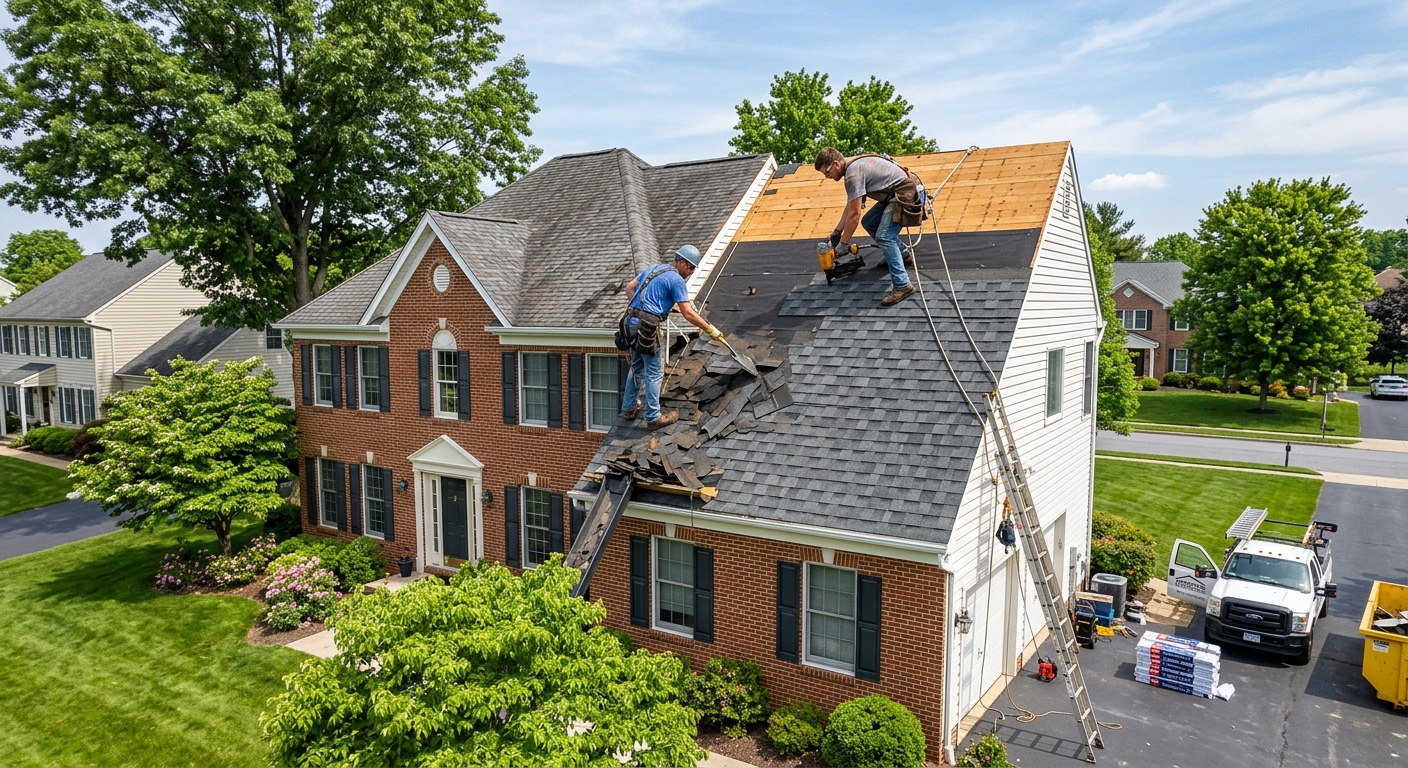
Pequea’s roofing costs aren’t quite like neighboring towns, thanks to a large share of single-family homes, most of which are owner-occupied and have roofs approaching or beyond middle age. With 37.9% of homes built before 1980 (U.S. Census Bureau, ACS 2024), many roofs here already have multiple layers of shingles and steeper than average pitches. Old decking, steep slopes, and two or more shingle layers turn a “basic” re-roof into a major, labor-intensive job—Amish and Mennonite crews, common in Lancaster County, have built their businesses around this tough, competitive market.
Most Pequea homeowners opt for asphalt architectural shingles, but metal roofing and modern membrane solutions for flat sections aren’t rare, especially on additions or barns. Costs climb when old materials need full tear-off or decking is water-damaged (common with substandard past repairs). Flashing, venting, and ridge details can run higher on the steep, complex roofs of Lancaster County’s typically pre-1950 housing stock. Here’s what to expect when pricing a roof in Pequea for 2026:
| Material / Scope |
Lifespan |
Best for |
Price range (installed) |
| Asphalt shingles — architectural (30-yr) |
25–30 yrs |
Owner-occupied homes, steep pitches, budget-conscious |
$10,500–$21,500 |
| Asphalt shingles — impact-resistant (Class 4) |
30+ yrs |
Storm-exposed locations, higher insurance savings |
$17,000–$21,500 |
| Metal standing seam |
40–70 yrs |
Historic homes, low maintenance, farmhouses |
$25,000–$44,500 |
| Flat roof — TPO or EPDM |
15–25 yrs |
Porches, rear additions, garages |
$13,000–$26,000 |
| Roof repair — leak or isolated section |
n/a |
Spot leaks, emergency fixes, field-replaceable sections |
$550–$2,100 |
Prices are estimates for a typical Pequea home and vary with roof size, pitch, decking condition and material selection.
Checking out a roofer in Pequea: what to verify
Hiring a roofer in Pequea means protecting yourself with facts, not just a handshake. For any job over $500, a Home Improvement Contractor (HIC) registration is required—check it yourself at hic.attorneygeneral.gov. Pennsylvania mandates a written contract over $500 (see the Home Improvement Consumer Protection Act). For workers’ comp insurance, use the WCAIS system (wcais.pa.gov) to confirm current coverage. For pre-1978 homes, check that the crew is certified for the federal EPA Lead RRP Rule, since Lancaster County has many older roofs with possible lead paint exposure.
On any bid in Pequea, verify:
- HIC registration (hic.attorneygeneral.gov) is active
- Written contract, as required by HICPA (over $500)
- 3-day right to cancel in the contract terms
- Current workers’ comp verified at wcais.pa.gov
- Physical business address (not just a PO box or out-of-area phone number)
- References—recent, local, and checkable in Lancaster County
- Manufacturer certifications for the shingles or membranes proposed
- Lead RRP certification for pre-1978 homes (certifiedrenovatorsearch.epa.gov)
- Detailed written scope of work—shows layers, flashing, venting, clean-up
- Proof of general liability insurance (ask for the certificate)
- No offer to “waive your insurance deductible” (prohibited in PA)
- Warranty terms in writing
Watch for these red flags in Pequea: “storm-chaser” crews going door to door after a thunderstorm, contractors who won’t provide written estimates, out-of-area phone numbers with no office you can visit, or pressure to sign a same-day contract. In a roofing market as busy as Lancaster, scams are often quick-moving and vanish just as fast—don’t be rushed.
When to book roofing work in Pequea
Roofers in Pequea work most efficiently from late March through early November. The prime months for full roof replacement are May through September, when temperatures allow shingles to seal and crews have full daylight. Once late fall arrives, pronounced freeze-thaw cycles typical of south-central Pennsylvania start to interfere with proper installation, especially of asphalt shingles, and can lengthen the job or degrade results if rushed. During the peak of summer, Amish and Mennonite crews in Lancaster County are often booked out weeks—sometimes even into next season, especially if there’s been a Susquehanna River valley thunderstorm.
Emergency work in February, when high winds and freeze-thaw patterns create leaks, carries a premium: crews have to mobilize in tough conditions, materials can be limited, and costs (even for a repair at $550–$2,100) do spike. Planning a full replacement well in advance for early autumn (September or October) typically gets you the most competitive labor rates and avoids the spring rush. With Pequea so close to Lancaster city and part of a saturated roofer market, you won’t wait months for an estimate, but the reputable contractors will fill up by midseason. Try to book your roof weeks—not just days—ahead, and avoid last-minute urgency wherever possible for better prices and results.
When a Pequea roof is worth repairing — and when it isn't
In Pequea, repair is only worthwhile for newer roofs with isolated issues. If your asphalt shingle roof is under 15 years old and there’s a single leak, paying $550–$2,100 for a targeted repair makes sense—especially if your house isn’t seeing widespread curling or loss of granules. Once your roof hits 15–25 years, particularly with multiple leak points or visible sagging, it is almost always time to replace. Lancaster County’s tendency for steep-pitch roofs with multiple shingle layers adds complexity and cost to each repair, diluting the value of patchwork fixes. If you spend even just $1,300 twice in five years on repairs to a 20-year-old roof, you’re at $2,600, with more patches likely. That’s money better put toward a full replacement at $10,500–$21,500 that gives decades of peace.
If your roof is over 25 years old, active leaks almost always signal major issues (deck rot, underlayment failure, flashing life exceeded). And for any storm-related damage—especially from those fast-moving thunderstorm wind bursts Pequea sees—claiming replacement through your insurer is usually the best route. Here’s how to think through the scenarios:
| Situation |
Recommendation |
Typical cost |
Reasoning |
| Under 15 years, one isolated leak |
Repair |
$550–$2,100 |
Roof is young; localized fix extends life at lowest cost |
| 15–25 years, several leak points |
Replace |
$10,500–$21,500 |
Multiple leaks signal system-wide wear; patching isn’t cost-effective |
| 25+ years, any active leak |
Replace now |
$10,500–$21,500 |
Material, underlayment, and flashings all likely due; repairs won't last |
| Storm damage, wind or hail |
Document, claim, replace |
$10,500–$21,500 |
Insurance may cover full replacement; isolated fixes rarely work |
| Flat roof ponding or blistering |
Replace membrane |
$13,000–$26,000 |
Water infiltration risk is high; new membrane restores full function |
| Active leak entering winter |
Emergency repair, schedule replacement |
$550–$2,100 |
Temporarily stop water intrusion, then plan full replacement for spring |
Reading the warranty on a Pequea roof
Roof warranties in Pequea come in two flavors—manufacturer and workmanship—and it pays to know the difference. Manufacturer warranties on shingles and membrane products cover material defects, not labor or installation errors. Most are prorated: if a defect shows up after 15 years, you’ll only get a percentage of the cost to offset a replacement. These warranties almost always require the installer to register the product within a set time after installation, and coverage may not transfer automatically if you sell the home—sometimes there's a short window to transfer for free, but often there are conditions.
The second warranty is workmanship, issued by the company that did your installation. This only protects you as long as that company is still operating, so a promised “25-year labor warranty” from a brand-new outfit is riskier than a 10-year guarantee from a well-established Lancaster County roofer who’s made it through local market cycles. Most workmanship coverage is tied to proper installation, so coverage can be voided by poor attic ventilation, installing over old shingles, or failing to follow code. Always keep a copy of the signed warranty and any product registrations for your records, and clarify upfront if you (or a buyer) will need to pay to transfer coverage after a sale.
What insurance covers on a Pequea roof
If you have roof damage in Pequea after a wind burst or severe summer storm, start a claim by documenting everything—take clear photos of damage before any cleanup, especially since Lancaster County roofs (often steep and multi-layered) show damage that’s otherwise tough to see. Once you file your claim, your insurer will send an adjuster to inspect, and provide a written scope of loss detailing what will be paid. Most policies pay out on an "actual cash value" (ACV) basis first—what your old roof is worth today, after depreciation—and then release the remaining "replacement cost value" (RCV) once the job is finished and invoiced.
Pennsylvania’s Home Improvement Consumer Protection Act requires a written contract for any roof work over $500, protecting you from fly-by-night contractors. The law strictly prohibits any contractor from offering to “waive your deductible” or “eat” the deductible amount—if someone suggests it, that’s a sign to walk away, as it violates both state law and insurer trust. After your claim, your chosen contractor should work only from the insurer’s written scope—not an inflated or vague estimate. Keep all documentation, especially for older or historic homes, since insurance will rarely pay for upgrades (like replacing three layers of shingles down to deck) unless documented as a necessity by your roofer and adjuster together. Expect to cover your deductible, which is just part of your policy’s cost-sharing.
Pennsylvania code and Lancaster County permit rules for roofing
Pennsylvania uses the Uniform Construction Code (UCC), based on the IRC, for residential roofing. In Lancaster city, a building permit is needed for any roof replacement that involves new sheathing or any structural work—so if boards or decking are getting replaced along with shingles, you’ll need a permit. In surrounding Lancaster County townships, small leak repairs or swapping out a few shingles usually don’t require permits, but each township handles enforcement individually.
Code authority is split: Lancaster city enforces the rules through its Bureau of Code Compliance, while each area township has its own code enforcement office. If your project is in a township with no local code office, the PA Department of Labor & Industry acts as the backstop authority. For any contract over $500, Pennsylvania requires Home Improvement Contractor (HIC) registration, which you can verify at hic.attorneygeneral.gov. Workers' compensation coverage is mandatory for any hired crew—always verify current status at wcais.pa.gov, not just by accepting a piece of paper. The written contract is also required by law (HICPA), along with your three-day right of cancellation. Insurance and registrations matter more here than any “license”—roofers in Pennsylvania register, but there’s no state-level roofing license, so thorough homeowner verification is key.
Frequently asked questions — roofing in Pequea
Can I inspect my own roof safely?
If you’re in Pequea, you might think that grabbing a ladder to check your roof is straightforward, but Lancaster County roofs tend to be steeper than average due to the heavy pre-1950 housing stock. Steep slopes, multiple layers, and older decking make even a simple walk dangerous. Most roofer falls I’ve seen here are from homeowners trying to check a leak themselves. Instead, you can use binoculars or a drone to spot missing shingles or flashing issues from the ground. Hiring a professional for a full inspection, often in the $550–$2,100 range, is a sound investment when you factor in medical risk and the potential to spot problems early. If you still want to take a look yourself, always use a sturdy extension ladder, place it on level ground, and never attempt to climb on wet or icy surfaces. For most people in Pequea, skip the DIY and protect your health.
Does attic ventilation matter in Pequea's climate?
Attic ventilation is a real concern in south-central Pennsylvania, including Pequea, because our pronounced freeze-thaw cycles and high humidity can accelerate roof aging if ventilation is poor. Without proper airflow, you’ll see premature curling, ice damming, and even mold on your rafters, especially in older homes that make up nearly 38% of Pequea’s housing stock. Both shingle and workmanship warranties often require adequate ventilation as a condition for coverage—if it’s missing, your roof could fail years early and repairs (easily $550–$2,100) won’t be covered. Make sure your contractor calculates venting to code when replacing a roof, not just reuses old holes. Good ventilation means longer roof life and lower risk of warranty disputes down the road.
What if my insurer denies my roof claim?
If your Pequea roof claim is denied, dig into the details—sometimes it’s because the insurer believes damage is due to age or poor maintenance, not a covered storm event. For older Pequea homes, many with multiple shingle layers, insurers may claim there’s “wear and tear” instead of damage. If you believe it’s wrongful, gather your roof photos, inspection report, and any contractor assessments, then ask for a written denial with details. In Pennsylvania, you’re also entitled to a copy of the insurer's adjuster report. Consider a second contractor’s inspection (usually in the $550–$2,100 range) or, if the stakes are high, a public adjuster familiar with Lancaster County construction. Do everything in writing, and don’t rush to repair until you’ve finished your appeal.
What does roof replacement cost per square in Pequea?
Roofers in Pequea commonly quote jobs by the “square” (100 square feet of roofing), but what that price includes varies. For a typical full-tear-off and reshingling with architectural shingles, expect $430–$650 per square in 2026. Steep pitches and multiple old layers (common here) push it to the high end, especially for pre-1950 homes. That compares to total roof replacements ranging from $10,500–$21,500 for an average-sized home. If a phone quote sounds far lower, it likely omits tear-off, underlayment, or disposal—insist on a clear, written scope by square so you know exactly what’s included.
Why is my Pequea roofing quote higher than the online average?
Online roofing price calculators rarely account for the realities of Pequea’s housing stock—namely, older, steeper roofs with multiple layers of worn-out shingles and historic details. Because 37.9% of Pequea homes were built before 1980, most jobs here aren’t a simple layover; they need full tear-off, repairs to old decking, and extra labor for tall, awkward rooflines. That’s why a true quote for asphalt replacement can easily run $10,500–$21,500, well above the “national average” you see online. Companies using local, skilled labor also have to compete with the highly efficient Amish and Mennonite crews in Lancaster County—leaving little margin for cutting corners. Local physical address, references, and insurance all cost more but protect you in the long run.
How many quotes should I get for a roof in Pequea?
For a major investment like a new roof in Pequea, three detailed written quotes is the right target. One quote isn’t enough to understand the market, and five or more gets overwhelming for most people. Make sure each quote covers the same scope—number of layers removed, deck repair, flashings, underlayment, attic venting, and the exact shingle type (standard vs. impact-resistant). In Lancaster County, a saturated roofer market means vendors range from national franchises to small Amish crews, so prices will vary from $10,500–$21,500 just for architectural shingles. Don’t simply choose the lowest: look for clear specs, reputable references, and contract details that match Pennsylvania requirements.
What happens if it rains mid-replacement?
Pequea’s weather can turn quickly, especially when summer thunderstorms roll down the Susquehanna River valley. If rain hits in the middle of a roof replacement, any reputable Lancaster County crew will have tarps and a plan ready—emergency covering is part of a responsible roofer’s kit, not an extra. While the job may pause for a day or two to let the roof dry out, this might add little or no extra cost beyond the original replacement range of $10,500–$21,500 (unless the home is left exposed and suffers interior damage, which is rare with diligent crews). Discuss the crew’s rain plan before work starts: it’s a good sign if they answer confidently and describe how they handle sudden storms, not just ideal weather.
What is the best roofing material for Pequea's climate?
For most homes in Pequea, architectural asphalt shingles are the standard for good reason: they’re affordable within the $10,500–$21,500 band, hold up well through our freeze-thaw cycles, and handle the moderate snow that Lancaster County sees each winter. For larger or historic homes, metal standing seam is gaining popularity, especially where owners want a 40–70 year lifespan without frequent maintenance ($25,000–$44,500). Flat roof sections do best with TPO or EPDM membranes, given the local risk of ponding after storms. Whatever you choose, insist on proper ventilation and skilled local installation—materials matter, but how they’re put on matters more in our climate.
Is ice barrier underlayment required in Pequea?
Pennsylvania UCC, enforced locally in Lancaster County, does require ice barrier underlayment (ice and water shield) along the eaves for most shingle roof replacements. In Pequea, this matters: with our winter design temperature at 12 °F and regular freeze-thaw cycles, ice dams do form along unprotected roof edges—especially in older, poorly insulated homes. Most reputable contractors will include one to two rows of ice and water shield by default in any quote within the $10,500–$21,500 range for an asphalt re-roof. If you’re getting a quote that doesn’t specify both underlayment and ice shield, insist on seeing exactly where it will be installed on your home’s plans before work begins.