Downingtown roofing prices by material and scope — 2026
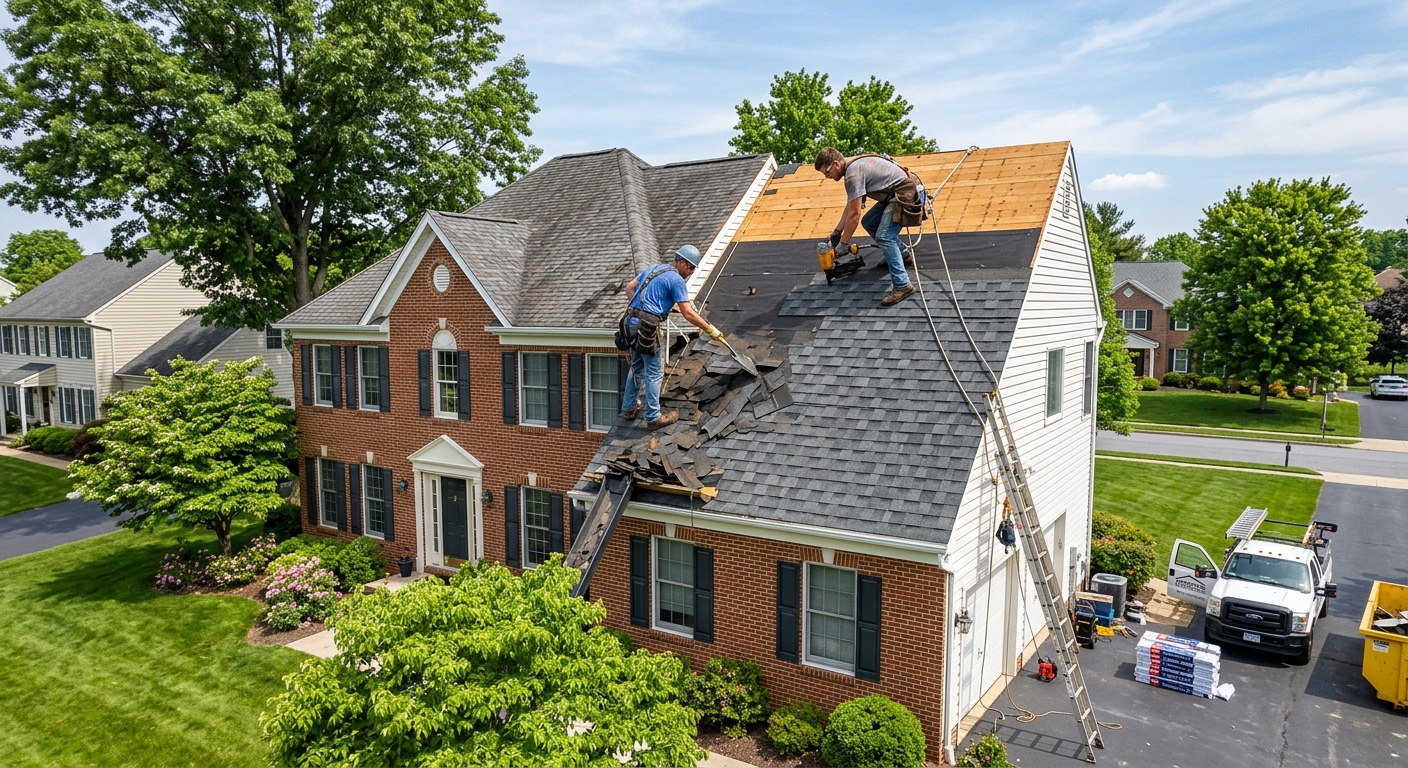
In Downingtown, tight housing supply and a median household income of $74,323 (U.S. Census Bureau, ACS 2024) shape the local roofing market. While only 19.9% of homes here are single-family dwellings, the prevalence of homes built before 1980 means many asphalt shingle roofs are at or beyond their expected service life. Large 1970s–1990s subdivisions in West Goshen and Uwchlan mean much of Downingtown’s housing stock mimics these neighborhoods: original roofs are now failing and full replacements – not just repairs – are typically needed when things go wrong.
That heavy concentration of older architectural asphalt shingles shapes the volume and cost of replacements. You’ll rarely see full tear-offs avoided, and decking repairs are routine, not exceptional. Neighboring townships’ HOA standards keep material choices conservative: architectural shingles and, for larger homes, the occasional metal standing seam. Flat roofs show up on porches and low-slope additions, but not on original colonial stock.
| Material / Scope |
Lifespan |
Best for |
Price range (installed) |
| Asphalt shingles — architectural (30-yr) |
25–30 yrs |
Suburban single-family, HOA-compliant |
$10,500–$22,000 |
| Asphalt shingles — impact-resistant (Class 4) |
30+ yrs |
Wind/hail-prone areas, premium builds |
$17,000–$22,000 |
| Metal standing seam |
40–70 yrs |
High-value, long-term homes |
$25,500–$45,000 |
| Flat roof — TPO or EPDM |
15–25 yrs |
Low-slope additions, porch roofs |
$13,000–$26,500 |
| Roof repair — leak or isolated section |
n/a |
Localized flashing, vent leaks |
$550–$2,100 |
Prices are estimates for a typical Downingtown home and vary with roof size, pitch, decking condition and material selection.
Pennsylvania code and Chester County permit rules for roofing
Roofing in Downingtown follows the Pennsylvania Uniform Construction Code (UCC), based on the IRC, as enforced by either your local municipality or the PA Department of Labor & Industry if the township has opted out. In the West Chester Borough—which sets the precedent for Chester County municipalities—a building permit is required for full roof replacements when structural deck repairs are involved. Like-for-like asphalt shingle repairs under one roofing square can usually be made in Downingtown without a permit. If your contractor says a permit isn’t needed for a full tear-off with decking replacement, that should be a red flag.
Before signing a roofing contract over $500, Pennsylvania law requires your contractor to hold a valid Home Improvement Contractor (HIC) registration from the Office of Attorney General. You can verify this registration directly at hic.attorneygeneral.gov. Just ask your roofer for their HIC number and check it online; you’ll see if it’s active and any enforcement actions. Always obtain written proof of workers’ compensation insurance (required for all employers, even small contractors) and verify it yourself through WCAIS at wcais.pa.gov. Both the HIC registration and workers’ comp coverage are more than paperwork—they’re your legal protection under the Home Improvement Consumer Protection Act.
Repair or replace? A decision guide for Downingtown roofs
In Downingtown, most decisions between roof repair and replacement hinge on the age of your roof and the pattern of leaks. When your roof is under 15 years old and the problem is a single, isolated leak, a professional repair ($550–$2,100) is justified. But with Downingtown’s housing skewed to pre-1980 builds, repeated repairs are usually a losing proposition. If your 25-year-old roof needs a third round of repairs, you’re likely to hit $3,900–$6,300 within three years—exceeding the cost of just replacing it, which falls between $10,500–$22,000 for architectural shingles. Once a roof leaks in multiple spots, or if you’re dealing with storm or hail damage, replacement is usually smarter. Seasonal urgency matters, too: entering a Chester County winter with an active leak usually means a temporary emergency repair now and a scheduled full replacement as soon as weather allows. Flat roofs with chronic ponding or blistering rarely benefit from patches; full membrane replacement is usually advised.
| Situation |
Recommendation |
Typical cost |
Reasoning |
| Under 15 years, one isolated leak |
Repair |
$550–$2,100 |
Roof system still sound; leak usually flashing, vent or nail pop. |
| 15–25 years, several leak points |
Replace |
$10,500–$22,000 |
Multiple leaks signal systemic aging; patching will spiral costs. |
| 25+ years, any active leak |
Replace now |
$10,500–$22,000 |
Roof is past lifespan. Water entry will worsen rapidly. |
| Storm damage, wind or hail |
Document, claim, replace |
$10,500–$22,000 |
Single-event, insurance-eligible; matching repairs rarely allowed by insurers. |
| Flat roof ponding or blistering |
Replace membrane |
$13,000–$26,500 |
Systemic failure; patches won’t last. |
| Active leak entering winter |
Emergency repair, schedule replacement |
$550–$2,100 |
Buy time, prevent structural/insulation damage. |
Choosing a roofing material for Downingtown's climate
Downingtown’s roofs deal with a ground snow load of 30 psf and winter design lows of 14 °F. Here, architectural asphalt shingles dominate. Why? They strike the best balance for the suburban homes that make up most of Chester County: affordable ($10,500–$22,000 installed), reliable life (25–30 years), and required by many local HOAs. Metal standing seam roofing does outperform in snow-shedding and lifespan (40–70 years), but at $25,500–$45,000, only makes sense for owners planning to stay for decades or for homes with heavy snow-slide hazards. Flat roofs—porch and low-slope sections—get TPO or EPDM membranes; these are unmatched for keeping water out on pitches too low for shingles.
The reason architectural shingles, not metal, dominate Downingtown is twofold: local development from the 1980s onward standardized these materials, and HOAs often won’t approve the reflective finishes or bold seams of metal. Class 4 impact-resistant shingles offer better storm performance but rarely pay for themselves, given our hail risk stays moderate. Unless you get hit with repeated storm events, most homeowners here see best total ownership value from a standard architectural shingle roof, properly installed.
| Material |
Installed cost |
Lifespan |
Cold-climate performance |
Maintenance |
| Asphalt architectural |
$10,500–$22,000 |
25–30 yrs |
Good for 30 psf snow; may ice-dam at eaves |
Gutter and vent checks; minor repairs |
| Asphalt Class 4 impact-resistant |
$17,000–$22,000 |
30+ yrs |
Improved hail/wind; sheds snow like standard shingle |
Same as architectural |
| Metal standing seam |
$25,500–$45,000 |
40–70 yrs |
Sheds snow instantly; no shingle ice-damming |
Annual fastener/seam inspection |
| TPO / EPDM membrane |
$13,000–$26,500 |
15–25 yrs |
Flat/low-slope only; good freeze-thaw resilience |
Inspect seams, resurface as needed |
What Downingtown's climate does to a roof
Roofing in Downingtown means dealing with more than just rainfall. Our exposure to ridge-line wind along the South Valley Hills and Chester Valley causes shingle tab lift and can break sealant bonds, leading to immediate water entry and repairs as high as $2,100 for just a few missing shingles. Snow loads here are not as severe as northern Pennsylvania, but 30 psf is enough to stress older decking. When snow melts slow in March and nights refreeze, meltwater backs up behind a block of ice at the gutter line—this is ice damming. As water creeps under shingles, it finds nail holes and small cracks, causing leaks that may require $1,300 roof repairs or—if decking is rotted from years of freeze-thaw—outright replacement. Hail is less common but does happen; “bruising” breaks asphalt’s surface without visible holes. Those soft spots quickly become leaks come summer storms or winter freeze, and most insurance adjusters recommend full roof replacement ($10,500–$22,000).
Flat roofs in Downingtown are especially vulnerable to ponding after heavy storms. The membrane’s seams, once breached by repeated freeze-thaw cycles, can start blistering and separate from the substrate—a failure that almost never returns to watertight with patching. Full membrane replacement falls between $13,000–$26,500, and usually can’t be put off without risking mold or interior rot.
Roofing season and lead times in Chester County
Here in Chester County, most roof replacements and large repairs are tackled from late March through early November. Shingles require ambient temperatures above 40 °F to seal properly—meaning the prime months for reliable installs are April through October. July, August, and early September are the busiest: local contractors book out 3–6 weeks in advance, not because there’s a shortage of roofers, but because the Philadelphia metro market is saturated and crews stay busy with contract volume. In contrast, winter roofing (December–February) faces two obstacles: sealing new shingles is unreliable under 40 degrees, and emergency work is riskier and pricier. If your roof leaks in February, you’ll face higher per-square repair rates, as crews work around snow and shorter daylight.
If you want to lock in a preferred crew and avoid a premium for “squeeze-in” scheduling, booking early in the season or after Labor Day gives the best combination of open schedules and comfortable weather. It’s rare to wait longer than 6–8 weeks for a full replacement outside of backlogged summer months, thanks to the density of roofing contractors based in and around West Chester.
Storm damage and insurance claims in Downingtown
When a storm rolls through Downingtown and you spot missing shingles, dented gutters, or obvious leaks, start with documentation. Take photos and videos before any clean-up or repairs. Next, file a claim with your insurer; they’ll assign an adjuster who will inspect and issue an initial “scope of loss”—a report defining what work will be paid and whether it’s at actual cash value (what your damaged roof is worth now) or replacement cost (the full cost to restore). In Chester County, where ridge-line wind events are frequent, adjusters are used to seeing systemic damage and rarely approve just a patch job.
Pennsylvania’s Home Improvement Consumer Protection Act (HICPA) requires contractors to provide a written contract for work over $500, along with a three-business-day cancellation window. Most importantly: legally, waiving a homeowner’s insurance deductible is prohibited. Any roofer offering to “cover your deductible” is risking both your insurance payout and their own registration. If you see this in Downingtown, walk away. After you receive the insurer’s scope, get your contractor’s written quote and ensure it matches the adjuster’s line items; if not, clarify before work starts. Once complete, your contractor will submit a completion certificate and you’ll get the balance of any withheld (recoverable) depreciation, provided you used a registered HIC contractor.
Frequently asked questions — roofing in Downingtown
Why is my Downingtown roofing quote higher than the online average?
In Downingtown, quotes often skew above “national averages” found online. There are a few reasons: first, local homes have a high percentage of older, complex roofs with multiple valleys, dormers, and add-on structures. Most online averages price out basic straight ranch roofs, not the mix of colonial-era and 1980s–90s builds found here. The cost of living is also higher in Chester County than many sample markets, and the volume of roofers competing for jobs means reputable outfits don’t low-bid with bare-bones crews. A typical architectural shingle replacement here lands in the $10,500–$22,000 band—which matches what you’ll see from long-established, insured contractors who pull permits and follow Pennsylvania law. Cheaper quotes almost always leave out something essential, like ice and water shield or proper attic venting.
What does roof replacement cost per square in Downingtown?
In Downingtown, the “per square” (100 square feet) price for architectural asphalt shingles typically ranges from $525 to $850 installed. On a typical 2,200 square foot roof, you’re looking at a total between $10,500–$22,000. Factors driving the price include age and condition of the wood decking, the roof’s pitch (steep roofs need more labor and safety set-up), number of penetrations (pipes, skylights, etc.), and disposal fees. Complex roofs with extra cut-up sections, more valleys, or multiple stories trend toward the higher end. Unlike some of the online formulas you’ll see, Downingtown jobs regularly involve decking repairs—the vast majority of our roofs are past the 30-year mark—so square footage alone rarely tells the whole story. Always insist on a detailed, written quote that calls out these line items.
Are impact-resistant shingles worth it in Downingtown?
Impact-resistant (Class 4) shingles promise better resilience against wind-blown debris and hail strikes. In Downingtown, where ridge-line wind events and the occasional hailstorm do occur, these shingles can reduce the frequency of major storm-related repairs. However, the upfront cost is higher: most roofs with Class 4 impacts run $17,000–$22,000. Insurance discounts for these shingles are not universal, so they’re worth it mainly if your home sits in an exposed location or if you’re looking to future-proof a high-value property. For most tract homes built since the 1980s, a well-installed architectural shingle is usually the smarter investment unless your HOA approves—and you specifically want—to pay for the higher-grade material.
What are the signs of hail damage on a roof?
In Downingtown, hail damage to asphalt roofs may not puncture shingles, but it leaves “bruising”—soft, dark spots where granules are knocked away, and the underlayment is exposed. Over months, these weakened spots turn into leaks once water and winter freeze-thaw cycles intrude. You might also see dented metal components (gutters, vents), but the most costly issue is hidden: small impact sites that only show with close-up inspection or after the next major storm. Insurance companies typically approve full roof replacement (in the $10,500–$22,000 band) if a representative area shows enough impact hits—even without immediate visible holes.
What happens if it rains mid-replacement?
If a sudden storm hits during your roof replacement in Downingtown, any crew worth hiring will immediately install emergency tarping over exposed decking and underlayment. Pennsylvania’s frequent pop-up storms mean seasoned crews are always ready to “dry-in” a roof quickly using synthetic underlayment that is water-shedding. This protective step is built into your replacement cost—no reputable company should ask for an extra charge during routine weather. If water does get in, minor ceiling repairs may be needed, but the primary aim is to avoid costly delays or interior damage. Emergency tarping or repair may run $550–$2,100, but most full replacements already plan for weather contingencies.
How do I file a storm damage roof claim in Pennsylvania?
Step one: document all visible damage—missing shingles, dented gutters, water stains—before any clean-up. Then contact your insurance carrier to start a claim. An adjuster will typically schedule a visit and provide a written “scope of loss.” In Pennsylvania, every roofing contract over $500 must be in writing, with a three-day right to cancel. Choose a contractor who is registered under the Home Improvement Contractor system and don’t sign blank paperwork. Your contractor should work directly from the adjuster’s scope. Remember, no contractor is legally allowed to “waive your deductible.” Insurance claims for full roof replacement are generally paid within $10,500–$22,000 for asphalt shingle jobs.
How do I find a reputable roofer in Downingtown?
Start by verifying the roofer’s Home Improvement Contractor (HIC) registration at hic.attorneygeneral.gov. Ask for proof of current workers’ compensation insurance and check it yourself at wcais.pa.gov. Avoid anyone who pressures you with time-limited offers or who claims a full tear-off is “permit-free.” In Downingtown, the price for quality work—using the right materials and obtaining needed permits—should likely fall in the $10,500–$22,000 range for architectural shingles. Local reputation, recent client references, and a clear written contract are your best signals. Out-of-area crews who lack documentation or push deductible waivers should be skipped.
Does attic ventilation matter in Downingtown's climate?
Yes, attic ventilation plays a major role in Downingtown’s roofing longevity. Poor ventilation traps winter moisture, which causes decking rot and accelerates shingle decay, especially where snow builds along cold eaves. In summer, trapped heat bakes roof materials and can void shingle warranties. When your replacement estimate—often between $10,500–$22,000—is prepared, ensure it includes calculated vent area upgrades. Overlooked ventilation is a prime reason for premature roof failure in Chester County’s climate, especially in homes with older, less energy-efficient construction.
Do I need a permit to replace a roof in Downingtown?
In Downingtown-area townships, a permit is usually required when you’re tearing off and replacing your full roof—especially with any decking repairs. For small repairs (like-for-like shingle fixes under one roofing square), a permit isn’t usually needed. This policy matches the precedent set in nearby West Chester Borough. Always ask your contractor to clarify which authority issues the permit—most likely your local code office, but sometimes the PA Department of Labor & Industry in “opt-out” townships. Permit fees and inspections are covered by your upfront labor price band—typically $10,500–$22,000 for full architectural shingle replacement. Proper permitting protects both your warranty and your home’s resale value.