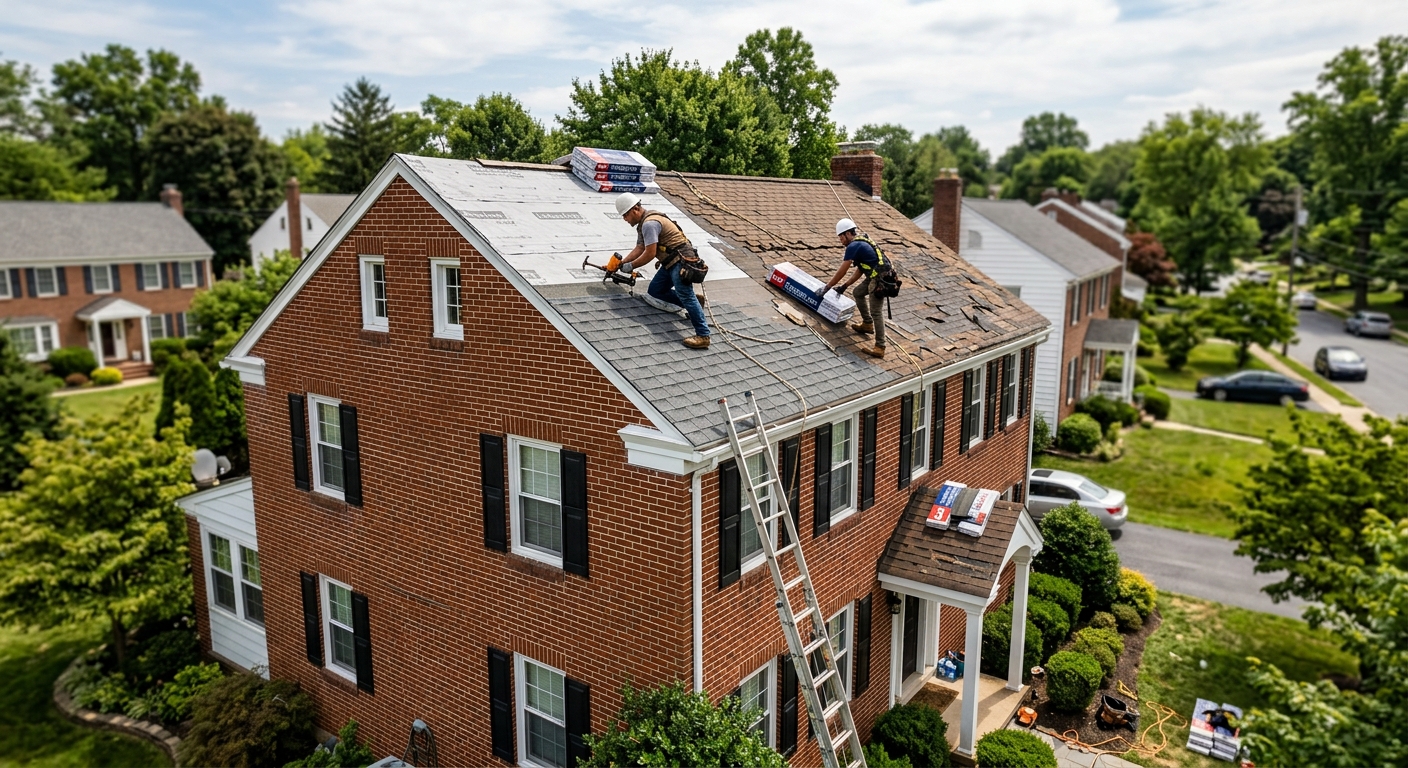
Richland roofing prices by material and scope — 2026
In Richland, strong homeownership rates (86.8%) and a high proportion of single-family homes (51.2%) shape the roofing market. Many properties in Richland share similarities with nearby Levittown, where a surge of 1950s tract housing set the tone for postwar development in Bucks County. These homes commonly have their original or second-generation asphalt shingle roofs—now well into or past their service lives—which creates steady demand for full roof replacements rather than spot repairs. If your house was built before 1980—and 30.0% here were—you’re likely facing key decisions around material lifespan, replacement timing, and cost containment. Bucks County’s suburban layout also means access to a saturated contractor market, which can keep pricing competitive but also calls for careful vetting of any installer.
If your roof hasn’t been replaced in at least two decades, budget for a full tear-off—especially with the region’s freeze-thaw cycles and summer humidity. Meanwhile, homes with flat or low-slope roofs may need membrane solutions, which run differently than pitch-roof asphalt or metal.
| Material / Scope |
Lifespan |
Best for |
Price range (installed) |
| Asphalt shingles — architectural (30-yr) |
25–30 yrs |
Richland's typical pitched single-family homes |
$10,500–$21,500 |
| Asphalt shingles — impact-resistant (Class 4) |
30+ yrs |
Homeowners seeking longevity and storm protection |
$17,000–$21,500 |
| Metal standing seam |
40–70 yrs |
Upmarket homes or long-term investment |
$25,000–$44,500 |
| Flat roof — TPO or EPDM |
15–25 yrs |
Low-slope additions, porches, or flat-roofed ranches |
$13,000–$26,000 |
| Roof repair — leak or isolated section |
n/a |
Storm repairs, isolated damage, stopgap fixes |
$550–$2,100 |
Prices are estimates for a typical Richland home and vary with roof size, pitch, decking condition and material selection.
Roofing season and lead times in Bucks County
Southeastern Pennsylvania’s climate sets a true roofing window. In Richland, most full replacements and major repairs are performed from late March through early November. Shingles seal best in temperatures above 40°F, so replacing in winter is possible, but not ideal unless urgent—especially since the region sees winter design temps drop to 14°F and moderate freeze-thaw cycles can complicate both removal and installation.
Summer is peak season across Bucks County. With many contractors based nearby in the Philadelphia metro, appointment slots for roof replacements fill quickly from May through September. The market is saturated, but that means crews are usually available within two to six weeks for non-emergency jobs in late spring or early fall. Late summer storms along the Delaware River valley (with wind-driven rain and the occasional hail) can spike demand and create short-term backlogs.
February presents a special case—emergency tarping or leak repairs then cost more, both for labor premiums and winter safety factors. If you can plan ahead, aim for September or October, when weather is moderate and crews are less oversubscribed. Many homeowners, especially those with aging 1950s or 1960s roofs from Richland’s common housing eras, find that scheduling early helps avoid both heatwaves and surprise autumn repairs. For flat roofs, late spring is safest to allow for proper membrane adhesion.
Patching vs full replacement in Richland
Deciding whether to repair or replace your roof in Richland comes down to age, past performance, and the number of trouble spots. Most 1950s–1970s tract houses here are now hitting the natural end of their original or second-layer shingle lifespan. If your roof is younger—under 15 years—and you spot a single leak after a storm, a targeted repair makes sense and is usually cost-effective, landing between $550–$2,100. However, once a roof is more than 20 years old or multiple areas start failing, repeated patchwork rarely adds up. For example, three separate leak repairs over two years could run $1,300 each time, totaling $3,900. That’s money better put toward a full replacement at $10,500–$21,500, which will restore the whole system and reset your warranty clock.
Storm damage is common in Bucks County, thanks to the Delaware Valley’s thunderstorm corridors. If wind or hail takes out several shingle tabs or leaves clear impact marks, patching no longer makes economic sense—a documented insurance claim can cover total replacement. For flat roofs, persistent ponding or large blisters signal the need to replace the membrane.
| Situation |
Recommendation |
Typical cost |
Reasoning |
| Under 15 years, one isolated leak |
Repair |
$550–$2,100 |
Roof still within service life; repair is least expensive route |
| 15–25 years, several leak points |
Replace |
$10,500–$21,500 |
Multiple failures signal system-wide age/outdated material |
| 25+ years, any active leak |
Replace now |
$10,500–$21,500 |
Original shingle roof well past lifespan; repairs would be wasted |
| Storm damage, wind or hail |
Document, claim, replace |
$10,500–$21,500 |
Insurance coverage likely; full system may be compromised |
| Flat roof ponding or blistering |
Replace membrane |
$13,000–$26,000 |
Ponding voids warranty, repeated repairs fail to last |
| Active leak entering winter |
Emergency repair, schedule replacement |
$550–$2,100 |
Quick patch buys time before snow and freeze-thaw |
Material comparison for Richland homeowners
Material should suit not just your house, but Bucks County’s 30 psf ground snow load and 14°F winter design temperature. Asphalt architectural shingles lead here because they balance up-front cost with durable service—handling moderate freeze-thaw and wind-driven rain events. Asphalt Class 4 impact-resistant versions offer some extra peace of mind but are rarely worth the upgrade unless storm-driven hail becomes frequent. Metal standing seam sheds snow more efficiently than any other common residential material, deals with humid summers, and could be justified for those planning to stay put for decades, but its higher cost may not pencil out for the average home.
Flat roofs—less common, but present on some ranches and porch additions—demand TPO or EPDM membrane. Both cope with ponding water, though you need to keep seams and drains clear.
Asphalt dominates in Richland due to the area’s 1950s postwar development: builders chose pitched roofs and affordable shingles to get Levittown-scale subdivisions up fast and cheap. That legacy endures because replacements are straightforward and parts/labor are widely available.
| Material |
Installed cost |
Lifespan |
Cold-climate performance |
Maintenance |
| Asphalt architectural |
$10,500–$21,500 |
25–30 yrs |
Good; holds up to 30 psf snow load and freeze-thaw |
Low—gutters clear, periodic moss removal |
| Asphalt Class 4 impact-resistant |
$17,000–$21,500 |
30+ yrs |
Better against hail/impact, same weather resilience |
Low—same as standard asphalt |
| Metal standing seam |
$25,000–$44,500 |
40–70 yrs |
Best—snow slides off, resists freeze-thaw |
Minimal—paint touch-ups, check fasteners |
| TPO / EPDM membrane |
$13,000–$26,000 |
15–25 yrs |
Handles ponding, check seams/seals after storms |
Inspect drains, reseal as needed |
Pennsylvania code and Bucks County permit rules for roofing
In Bucks County, all roof replacements and major structural repairs on residential properties fall under the Pennsylvania Uniform Construction Code (UCC), which is based on the International Residential Code (IRC). Permits are required for full re-roofing, any work that replaces decking, or changes your roofline. Simple repairs—like swapping out a handful of torn shingles—typically do not require a permit. Each township, including those bordering Richland, issues building permits through their local municipal office by enforcement of the UCC. Some areas may rely on the Pennsylvania Department of Labor & Industry if they have opted out of local enforcement.
To verify that your contractor is properly registered for work over $500, check their Home Improvement Contractor (HIC) registration at hic.attorneygeneral.gov. Written contracts are mandatory for work exceeding $500, and you have a 3 business-day right to cancel as part of the Home Improvement Consumer Protection Act. Pennsylvania requires that all employers on roofing jobs carry workers' compensation, which you can verify using the state’s WCAIS system (wcais.pa.gov). Lead-safe practices are federally required for homes built before 1978.
What insurance covers on a Richland roof
If your Richland home sustains roof damage from hail, wind, or a fallen branch, the first step is to photograph everything thoroughly—before any cleanup or emergency patching. Your insurer will want clear evidence of the condition and the cause. Once documented, file a claim and expect an adjuster to visit. They’ll write a “scope of loss”: make sure you get this in writing. Coverage is usually either actual cash value (pays what the roof is worth now, factoring age) or replacement cost (covers what it takes to install new materials of like kind). Ask your adjuster which applies to your policy, as it impacts how much you receive and your out-of-pocket responsibility.
When the adjuster gives you their estimate, review it or get a roofer’s help to make sure nothing’s missed—such as gutters, ice shield, or code upgrades. In Bucks County, insurers will generally cover full shingle or membrane replacements for qualifying storm damage, but not for age-related deterioration. Under the Pennsylvania Home Improvement Consumer Protection Act, a contractor cannot legally waive or “eat” your deductible. If someone offers this, walk away: it’s a sign they may cut corners or could get both parties in legal trouble.
Expect contractors to require a written contract for any insurance-funded work over $500, and do not start repairs or cleanup until your adjuster’s photos and scope are complete. Storm-driven claims are common here—especially in summers when Delaware Valley storms roll through—so prompt documentation and reputable contractors matter.
Roofing warranties in Richland: what's actually covered
Homeowners in Richland often confuse two warranties: manufacturer and workmanship. Manufacturer warranties cover the roofing material against defects, not leaks or installation mistakes, and are almost always prorated—meaning coverage value drops as your roof ages. To stay valid, they require proper attic ventilation and single-layer installation (no shingling over old roofs), and must be registered—sometimes within 60–90 days of installation.
Workmanship warranties are separate, issued by the company that installs your roof. These guarantee their labor for a set number of years. However, a “25-year workmanship warranty” from a company just founded last year in Richland is objectively less reliable than a 10-year guarantee from a crew that’s worked Bucks County for decades—you want someone likely to be in business years from now.
Both types of warranty can be transferable to a new owner at resale, but check deadlines and paperwork requirements. Most will be voided by poor ventilation, failing to register, or improper repair attempts. Always get the details in writing and keep thorough records if you ever need to make a claim or transfer coverage.
Frequently asked questions — roofing in Richland
What does roof replacement cost per square in Richland?
Most Richland roofers quote architectural shingle replacement by the "square"—that’s 100 square feet. For 2026, local prices for an architectural shingle roof replacement typically land between $10,500–$21,500 for a standard home. Divide that by your roof’s area, and you’re usually looking at $420–$530 per square, including teardown, disposal, and installation. If your roof is complex—think extra valleys, steep slopes, or multiple layers—budget closer to the high end. For more durable options, like Class 4 impact-resistant shingles, the range rises to $17,000–$21,500 overall. Always insist your quote specifies the square count, all tear-off and underlayment costs, and clarifies if plywood replacement is extra. Don’t be fooled by lowball “per square” ads that roll up to a surprising total on closing day.
Does Richland get enough hail to justify Class 4 shingles?
Bucks County, including Richland, experiences occasional hail—mainly during summer thunderstorm corridors along the Delaware River. However, Class 4 impact-resistant shingles really pay off in Midwest "hail alley," not southeastern Pennsylvania. If you’re set on minimizing claim hassles and plan to own the house for decades, the difference between standard and Class 4 materials is about $17,000–$21,500 versus $10,500–$21,500 for a typical job. That upgrade may net you a modest insurance premium discount, but most Richland homes do not see hail damage regularly enough to recoup the upfront cost. Consider Class 4 if your property is especially exposed, but for most here, standard architectural shingles are the most logical balance of price and performance.
What's the cheapest way to replace a roof in Richland?
If you want the lowest up-front cost on a full roof replacement in Richland, you’ll usually land on standard architectural asphalt shingles, installed as a full tear-off. That brings you in at the low end of $10,500–$21,500 for most homes. Skipping tear-off (“roofing over”) or hiring uninsured labor isn’t worth the risk: it can void manufacturer warranties, create ventilation issues, and leave you exposed if there’s an accident. Local, well-established companies often run off-season discounts in late fall or early spring. If money is tight and you’ve only got an isolated leak, targeted repair for $550–$2,100 can buy you time—just know that on a roof over 20 years old, repairs become a false economy very quickly.
Can a contractor cover my insurance deductible in Pennsylvania?
No—Pennsylvania law under the Home Improvement Consumer Protection Act makes it illegal for a contractor to “waive” or “cover” your insurance deductible for roof work in Richland or anywhere statewide. If someone offers this, walk away; it’s a tactic used by less reputable outfits. The law is very clear: you are responsible for the out-of-pocket deductible portion (often $500–$2,000 by policy). Any attempt to fudge the paperwork or kick back cash exposes both contractor and homeowner to legal trouble—up to contract voiding or penalties. Contractors are paid by your insurer minus your deductible; legitimate roofers in Bucks County have no trouble explaining this. If the price to replace your roof is quoted as $10,500–$21,500, expect to pay your policy’s deductible out of pocket.
Will the crew damage my landscaping or driveway?
Professional Richland roofing crews take real steps to protect your property—laying tarps over plants, using trailers for tear-off debris, and placing wood under dumpsters to avoid driveway cracks. Still, access can be tight in older subdivisions with mature trees. If you have shrubbery up close, mention it before work starts; extra hand protection may cost more but is often worth it. Schedule roof work when your garden is dormant if possible. In the busy spring and summer, confirm in writing who fixes any accidental damage. Full replacement jobs costing $10,500–$21,500 generally include tear-off cleanup, but not landscaping repair. Trust only those who walk you through their protection plan and are insured for property damage. Ask for written proof of insurance through WCAIS just to be sure.
Do I need a permit to replace a roof in Richland?
Yes, full roof replacements in Richland and across Bucks County require a permit as part of compliance with the Pennsylvania Uniform Construction Code (UCC). You’ll need to apply through your township’s municipal office, since each handles their own enforcement—unless your area is one where the PA Department of Labor & Industry steps in. Minor repairs, like a handful of missing shingles with no deck work, generally don’t trigger permits. Always confirm up front because working without one can lead to project stop orders or trouble at resale. Permit costs are usually modest compared to the replacement itself: on a job quoted at $10,500–$21,500, the permit might run just a couple hundred dollars, but is not optional if you want your warranty and insurance claim to stick.
How long do architectural shingles last compared to 3-tab?
Most homes in Richland that were last re-roofed in the 1990s or after have architectural (laminated) shingles, which usually deliver 25–30 years of real world service in Bucks County’s winters and humid summers. Older 3-tab styles, common on 1950s–1970s homes, usually struggled to make it much past 18–22 years here, especially with freeze-thaw cycles and wind-driven storms. Given today’s price of $10,500–$21,500 for architectural, the upgrade from 3-tab isn’t just cosmetic: you get a much thicker, heavier shingle, longer life, and far better wind resistance. If you’re still sporting original 3-tabs from decades ago, replacement is overdue—they’re not made for our weather and nearly every credible contractor will steer you to architectural or better.
What does it mean if my shingles are curling or losing granules?
In Richland, curled or cracked shingles and visible granule loss usually signal the end of your roof’s useful life—especially on homes built before 1980 that may still have 20–30 year old shingles. Granules protect the asphalt from UV rays; when they fill your gutters or bald the surface, leaks aren’t far behind. Curling or cupping happens with age, heat cycles, and inadequate ventilation—all common in Bucks County’s housing stock. At this stage, repairs are a stopgap and not cost-effective unless you’re buying a year before resale. A typical replacement using architectural shingles will run $10,500–$21,500, which is less expensive than chasing escalating repairs. If your roof is shedding granules after less than 10 years, you may have a defective product that could be covered under manufacturer warranty.
Should I use a local roofer or a national company?
Richland is part of a high-density Philadelphia metro market, attracting both local and big national roofing contractors. Local firms usually offer more personal service and a better understanding of area building codes, climate, and typical roof structures—think postwar suburbs with familiar attic layouts and ventilation quirks. They’re easier to reach for warranty issues and more likely to be accountable; national brands sometimes play “shuffle the crews.” Both should provide a written contract and proof of HIC registration. Prices for a full job are similar—$10,500–$21,500 for most asphalt shingle projects—but locals often work faster due to fewer layers of scheduling bureaucracy. For emergency services (like tarping after a windstorm), a local often beats a big box outfit. Always check registration at hic.attorneygeneral.gov, regardless of who you hire.