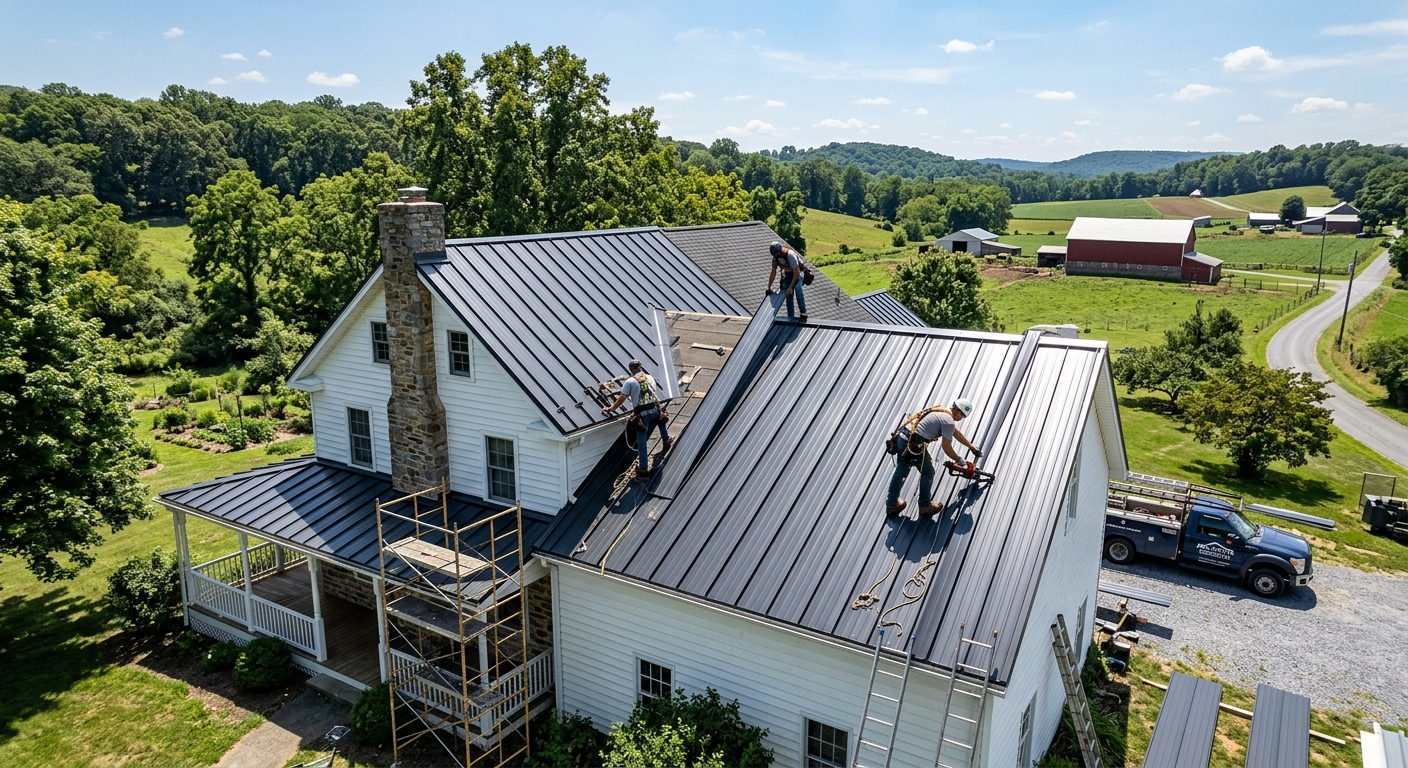
What roof replacement costs in South Whitehall in 2026
South Whitehall, with a homeownership rate above 80% and a predominately single-family housing stock, sees regular demand for roof replacement as these houses continue to age (U.S. Census Bureau, ACS 2024). Most of these homes were built before 1980, so many original or second-generation roofs have reached the end of their lives. This market reality means a wave of replacements is typical, and the work often focuses on entire roof systems, not just patches or stopgaps.
Post‑World War II suburban tract homes in South Whitehall and neighboring Upper Macungie share very similar roof dimensions and construction details. That means you’ll typically see projects handled efficiently, with costs stabilizing around the volume, house size, and shingle type that suit these subdivisions. If you’re comparing prices with a friend in another Lehigh County township, the similarity in housing here makes those numbers actually meaningful.
Here’s what you can expect to pay in South Whitehall as of 2026 for the most common roof materials and scopes:
| Material / Scope |
Lifespan |
Best for |
Price range (installed) |
| Asphalt shingles — architectural (30-yr) |
25–30 yrs |
Standard re-roof, subdivision homes |
$10,000–$21,000 |
| Asphalt shingles — impact-resistant (Class 4) |
30+ yrs |
Storm-exposed ridges, insurance discounts |
$16,500–$21,000 |
| Metal standing seam |
40–70 yrs |
Maximum lifespan, snow-shedding |
$24,000–$43,000 |
| Flat roof — TPO or EPDM |
15–25 yrs |
Low-slope sections, rowhomes, additions |
$12,500–$25,500 |
| Roof repair — leak or isolated section |
n/a |
Spot leaks, storm damage |
$550–$2,000 |
Prices are estimates for a typical South Whitehall home and vary with roof size, pitch, decking condition and material selection.
Asphalt, metal or membrane — what suits a South Whitehall roof
In South Whitehall, the climate is defined by cold winters (design temperature 4°F) and significant snow events with a 40 psf ground snow load. These aren’t just numbers—they dictate how roofing materials perform and what makes the most sense financially and functionally. Asphalt shingles, especially architectural, are dominant here not simply because they're less expensive, but because local contractors have built deep expertise installing them on the standard roof pitches found in the area’s postwar suburban tracts. Quick installation and reliable service life mean costs stay in line, with most homeowners choosing shingles as the practical choice.
Metal roofing excels in shedding snow, so it’s technically a winner for high snow exposure. If your house is on a wind-swept ridgeline or you want a roof with a 40–70 year lifespan, metal justifies its premium cost—$24,000–$43,000—but you won’t see a payoff unless you plan to stay put for decades or have annual ice-dam problems. For most South Whitehall homes, the higher installation cost isn’t matched by a proportional increase in resale value or actual lived benefit.
Flat roof membranes like TPO or EPDM are chosen only where the structure demands them—think low slopes or modern additions. Their strong points are waterproofing and flexibility on non-pitched roofs, but their lifespan and cost rarely compete with shingle on a typical gable roof.
| Material |
Installed cost |
Lifespan |
Cold-climate performance |
Maintenance |
| Asphalt architectural |
$10,000–$21,000 |
25–30 yrs |
Good—ice management needed at eaves |
Low, periodic inspection |
| Asphalt Class 4 impact-resistant |
$16,500–$21,000 |
30+ yrs |
Improved vs hail, slight snow edge |
Low, check after wind/hail |
| Metal standing seam |
$24,000–$43,000 |
40–70 yrs |
Excellent, snow sheds easily |
Minimal, gasket checks |
| TPO / EPDM membrane |
$12,500–$25,500 |
15–25 yrs |
Fair, seams vulnerable to ice |
Annual seam and penetration check |
Patching vs full replacement in South Whitehall
If your roof is under 15 years old and there’s just a spot leak, repair makes sense—especially in South Whitehall’s typical postwar tract homes where framing and sheathing tend to be uniform, not custom. But once a roof crosses 20 years, especially on homes built before 1980 that dominate this area, patching becomes a band-aid. It’s common to see homeowners spend $1,250 or so per repair, only to repeat the process every year or two. After just a handful of such visits, you’ll have spent half or more of a full replacement ($10,000–$21,000 for architectural shingles), with leaks still recurring and resale value sinking.
For any roof with multiple leak points after year 15, or any roof over 25 years with active leaks—replacement is the only move that genuinely makes financial sense. Historic ridge-line wind events in Lehigh County mean that storm damage, even if apparently minor, accelerates the wear process. Flat roofs with ponding or blisters nearly always need the membrane replaced, not patched. Entering winter with an active leak is a recipe for deeper structural rot—get an emergency patch for $550–$2,000, then plan the full job for spring.
| Situation |
Recommendation |
Typical cost |
Reasoning |
| Under 15 years, one isolated leak |
Repair |
$550–$2,000 |
Roof still in service life, one-off issue |
| 15–25 years, several leak points |
Replace |
$10,000–$21,000 |
Patching will add up fast, risk repeats |
| 25+ years, any active leak |
Replace now |
$10,000–$21,000 |
Materials at end of life, high risk of rot |
| Storm damage, wind or hail |
Document, claim, replace |
$10,000–$21,000 |
Insurance claim warranted, long-term fix |
| Flat roof ponding or blistering |
Replace membrane |
$12,500–$25,500 |
Failure in membrane means end of life |
| Active leak entering winter |
Emergency repair, schedule replacement |
$550–$2,000 |
Immediate water entry risk—buy time only |
Timing a roof replacement in South Whitehall
In South Whitehall’s northeastern Pennsylvania climate, roofing is a true seasonal business. Shingle sealing needs sustained temperatures above 40°F, which really means April through early November for high-quality work. Most jobs happen between May and October, when both the weather and material performance are reliable. In the spring and fall—especially September and early October—you’ll find the sweet spot: cool enough to work fast, but warm enough for proper shingle adhesion.
Because the greater Allentown–Bethlehem–Lehigh Valley metro is a dense roofing market, the best crews are booked weeks out during peak season. Book in spring for a summer install, and don’t expect an emergency response in late July unless you’re facing active leaks. If you try to schedule replacement in February, costs may jump due to weather delays, risk of improper sealing, and what it takes to keep an experienced crew working through snow and ice. Planned jobs in September are nearly always cheaper ($10,000–$21,000) than a midwinter emergency that gets bandaged for $550–$2,000 with cold-weather surcharges.
Flat roof work is even narrower—only tackle membrane installations when ambient temps allow full curing, typically late spring through early fall.
Roofing permits in South Whitehall: what you need before work starts
Roofing in South Whitehall falls under the Pennsylvania Uniform Construction Code (UCC), which is based on the International Residential Code and enforced here by the code authority named in state law—the PA Department of Labor & Industry or by the municipality if it has not opted out. In practice, the local township office handles enforcement for most residential projects.
Structural roof replacement and new roofing installed over multiple existing layers usually require a building permit. However, localized repairs—like swapping out a few shingles for a small leak—are commonly done without a permit. Before any work starts, especially if insurance or resale is involved, ask your contractor directly about their permit process.
Pennsylvania requires Home Improvement Contractor (HIC) registration for jobs over $500. Always verify your roofer’s active registration through hic.attorneygeneral.gov. Insurance—especially workers’ compensation for all employees—is mandatory. Homeowners can confirm this coverage directly with the contractor’s insurance carrier or check through the state’s WCAIS system (wcais.pa.gov).
A valid written contract is required by Pennsylvania law for any job over $500, and you have a 3-business-day right of cancellation. Contractors are forbidden from offering to waive your insurance deductible; if someone suggests this, walk away.
How to compare roofing quotes in South Whitehall
Don’t just glance at the lump sum when comparing roofing quotes in South Whitehall. The right quote will clearly state the roof area (in squares and pitch), list tear-off and dumpster disposal, name brands and types for underlayment and ice/water shield, and spell out the per-sheet price for any needed decking replacement. Pay special attention to flashing and vent boot lines—these are where repairs and leaks fail if skimmed over. Separate manufacturer and workmanship warranties should be clear. Legitimate contractors will ask for a modest deposit (under 15%), with most payment due at completion.
If a quote doesn’t state the square count or hides the tear-off in a bundled “miscellaneous” fee, you cannot possibly compare apples to apples with another bid. The same goes if “felt” is the only mention of underlayment, or there’s no ice and water shield coverage listed. If you can’t find a per-sheet contingency for decking, you’re at risk of a giant upcharge once the shingles come off. Demand these details—South Whitehall’s contractor market is competitive enough to supply them.
| Line item |
What to look for |
Red flag if… |
| Roof area |
stated in squares, with pitch |
no measurement given |
| Tear-off and disposal |
number of layers, dumpster included |
bundled into one figure |
| Underlayment |
product type and coverage |
listed only as 'felt' |
| Ice and water shield |
coverage height at eaves |
omitted entirely |
| Decking |
per-sheet contingency price |
no allowance at all |
| Warranty |
workmanship years stated separately |
only the shingle warranty |
| Payment |
deposit under 15%, balance on completion |
large upfront cash |
Why two South Whitehall roofing quotes can differ by 40%
In South Whitehall, roof replacement quotes often diverge sharply—even for identical tract homes—because the local housing stock, built mostly before 1980, covers a range of roof sizes and pitches. Volume-built homes have mostly similar footprints, but small differences in square footage or a hip versus a gable roof can move a quote by thousands. A home needing 5 more squares of roofing will push the price toward $21,000 rather than the average $16,500.
Labor costs climb quickly with steep roof pitch, which is relevant here thanks to high snow load requirements—some South Whitehall builders went steeper than others to shed snow better. More complicated access, like fenced back yards or mature trees, also slows the crew, sometimes by 20–30% over a simple walkable roof.
Quotes also diverge whenever hidden damage comes into play. Older homes commonly have rotted sheathing under decades-old shingles, discovered only during tear-off. Replacing a dozen sheets of roof decking at $75–$150 each adds fast and isn’t always priced out front. If one contractor includes ice and water barrier (recommended with the region’s severe ice-dam history) while another skips it, you’ll see a difference of $300–$800 just at the eaves line.
Finally, material upgrades—standard architectural versus Class 4 impact-resistant shingles—make up to $2,500 of the total price jump. Always check for allowances for old layer tear-off, especially since code in Allentown and its neighboring townships sometimes requires full removal of old shingles for permitting or warranty.
| Factor |
Why it matters here |
Cost impact |
| Roof size in squares |
each square is 100 sq ft of roof surface |
primary multiplier |
| Pitch and access |
steep pitches need harnesses and slow the crew |
+20–30% labour |
| Existing layers to tear off |
two or more layers means full tear-off and disposal |
$500–$1,500 per layer |
| Decking condition |
rot is found during tear-off, not before |
$75–$150 per sheet |
| Ice barrier at eaves |
required where ice damming has a history |
$300–$800 |
| Material grade |
3-tab vs architectural vs Class 4 impact-resistant |
$500–$2,500 |
Frequently asked questions — roofing in South Whitehall
What is the best roofing material for South Whitehall's climate?
Asphalt architectural shingles remain the best overall balance for cost, performance, and contractor specialization in South Whitehall. The 40 psf ground snow load and 4°F design winter temperatures mean you need a roof that can handle heavy snow and ice with minimal risk of leaks. While standing seam metal excels at snow-shedding, its installed price of $24,000–$43,000 is rarely justified unless you have a steeper roof, are in a wind-exposed area, or plan to stay put for decades. For almost all postwar tract homes found here, standard architectural asphalt shingles (installed for $10,000–$21,000) offer solid lifespan and easy sourcing of skilled labor. If hail and windstorms are common in your particular spot, consider impact-resistant Class 4 shingles—but they’re overkill for most flat lots.
What does roof replacement cost per square in South Whitehall?
South Whitehall’s roofing market uses the “square” just like anywhere else—100 square feet of finished roofing material. For architectural asphalt shingles, expect to pay about $500–$700 per square (all-in labor and material) in 2026, assuming a straightforward tear-off and replacement. This pricing anchors the typical full-house job between $10,000–$21,000 for the township’s standard tract homes. More complex roofs, extra layers to remove, or steeper pitches will push the per-square number up. Always ask for the number of squares measured in your quote so you know how it was calculated, and compare that directly if looking at multiple estimates.
Will filing a roof claim raise my premium?
In Pennsylvania, insurance companies aren’t allowed to raise your premium for making a single legitimate weather claim, but they often increase rates if you file repeated claims or if storms have hit an entire area and claims volume is high. South Whitehall, especially near ridge lines, can see burst patterns of wind and hail damage—and insurers sometimes reevaluate regional risk after big events. If your damage tips you into a full replacement costing $10,000–$21,000, it generally makes sense to claim. For smaller issues—like a $550–$2,000 repair—paying out of pocket can avoid any flag on your history. Never authorize a contractor to waive your deductible; it’s prohibited by state law.
How much does a flat roof replacement cost in South Whitehall?
For flat and low-slope roofs—often found on porch additions or split-level homes in South Whitehall—the installed price for full membrane replacement (TPO or EPDM) typically falls between $12,500–$25,500 in 2026, depending on footprint and any needed new insulation or drain details. The typical job costs about $18,000. Material and labor here are higher per square foot compared to shingles because installation is slower and crews are more specialized. These membranes tend to last 15–25 years, and repairs to seams or flashings are common in the back half of that lifespan. Winter installations are not recommended, as seams need warmth to cure.
How much snow load can a South Whitehall roof handle?
South Whitehall homes are built to Pennsylvania’s Uniform Construction Code, which in this northeastern region specifies a ground snow load of 40 pounds per square foot (psf). For standard post-1980 construction, this means your roof should safely support the weight of a typical historical snowpack in the Lehigh Valley. Flat or low-slope roofs require stricter attention, as drifting and ponding can increase loads—another reason membrane replacements may be needed after decades. If you ever see structural sag after a snowstorm, call for an inspection right away. The cost of a professional assessment is a small price compared to the risk of collapse. A major roof replacement to current standards will run $10,000–$21,000 for shingle, or $12,500–$25,500 for membrane.
Do I need a permit to replace a roof in South Whitehall?
Yes—if your project involves structural replacement or adding new roofing material over existing layers, the Pennsylvania Uniform Construction Code (UCC) typically calls for a permit, which in South Whitehall is issued by the local township or the PA Department of Labor & Industry if the municipality has opted out. Small repairs, like swapping out a few shingles, usually don’t require a permit. Always have your contractor show their Home Improvement Contractor (HIC) registration (verify at hic.attorneygeneral.gov), and make sure workers’ compensation insurance is in place—this can be confirmed through WCAIS (wcais.pa.gov). For any job over $500, Pennsylvania law requires a contract and gives you a three-day right to cancel after signing.
Is a sagging roof line an emergency?
In any South Whitehall home—especially those from the pre-1980 wave—a sagging ridge or bowed roof line is cause for immediate concern, not just cosmetic worry. This can signal rotted decking or framing, often from prolonged leaks or cumulative snow load, both of which are risks in this climate. If you notice sagging, halt any plans to patch or ignore: a professional assessment and likely roof replacement are in order, which runs $10,000–$21,000 for standard asphalt. Do not walk the roof or allow anyone up there until it’s been checked. Every winter, heavy snow adds risk, and prompt action can prevent a full structural failure or collapse.
How long does a roof replacement take in South Whitehall?
Most full tear-off and shingle replacements in South Whitehall’s typical postwar homes are completed in 1–2 days, weather permitting. Larger or more complex roofs may stretch to three, but that’s rare. Flat roof membrane jobs (TPO/EPDM) are usually done in 2–4 days depending on size, especially if deck repairs or insulation replacement is needed. The biggest delay in busy season (May–October) is actually crew lead time, not installation time—expect a 2–6 week wait from contract to job start, especially in the dense Lehigh Valley market. Emergency repairs, like a leak patch for $550–$2,000, can sometimes be done same-day if you call early. Plan ahead if you want your full replacement done before winter weather closes the window.
What warranty should a South Whitehall roofer offer?
For a shingle roof in South Whitehall, a quality contractor should offer a workmanship warranty of at least 5–10 years, stated separately from the manufacturer’s material warranty (which is typically 25–30 years for architectural shingles). Manufacturer warranties (covering defects in the shingle, not leaks from bad install) are usually “limited lifetime,” but always check if “non-prorated” coverage is offered in the first decade. Workmanship issues—like improper flashing or ice barrier—almost always appear early, so this is the meaningful coverage for homeowners here. In writing, your contract should state both. Always clarify if wind or hail damage is covered, as not all “lifetime” warranties include storm events. Warranty terms are not just boilerplate in Pennsylvania—they are enforceable under the Home Improvement Consumer Protection Act for jobs over $500.