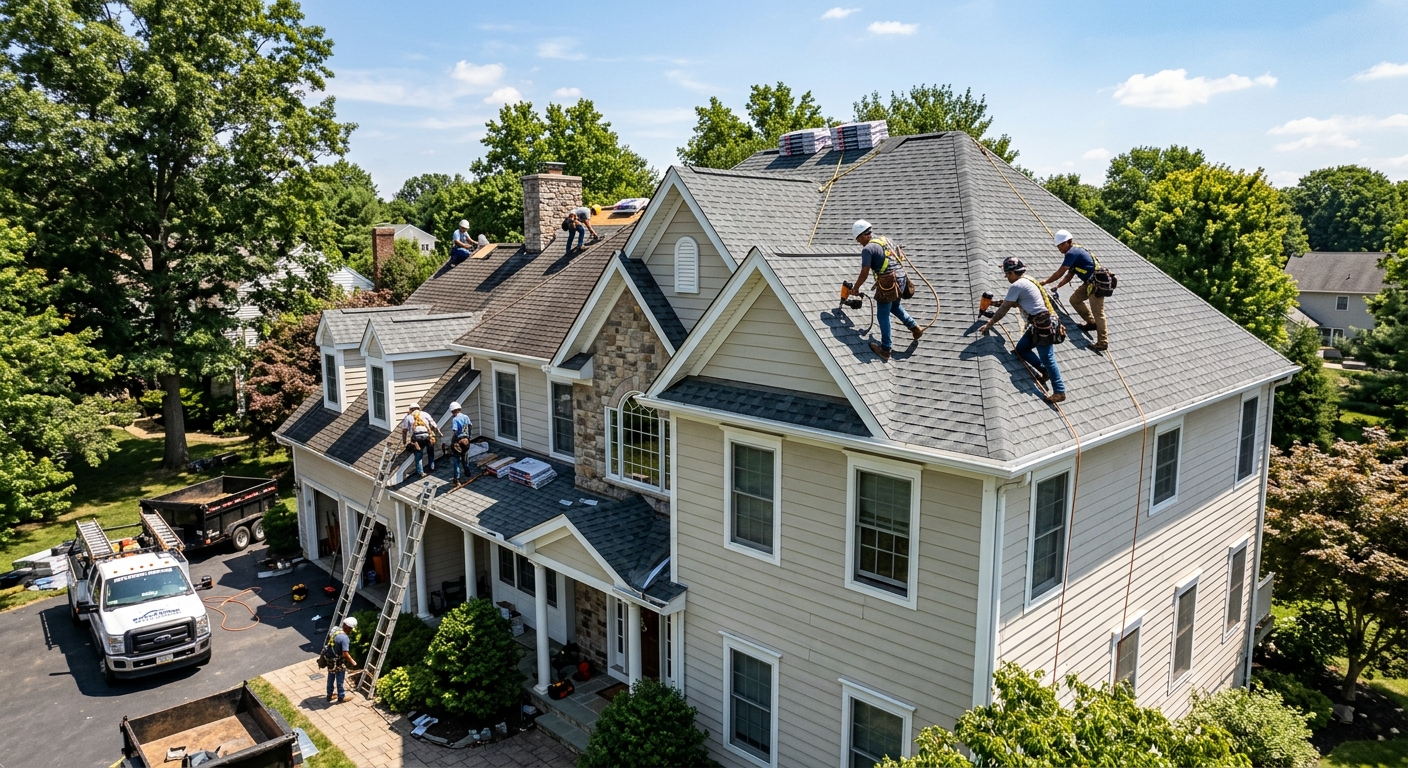
Roofing Replacement & Repair costs in Willistown — 2026
In Willistown, the roofing market is shaped by the area’s established homeowner base and the age of the local housing stock. With a homeownership rate above 90% and more than half of homes built before 1980, most roof replacement or repair projects here factor in older materials, past installation standards, and frequent updates that come with long-term ownership (U.S. Census Bureau, ACS 2024). The large subdivisions in nearby West Goshen and Uwchlan, developed mainly between the 1970s and 1990s, mean a substantial number of homes in Willistown have asphalt shingle roofs that are reaching the end of their original lifespan. For many residents, this is the first full replacement, with underlying decking, ventilation, and drainage needing evaluation—not just a new layer of shingles.
Roofing costs in Willistown reflect the local housing style and storm exposure, especially from periodic wind events along Chester Valley. Many homes require both roof and gutter work to address water management issues that show up in aging properties. Below are typical installed costs for common roof types and repairs in 2026:
| Material / Scope |
Lifespan |
Best for |
Price range (installed) |
| Asphalt shingles — architectural (30-yr) |
25–30 yrs |
Most suburban homes, HOA-compliant, cost-effective |
$12,000–$25,500 |
| Asphalt shingles — impact-resistant (Class 4) |
30+ yrs |
High wind-exposed properties along ridges |
$19,500–$25,500 |
| Metal standing seam |
40–70 yrs |
Long-term owners, snow-shedding, historic and custom homes |
$29,000–$52,000 |
| Flat roof — TPO or EPDM |
15–25 yrs |
Porches, additions, some 1960s ranches |
$15,000–$30,500 |
| Roof repair — leak or isolated section |
n/a |
Single-room leaks, flashing, small storm damage |
$650–$2,400 |
Prices are estimates for a typical Willistown home and vary with roof size, pitch, decking condition and material selection.
Reading the warranty on a Willistown roof
Homeowners in Willistown are usually handed two separate warranties after a roof replacement, though these are often confused. First, there is the manufacturer warranty, which covers defects in the roofing material itself—primarily premature cracking, granule loss, or other failures related to factory faults. These warranties are typically prorated, meaning their value drops with each year after installation, and most require you (or your contractor) to register within a strict deadline after the job. If you sell the house, coverage may transfer, but only once and usually with reduced future coverage. Poor ventilation or installing new shingles over old ones are two common exclusions that can void this warranty entirely, especially in homes built before attic airflow was standard code practice.
The second is the workmanship warranty from your roofer. This is what covers wrong nail placement, leaking flashing, or missed details that result in leaks or rapid wear. The real value of this coverage depends on the stability of the company offering it—a 25-year workmanship warranty from a Willistown contractor who’s only been around two years is worth less than a 10-year guarantee from a firm established since the 1990s. During resale, both warranties may be transferrable, but read the fine print: failure to notify the manufacturer or installer within a short window after purchase often means the next owner gets no coverage at all. Ask to see registration paperwork at contract signing, and don’t accept verbal assurances.
Why gutters get replaced with the roof
In Willistown, roof and gutter systems work together to manage water away from your home. Replacing just the shingles but leaving old or undersized gutters does half the job, especially because downspout discharge and grading are so critical in Chester County’s heavy clay soils. Water spilling near your foundation can turn a simple $2,000 gutter project into a much bigger problem if it leads to a wet basement—something that’s common in the subdivisions here with older layouts and minimal foundation drainage.
Many roof warranties also hinge on the presence of sound gutters and proper drip edge details. Some manufacturers won’t honor their labor or material protection on new shingles if water continually backs up due to clogged or leaky gutters. When you replace a roof in Willistown, expect to see offers for new seamless aluminum gutters, frequently running $2,200–$4,500 for an average-sized home with standard 5-inch K-style gutters and matching downspouts. Gutter guards are often bundled at an extra $800–$1,800, with the upper end for heavy tree coverage near the home. If your roofer says your old gutters are “fine,” but they’re over 20 years old or show pulling, leaking, or rust, a piecemeal fix is usually false economy in this climate.
What Willistown's housing stock means for your roof
Most homes in Willistown reflect the same construction boom that affected West Goshen and Uwchlan from the 1970s through the 1990s, with more than half of local homes built before 1980 (U.S. Census Bureau, ACS 2024). This wave of suburban development means the typical roof pitch is moderate—steeper than the ranches found elsewhere, but far from the steep, older Victorians. The original roof decking in these homes is most often plywood, not the plank sheathing of pre-war houses. While this plywood is more stable and less likely to create shingle ripples, older installations may still use thinner 3/8-inch sheets that don’t match today’s 5/8-inch preference for better fastener grip.
Another consequence of construction era: code requirements for ice barrier (ice and water shield) at the eaves didn’t come into play until well after most Willistown homes were built. Many of these roofs still lack proper underlayment at the gutter line, so ice damming is more likely and repairs can reveal moisture stains or rot at roof edges. As for layers, these subdivisions rarely have more than one old roof to tear off—HOA oversight and newer code enforcement make it unlikely you’ll find three or more layers, but two is common, especially where the first reroof was done in the early 2000s. If your home is ready for its first full replacement since original construction, expect added costs for better ice protection, deck repair, and upgrading ventilation.
Material comparison for Willistown homeowners
In Willistown, most roof replacements use architectural asphalt shingles. That’s not just tradition—the choice is shaped by the 30 psf ground snow load and 14°F winter design temperature typical for southeastern Pennsylvania. Metal roofs shed snow efficiently, which helps in a region with freeze-thaw cycles, but the upfront expense makes sense only for homeowners planning to stay in their house long-term. Asphalt shingles, especially the current 30-year architectural type, hold up well here, offering strong storm resistance and good value per dollar. Class 4 impact-resistant asphalt is sometimes chosen for homes along the more exposed ridges to guard against frequent wind events but isn’t always justified for houses sheltered by trees or set lower in the terrain.
Flat membrane systems (TPO or EPDM) have their place—porches, additions, and occasional low-slope ranches—but aren’t needed (or appropriate) for most Willistown main roofs. Architectural asphalt dominates here because of wide HOA acceptance, compatible roof pitches from the housing era, and the relatively straightforward appearance most subdivisions require. Unless you face extreme snow drifting or want a metal look for architectural reasons, asphalt wins on overall performance and value for this area. Only very custom homes, with unusual pitches or historic details, benefit enough from the cost of metal to justify it.
| Material |
Installed cost |
Lifespan |
Cold-climate performance |
Maintenance |
| Asphalt architectural |
$12,000–$25,500 |
25–30 yrs |
Withstands typical snow/ice, low risk of cold-weather cracking |
Annual inspection, periodic gutter cleaning |
| Asphalt Class 4 impact-resistant |
$19,500–$25,500 |
30+ yrs |
Best at handling hail, wind-driven debris |
Similar to architectural; check wind-worn spots after storms |
| Metal standing seam |
$29,000–$52,000 |
40–70 yrs |
Excellent snow shedding, lowest ice dam risk |
Check fasteners, clean minor oxidization if present |
| TPO / EPDM membrane |
$15,000–$30,500 |
15–25 yrs |
Handles snow load on flat, modern additions |
Keep drains clear, reseal seams as needed |
Pennsylvania code and Chester County permit rules for roofing
Roofing in Willistown is regulated by the Pennsylvania Uniform Construction Code (UCC), based on the International Residential Code, and enforced in Chester County by each municipality or by the PA Department of Labor & Industry if a municipality has opted out. In West Chester Borough, a building permit is required for full roof replacement involving structural deck repair. Routine shingle repair covering less than one roofing square (100 square feet) usually does not require a permit.
For contracting, Pennsylvania requires Home Improvement Contractor (HIC) registration for any roofing work over $500. Homeowners should verify a contractor’s registration at hic.attorneygeneral.gov. To confirm workers’ compensation insurance, the required system is WCAIS (wcais.pa.gov), and every legitimate contractor should provide a current certificate from this source. A written contract is required by state consumer law for roofing jobs over $500, and you have a 3-business-day right to cancel after signing. Waiving a homeowner’s insurance deductible is not legal. For homes built before 1978, all roofing contractors must comply with the federal EPA Lead RRP Rule—check their certification if you suspect any exterior painting or demolition will expose old materials.
What moves the price of a roof in Willistown
In Willistown, even neighboring homes can see a few thousand dollars’ difference in roofing quotes because of both property specifics and contractor practices in the saturated Chester County/Philadelphia market. Roof size is straightforward—it’s measured in “squares,” each being 100 square feet of surface. A larger colonial with lots of hips, valleys, and dormers will cost more per square than a straightforward gable. Steep pitches are another price driver here, especially in the late-1970s and 1980s subdivisions, where safety harnesses and slower footwork are required for code compliance and insurance—often adding 20–30% to labor costs.
Next is how many existing layers must be removed. Original tract homes often have at least one previous layer, especially in parts of Willistown where the first “layover” reroof was permitted in the early 2000s. Tearing off an additional asphalt layer adds $500–$1,500 per layer to disposal and labor. Decking condition is also pivotal—older plywood from the 1970s can be thin or water-damaged, requiring expensive replacement sheets at $75–$150 each. Storm exposure isn’t just theoretical; wind events along South Valley Hills mean premium shingles or extra sealing around penetrations might make sense, and those upgrades run from $500–$2,500 above baseline pricing. Lastly, adding ice barrier at the gutters is now considered standard because so many Willistown roofs lack it—budget an extra $300–$800 for insulating vulnerable areas.
| Factor |
Why it matters here |
Cost impact |
| Roof size in squares |
Each square is 100 sq ft of roof surface |
Primary multiplier |
| Pitch and access |
Steep pitches need harnesses and slow the crew |
+20–30% labour |
| Existing layers to tear off |
Two or more layers means full tear-off and disposal |
$500–$1,500 per layer |
| Decking condition |
Rot is found during tear-off, not before |
$75–$150 per sheet |
| Ice barrier at eaves |
Required where ice damming has a history |
$300–$800 |
| Material grade |
3-tab vs architectural vs Class 4 impact-resistant |
$500–$2,500 |
Frequently asked questions — roofing in Willistown
Will filing a roof claim raise my premium?
Filing a roof claim on your homeowner’s insurance in Willistown can lead to a premium increase, but the likelihood and size of the increase depends on your carrier and claims history within Chester County. Insurers in Pennsylvania treat storm-related roof claims differently than preventable damage claims, but significant wind or hail events in the region—like those hitting the Chester Valley—may prompt many neighbors to file at once, drawing extra attention from carriers. One claim for sudden storm damage typically won’t double your annual cost, but two or more in five years will almost always trigger a rate hike or even put you into a high-risk pool. Comparing the cost of a modest leak repair ($1,500) to your deductible, it’s usually not worth filing unless the damage is widespread and the cost approaches replacement levels. Always ask your agent how comprehensive loss underwriting exchange (CLUE) reports are used, as future buyers may see your claims.
Can I install new shingles over old ones in Pennsylvania?
In Pennsylvania, it’s legal under the Uniform Construction Code to install new asphalt shingles over one old layer, as long as the decking is sound, the structure can support the load, and there are not already two or more layers present. In Willistown, where many homes are on their first or second roof since original construction, it’s common to find one layer from the late 1990s or early 2000s. However, most local contractors and manufacturers discourage this approach—and some roofing warranties become void if new shingles are layered on old. If you do overlay, you may save the tear-off cost (often $1,000–$2,000), but you risk trapping heat and moisture, shortening roof life, and hiding sheathing rot. Always check HOA rules first, as some subdivisions prohibit overlays. For a 30-plus-year roof, a complete tear-off is nearly always the smart investment.
What causes ice dams on Willistown roofs?
Ice dams form when snow melts on a warm roof, runs down to a cold overhang, and then refreezes at the eave, gradually building a barrier that traps additional water. In Willistown, ice dams are a particular concern due to how many homes were built before ice barrier underlayment was added as a code requirement. Attic air leaks, old insulation, and outdated ventilation design—especially in 1970s–1980s subdivision homes—contribute to uneven roof temperatures. Once an ice dam develops, water backs up under the shingles, causing leaks and often damaging drywall and insulation. Adding proper ice and water shield at the eaves during a replacement (usually $300–$800) can greatly limit future damage, but the best defense is improving attic insulation and sealing any air leaks during reroofing.
How long does a roof replacement take in Willistown?
In Willistown, a full asphalt shingle roof replacement on an average two-story colonial typically takes one to three days, depending on size, pitch, and weather. Homes with complex valleys or a higher number of existing layers can add a day to that schedule. Permit processing often runs smoothly in Chester County, but adding deck repair, new gutters ($2,200–$4,500), or specific HOA-mandated details can slow the job. Sudden storms or windy conditions—common in this area—may also delay work. Most contractors here aim for minimal disruption, but don’t be surprised if the crew needs an extra morning to clean up (especially after a strong wind event exposes unseen ventilation or decking issues). Always plan for some flexibility in your schedule, and expect extra time if the project uncovers code-required upgrades.
How much does a new roof cost in Willistown?
For an average-sized home in Willistown, a full replacement with architectural asphalt shingles falls between $12,000–$25,500. Most homeowners land near the center of this range, around $19,500, especially if new underlayment or minor wood repairs are needed. Upgrading to impact-resistant shingles for added wind protection can push the price up to $25,500. Metal roofing is substantially more, beginning at $29,000 and running up to $52,000 for the largest footprints. Flat membrane replacements (common for additions and porches) run $15,000–$30,500 depending on complexity. Always request a detailed quote with line-item pricing for tear-off, disposal, ventilation, and gutters—hidden costs appear most often in the details, not the shingles themselves.
How do I know if my Willistown roof needs replacing?
Common signs your Willistown roof is due for replacement include missing, curling, or cracked shingles (often visible from the ground), granules collecting in gutters or downspouts, persistent attic leaks after storms, or mold/mildew near ceiling edges. If your home is in one of the late-1970s through 1990s subdivisions, a 25–30-year-old roof is often already on borrowed time—especially if no ice and water shield or ventilation upgrades were made since original construction. Small repairs ($650–$2,400) are sometimes enough for isolated leaks, but if the deck is soft underfoot or shingle edges are curling throughout, a full replacement is usually cheaper and safer in the long run. Schedule a roof inspection after any major storm and before listing your house for sale to avoid negotiations based on roof age.
How do I find a reputable roofer in Willistown?
The Chester County market includes many contractors, so always start by checking the Pennsylvania Home Improvement Contractor (HIC) registration at hic.attorneygeneral.gov before hiring. Ask for local references—not just recent ones, but customers from five or more years ago. Request verification of workers’ compensation insurance through the state’s WCAIS system, and require a written contract (the law mandates this for work above $500). In Willistown, try to look for contractors with a stable local presence, especially ones who have roofed multiple homes in your neighborhood or subdivision. Don’t be lured by low-ball offers from outfits without a real address or those eager to waive your insurance deductible—both are red flags in Chester County. Lastly, see if the company will walk you through their warranty paperwork on site.
What does roof replacement cost per square in Willistown?
Most Willistown homeowners can expect architectural asphalt shingles to cost between $650–$825 per square (a square is 100 square feet of roof area), including tear-off, disposal, underlayment, and basic flashing. For higher-pitch roofs or repairs with difficult access, this per-square price can climb towards $900 or more, especially if rot is found or specialized code upgrades (ventilation, ice barrier) are required. Metal roofs start much higher, often in the $1,500–$2,000 per square range, reflecting material and labor complexity. Always compare “apples to apples” between quotes: verify what’s included in the base square-foot price versus added on as extras. A reputable Willistown contractor should provide a line-by-line breakdown.
Is metal roofing noisy in rain?
Today’s standing seam metal roofs, when installed correctly on Willistown homes, are not particularly noisy in the rain. Modern systems use solid plywood decking and synthetic underlayments that deaden the drumming sound associated with older barn-style installations. If your attic is unfinished or insulation is limited (common in pre-1980 Willistown homes), you might hear some patter during heavy storms, but it is rarely louder than a standard asphalt roof and never echoing like metal on open rafters. Cost-wise, you’re investing $29,000–$52,000 on a typical home, so any reputable installer will walk you through insulation options for minimal noise. If you’re especially sensitive to sound, discuss thicker underlayment or attic upgrades before work begins. Most homeowners are surprised at how quiet a properly installed new metal roof actually is.