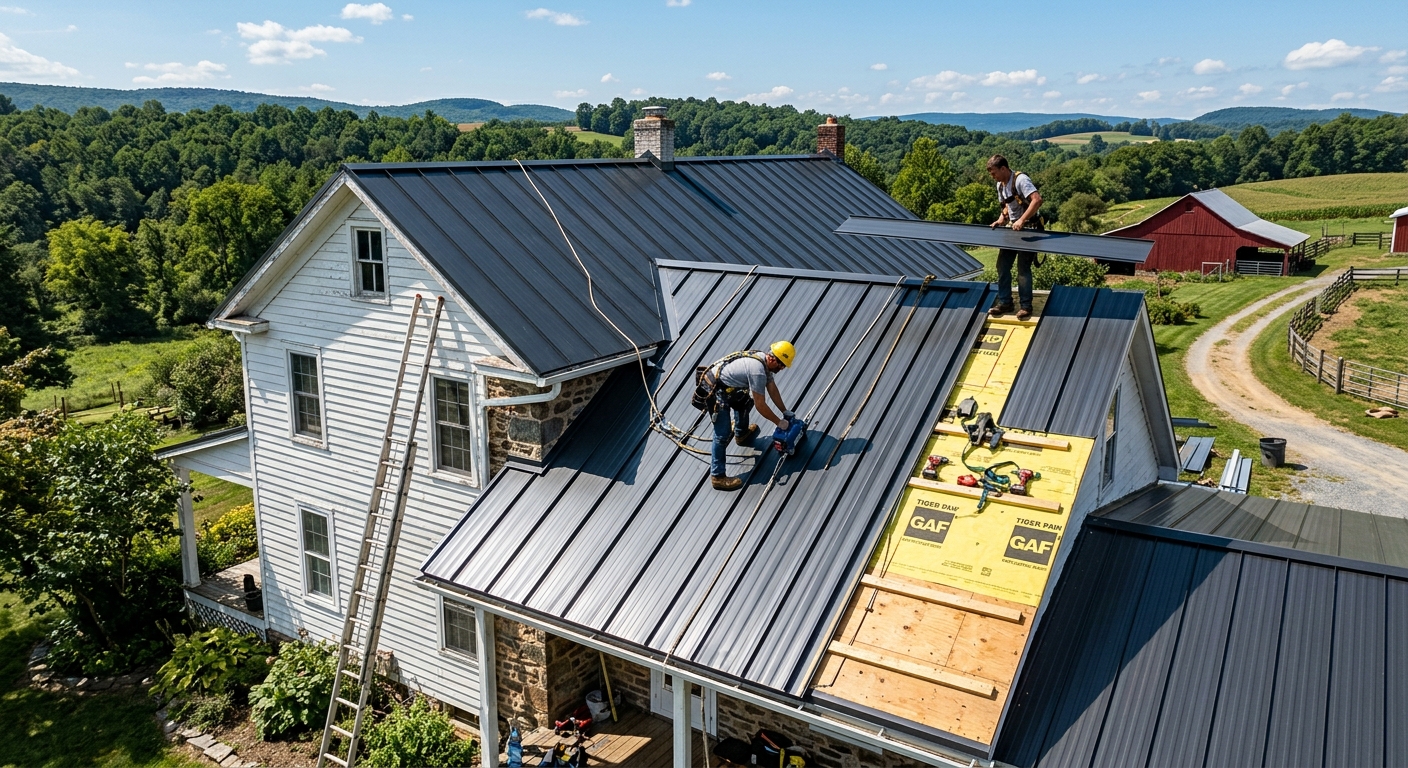
Roofing Replacement & Repair costs in Lower Gwynedd — 2026
Lower Gwynedd homeowners have specific roofing needs shaped by an owner-occupied community and older homes—77.9% of local households own their homes and more than half the properties were built before 1980 (U.S. Census Bureau, ACS 2024). This means roofing projects here typically address not just shingles, but aging decking, ventilation, and sometimes non-code legacy work. A substantial number of Lower Gwynedd roofs show typical wear of post-war builds, similar to Abington and Cheltenham, where tract-house stock is now at the stage for full replacements. That drives steady demand for architectural asphalt shingles, especially in subdivisions developed during the local suburban boom.
Aging roofs in Lower Gwynedd, often with two or more layers of older shingles, require full tear-off and potential deck repairs. Flat roof sections—like those on older additions or porches—bring their own cost structure and need membrane systems rather than shingles.
Below is a price and lifespan guide tailored to the most common roofing choices and situations in Lower Gwynedd in 2026:
| Material / Scope |
Lifespan |
Best for |
Price range (installed) |
| Asphalt shingles — architectural (30-yr) |
25–30 yrs |
Most single-family homes |
$11,000–$23,000 |
| Asphalt shingles — impact-resistant (Class 4) |
30+ yrs |
Homes exposed to storm debris |
$18,000–$23,000 |
| Metal standing seam |
40–70 yrs |
High-end homes or long-term owners |
$26,500–$47,000 |
| Flat roof — TPO or EPDM |
15–25 yrs |
Porch, addition, or low-slope sections |
$14,000–$27,500 |
| Roof repair — leak or isolated section |
n/a |
Spot leaks or single trouble spots |
$550–$2,200 |
Prices are estimates for a typical Lower Gwynedd home and vary with roof size, pitch, decking condition and material selection.
Repair or replace? A decision guide for Lower Gwynedd roofs
A roof in Lower Gwynedd built during the suburban expansion—especially anything dating before the early 1980s—is usually nearing the end of its functional life. For one-off leaks on a roof under 15 years old, a repair makes solid sense. Once that same roof gets past 20 years, repairs become temporary at best. In this township's older homes, patching four or five leaks over a few years (at
$1,400 each) ends up close to the cost of a new 30-year system; that's
$5,600–$7,000 in repairs versus
$11,000–$23,000 for a full replacement with long-term reliability.
In Lower Gwynedd’s climate—with humid summers and moderate freeze-thaw cycles—roofs tend to show weakness at flashings and valleys. Multiple leak points or any leak on a roof over 25 years means a repair is no longer a good use of money. Storm damage from a thunderstorm wind event, which isn’t rare for this part of Montgomery County, can also push a roof from “repairable” to “replace it now,” especially when insurance is in play.
Here’s a breakdown for typical scenarios faced by local homeowners:
| Situation |
Recommendation |
Typical cost |
Reasoning |
| Under 15 years, one isolated leak |
Repair |
$550–$2,200 |
Roof is well within lifespan; isolate and fix |
| 15–25 years, several leak points |
Replace |
$11,000–$23,000 |
Out of warranty and multiple failures signal systemic aging |
| 25+ years, any active leak |
Replace now |
$11,000–$23,000 |
Past typical shingle lifespan—new roof saves future repair bills |
| Storm damage, wind or hail |
Document, claim, replace |
$11,000–$23,000 |
Insurance often covers roof replacement if damage is verified |
| Flat roof ponding or blistering |
Replace membrane |
$14,000–$27,500 |
Flat roof membranes deteriorate rapidly once water enters |
| Active leak entering winter |
Emergency repair, schedule replacement |
$550–$2,200 |
Temporary fix is essential if full job can't be completed before freeze |
Checking out a roofer in Lower Gwynedd: what to verify
Before you sign any roofing contract in Lower Gwynedd, take the time to check a few credentials and documents. First, every contract over $500 requires the contractor to be registered under Pennsylvania’s Home Improvement Contractor program, which you can verify at hic.attorneygeneral.gov. Ask for proof of current workers' compensation coverage—required for every employer in the state—and verify it using the WCAIS system (wcais.pa.gov). Request a copy of the written contract, as required by the Home Improvement Consumer Protection Act, which also gives you a 3-day right to cancel. If your home dates to before 1978, ensure the crew is certified for lead-safe work (EPA Lead RRP Rule) using the EPA database.
Here’s a checklist for Montgomery County homeowners:
- Verify HIC registration at hic.attorneygeneral.gov
- Confirm business name matches registration
- Check active workers' compensation through wcais.pa.gov
- Request a copy of the written contract (required by state law)
- Ensure you receive the 3-day right-to-cancel notice
- Ask for certificate of insurance for liability and workers’ comp
- For pre-1978 homes, confirm EPA lead-safe certification
- Obtain and keep all written estimates and warranties
- Clarify who pulls any required permits (contractor or you)
- Get job site address references—ask for recent work in Lower Gwynedd
- Verify that payments go to a business account, not an individual
- Check company contact info: local office or verified local phone
Red flags in Lower Gwynedd include door-to-door roofers after a storm, “contractors” who offer to cover your insurance deductible, requests for large upfront payments, out-of-area license plates, or a lack of recent, local references. The saturated Philadelphia metro market means you should expect legitimate crews to have all paperwork ready and no trouble proving their legitimacy.
What moves the price of a roof in Lower Gwynedd
In Lower Gwynedd, roofing quotes swing most with the house’s original construction date, roof complexity, decking surprises, and code-driven ice dam protections. Many homes here have been roofed multiple times—often with two layers or more. On a 1950s house, tearing off two existing shingle layers adds both labor and landfill fees, increasing your job cost by
$500–$1,500 per layer.
Montgomery County’s 30 psf snow load—paired with moderate freeze-thaw cycles—means houses built before the latest code updates sometimes lack proper ice and water shielding. If your roof sits along the Schuylkill River valley or in an older terrace, persistent ice damming will require an upgraded underlayment, an extra
$300–$800 that’s not always quoted upfront.
Roof size and pitch drive costs more than most realize: a two-story colonial with steep slopes costs at least 20% more in labor than a one-story ranch, due to more crew time and added harnessing. Repairing rough, old decking discovered during tear-off can run another
$75–$150 per sheet. Finally, picking architectural or Class 4 shingles over basic 3-tabs for HOA compliance or durability ups your material spend by
$500–$2,500.
| Factor |
Why it matters here |
Cost impact |
| Roof size in squares |
Each square is 100 sq ft of roof surface |
Primary multiplier |
| Pitch and access |
Steep pitches need harnesses and slow the crew |
+20–30% labor |
| Existing layers to tear off |
Two or more layers means full tear-off and disposal |
$500–$1,500 per layer |
| Decking condition |
Rot is found during tear-off, not before |
$75–$150 per sheet |
| Ice barrier at eaves |
Required where ice damming has a history |
$300–$800 |
| Material grade |
3-tab vs architectural vs Class 4 impact-resistant |
$500–$2,500 |
Storm damage and insurance claims in Lower Gwynedd
If your Lower Gwynedd roof is hit by wind or hail, start the claim process by documenting the damage—before any cleanup—with photos from multiple angles, including interior water stains. File an insurance claim promptly, and expect an adjuster to inspect the damage before work starts. The insurer will produce a written scope of loss, which should be shared with your contractor for apples-to-apples quoting.
Know your policy: Most local homeowners’ insurance offers either actual cash value (depreciated) or replacement cost for roofs. Clarify which you have: actual cash value means your old roof’s age is deducted, leaving you with a bigger out-of-pocket. Replacement cost covers the full job, minus your deductible.
Pennsylvania’s Home Improvement Consumer Protection Act requires every roofer to give you a written contract (for jobs over $500) and clearly outline the scope and payment terms. State law also forbids waiving your insurance deductible. If a roofer offers to “eat your deductible,” walk away—both you and the contractor could be committing insurance fraud, and you will likely get cut-rate materials or a botched job.
Expect your insurance company to require proof of permit and licensed contractor registration before issuing final payment. Don’t sign a completion certificate until every punch list item is done. Documentation and contractor legitimacy are your best defenses when dealing with insurance work in Lower Gwynedd.
Flat roof sections: the part most quotes get wrong
Flat roof sections are common in Lower Gwynedd, especially as back additions, porches, or where postwar homes were expanded. Shingles must never be used on flat or low-slope areas (under 2/12 pitch) because water doesn't shed fast enough—leading to leaks, rot, and premature failure. A proper flat roof uses a membrane: TPO or EPDM is typical, each designed to stay watertight under slow drainage and standing water.
A shingle pitched roof might last 25–30 years here, but a flat roof membrane should be budgeted to replace every 15–25 years. Drainage is crucial: ponding accelerates breakdown, and improper installation is a leading cause of callbacks. If your quote uses shingles where slope doesn't permit, the roofer lacks knowledge of Montgomery County codes—or is cutting corners.
Expect a professionally installed TPO/EPDM flat roof in Lower Gwynedd to cost
$14,000–$27,500, depending on size and whether decking needs replacement. Membranes cost more to install than shingles per square foot, but they protect what’s beneath in places shingles never should have been used.
Roofing permits in Lower Gwynedd: what you need before work starts
In Lower Gwynedd, the Pennsylvania Uniform Construction Code (UCC)—based on the IRC—is enforced, with authority vested in either your local municipality or, in areas that have opted out, by the PA Department of Labor & Industry. Most roof work here calls for a permit only when replacing more than 25% of the existing roof surface in a single project. Small repairs—like patching a couple of damaged shingles—typically do not require a permit, saving you some paperwork and fees.
Before work begins, verify your contractor’s Home Improvement Contractor (HIC) registration through hic.attorneygeneral.gov. This is mandatory for all jobs over $500. For insurance, make sure your contractor provides proof of active workers’ compensation—check the validity yourself using Pennsylvania’s WCAIS portal (wcais.pa.gov), especially since all employers must carry this coverage.
The Pennsylvania Home Improvement Consumer Protection Act requires a written contract spelling out costs and scope for any work above $500. You should also confirm lead-safe work certification through the federal EPA’s database if your home was built before 1978.
No special roofing trade license exists—just HIC registration. For larger jobs involving deck replacement or substantial change to structure or insulation, your contractor should handle the permit application and inspections; your township office (not the county) will issue the approval under the UCC. Always clarify in your written contract who is responsible for permits—the contractor or you.
Frequently asked questions — roofing in Lower Gwynedd
How much does a flat roof replacement cost in Lower Gwynedd?
For a flat roof replacement on a typical Lower Gwynedd home—such as an addition, porch, or low-slope section—the price in 2026 generally ranges from $14,000–$27,500. Most jobs fall around $19,500 if the decking is in good shape and there aren't multiple roof layers to tear off. This price covers installation of quality TPO or EPDM membrane systems designed to handle the specific drainage and ponding issues common to flat roofs in Montgomery County. Local contractors know that membranes last 15–25 years, a shorter interval than asphalt shingles, so the investment covers both watertight performance and code compliance.
Can a contractor cover my insurance deductible in Pennsylvania?
No, and you should be wary of any contractor who offers to do so. In Pennsylvania—including Lower Gwynedd—waiving or “covering” your homeowner’s insurance deductible on a roof claim is directly prohibited under state law. This is considered insurance fraud, and it puts both homeowner and contractor at legal and financial risk. Any roofer suggesting “we’ll eat your deductible” is not following the Home Improvement Consumer Protection Act or industry best practices. The right contractor will give you a straightforward estimate and guide you through the insurance claim process—your only out-of-pocket should be your actual policy deductible and any desired upgrades, such as Class 4 impact-resistant shingles at $18,000–$23,000.
How much deposit should I pay a roofer upfront?
In Lower Gwynedd, a reputable roofing contractor will never ask for more than one-third of the contract price as a deposit—and Pennsylvania law sets this as the legal maximum for home improvement projects. For example, on a shingle replacement at $18,000, your deposit should not exceed $6,000. This ensures you’re not over-exposed if a contractor disappears or doesn’t start. You should pay the balance upon completion and after inspection of the finished work. If a roofer demands half or the full amount upfront, that’s a red flag—especially in a competitive Montgomery County market.
How do I confirm a roofer carries workers' compensation?
Pennsylvania requires every roofing employer working in Lower Gwynedd to have valid workers’ compensation insurance, which shields homeowners from potential liability if a worker is injured onsite. Always ask for a certificate of insurance and verify it directly through the state’s WCAIS database (wcais.pa.gov). This extra step takes a few minutes, but it ensures any claim will be covered. For a standard roof replacement costing $11,000–$23,000, proper insurance is non-negotiable; uninsured contractors put you at risk for lawsuits and can signal questionable business practices.
What causes ice dams on Lower Gwynedd roofs?
Ice dams form on Lower Gwynedd roofs when daytime thawing and nighttime refreezing create water backups behind ridges of ice at the eaves. This is common here due to moderate freeze-thaw cycles and a 30-inch frost depth, especially on houses with older attic insulation or poor ventilation. Melted snow from the warm roof runs to the cold overhang, refreezes, and forces water back under the shingles. Addressing this may require both better attic ventilation and installation of an ice barrier at the eaves, an upgrade that typically adds $300–$800 to your roof project. Without it, you risk interior leaks and drywall damage, so it’s something local reputable contractors now quote for all replacements.
Can I inspect my own roof safely?
While many Lower Gwynedd homeowners are handy, roof inspection here has risks—older homes often have steeper pitches, slippery moss, or worn-out decking. If you must check for visible issues, use binoculars from the ground or a sturdy extension ladder secured on flat pavement. Never walk a roof with suspected rot or loose shingles. Professional inspectors use harnesses and have the right insurance. Even for a minor repair costing $550–$2,200, your safety is worth more than the savings. If you’re worried about a leak or storm damage, call a local, registered contractor to take a closer look.
Is metal roofing noisy in rain?
Modern metal roofing installed on Lower Gwynedd homes is much quieter than you might expect. Standing seam systems are typically placed over solid decking and underlayment, which absorbs sound far better than the old barn roofs some folks remember. If insulation in the attic is up to current code, rain on a metal roof is only slightly louder than on asphalt shingles—often unnoticeable indoors. Metal roofs can cost $26,500–$47,000 installed, but bring long life and excellent storm performance. If you’re sensitive to sound, talk to your contractor about thicker underlayments and attic insulation upgrades.
How much does it cost to repair a roof leak in Lower Gwynedd?
Roof leak repairs in Lower Gwynedd usually range from $550–$2,200. The lower end covers a small patch or isolated shingle replacement; the upper end involves more complex flashings or partial deck repair, particularly on older homes built before 1980. Labor, disposal of damaged material, and site setup all factor in. If you experience repeated leaks, especially on a 20+ year old roof, consider budgeting for replacement instead—multiple repairs add up quickly and don’t solve systemic age-related issues commonly found in township homes.
What is the best time of year to replace a roof in Lower Gwynedd?
The ideal window for roof replacement in Lower Gwynedd runs from late April through October. Temperatures are warm enough for shingle adhesives to seal properly, and you avoid winter’s freeze-thaw cycles that complicate installation. Scheduling in late spring or early fall also means contractors are less likely to be backed up by summer storm emergencies. For a full asphalt shingle replacement (typically $11,000–$23,000 here), you can expect faster job turnaround and easier permit approvals before the busy season hits. Emergencies can be tackled year-round, but planned projects do best in the milder months.