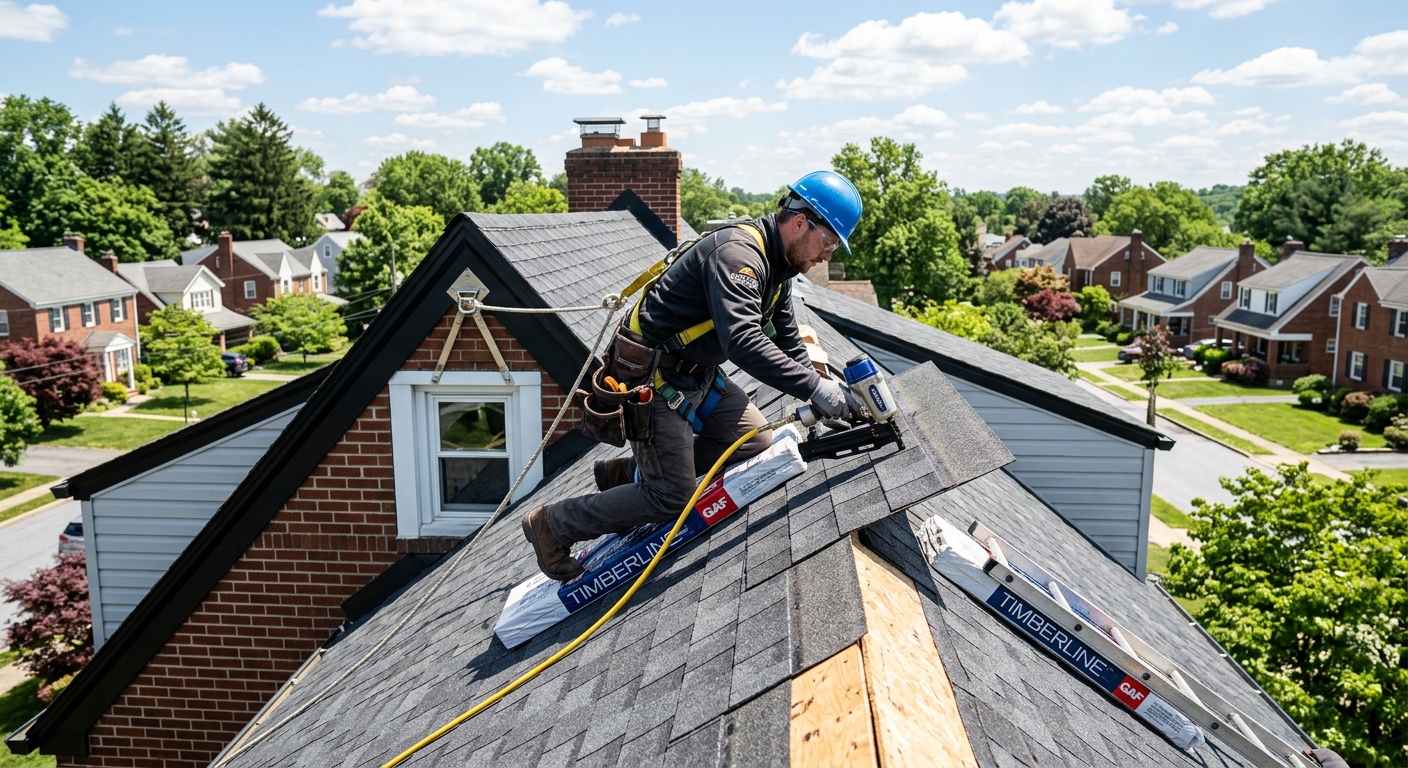
What roof replacement costs in Lower Oxford in 2026
Lower Oxford, with its high homeownership rate and predominance of single-family houses (U.S. Census Bureau, ACS 2024), has a steady demand for both re-roofing and significant repairs. In neighborhoods dense with owner-occupied homes, especially those built before 1980, many residents now face the reality that their original roofs are past due for replacement. Roof projects here rarely involve just patching; whole systems often need to be updated at once, especially if you want to get the most out of a new roof investment.
Look at the nearby subdivisions in West Goshen and Uwchlan Township: miles of homes from the 1970s through the 1990s, with roofs designed to last 25–30 years. Those same construction eras are mirrored in many Lower Oxford developments. We diagnose and replace many roofs where weather exposure—and simply hitting the end of a 25- or 30-year lifespan—means asphalt shingles no longer offer protection. It’s common to find venting or flashing that’s lasted for decades, never properly modernized, and desperately in need of improvement when re-roofing is under way.
| Material / Scope |
Lifespan |
Best for |
Price range (installed) |
| Asphalt shingles — architectural (30-yr) |
25–30 yrs |
Suburban single-family homes, HOA standard replacements |
$10,500–$22,000 |
| Asphalt shingles — impact-resistant (Class 4) |
30+ yrs |
Ridge-line homes, storm-prone exposures |
$17,000–$22,000 |
| Metal standing seam |
40–70 yrs |
Homeowners wanting long-term durability and distinctive curb appeal |
$25,500–$45,500 |
| Flat roof — TPO or EPDM |
15–25 yrs |
Porches, additions, rowhouse rears with ponding risk |
$13,500–$26,500 |
| Roof repair — leak or isolated section |
n/a |
Stopping active leaks but system nearing end-of-life |
$550–$2,100 |
Prices are estimates for a typical Lower Oxford home and vary with roof size, pitch, decking condition and material selection.
Permits and code requirements in Lower Oxford
Roofing work in Lower Oxford falls under the Pennsylvania Uniform Construction Code (UCC), which is based on the International Residential Code (IRC). The Pennsylvania Department of Labor & Industry oversees the UCC, but enforcement in Chester County—including Lower Oxford—is handled by each municipality or, in cases where municipalities have opted out, by the Department itself.
If you’re replacing your entire roof and the project involves structural deck repair, expect your township to require a building permit. This aligns closely with the approach in West Chester Borough, which triggers permits for full replacements involving deck work. On the other hand, if you’re performing a like-for-like shingle repair under one roofing square, local enforcement typically does not require a permit. It’s always smart to confirm requirements with your township office before starting any roofing job.
Pennsylvania does not require a trade-specific roofing license. However, for any contract over $500, roofing contractors must have Home Improvement Contractor (HIC) registration issued by the Pennsylvania Office of Attorney General. You can look up and verify this at hic.attorneygeneral.gov before signing any contract. Written contracts are also required by the Home Improvement Consumer Protection Act for jobs over $500, and you have a three business-day right of cancellation by state law.
All employers must carry workers’ compensation insurance. To verify this, use the official WCAIS database at wcais.pa.gov. Making these checks protects you from liability and ensures compliance with state standards.
The scope items Lower Oxford homeowners don't budget for
No matter how experienced the estimator, some expenses only appear after the first shingles are removed. In Lower Oxford, where humid summers and moderate freeze-thaw cycles are the norm, hidden roof issues are common—especially in the large number of homes built before 1980. The first and most frequent surprise is rotted or delaminated roof decking: once exposed, it’s unsafe to shingle over. Most jobs in this area require one to four new sheets, adding $75–$150 per sheet to your bill.
Proper attic ventilation is often missing or inadequate in older homes around Lower Oxford. Without venting, the risk of ice damming grows each winter when heat loss from the house melts snow, causing water to back up and rot the sheathing. Correcting the ventilation—by installing or increasing ridge vent or adding intake—may add $400–$1,000 depending on size and method. It isn’t negotiable: manufacturers can void your shingle warranty if attic airflow is not up to standard.
Flashing and vent boots cause leaks if re-used or skipped. Flashing around chimneys, walls, and valleys typically adds $200–$800 for materials and labor, while vent pipe boot replacement often runs $60–$120 each. Drip edge—now standard to meet code requirements and to prevent water intrusion at eaves—adds another $250–$500 for most homes. These items are rarely “upgrades” but are mandatory to meet code and warranty terms in Chester County’s climate.
Flat roof sections: the part most quotes get wrong
Many Lower Oxford homes have a flat or near-flat roof section—a rear addition, porch, or sunroom. These cannot be covered reliably with the same shingles as the pitched main roof. Shingles on slopes under 3/12 (especially 2/12 and below) fail early due to poor drainage, with wind-driven rain and snowmelt finding every opportunity to leak. In Chester County’s humid summers and moderate freeze-thaw winters, ponding water on a shingled low slope means rapid rot and interior leaks.
The solution for these areas is a single-ply membrane system: TPO or EPDM. These materials resist ponding, stand up to the region’s winter-snow load, and protect the home’s structure from the long-term effects of slow leaks. Lifespan for a membrane roof runs 15–25 years—less than a well-installed shingle or metal roof, but realistic for flat areas. Expect to pay $13,500–$26,500 for replacement on most residential flat sections in Lower Oxford.
If a roofer is willing to quote shingles for a 2/12 pitch, that’s telling you they’re willing to cut corners. Flat or low-slope sections are where most long-term leak claims originate, and choosing the right system here directly affects how often you’ll see water stains on your ceiling.
Checking out a roofer in Lower Oxford: what to verify
Hiring a roofer in Lower Oxford isn’t just about price—it’s about ensuring legal compliance and real accountability. Require any contractor quoting more than $500 to show their Home Improvement Contractor (HIC) registration. Confirm their status yourself at hic.attorneygeneral.gov. Pennsylvania’s Home Improvement Consumer Protection Act also requires a written contract and gives you a three-business-day right to cancel. For insurance, request a current Certificate of Insurance and then check workers’ compensation coverage directly through the WCAIS database at wcais.pa.gov. Authentic documentation matters.
- Check HIC registration at hic.attorneygeneral.gov
- Review written contract terms for required consumer protections
- Verify current certificate of insurance—both liability and workers’ comp
- Use wcais.pa.gov to confirm active workers’ compensation status
- Ask for at least three local references, preferably on jobs five years old or more
- Request photos of recent work on houses similar to yours in Lower Oxford
- Ask about the company’s full-time crew versus temporary laborers
- Clarify who will supervise the crew day-of and their years of experience locally
- Get all change orders in writing before any extra work starts
- Require proof of manufacturer status for extended warranties, if offered
- Confirm lead-safe certification for work on pre-1978 homes if paint is disturbed
- Never pay in full up front—deposits should not exceed 1/3 under state law
In Chester County’s crowded Philadelphia metro roofing market, beware of door-knockers after a storm, crews without a local address, out-of-state phone numbers, high-pressure “today-only” discounts, and vague insurance documents that don’t list your township. Established local companies simply do not operate this way.
Water management on a Lower Oxford roof
A roof’s job isn’t finished until its water management system works together: shingles or membrane, gutters, downspouts, and the grading near the foundation. In Lower Oxford, a common mistake is to replace shingles and ignore gutters that are clogged, loose, or undersized. Old or failing gutters let water pour too close to your foundation—leading directly to basement seepage, wall cracks, and mold. That risk is higher here because most homes stand on full basements and the clay-heavy soils in Chester County slow water runoff.
A well-installed roof project should pair new shingles or membrane with new seamless gutters and properly sized downspouts that carry water at least five feet from the foundation. Drip edge, now required by code, helps channel water into the gutter and keeps it off the fascia and into the system. Some long-term shingle warranties require demonstration of “adequate drainage”—which means blocked or missing gutters can actually affect coverage terms.
Gutter replacement alongside a re-roof usually adds $1,600–$3,000 for a typical single-family home in Lower Oxford, with gutter guards adding another $1,200–$2,200 depending on system and lineal feet.
Why two Lower Oxford roofing quotes can differ by 40%
Roofing quotes in Lower Oxford can diverge sharply—sometimes by as much as 40%—for reasons that come down to home design, code, and what’s hidden under your old shingles. A big driver here is roof size: many homes built in the 1970s–1990s developments have larger, more complex roofs than older bungalows. More roof surface means more labor and more tear-off—and that multiplier dominates your price band. For example, two typical homes needing architectural shingles might range from $10,500–$22,000, simply based on roof area and complexity.
Pitch and access also matter here, where tracts with steeply-pitched colonial and split-level homes are common. Steeper slopes require harnesses and slow down the crew, pushing labor costs up 20–30%. In Lower Oxford’s climate, with a ground snow load of 30 psf and freeze-thaw cycles, roofs must meet higher material and flashing standards than projects further south, which adds to the quote. And local storm exposure means some homes need Class 4 impact-resistant shingles, not basic architectural, at an added premium.
| Factor |
Why it matters here |
Cost impact |
| Roof size in squares |
Each square is 100 sq ft of roof surface—a major variable with large 1970s–1990s homes |
Primary multiplier |
| Pitch and access |
Steep roof pitches common in Chester County require harnesses and more staging; slow the crew |
+20–30% labor |
| Existing layers to tear off |
Older jobs often have two layers; full tear-off and disposal adds crew time |
$500–$1,500 per layer |
| Decking condition |
Rot is found during tear-off, especially in humid summers or where ventilation lacks |
$75–$150 per sheet |
| Ice barrier at eaves |
Required where ice damming has a history on north-facing or poorly vented roofs |
$300–$800 |
| Material grade |
3-tab vs architectural vs Class 4 impact-resistant determines warranty and wind resistance |
$500–$2,500 |
Frequently asked questions — roofing in Lower Oxford
What if my insurer denies my roof claim?
If your insurer denies your roof claim in Lower Oxford, it's usually because they determined the damage was due to age, wear, or improper maintenance, rather than a sudden event like wind or hail. Many homes here have roofs well past 25 years old, so insurers often cite “end of lifespan” as grounds for denial. The cost to replace a typical architectural shingle roof in Lower Oxford is $10,500–$22,000. If you know your roof qualifies as storm damage and you disagree with your insurer’s decision, you can hire a public adjuster or request a reinspection. If all else fails and coverage is denied, investing in preventative maintenance or a staged replacement (just the most at-risk section) may be wise—since patch repairs run $550–$2,100 here, but the cost can multiply if hidden damage goes unchecked.
Are storm-chasing roofers a problem in Lower Oxford?
Yes—Chester County, including Lower Oxford, is affected by storm-chasing roofers, especially after high-wind events that are not uncommon along the South Valley Hills. These crews often operate without a local address, offering "today-only" deals or promising to “take care of your deductible,” which is prohibited under state law. Always verify Home Improvement Contractor registration through the official state portal (hic.attorneygeneral.gov) before signing anything. Ask for references on homes in Lower Oxford, not just in neighboring towns. If you receive a suspiciously low offer—say, for an architectural shingle replacement below $10,500—be wary. The risk is shoddy work, skipped permits, or disappearing after payment, leaving you unprotected if the roof fails or leaks appear.
How long do architectural shingles last compared to 3-tab?
For homes in Lower Oxford and the rest of central Chester County, architectural shingles offer a significant step up from 3-tab. Expect 25–30 years from architectural shingles—matching what most subdivision homes first received in the 1980s and 1990s. By contrast, 3-tab shingles in this climate often fail after 15–18 years, thanks to freeze-thaw cycles, wind exposure, and high humidity. While the up-front cost is higher—typically $10,500–$22,000 for an architectural shingle roof versus a few thousand less for 3-tab—the difference in replacement frequency and repair costs makes architectural the default for most modern reroofing in Lower Oxford.
How much does a flat roof replacement cost in Lower Oxford?
In Lower Oxford, replacing a flat roof with a membrane system like TPO or EPDM runs $13,500–$26,500 for a typical residential section. This is common for additions, porches, and rear sunrooms. These systems are necessary because our climate—with humid summers and freeze/thaw winters—quickly degrades shingle roofs on low slopes. The flat roof’s shorter lifespan (15–25 years) is factored into the price but, if done right, you can expect reliable leak protection and reduced risk of ponding problems that plague older add-ons. Avoid bids that suggest using shingles on a flat or near-flat section—it’s more expensive in the long run once water makes its way inside.
Will the crew damage my landscaping or driveway?
Crews working in Lower Oxford must navigate tight driveways, mature plantings, and limited yard access—especially on lots from older subdivisions. Quality contractors use plywood to protect driveways and tarp over plants, but some wear-and-tear is hard to avoid with heavy tear-offs. If you’re getting a full tear-off and replacement (say, an architectural shingle job in the $10,500–$22,000 range), ask in advance how debris will be handled and where dumpsters will sit. Get promises in writing about yard cleanup. Walk your property after job completion—local roofing contracts should specify site restoration, so you’re not left picking nails from the lawn.
How much does it cost to repair a roof leak in Lower Oxford?
Leak repairs on Lower Oxford roofs typically cost $550–$2,100, depending on location and scope. Water staining near chimneys, under roof valleys, or at pipe boots are the most common. Many leaks trace back to flashing—a detail rarely addressed in original builds or past patch jobs. Pricing at the lower end addresses basic shingle replacement or caulking, while more complex fixes that require opening up roof decking or extensive membrane work will run higher. If your home was built before the 1980s and repair attempts have failed in the past, consider a thorough inspection: sometimes repeated leaks signal the roof as a whole is nearing end-of-life and a sectional repair is only a short-term fix.
What are the signs of hail damage on a roof?
In Lower Oxford, signs of hail damage include granule loss on shingles (often visible in gutters), circular bruising or soft spots when pressed, split or cracked tabs on 3-tab shingles, and dented metal flashings. Because architectural shingles are most common here, look for patches of asphalt exposed on the surface. After a storm, especially in neighborhoods with mature trees, heavy hail can strip shingles fast—leading to accelerated aging even if there’s no immediate leak. If you suspect hail, call for an inspection before the next event or rainy season. Insurance claims are more likely to be successful if you document damage promptly; full replacement for storm-compromised shingle roofs here starts around $10,500.
Why do roofs fail faster in southeastern Pennsylvania?
The combination of moderate freeze-thaw cycles, humid summers, and regular wind-driven storms causes roofs in southeastern Pennsylvania—including Lower Oxford—to wear faster than national averages. Shingles here face both swelling from summer humidity and contraction from winter cold, increasing the risk of thermal cracking, seal-tab failure, and water ingress. Storm exposure is heightened along local ridges—another reason why architectural shingles and Class 4 impact-resistant options (at $17,000–$22,000) are common upgrades. Most failures start at penetrations and over unvented attic spaces, so even “lifetime” roofs rarely hit that mark here.
Can I install new shingles over old ones in Pennsylvania?
In Pennsylvania, you are legally allowed one reroof-over (also known as “overlay”)—installing new shingles on top of a single existing layer. In Lower Oxford, many older roofs have already been overlaid once, which means the next replacement will require a full tear-off. Overlays save money up front, but they don’t address hidden problems: rotted decking, poor ventilation, or faulty flashing are simply buried, and warranties are often voided. Plus, overlays don’t perform as well in high-wind events that are common along central Chester County ridges. If you’re quoted less than $10,500 for a full replacement, clarify if it’s an overlay or tear-off—it makes a difference in long-term durability and compliance with code and shingle manufacturer standards.