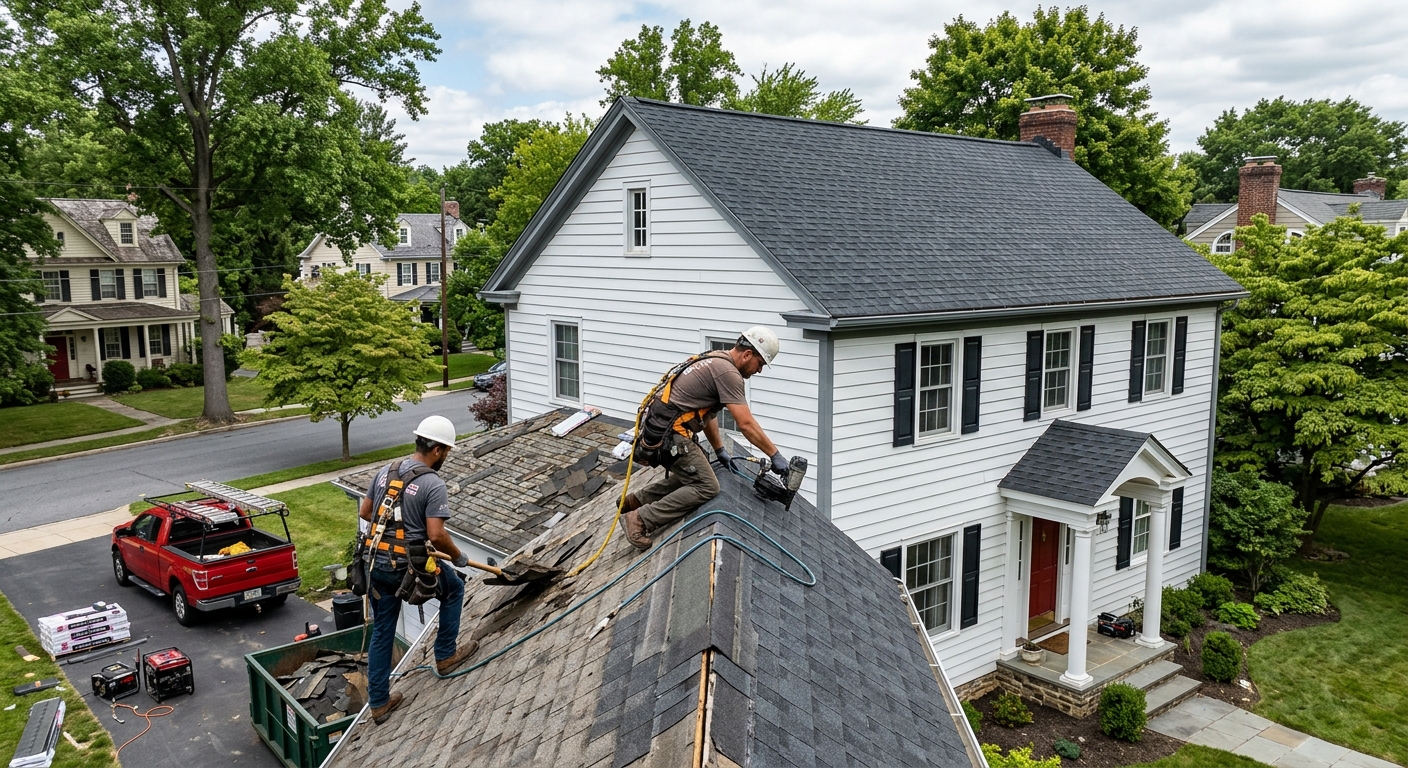
What roof replacement costs in Skippack in 2026
Skippack's housing market, where almost 95% of households own their homes and single-family houses dominate, puts a clear focus on long-term, quality roof investments. Here, a typical household income is high compared to most places in Pennsylvania, so most homeowners want real durability but won't spend for show. Many homes in Skippack have stood since before 1980, and you’ll see the impact of aging roofs everywhere—especially if you look at post‑World War II neighborhoods similar to those in Abington and Cheltenham. Those suburbs built in the postwar boom brought a wave of asphalt shingle roofs, and now, decades later, Skippack faces many of those same systems coming due for full replacement.
Most Skippack homeowners choose architectural asphalt shingles, which fit the local HOA preferences and the style of the neighborhoods. Metal roofs do appear, but are rarer due to both upfront cost and township aesthetics. Flat roof membranes like TPO and EPDM show up mostly on porches, additions, or a few split-level homes, not always visible from the street. Because storm exposure is real in Montgomery County—especially around the Schuylkill River valley—unexpected repairs occur and are priced accordingly. If you see a “bargain” roof quote, read the fine print, as quality replacements fall within the ranges below for good reason.
| Material / Scope |
Lifespan |
Best for |
Price range (installed) |
| Asphalt shingles — architectural (30-yr) |
25–30 yrs |
Most Skippack single-family homes |
$11,500–$23,500 |
| Asphalt shingles — impact-resistant (Class 4) |
30+ yrs |
Homes with large trees or storm exposure |
$18,500–$23,500 |
| Metal standing seam |
40–70 yrs |
Custom homes, high-end renovation |
$27,500–$48,500 |
| Flat roof — TPO or EPDM |
15–25 yrs |
Additions, low-slope porches |
$14,000–$28,500 |
| Roof repair — leak or isolated section |
n/a |
Spot leaks, missing shingles |
$600–$2,300 |
Prices are estimates for a typical Skippack home and vary with roof size, pitch, decking condition and material selection.
Roofing permits in Skippack: what you need before work starts
In Skippack and the rest of Montgomery County, roofing work falls under the Pennsylvania Uniform Construction Code (UCC), which is based on the International Residential Code. In most townships, replacing more than 25% of your existing roof surface requires a building permit. Minor shingle repairs—such as under one roofing square—often do not. Permits are enforced by the local municipality in Skippack unless otherwise handled by the PA Department of Labor & Industry (for municipalities that have opted out).
If you’re hiring a contractor, state law requires them to hold a Home Improvement Contractor (HIC) registration from the Pennsylvania Office of Attorney General for contracts over $500. You can and should verify this at hic.attorneygeneral.gov. Proper workers’ compensation insurance is also mandatory for every employer. Homeowners should check coverage status through the WCAIS system at wcais.pa.gov. Do not rely on verbal assurances from the contractor—insist on seeing proof and confirm it yourself online before any agreement is signed.
A written contract is required by the Home Improvement Consumer Protection Act for work over $500, and you have a 3 business-day right of cancellation. If your Skippack home was built before 1978, the contractor must comply with the EPA Lead RRP Rule for disturbing painted surfaces—this is especially important for fascia or soffit repairs where old paint is present. Always get documentation.
Repair or replace? A decision guide for Skippack roofs
In Skippack, many homes are reaching the later stages of their original or second roof life, especially those built in the decades after World War II. As a result, “patch and repair” only makes sense in very specific cases—such as a single storm-blown shingle or a recent, isolated leak within an otherwise young roof. Any roof older than 20 years showing multiple leak points should be replaced, not continually patched. Flat roof membranes on older additions become brittle after about 20 years and are rarely worth mending if problems recur.
Consider the numbers: if you spend $1,400 three times in eight years on repairs for a 22-year-old architectural shingle roof, you’re at $4,200. That’s over a third of what a full replacement would cost, and you’ll still need a new roof in the end—plus risk interior damage and insurance claim issues. In this part of Pennsylvania, roof age and repeated leaks are the tipping points. If your 25+ year-old roof is leaking, full replacement is almost always the only answer. When you see ponding, blistering, or severe wind and hail damage, don’t chase repairs. Your money and time are better spent on doing the job right.
| Situation |
Recommendation |
Typical cost |
Reasoning |
| Under 15 years, one isolated leak |
Repair |
$600–$2,300 |
Roof has years left; targeted fix saves money |
| 15–25 years, several leak points |
Replace |
$11,500–$23,500 |
Patching is short-term; underlying system is near end of life |
| 25+ years, any active leak |
Replace now |
$11,500–$23,500 |
Structure, decking may be compromised |
| Storm damage, wind or hail |
Document, claim, replace |
$11,500–$23,500 |
Insurance often covers major replacement; patching risks future claims |
| Flat roof ponding or blistering |
Replace membrane |
$14,000–$28,500 |
Systematic failure; repair won't last over our winters |
| Active leak entering winter |
Emergency repair, schedule replacement |
$600–$2,300 |
Prevent interior damage until full replacement can be done |
What a proper Skippack roofing quote contains
To compare Skippack roofing estimates, you need specifics: start with roof area measured in “squares” (100 square feet each) and the actual pitch, as this affects material and labor. Tear-off and disposal should be itemized by number of layers (one, two, or even three isn’t rare here) and note dumpster service. The underlayment must be identified by brand or at least composition (synthetic vs. basic felt) and coverage area. Ice and water shield, mandatory along eaves, should state coverage in feet, not just “included.” Decking replacement—often needed on homes built before 1980—should show a per-sheet cost, not just “if needed.” Both flashing and vent boots require clear specification, or you’ll end up paying again in a few years.
A reliable quote separates the workmanship warranty from the material warranty. You should also see a payment schedule with no more than 15% upfront, and the balance paid only after the roof passes inspection. Any quote that lumps all this together or skips square count hides risk and cost. If a contractor can’t show you what each line item really covers, move on.
| Line item |
What to look for |
Red flag if… |
| Roof area |
stated in squares, with pitch |
no measurement given |
| Tear-off and disposal |
number of layers, dumpster included |
bundled into one figure |
| Underlayment |
product type and coverage |
listed only as 'felt' |
| Ice and water shield |
coverage height at eaves |
omitted entirely |
| Decking |
per-sheet contingency price |
no allowance at all |
| Warranty |
workmanship years stated separately |
only the shingle warranty |
| Payment |
deposit under 15%, balance on completion |
large upfront cash |
What gets discovered after tear-off in Skippack
The biggest surprises on Skippack reroofs come after the shingles are stripped. Rotted roof decking is common, especially on homes built before 1980, where leaks have gone unnoticed or previous re-roofs hid the damage—budget $600–$2,300 extra for repairs, depending on how many plywood sheets need replacing. Poor attic ventilation is another frequent discovery. In our climate, with moderate freeze-thaw swings and humid summers, inadequate venting causes condensation, wets the insulation, and drives early shingle failure through ice damming. Upgrading attic venting or baffles after tear-off usually adds $600–$2,300 for standard changes, more if you need new ridge or soffit vents cut in.
Old or corroded flashing at chimneys and walls is a hidden cost if reused, as it can’t be checked until the roof is off. Replacing flashing generally comes out to $400–$1,200 depending on detail. Vent boots—those little rubber covers around plumbing penetrations—are habitual leak points; replacing them during a reroof usually lands between $100–$300 each. Drip edge and ridge vent upgrades, inevitable for roofs without modern systems, bring another $400–$900. If your quote doesn’t list out all these contingencies, expect a higher final invoice. In Skippack’s mix of older and new homes, a thorough contractor will always prepare you for these finds.
When to book roofing work in Skippack
Here in Skippack, roofing has a real seasonal rhythm. Crews typically ramp up with spring projects in late March as weather stabilizes. April through early June is prime season for replacements—shingles seal well, and contractors’ schedules aren’t overloaded yet. By late June through August, the heat and humidity can slow productivity a bit, but roofs still go on. September and October remain busy months and are the safest bet for predictable dry weather and proper installation temperatures.
If you need a roof in January or February, expect a premium. Emergency winter work—especially after a Nor’easter or ice storm—comes at a cost, with prices easily 10–15% above September replacements. Shingles require specific temperature ranges to seal and perform long-term, so cold installs risk issues. Because Montgomery County is part of the Philadelphia metro, there’s no shortage of contractors, but that also means reputable crews can be booked out 4–8 weeks during peak demand (late summer and early fall). If your old roof is limping along into autumn, get on a schedule before the first frost, or you may pay more for winter patching or have to accept lower-quality labor.
How to vet a Skippack roofing contractor
Before signing anything in Skippack, confirm that your roofer is registered with a valid Home Improvement Contractor number through the Pennsylvania Office of Attorney General at hic.attorneygeneral.gov. Also, check their workers’ compensation insurance status with WCAIS at wcais.pa.gov. For homes built before 1978, verify EPA Lead RRP certification for any tear-out involving old painted surfaces. Insist on a copy of your written contract and don’t let the company start work until you have confirmed these details yourself.
- Verify HIC registration number at official website
- Check workers’ compensation status through WCAIS
- Get a hard copy of the full contract, signed by both parties
- Require explicit scope of work and square count in writing
- Ensure payment schedule requires 15% or less up front
- Ask about decking replacement pricing per sheet
- Request specification sheets for shingles and underlayment
- Insist on a copy of both material and workmanship warranties
- Confirm permit details for full replacements
- If pre-1978, ask for EPA Lead RRP credentials
- Request proof of local work (project addresses, recent photos)
- Meet the job foreman (not just a salesperson)
Red flags for Skippack: door-knockers after storms claiming “free” roofs, any pressure to sign immediately for a discount, no actual HIC number, refusal to provide insurance proof, or “out-of-town” crews with no Montgomery County references. A saturated market means more fly-by-night operations chasing volume after severe weather.
Frequently asked questions — roofing in Skippack
What is the best roofing material for Skippack's climate?
For most Skippack homes, architectural asphalt shingles offer the best balance of cost, appearance, and durability in our local conditions. Southeastern Pennsylvania’s freeze-thaw cycles, humid summers, and occasional windstorms are exactly what leading architectural shingles are designed for. These typically last 25–30 years and resist algae and wind better than old-school three-tabs. If your home is surrounded by large oaks or in an area hit hard by storms, consider impact-resistant (Class 4) asphalt, which sits at the top end of the price range at $18,500–$23,500 installed. Unless you plan to stay for several decades or run a custom build, metal roofing is usually overkill for most Skippack properties, both cost and style-wise.
Will filing a roof claim raise my premium?
In Skippack and throughout Pennsylvania, an insurance claim for storm damage or a sudden event can trigger a rate review, but it’s usually only repeated claims or signs of neglect that drive premiums up significantly. If your home needs a full replacement from a major wind or hail event—typically a $11,500–$23,500 job—your company may increase rates or apply a surcharge at renewal. However, letting a leak continue unrepaired can cost more in the long run, both in structural damage and insurability. Always have storm losses well-documented and work with a contractor who knows how local insurance adjusters operate.
Why do roofs fail faster in southeastern Pennsylvania?
Skippack’s climate—marked by freeze-thaw cycles, 30 psf ground snow loads, and muggy summer stretches—puts pressure on roofing materials. Even well-installed asphalt shingles will break down faster here than in milder zones, particularly if attic ventilation is neglected. Humidity drives algae growth; winter ice damming can loosen or curl shingles and lead to wood rot underneath. With about a quarter of Skippack’s homes built before 1980, older ventilation systems often accelerate shingle wear. If you want your $18,500 roof investment to reach its full lifespan here, insist on upgraded ventilation and professional installation.
Is ice barrier underlayment required in Skippack?
Yes, ice and water barrier is required by code along the eaves of homes in Skippack, in line with the Pennsylvania Uniform Construction Code’s adaptation of the IRC. Our area’s moderate freeze-thaw and 14 °F winter design temperatures make ice dams a real risk, especially if a roof was poorly vented or insulated in the past. Make sure your roof quote specifies the height (in feet) of ice and water shield being installed. Proper coverage, especially on low-pitch areas, can prevent repair bills of $600–$2,300 from water entering the eaves after freeze events.
Why is my Skippack roofing quote higher than the online average?
Online averages rarely account for real materials, ventilation fixes, and tear-off costs in a place like Skippack, where a high percentage of roofs are layered or have sections needing decking replaced. Labor costs in Montgomery County are also higher than outlying rural areas due to demand and insurance requirements. If you get a quote under $11,500 for a full tear-off and replacement with architectural shingles, look very closely—corners may be getting cut on materials, flashing, or ventilation. A detailed inspection here will almost always drive repairs beyond the “national average” roof numbers you’ll find top-ranked online.
How far ahead should I book a roofer in Skippack?
With the Philadelphia metro market’s density, Skippack roofers with solid reputations are commonly booked out 4–8 weeks from mid-summer into fall. If you’re aiming for a September or October project—for optimal weather and shingle performance—schedule in June or early July. The only way you’ll get a crew on short notice in September is if you’re paying emergency rates, which can push your total to $23,500 for a standard job. For emergency leaks, most companies reserve slots but charge more. Don’t wait for your roof to fail entirely if you want skilled labor and fair pricing in Skippack.
What warranty should a Skippack roofer offer?
Every replacement in Skippack should come with two distinct warranties. The manufacturer’s material warranty—often limited lifetime for architectural shingles—and a separate workmanship warranty from the roofer. A good local contractor will give you at least 5 years on workmanship; some offer 10. Watch out for quotes offering only the shingle warranty—this does not cover labor or installation mistakes. On a job costing $18,500 for architectural shingles, that installation warranty is your only protection if leaks appear down the line due to improper nailing or bad flashing, which are not manufacturer defects.
Is a sagging roof line an emergency?
Yes, a sagging or bowed roof in Skippack is a structural warning sign—especially on homes built before 1980. It may result from rotted decking, inadequate rafters, or even sustained water damage, none of which will correct themselves. Don’t simply overlay new shingles if the framing is compromised. Emergency repairs can range from $600–$2,300 to stabilize, but resolving the underlying cause (and restoring resale value) almost always requires a full deck and rafter evaluation—best handled before the next storm. Call a local pro for assessment as soon as you spot a sag.
What's the cheapest way to replace a roof in Skippack?
The lowest-cost full roof in Skippack will be a single layer of architectural asphalt shingles, basic ridge vent, and minimal plywood replacement. Expect no real frills or premium underlayments. Even then, the installed range is $11,500–$23,500—going lower means something (materials or scope) is being left out. You can save by scheduling outside of peak fall months, getting competing bids, and avoiding extras like decorative metal or high-profile ventilation. Don’t skip proper ventilation or reuse old flashing just to trim hundreds off your project, as this almost always leads to expensive repair calls within a few years.