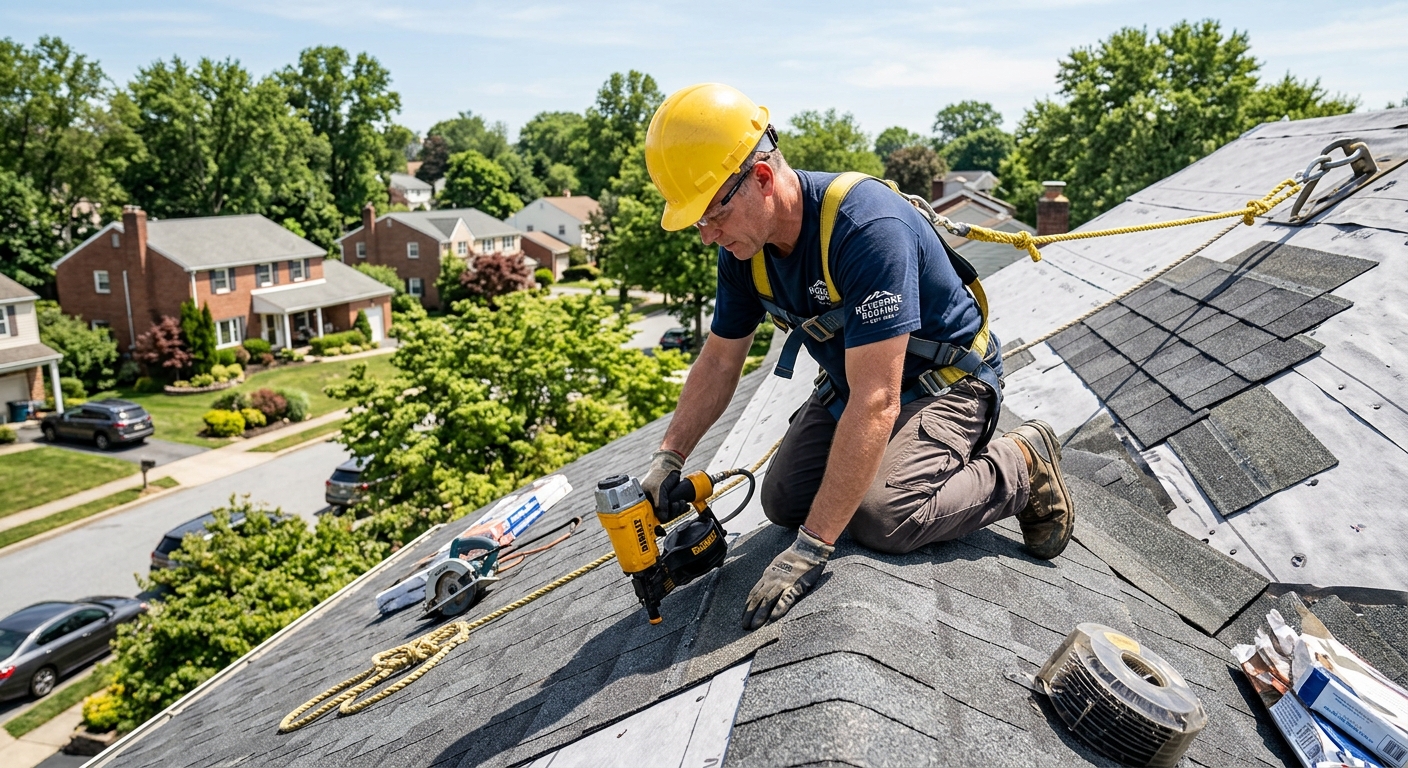
Roofing Replacement & Repair costs in Moore — 2026
In Moore, roofing costs reflect both the township’s specific housing stock and Northampton County’s contractor trends. With a homeownership rate over 90% and the vast majority of homes being single-family (U.S. Census Bureau, ACS 2024), most residents are responsible for roof upkeep and see the direct return on this investment in comfort and resale value. Large post‑World War II subdivisions in nearby Palmer Township mean many Moore homes were built together, typically with architectural asphalt shingles, and even today these same neighborhoods are cycling into their second or even third roof replacements. That means whole blocks can face similar roof aging — and, as a result, Moore contractors routinely handle full tear-offs rather than spot repairs.
Most Moore roofs are pitched, favoring architectural asphalt or, to a lesser extent, metal standing seam. Flat roofs are seen on utility structures or additions, not the primary house. Prices in Moore track closely with the Lehigh Valley: architectural shingle replacements are common, and insurance pays out for wind or ice event losses at the higher rates seen in wind-exposed escarpment areas of Northampton County. Below is a breakdown of what homeowners here can expect to pay in 2026:
| Material / Scope |
Lifespan |
Best for |
Price range (installed) |
| Asphalt shingles — architectural (30-yr) |
25–30 yrs |
Pitched suburban single-family, code-compliant replacement |
$9,800–$20,500 |
| Asphalt shingles — impact-resistant (Class 4) |
30+ yrs |
Wind-exposed roofs, homes near escarpment |
$16,000–$20,500 |
| Metal standing seam |
40–70 yrs |
Custom homes, barns, maintenance-averse owners |
$23,500–$42,500 |
| Flat roof — TPO or EPDM |
15–25 yrs |
Utility structures, newer additions |
$12,500–$25,000 |
| Roof repair — leak or isolated section |
n/a |
Flashing leaks, shingle blow-offs, small areas |
$500–$1,950 |
Prices are estimates for a typical Moore home and vary with roof size, pitch, decking condition and material selection.
Roof age and construction era in Moore
Moore’s housing reflects the same trend as Palmer Township — a heavy wave of post‑World War II construction, with more than half of homes built before 1980 (U.S. Census Bureau, ACS 2024). That means most roofs here sit on pitched trusses, not rafters over attic storage, and the sheathing is usually 1/2" plywood or sometimes tongue-and-groove plank if the home is from the earlier side of that range. For these homes, original roof installations used a single layer of 3-tab or early laminated shingles, but by the time these houses entered their second reroofing cycle, contractors switched to architectural asphalt, adding another 25–30 years to most roofs.
In Moore, two issues come with this era: First, ice barrier underlayment was generally not code until the 1990s, so many roofs only have bare felt at the eaves if they haven’t been redone since. Second, many homes have already had one or even two layers of shingles added before full replacement became necessary. That can mean tear-offs in this township are more labor-intensive, as multiple layers need to be removed to deck for code compliance. And when plywood underlayment is original, leaks or decades of condensation often mean sheets need to be replaced; that adds visible cost to a replacement, and the best estimates make clear how contingencies are handled.
If your Moore house is in a 1970–1980s subdivision, it’s likely on its second or third roof. What matters for your quote is whether the last replacement included a full tear-off, ice barrier at the eaves, and the right flashing details for today’s code — most local jobs don’t uncover surprises, but when they do, it’s almost always rotten plank joints or edge rot at the eaves from old short gutters.
Filing a roof claim after a Pennsylvania storm
Storm claims are a reality in Moore, especially along the ridgeline winds that cross Northampton County. After a blow-off or wind-driven damage, start by photographing all roof surfaces, gutter lines, and any debris found around your home. Before cleanup or removal, you want timestamped photos and a written record; insurance companies often base actual cash value calculations on the documented pre-mitigation state. Call your insurance company and request a written scope of loss. Most adjusters will visit in person, especially for a replacement-level claim, and provide an assessment of both visible damage and potential code upgrades.
Understand the difference between “actual cash value” and “replacement cost”: most policies in Pennsylvania will factor depreciation unless you have a replacement cost endorsement. Review the adjuster’s scope in writing before any contractor begins work. Importantly, under the Home Improvement Consumer Protection Act (HICPA), Pennsylvania requires a written contract for any job over $500, and you have a three business-day right to cancel. Any contractor offering to “waive your deductible” is violating Pennsylvania law; insurers consider this insurance fraud. If a roofer hints at “covering” your deductible, walk away — this puts you at risk with your insurer and is a classic sign of an unscrupulous operator. Instead, expect to pay your full deductible, and confirm that your chosen contractor is appropriately registered: you can verify Home Improvement Contractor registration at hic.attorneygeneral.gov.
Snow load, ice dams and wind in Moore
Snow and wind put roofs in Moore under loads you just don’t see one county west. The ground snow load here is 40 psf, making it vital that shingle and underlayment choices can handle not just standing snow but the freeze-thaw cycles that trap water at the eaves. When attic air leaks warm the lower surface of the roof, snow melts just above the wall and refreezes in the colder overhang — forming classic ice dams. As the dam grows, water backs up under the shingles and traditional felt, and if there’s no ice-and-water shield extended at least 3 feet in from the eave (as more recent code requires), that water soaks the plywood, causes delamination, and can even reach interior ceilings. Damage from a single ice dam can jump a repair from a modest $500–$1,950 patch to a full plywood tear-off at $9,800–$20,500 for shingle replacement.
Wind also matters here, especially in Forks and along the Lehigh Valley escarpment, where ridge winds have a habit of flipping tabs or even entire shingle courses. Insurance adjusters know Northampton County’s wind profile and don’t pay for “wind damage” unless shingles are clearly creased, missing, or have visible aggregate loss. Hail, while less common, can bruise shingles — compressing the mat and reducing life, even if no granules are immediately missing. Whenever any of these events occurs, a close inspection from a contractor who knows Moore’s exposures is key; not every aged shingle is insurance-eligible, but a wind-blown field is. Moore’s snow and wind risks means investing in Class 4 impact shingles or a wider ice barrier layer is money well spent, even if it nudges your price up toward $16,000–$20,500.
What a proper Moore roofing quote contains
In Moore, a trustworthy roofing quote doesn’t just list a total — it gives you the details so you know exactly what you’re getting. The estimate should say how many squares your roof covers (a “square” is 100 square feet), with pitch and access conditions spelled out. Tear-off and disposal should be itemized: a good quote lists how many layers will be removed and whether dumpster costs are included. Underlayment type matters, as do ice and water shield coverage — don’t settle for “felt” or “included”: you want branded products and designated coverage areas called out.
If your decking is older plywood or plank, the quote should set a per sheet replacement price for any rot uncovered; this should be listed as a contingency, not buried inside a padded lump sum. Flashing, vent boots, and chimneys need to be addressed — either as replacement or as specifically excluded, with reasons stated. Ask for both workmanship and manufacturer warranties, separated (for example, a 5-year labor warranty distinct from the shingle’s warranty). The payment schedule is a tell: in Moore, don’t pay more than 15% upfront, and the balance should be on completion and visual inspection. Here’s what the major line items look like in a real Moore quote:
| Line item |
What to look for |
Red flag if… |
| Roof area |
stated in squares, with pitch |
no measurement given |
| Tear-off and disposal |
number of layers, dumpster included |
bundled into one figure |
| Underlayment |
product type and coverage |
listed only as 'felt' |
| Ice and water shield |
coverage height at eaves |
omitted entirely |
| Decking |
per-sheet contingency price |
no allowance at all |
| Warranty |
workmanship years stated separately |
only the shingle warranty |
| Payment |
deposit under 15%, balance on completion |
large upfront cash |
Why gutters get replaced with the roof
Most Moore roofs are part of a complete water management system, and gutting the roof but leaving deteriorated gutters is a false economy. The downspouts, discharge locations, drip edge, and even the way your yard slopes all decide where water ends up. Replacing the roof without addressing old or undersized gutters means water can overshoot, dumping right next to the foundation—and in Moore’s clay-heavy soils, that leads directly to wet basements and foundation trouble.
Modern architectural shingle reroofs almost always require new aluminum gutters: not only do newer drip edges and gutter brackets fit differently, but many manufacturers now require proper water discharge as part of the system warranty. In practical terms, if you’re spending $9,800–$20,500 on a full replacement, expect gutters and downspouts to add another $2,400–$4,500 to a standard job, depending on home size and gutter guards. While it can feel like an upsell, tying gutter work to the roof project is an investment in both durability and peace of mind. If a quote doesn’t mention gutters, ask whether your current system will meet warranty and code requirements under the new installation.
Roofing permits in Moore: what you need before work starts
Moore falls under the Pennsylvania Uniform Construction Code (UCC), based on the IRC, with code enforced by the municipality or, in opted-out areas, by the PA Department of Labor & Industry. In Northampton County, each township—including Moore—typically runs its own local code office. For a full roof replacement, especially one involving new sheathing, a building permit is usually required. Minor shingle patch repairs generally do not need a permit in Moore, similar to the rules in Easton, where small repairs can often proceed without one.
Before signing a contract for roofing work over $500, make sure your contractor is registered for Home Improvement Contractor (HIC) work: you can check their registration at hic.attorneygeneral.gov. Pennsylvania requires every roofing employer to carry workers’ compensation insurance, and you can verify coverage through the state’s WCAIS system (wcais.pa.gov). Both registration and active insurance are non-negotiable: a legitimate Moore contractor won’t hesitate to show proof. Remember, for work beyond minor patching, a permit is not just paperwork—it’s also your best guarantee that the project will be inspected to code and eligible for insurance claim payout if issues arise later.
Frequently asked questions — roofing in Moore
Is a sagging roof line an emergency?
A sagging roof line in Moore is always cause for concern and often signals trouble with the roof’s framing, deck, or underlying support. Given more than half of homes here date before 1980, older plywood or plank sheathing is sometimes past its prime, especially if there’s been a history of leaks or poor attic ventilation. Sagging can be a symptom of long-standing water infiltration, rot at the eaves from past ice dams, or over-spanned decking. While not every sag is an immediate collapse risk, you shouldn’t wait—this sort of defect can spiral into a major expense if left unaddressed. A qualified Moore roofing contractor will check both the surface and attic structure before recommending repair or full replacement. Sometimes the fix is a local reinforcement and a $1,250 repair ($500–$1,950); in more severe cases, a sagging area could prompt a full tear-off in the $10,000+ range. Don’t ignore it, but don’t panic—what matters is prompt assessment from someone who understands our local building stock.
What causes ice dams on Moore roofs?
Ice dams on Moore roofs are a familiar problem, especially after heavy snow or back-to-back freeze-thaw days common in Northampton County. They form when attic heat escapes and melts snow at the ridge, sending water down to the colder eaves, where it refreezes and gradually builds up a dam. As the dam grows, it holds back more meltwater, which can back up under the shingles and eventually leak into attics and walls. Many Moore homes were built before 1980, using insulation and vapor barrier standards that allow heat loss—this, combined with original felt-only eaves protection, makes the region especially vulnerable. Homeowners often only notice the consequences when ceilings stain or wall paint peels in late winter. Repairing leaks linked to ice dams can range from an affordable patch ($500–$1,950) to a full partial roof replacement if deck rot is discovered. Preventing ice dams by upgrading insulation, ventilation, and installing ice barrier at the eaves is usually far less expensive in the long run.
Is ice barrier underlayment required in Moore?
In Moore, ice barrier underlayment—sometimes called “ice and water shield”—is a code requirement for reroofs and roof replacements under the Pennsylvania Uniform Construction Code. It’s especially enforced because our region’s ground snow load is 40 psf, and there’s severe ice-dam exposure through the Poconos and Lehigh Valley escarpments. Most homes built before 1990 likely do not have ice barrier at the eaves, but when you have a permit pulled for reroofing today, at least 3 feet of ice barrier from the eave up is standard. This protects the lower sections of the roof and prevents water backup under shingles. While this adds a few hundred dollars to a quote, the protection it gives—especially when compared to the typical $9,800–$20,500 full replacement cost—makes it a must-have. If your quote omits this detail, insist on it—there’s no financial sense in skipping code-required ice barrier in a region so prone to water infiltration and deck rot.
What happens if it rains mid-replacement?
If it rains during a Moore roof replacement, a reputable contractor will pause work and cover open sections with tarps or roofing underlayment immediately. Given the high owner-occupancy rate in Moore (U.S. Census Bureau, ACS 2024), most crews know homeowners are on site and expect transparency and proactive protection. No reputable roofer will leave your decking or insulation exposed to the elements overnight; if a major storm is forecast, many will even reschedule tear-off to avoid the risk altogether. If minor rain does intrude, reliable contractors work to fix any resulting damage without added charge. It’s a situation that shouldn’t add cost to you—the best Moore roofing companies build in contingency plans and fast weather response. If you suffer a leak or visible interior damage mid-project, repairs may fall under your homeowner’s insurance (typical leak repairs here run $500–$1,950). Always ask your roofer about their rainy-day protocol before work begins.
How much does it cost to repair a roof leak in Moore?
Roof leak repair costs in Moore run between $500–$1,950, depending on the location of the leak, whether interior drywall or attic insulation is affected, and how accessible the damaged area is. Most small repairs—such as flashing at a chimney, a few missing shingles, or a valley with minor rot—typically cost about $1,250. If the leak has gone untreated and deck rot or mold is found, repairs can nudge toward the upper end of that band. For older Moore homes with historic details, repairs sometimes involve more detailed carpentry or matching unusual shingles, which can add modest cost, but the range above covers almost all cases in this township. Always request documentation of the repair and ask whether the cause (ice dam, wind, or missing flashing) is likely to recur, as prevention could save you thousands over the long lifespan of a Northampton County roof.
How do I file a storm damage roof claim in Pennsylvania?
Filing a storm damage roof claim in Moore (and across Pennsylvania) is a predictable process. First, photograph all visible damage, including missing shingles, exposed deck, granule loss, or gutter damage. Don’t start cleanup until you’ve logged photos and video of the condition. Next, contact your insurance provider and request an adjuster visit—a scope of loss will follow, which details what’s covered and whether the payout is actual cash value or replacement cost. Pennsylvania’s Home Improvement Consumer Protection Act requires a written contract over $500 and grants you a 3-business-day right to withdraw from any agreement. Don’t trust any roofer offering to “waive your deductible”; that’s prohibited under state law and invites insurance trouble. Work with a Moore-based contractor registered through hic.attorneygeneral.gov, and keep copies of all documents for your records. If you need to hire for temporary repairs or tarping, these usually fall in the $500–$1,950 range. Full replacements covered by insurance are typically priced between $9,800–$20,500.
What is the best roofing material for Moore's climate?
For Moore’s climate—defined by 40 psf snow loads, wind exposure along the escarpments, and widespread pitched roofs—architectural asphalt shingles are the overwhelmingly common choice. They stand up well to our snow and freeze/thaw cycles, and most homes—especially those built in Palmer-era subdivisions—are designed with these in mind. For owners wanting longer-term value, upgrading to Class 4 impact-resistant asphalt shingles is sensible, if you’re in a wind- or tree-exposed location; these cost more up front—up to $20,500—but resist blow-off and hail hits. Metal standing seam is a great “set it and forget it” solution, especially for custom homes and barns, but at $23,500–$42,500, it’s a bigger investment and sometimes not warranted for typical Moore architecture. Flat membranes like TPO or EPDM are uncommon for main home roofs here. For most Moore families, weather-tested architectural asphalt is the practical and cost-effective pick.
Does roof pitch affect the price in Moore?
Yes, roof pitch has a significant effect on price in Moore. Steeper roof pitches (those above 6/12) make labor more intensive, require additional safety measures, and sometimes generate more waste, particularly if valleys and dormers are involved. In practical terms, that can push a full architectural shingle replacement from the lower end around $9,800 up to $18,000 or more. Pitch is especially relevant in Moore, where most subdivision homes from the postwar era have 5/12 to 8/12 pitches. Low-slope additions (under 4/12) may need a different material altogether, like TPO or EPDM, with a separate price structure ($12,500–$25,000). Any serious quote will state both total area and pitch explicitly; if it’s missing from your estimate, ask for a breakdown, as this is the main reason two otherwise identical houses can have very different bids.
How much deposit should I pay a roofer upfront?
In Moore, Pennsylvania, a standard deposit for roofing work should not exceed 15% of the total contract price. For example, if you’re quoted a typical architectural shingle replacement at $16,000, a reasonable deposit is $2,400 or less. State law (HICPA) supports this limit, protecting you from cash-flow abuses. The balance should be due upon completion and after you’ve seen the work finished and inspected. Any contractor in Moore requesting 30%, 50%, or even full payment up front is not following best practice and likely isn’t registered as a Home Improvement Contractor with the state. Don’t release more than the standard deposit before a single shingle is removed; stick with well-established local firms who are transparent about pricing and compliant with Pennsylvania’s consumer protection standards. You’re paying for quality and peace of mind, not for someone else’s working capital.