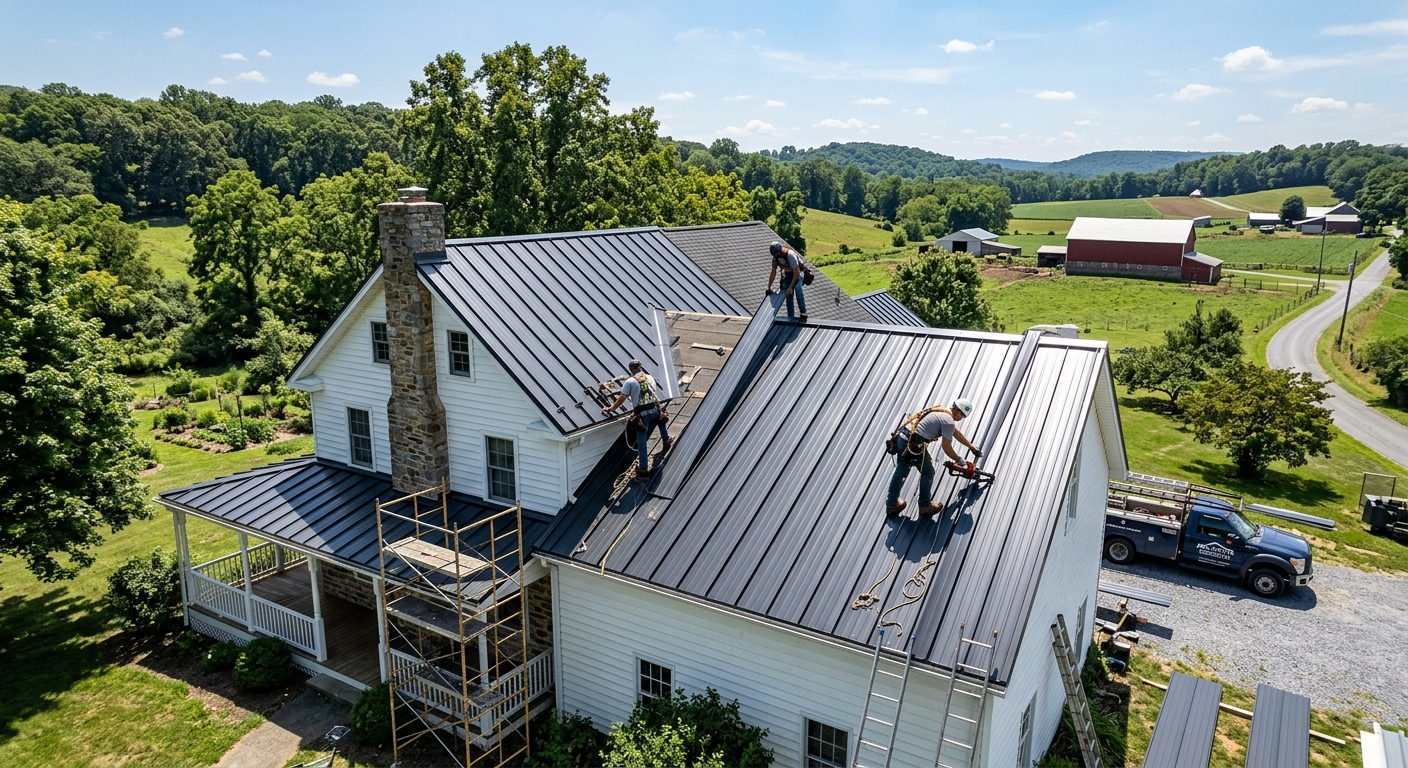
Roofing Replacement & Repair costs in Mount Joy — 2026
Mount Joy’s roof replacement costs are closely tied to the region’s older housing stock and its strong homeownership rate (U.S. Census Bureau, ACS 2024), which means decisions are often made by long-term residents rather than landlords seeking to minimize expenses. Many homes here, especially those predating 1950, have steep-pitch roofs and sometimes carry two or even three layers of old shingles. This adds considerable labor, since full tear-off is nearly always necessary—and each layer has to be disposed of and replaced with new decking if needed. In practical terms, swapping out a roof here involves more than just swapping shingles, which puts pressure on both timeline and budget.
Asphalt shingles remain the most common material, with competition among crews (including Amish and Mennonite roofing outfits) keeping installation quality and pricing highly competitive. Flat roof replacements are typical for rear additions or porches, and the cost for membrane replacement can jump if rot or poor drainage is discovered under older overlays. The range for a full architectural asphalt replacement is substantial—families are most often quoted $10,000–$21,000, with a typical job landing in the $16,500 bracket. Metal standing seam installations are less common on Mount Joy’s historic frame houses, but when installed, the investment is markedly higher.
| Material / Scope |
Lifespan |
Best for |
Price range (installed) |
| Asphalt shingles — architectural (30-yr) |
25–30 yrs |
Typical Mount Joy single-family roof |
$10,000–$21,000 |
| Asphalt shingles — impact-resistant (Class 4) |
30+ yrs |
Storm-prone exposures, steeper slopes |
$16,500–$21,000 |
| Metal standing seam |
40–70 yrs |
Low maintenance, long-term investment |
$24,500–$43,000 |
| Flat roof — TPO or EPDM |
15–25 yrs |
Flat or near-flat porch/addition sections |
$12,500–$25,500 |
| Roof repair — leak or isolated section |
n/a |
Flashing, chimney leak, spot repairs |
$550–$2,000 |
Prices are estimates for a typical Mount Joy home and vary with roof size, pitch, decking condition and material selection.
Permits and code requirements in Mount Joy
Roofing work in Mount Joy is governed by the Pennsylvania Uniform Construction Code (UCC), which is built on the IRC and enforced at the municipal level. Mount Joy falls within Lancaster County, where each township manages its own code enforcement. For roof replacements involving new sheathing or any structural carpentry, a building permit is typically required in nearby Lancaster city and should be expected for similar scope work in most surrounding townships. Simple repairs, such as swapping out a handful of damaged shingles, are often performed in the county’s townships without any permit.
Contractors working on projects valued over $500 must hold active Home Improvement Contractor (HIC) registration through the Pennsylvania Office of Attorney General. Homeowners can verify a roofer’s HIC status at hic.attorneygeneral.gov. Likewise, all employers in Pennsylvania—including roofing contractors—are mandated to carry workers’ compensation insurance; this can be confirmed by searching the statewide WCAIS system at wcais.pa.gov. Always ask to see both credentials before signing a contract, as they form your first and best legal defense if a dispute arises or someone is injured on your property during the job.
Federal lead paint laws apply to any home built before 1978, so make sure your contractor follows EPA Lead RRP rules, which you can verify at the EPA’s search portal. In Pennsylvania, there is no special roofing trade license—registration and insurance are your main lines of protection.
The cost drivers behind a Mount Joy roof replacement
In Mount Joy, bid prices for roof replacements can diverge sharply—even for neighboring houses on the same block—due to a few consistent but critical local factors. First and foremost is the prevalence of steep-pitch, pre-1950 roofs, which are notorious for having multiple layers of shingles. Every additional layer adds to labor and landfill costs, often tacking on $500–$1,500 per layer just for removal and disposal alone. If the roof deck beneath is found to be rotted (a real risk on century-old homes in the county), you’re looking at additional material charges of $75–$150 per sheet of plywood replaced.
Mount Joy’s pronounced freeze-thaw cycling, plus a regional ground snow load of 30 psf, means ice damming is a recurring issue here. Therefore, a code-mandated ice barrier at the eaves is an absolute must in all but the rarest cases, adding $300–$800 to the total. If a contractor doesn’t specify this in their scope or estimate, push back—skimping invites future leaks. Material selection is the final major driver: while basic 3-tab shingles are still seen on older homes, most quotes now reflect higher-grade architectural or Class 4 impact-resistant shingles, which add $500–$2,500 to the job.
Roof size is quoted in “squares” (100 sq ft sections)—bigger roofs demand more shingles and more labor, but it’s often the access (narrow alleys, steep pitches, or houses with elaborate landscaping) that determines crew efficiency and risk. Steep-pitch jobs may result in a 20–30% bump in labor compared to low-sloped counterparts. All of this is shaped by Mount Joy’s locally competitive labor market, where workmanship is closely watched but underlying material and access costs can’t be negotiated away.
| Factor |
Why it matters here |
Cost impact |
| Roof size in squares |
each square is 100 sq ft of roof surface |
primary multiplier |
| Pitch and access |
steep pitches need harnesses and slow the crew |
+20–30% labour |
| Existing layers to tear off |
two or more layers means full tear-off and disposal |
$500–$1,500 per layer |
| Decking condition |
rot is found during tear-off, not before |
$75–$150 per sheet |
| Ice barrier at eaves |
required where ice damming has a history |
$300–$800 |
| Material grade |
3-tab vs architectural vs Class 4 impact-resistant |
$500–$2,500 |
What Mount Joy's climate does to a roof
In Mount Joy and throughout Lancaster County, roofing issues are shaped more by sudden thunderstorm wind bursts from the Susquehanna River valley than by lake-effect snow. These storms create powerful updrafts and swirling wind loads that catch the eaves and ridges of steep-pitch roofs—the design common in the area’s pre-1950 homes. When high winds pry at older or poorly installed shingles, minor roof leaks can become full tear-offs overnight, resulting in out-of-pocket repair costs between $550–$2,000.
Although the region’s ground snow load is set at 30 pounds per square foot (psf), major snow accumulation is less of a risk than repeated freeze-thaw events. Here’s the mechanism: On a sub-12°F winter morning, insulation gaps or roof leaks let interior heat melt snow at the ridge. The runoff refreezes over the eaves, which stay cold—forming an ice dam. With every cycle, meltwater can back up under shingles, rot out the deck, or even seep inside onto ceilings. That’s why code requires ice barriers along all eaves—without them, a $16,500 new roof can go bad in five years.
Hail is a less frequent problem than out west, but when it hits, it bruises asphalt shingles and reduces their life even if punctures aren’t visible. Impact-resistant Class 4 shingles are sometimes specified here for that reason, even though they come at a premium, running from $16,500–$21,000 installed. For flat roof add-ons, ponding after storms can accelerate membrane failure, raising replacement costs and shortening lifespan compared to sloped sections.
Storm damage and insurance claims in Mount Joy
When a summer thunderstorm hits Mount Joy and damages your roof, the right claim sequence is crucial. Take clear photos of damage before any cleanup or tarping—these serve as primary evidence for your insurer. Next, contact your insurance company to file the claim and ensure an adjuster is assigned promptly. The adjuster will produce a written scope of loss, describing what will be repaired or replaced and how much the company will pay. In Pennsylvania, your actual claim payment may be based on Actual Cash Value (ACV)—the depreciated value of your roof—or Replacement Cost Value (RCV), which covers the full replacement less your deductible. Make sure to clarify which applies to your policy, as the difference often runs into the thousands.
State consumer protections apply: the Home Improvement Consumer Protection Act (HICPA) requires a written contract for work over $500, and you have a three business-day right of cancellation after signing. Never accept an offer from any contractor to “waive” or “cover” your deductible—it’s strictly prohibited under Pennsylvania law and is a surefire sign that the roofer is shady or cutting legal corners. Your insurer will expect detailed documentation and invoices, and may withhold final payment until all work is complete and you submit proof. Never pay a roofer in full before the materials are delivered and substantial work is performed, especially when dealing with insurance proceeds. By following these steps and working with a registered, insured Mount Joy contractor, you protect your claim and your property.
Flat roof sections: the part most quotes get wrong
Flat or low-slope roof sections—on porches, rear additions, or the occasional garage in Mount Joy—should never be treated like the main pitched roof. Standard asphalt shingles simply cannot perform below about a 4/12 pitch, and will almost always leak on the 2/12 and 3/12 slopes often seen here. Water ponding, especially during freeze-thaw spells, accelerates rot and can cut the life expectancy of the wrong material down to just a few years.
The right approach is a continuous membrane roofing system, like TPO or EPDM, which is designed for low-slope applications and typical lifespans of 15–25 years. Replacement of a flat membrane roof on a Mount Joy addition usually lands in the $12,500–$25,500 range—including the extra labor to strip out multiple old layers and potential deck repairs. A roofer quoting shingles for your nearly flat section is either using outdated practices or signaling disregard for basic best practices, and should be reconsidered. Drainage should always be built into the scope; if a contractor ignores ponding, the new roof will start to fail long before the main house roof does.
Workmanship vs manufacturer warranty
Mount Joy homeowners often conflate workmanship and manufacturer warranties, but the difference is critical. A manufacturer warranty covers defects in shingles, membrane, or metal panels—usually on a prorated basis as the roof ages. It rarely covers labor, and nearly always excludes issues related to poor installation, improper ventilation, or if you’ve had the roof layered over existing shingles.
Workmanship warranties, by contrast, guarantee the installer’s labor. If flashing leaks, shingles pop, or seams fail because they were improperly installed, it’s the roofer’s warranty that matters. But these are only as good as the company’s track record—if a two-year-old company offers a 25-year workmanship warranty, it’s not nearly as solid as 10 years from someone with decades in Lancaster County. Also, double-check transferability; some workmanship warranties (especially on smaller or ultra-local firms) don’t carry over at resale, and nearly all require you to notify the roofer promptly if a leak appears.
Most manufacturers require registration of your new roof within 30–60 days for warranty to be valid, and may void coverage if you don't follow ventilation codes or tear off all old layers. Always ask about both types of warranty in writing, understand their exclusions, and register the warranty right after installation.
Frequently asked questions — roofing in Mount Joy
Do I need to leave my house during a roof replacement?
For most Mount Joy homes, you don’t need to leave during a roofing replacement, unless you’re particularly sensitive to noise. Installers rip off old layers and hammer on new decking and shingles, which can be loud enough to rattle windows—especially on the steep-pitch, pre-1950 homes found in this area. If you work from home or have small kids, plan ahead for a few days of disruption. Work typically wraps up in two to four days for a full asphalt roof, priced between $10,000–$21,000, depending on size and complexity. Heavy dust or debris rarely enters living spaces unless attic hatches are open, but you’ll want to move cars and cover anything in the attic. Staying home is safe, but you may want to plan errands or day trips while the crew is working overhead.
Does roof pitch affect the price in Mount Joy?
Yes—steep-pitch roofs are extremely common in Mount Joy, given the prevalence of older houses. A 10/12 or 12/12 pitch requires safety harnesses, more scaffolding, and can slow a crew by 20–30% compared to a low-slope roof. This extra labor is why you’ll see quotes for otherwise similar houses diverge by a few thousand dollars. On a typical architectural asphalt replacement, you can expect a range from $10,000–$21,000, but steeper roofs almost always land toward the higher end. If your contractor doesn’t factor in pitch—either by visiting your house or checking in person—they’re likely guessing, which could mean bigger change orders once work begins.
How do I file a storm damage roof claim in Pennsylvania?
In Mount Joy, the process starts with documenting every visible sign of storm damage before making any repairs. Use your phone for photos and video, both up close and from the street. Call your insurer next—they’ll ask for a written description and typically send out an adjuster. Pennsylvania law requires all contracts over $500 to be in writing, and you have three business days to cancel. Your claims payment will either be for actual cash value or replacement cost, so clarify this up front; difference on a full asphalt replacement can be up to several thousand dollars, with a full job sometimes reaching $16,500. Only hire a contractor registered with the state and never accept a promise to “waive” your deductible—it’s illegal here and flags a contractor as disreputable.
How much does a flat roof replacement cost in Mount Joy?
Flat roof replacements—common on Mount Joy’s porch and garage additions—cost more than sloped sections because they require a specialized membrane like TPO or EPDM. For a typical low-slope area, you’re looking at $12,500–$25,500, depending on square footage and condition of the deck. These systems are built for 15–25 years of service, but if your contractor finds water-damaged decking during tear-off, expect per-sheet charges on top. Using shingles on a flat or near-flat section is a shortcut that’s sure to fail—insist on the right membrane, and make sure drainage is part of the plan.
Can I inspect my own roof safely?
In Mount Joy, most single-family homes have steep roofs—often 8/12 or steeper on older houses—which makes DIY inspection risky. While binoculars or a camera on a monopod can spot missing shingles or obvious damage from the ground, accessing the roof itself is best left to professionals. The cost for a proper diagnostic roof repair or inspection is often under $550–$2,000, and experienced crews have the harnesses and insurance required by Pennsylvania law. A slip from even a one-story Mount Joy roof is a major injury risk, so save personal effort for ground-based checks—leave the roof walking to registered contractors with proper workers’ compensation.
Is metal roofing noisy in rain?
Properly installed standing seam metal roofs in Mount Joy are not significantly noisier than shingle roofs, thanks to modern underlayment and existing roof decks. Most metal is installed over solid decking, which absorbs and muffles sound. If you hear loud drumming on a metal roof, the culprit is usually improper installation or lack of insulation—hardly ever an issue when replacing a typical Mount Joy roof in the $24,500–$43,000 range. Ask your roofer to specify underlayment type and installation technique if noise is a concern; both can make a big difference, especially in the frequent Susquehanna valley thunderstorms.
What warranty should a Mount Joy roofer offer?
In Mount Joy, responsible contractors offer two warranties: manufacturer (covering product defects) and workmanship (covering labor). Manufacturer warranties for asphalt or metal often claim “lifetime” coverage but are prorated and subject to registration and code-compliant ventilation. Workmanship warranties commonly run 5–10 years; don’t be seduced by promises of 25 years from a brand-new business—look for someone established locally. With a replacement priced from $10,000–$21,000, make sure both are spelled out in your contract and check if the workmanship coverage transfers if you sell. Always submit warranty registration forms as soon as the job finishes for coverage to take effect.
Do I need a permit to replace a roof in Mount Joy?
For most full roof replacements in Mount Joy—especially if replacing decking or making structural improvements—a permit is required under the Pennsylvania Uniform Construction Code. Minor shingle repairs, such as replacing a handful of tabs after a storm, don’t require permits in most surrounding Lancaster County townships, but anything more substantial should be checked with your local township office. Ask your contractor to supply a copy of their Home Improvement Contractor registration (which you can verify at hic.attorneygeneral.gov) and proof of workers’ compensation insurance from WCAIS. On a typical full replacement (priced $10,000–$21,000), you want both legal and safety protections in place before work begins.
What causes ice dams on Mount Joy roofs?
Ice dams form on Mount Joy roofs when snow melts from attic or roof heat, then refreezes at the colder eaves—especially in older homes lacking modern insulation or ventilation. Water backs up behind the dam, seeping under shingles and into the wood deck; leaks onto ceilings or down walls are common. With a ground snow load of 30 psf and winter design temperature dipping as low as 12°F, Mount Joy is prone to this issue nearly every winter. That’s why every full re-roof here—typically a $16,500 investment—should include a proper ice barrier at the eaves. Without it, new shingles won’t stop future water entry during freeze-thaw cycles, and warranty coverage may be voided for improper underlayment installation.