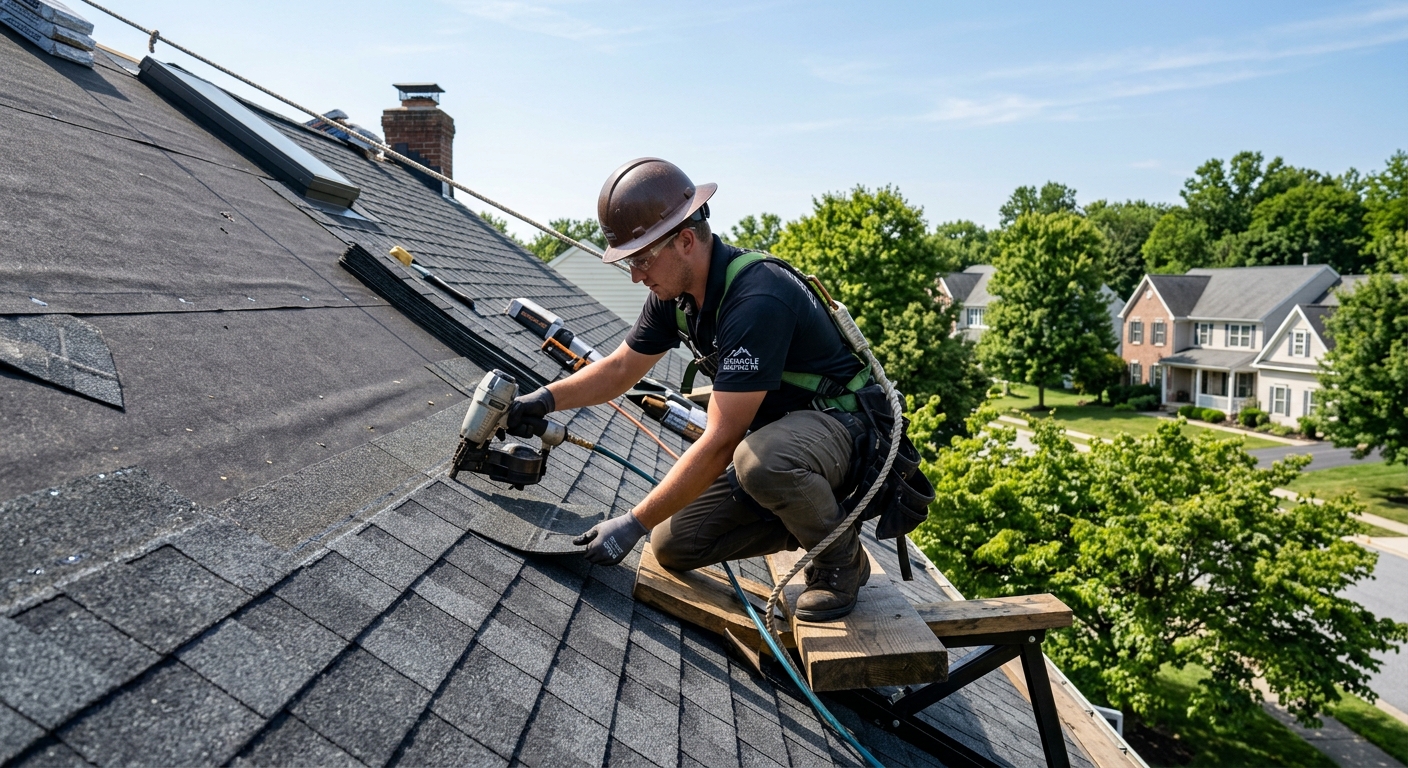
What roof replacement costs in Mount Pleasant in 2026
If you live in Mount Pleasant, you’re probably in a single-family home—over eight out of ten are here (U.S. Census Bureau, ACS 2024)—and that means a typical roof job is a lot bigger than a city condo. Most of the houses in this area were built before 1980, so the majority of homeowners aren’t deciding “if” the roof should be done, but “when.” As roofs from the 1960s-80s reach the end of their lifespan, especially in areas like Hempfield and North Huntingdon that saw fast growth decades ago, houses often need more extensive work than just shingles. On subdivisions from that era, you’ll often run into issues like two layers of old roofing, tired flashing, chimney leaks, or ventilated attics that fall short of current practice.
That translates to more than just a straight swap of shingles. Here, full tear-offs and repairs under the surface aren’t rare. A roof in this part of Westmoreland County costs more than the low end you might see on simple ranches out west, but far less than urban high rises. The table below gives a realistic scope for what most Mount Pleasant homeowners face today—whether you’re dealing with shingles, metal, or flat roofs.
| Material / Scope |
Lifespan |
Best for |
Price range (installed) |
| Asphalt shingles — architectural (30-yr) |
25–30 yrs |
Standard single-family replacements, most homes |
$9,000–$19,000 |
| Asphalt shingles — impact-resistant (Class 4) |
30+ yrs |
Hail-prone neighborhoods and ridge exposures |
$14,500–$19,000 |
| Metal standing seam |
40–70 yrs |
Maximum lifespan, snow shedding, modern farmhouses |
$21,500–$38,500 |
| Flat roof — TPO or EPDM |
15–25 yrs |
Porches, low-pitch additions, garages |
$11,500–$22,500 |
| Roof repair — leak or isolated section |
n/a |
Quick fixes, insurance patch jobs |
$475–$1,800 |
Prices are estimates for a typical Mount Pleasant home and vary with roof size, pitch, decking condition and material selection.
Pennsylvania code and Westmoreland County permit rules for roofing
Roofing work in Mount Pleasant follows the Pennsylvania Uniform Construction Code (UCC), based on the IRC. For complete roof replacement or significant re-roofing—like stripping off all existing material down to the decking—you’ll need a permit. Simple repairs (patching a few shingles, minor leaks, or small sections under 25% of the roof) generally don’t require permits, but always check with your local township office—Westmoreland County towns enforce permits themselves, not the county seat. The City of Greensburg runs its own code enforcement office, while every township (such as Hempfield or Unity) may have slightly different procedures. In any municipality that’s opted out, the permit comes through the PA Department of Labor & Industry.
To hire a contractor, make sure they hold a Home Improvement Contractor (HIC) registration, issued by the Pennsylvania Office of Attorney General—this is required for any contract over $500. You can verify a roofer’s status at hic.attorneygeneral.gov. For insurance, all employers in Pennsylvania must carry workers’ compensation, and you can look up valid coverage through WCAIS (wcais.pa.gov) before signing a contract. In this state, there’s no separate “roofing license”—HIC registration is what matters, and a written contract is required above $500. You also get 3 business days to cancel after signing, thanks to state consumer protection law, and reputable roofers will always honor it.
When to book roofing work in Mount Pleasant
In Mount Pleasant, the busiest time for roofing crews lines up with when the weather allows shingles to seal properly—usually mid-April through early November. Crews start filling their summer and fall schedules as early as March, especially around larger towns like Greensburg and Murrysville, where a moderate suburban roofing market keeps experienced contractors in demand. Late spring and early fall are the most coveted windows: it’s warm enough for proper adhesion, but not sweltering on a sun-beaten roof, and you sidestep the highest risk for pop-up storms or early frost.
If you wait for late October or November, you run into Mount Pleasant’s freeze-thaw cycles that slow down jobs and delay material deliveries. Emergency repairs (tarping, patching, and leak control) spike in the winter, but so do prices—getting a crew on your roof in February costs a premium over the same repair done in September, in both materials and labor.
Because Westmoreland County sits in the Pittsburgh metro, there’s no shortage of roofers, but the better ones book up quickly, especially for full replacements. Repairs can usually be handled within a week or two, but a full replacement often takes 3–6 weeks from contract to completion, especially if permits are needed. Planning ahead, especially if you’re eyeing a 30-year architectural shingle or a metal roof, saves money and hassle.
What gets discovered after tear-off in Mount Pleasant
It’s common in Mount Pleasant to have surprises under an old roof, especially on homes built before 1980. Once the shingles are torn off, roofers often find rotted or delaminated decking—plywood that’s soft to the touch or crumbles, mainly where past leaks went unnoticed or around old chimneys. Replacing decking typically runs $75–$150 per sheet. Inadequate attic ventilation is another regular issue. In our climate, poor ventilation drives ice damming—in winter, warm air melts snow at the ridge, it refreezes at the eaves, and you end up with water under the shingles. Not only can this void shingle warranties, it also leads to hidden rot or mold. Fixing it means additional vents or a ridge vent for roughly $400–$1,000 extra depending on scope.
Westmoreland County homes from the 1960s-80s commonly have marginal flashing around chimneys, walls, and valleys. Bad flashing is a major leak source, and replacing it during re-roofing typically adds $400–$1,200 depending on complexity and number of features. Old vent boots (the collars around pipes) can be brittle, leaking, or missing—upgrading these during reroof runs about $40–$120 per stack. New drip edge is almost always part of code-compliant installation and can add $350–$700—but it’s cheap insurance against future rot. Ridge vents are frequently missing from older roofs and, in this area, are worth adding for both code and performance.
All these hidden repairs are why a lower “bid” can turn into a completely different invoice after tear-off in Mount Pleasant. A reputable roofer will prepare you with allowances or ranges for these discoveries, rather than nickel-and-diming after the fact.
Choosing a roofing material for Mount Pleasant's climate
Mount Pleasant gets 30 psf ground snow load and 8 °F design winter temperatures—practically, that means your roof needs to handle regular snow cover and freeze-thaw cycles that punish poor materials and shortcuts. Metal roofs, like standing seam, excel here because they shed snow and ice before dams can form, and they hold up to hail far better than basic shingles. However, a metal roof costs from $21,500–$38,500, so unless you plan to stay put for decades or want to match a farmhouse style, it may not pay off on a typical Mount Pleasant home.
Asphalt architectural shingles remain the most common choice in Westmoreland County, for good reason. They’re affordable—$9,000–$19,000—with a solid 25–30 year track record if installed right and kept ventilated. Most subdivision homes use these, largely because regional contractors are set up for them, and nearly 69% of homes here are older, so the cost to upgrade every roof to metal just isn’t practical. Class 4 impact-resistant asphalt shingles give added protection in areas hit by hail and wind off the ridges (common in the Ohio Valley corridor), but only pay off if your insurer offers a premium cut or if previous hail claims suggest chronic trouble.
For low-slope additions and porches, TPO/EPDM membranes give reliable waterproofing but have a shorter life—still, flat roofs here aren’t common on main houses. Every material needs a proper underlayment to handle the area’s snow and ice risk.
| Material |
Installed cost |
Lifespan |
Cold-climate performance |
Maintenance |
| Asphalt architectural |
$9,000–$19,000 |
25–30 yrs |
Good, needs ice barrier at eaves |
Clean gutters, check flashing |
| Asphalt Class 4 impact-resistant |
$14,500–$19,000 |
30+ yrs |
Better hail and wind resistance |
Same as standard architectural |
| Metal standing seam |
$21,500–$38,500 |
40–70 yrs |
Excellent—sheds snow & ice quickly |
Inspect fasteners/seams every few years |
| TPO / EPDM membrane |
$11,500–$22,500 |
15–25 yrs |
Performs well if drainage is good |
Annual checks for punctures, seam wear |
The cost drivers behind a Mount Pleasant roof replacement
Mount Pleasant’s roof replacement costs swing more than you might expect, mainly because of the house styles and climate here. Roofs in this region tend to be larger than an urban row home, and with nearly 69% of homes built before 1980, you’re often dealing with two or more layers of old roofing that must be torn off ($500–$1,500 per layer). Add in the ground snow load of 30 psf and regular freeze-thaw, and you can’t skimp on sturdy underlayment or ice barriers, which add $300–$800 for a typical home.
Pitch and access are major cost variables locally—many homes have steeper roofs, making harnesses and staging a must and adding up to 20–30% to the labor charge. Bigger homes from the subdivision boom mean higher material and disposal costs. Decking rot—rarely apparent before tear-off—pushes the total up by $75–$150 per 4x8' plywood sheet. If you opt for architectural or Class 4 impact-resistant shingles, material grade alone adds $500–$2,500 to the bill; not always necessary unless you’re in the county’s hail-prone spots.
| Factor |
Why it matters here |
Cost impact |
| Roof size in squares |
Each square is 100 sq ft of roof surface |
Primary multiplier |
| Pitch and access |
Steep pitches need harnesses and slow the crew |
+20–30% labour |
| Existing layers to tear off |
Two or more layers means full tear-off and disposal |
$500–$1,500 per layer |
| Decking condition |
Rot is found during tear-off, not before |
$75–$150 per sheet |
| Ice barrier at eaves |
Required where ice damming has a history |
$300–$800 |
| Material grade |
3-tab vs architectural vs Class 4 impact-resistant |
$500–$2,500 |
What Mount Pleasant's climate does to a roof
Mount Pleasant sits right in the Ohio Valley hail and wind corridor, just east of Pittsburgh, and that has real consequences for how roofs fail. When a hailstorm comes through, it may not always punch through your shingles—but it can bruise the asphalt granules underneath. These bruises weaken the shingle’s weatherproofing, leading to leaks that sometimes show up months later, well after the storm is forgotten. What looks like a harmless storm can translate into repairs costing $475–$1,800 or entire roof replacements if there’s a track record of claims.
We also operate under a 30 pounds per square foot ground snow load. During snow events, warm attic air melts the underside of the snowpack on your roof. That meltwater trickles down toward the eaves, which stay below freezing—so water refreezes and forms an ice dam. The dammed up water has nowhere to go but back under the shingles, saturating the underlayment, and rotting the decking. If you skip a proper ice barrier at the eaves—a step that’s tempting to omit when budgets are tight—you end up with deck repairs at $75–$150 per sheet, and sometimes need a full underlayment replacement.
On exposed ridge-line roofs (think Hempfield’s 1960s-80s subdivisions), gust-driven rain and wind-driven sleet are the norm. If flashing isn’t installed correctly, water intrusion along the chimney or wall can cost hundreds in recurring repairs. Here, the climate’s “gotchas” aren’t the obvious disasters, but the repeated minor events that wear your roof system out before its time.
Frequently asked questions — roofing in Mount Pleasant
How do I confirm a roofer carries workers' compensation?
Contractors in Pennsylvania, including those working in Mount Pleasant, are required by law to carry workers' compensation coverage for all employees. Verifying this is straightforward: Pennsylvania operates a state portal called WCAIS, available at wcais.pa.gov. You can search for your contractor’s insurance status using their business name or policy number—don’t take their word for it or rely on paper certificates alone. If a worker is injured on your property and the contractor doesn’t carry valid coverage, a claim could land on your homeowner’s policy. That’s not a risk worth taking just to save a couple hundred bucks. Reliable roofers expect this question and will help you check their current status. Considering a typical roof repair in Mount Pleasant can run $475–$1,800, you’ll want every dollar going into the roof—not court fees.
How do I find a reputable roofer in Mount Pleasant?
In Mount Pleasant, you want a roofer who can show their Home Improvement Contractor (HIC) registration, issued by the Pennsylvania Office of Attorney General—check it at hic.attorneygeneral.gov. Avoid anyone working “under the table” or without a written contract, especially since state law requires a contract for any work over $500. Look for contractors familiar with roofs built 1960–1980 (which most of our local stock is), who can show jobs done on houses like yours in Westmoreland County. Ask about recent work within Mount Pleasant or neighboring Hempfield and Greensburg, not just Pittsburgh addresses. Expect to see reference photos, local client lists, and clear breakdowns of warranty coverage. Reputable roofers also discuss discovery of hidden damages after tear-off, so you’re not ambushed on price—sometimes with repairs ranging $475–$1,800 added to the base replacement.
How long should a roof last in Mount Pleasant?
Most architectural asphalt shingle roofs in Mount Pleasant last 25–30 years if they’re installed correctly and well-ventilated. The area’s 30 psf ground snow load and heavy freeze-thaw cycles are tough on shingles and underlayment, so poor attic ventilation or missing ice barriers can shave 5–10 years off an otherwise good roof. Metal roofs, usually standing seam, are rare but can reach 40–70 years when properly installed—however, most homes here use the regional standard of architectural asphalt. Regular inspections, especially after wind or hail, will help your roof reach its full lifespan. Flat TPO/EPDM membranes on low-slope porches or additions typically make it 15–25 years. Expect replacements to cost between $9,000–$19,000 for standard architectural shingles, depending on roof size and what’s discovered during tear-off.
Is metal roofing noisy in rain?
Metal roofs in Mount Pleasant can be noisier in heavy rain than asphalt shingles, especially if installed directly over open framing without a solid deck or insulation. However, most residential metal roofs in Westmoreland County are installed over plywood and underlayment, greatly dampening the “pinging” sound you hear on old barns. If there’s a finished attic or insulation under the deck, rain noise difference becomes minor—about the same as a shingle roof. On older homes, it’s worth asking what’s underneath before deciding. Keep in mind, metal installs here cost from $21,500–$38,500 installed, so it’s best to look at noise in context with other factors like snow shedding, wind resistance, and total budget.
How much does a new roof cost in Mount Pleasant?
For a typical Mount Pleasant single-family home, a new architectural asphalt shingle roof costs between $9,000–$19,000 installed as of 2026, landing near the middle for most jobs. This includes full tear-off, code-compliant ice barriers, and code-required drip edge. If you have multiple layers to remove or need decking replaced, project totals climb accordingly. Upgrading to Class 4 impact-resistant shingles for hail and wind adds to the price, typically pushing you up to $14,500–$19,000. Metal standing seam roofs are a bigger investment—$21,500–$38,500—but last several decades longer. Flat roof replacements using TPO or EPDM are common for porches and additions and run $11,500–$22,500. Always ask for itemized quotes and confirm who covers hidden damage repairs.
What happens if rotted decking is found after tear-off?
In Mount Pleasant, homes built before 1980 especially are prone to hidden water damage under old shingles. If rotted, delaminated, or badly stained plywood is found after tear-off—and this is common around chimneys, valleys, and anywhere flashings have failed—the crew will cut out and replace each bad 4x8' sheet. The going rate is $75–$150 per sheet, depending on thickness and local lumber pricing. A reputable contractor will stop the job, show you photos or in-person evidence, and get written approval for extra work—that’s required under Pennsylvania’s Home Improvement Consumer Protection Act. Hidden repairs like this are a normal part of any complete re-roof in Westmoreland County, especially on houses with multiple roof layers or patchwork repairs in the past.
Does Mount Pleasant get enough hail to justify Class 4 shingles?
Mount Pleasant lies within Westmoreland County’s Ohio Valley hail and wind corridor, so ridge-line exposures and certain neighborhoods are likely to see damaging hail every few years. Class 4 impact-resistant shingles offer better protection and may qualify for small insurance discounts if your carrier recognizes them. For roofs frequently hit by hail, upgrading makes sense—these shingles cost $14,500–$19,000 installed versus basic architectural, but stand up better when storms roll through. However, if hail is rare on your block or your insurer won’t cut your premium, architectural shingles are usually enough and cheaper to replace down the line.
How much does it cost to repair a roof leak in Mount Pleasant?
Most roof repairs in Mount Pleasant land between $475–$1,800, depending on where the leak is and what’s required to fix it. Simple repairs—like replacing a few damaged shingles or a vent boot—are at the low end, while fixes involving rotten decking or structural flashing creep toward the top. The age of the home also matters: older Mount Pleasant houses often need a bigger section torn open to fix hidden damage correctly. Because our climate brings heavy freeze-thaw and spring rain, ignoring a leak tends to cost a lot more—damage spreads to attic insulation, drywall, and even wiring if left unchecked.
What if my insurer denies my roof claim?
If your insurer denies a roof claim in Mount Pleasant, it’s usually tied to “wear and tear” exclusions, pre-existing damage, or poor maintenance (such as missing ice barriers or skipped attic ventilation). Insurers here scrutinize claims after hail, wind, or ice dam leaks—especially if your roof was already approaching its natural lifespan (25–30 years for most shingles). In that case, you’re paying out of pocket. Depending on scope, repairs may run $475–$1,800 for isolated leaks or $9,000–$19,000 for a full replacement. If denied, ask your roofing contractor for a full written assessment and keep photo documentation—it helps in appeals or if you switch carriers. Always get a second opinion before spending big and check if overlooked maintenance (like attic vents or flashing) contributed to the problem—sometimes fixing those buys you time before a full replacement.