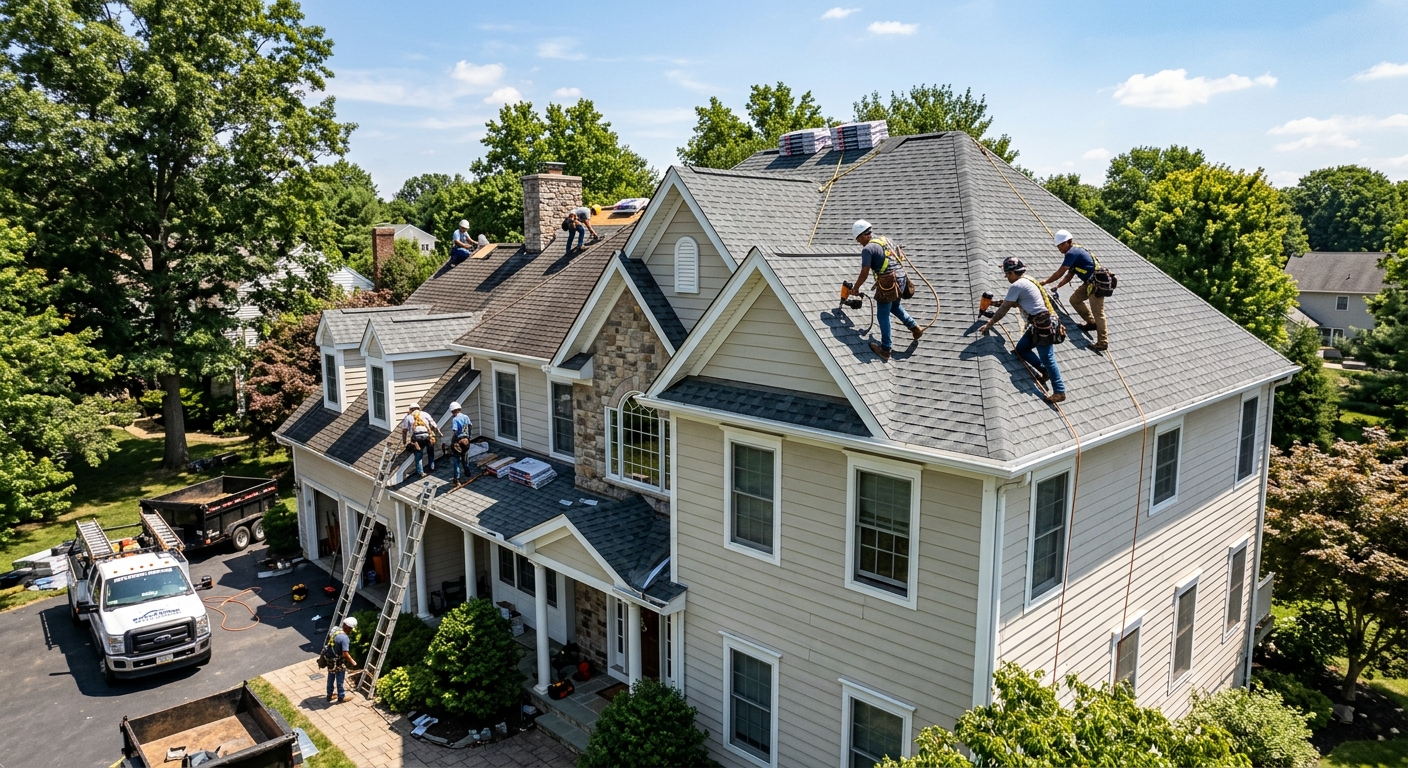
East Huntingdon roofing prices by material and scope — 2026
In East Huntingdon, roofing costs reflect the realities of an older, mostly owner-occupied housing market. With 78.2% homeownership and over 56.2% of homes built before 1980 (U.S. Census Bureau, ACS 2024), most projects aren’t new construction but are instead replacements for aging roofs that have lasted decades. The neighborhoods here saw steady growth during the 1960s through the 1980s, driven by the wave of suburban expansion out of Hempfield and North Huntingdon. That era accounts for much of the asphalt shingle stock you're likely to see on your street—and as these roofs hit 35–55 years old, replacement is becoming mandatory rather than optional.
One effect of that housing wave is a high volume of similar-sized asphalt shingle jobs, often on hip or gable roofs with moderate slopes. Older decks may be plank or first-generation plywood, sometimes hidden beneath two or even three shingle layers. Many East Huntingdon homes are now facing their first or second replacement, which means you’re not alone if you’re getting sticker shock or weighing repair versus replacement. It’s worth knowing, too, that in this region—owing to heavy freeze-thaw cycles and Ohio Valley wind exposure—recommendations on material or repair strategy may differ from flatter, warmer counties.
| Material / Scope |
Lifespan |
Best for |
Price range (installed) |
| Asphalt shingles — architectural (30-yr) |
25–30 yrs |
Standard replacement, most postwar homes |
$8,900–$18,500 |
| Asphalt shingles — impact-resistant (Class 4) |
30+ yrs |
Wind-/hail-exposed ridges, insurance incentives |
$14,500–$18,500 |
| Metal standing seam |
40–70 yrs |
Long-term/permanent upgrade, snow shedding |
$21,500–$38,500 |
| Flat roof — TPO or EPDM |
15–25 yrs |
Low-slope porches, garages, additions |
$11,000–$22,500 |
| Roof repair — leak or isolated section |
n/a |
Spot repairs, flashing, partial tear-off |
$475–$1,750 |
Prices are estimates for a typical East Huntingdon home and vary with roof size, pitch, decking condition and material selection.
Roofing permits in East Huntingdon: what you need before work starts
In East Huntingdon, any full roof replacement requires a building permit issued under the Pennsylvania Uniform Construction Code (UCC), based on the International Residential Code. This code is enforced by your municipality unless they’ve opted out, in which case the Pennsylvania Department of Labor & Industry takes over permitting.
Simple repairs (for example, replacing a few shingles or fixing a small leak) don’t generally require a permit here. However, once the work meets the definition of replacement—such as tearing off old material or replacing decking—you or your contractor should pull a permit before starting. If in doubt, your township office can clarify, and it’s always better to ask before work begins than risk a fine or inspection-related delays.
For any roofing contract over $500, your contractor must be registered as a Pennsylvania Home Improvement Contractor (HIC). You can look up their HIC registration number easily at hic.attorneygeneral.gov. Workers' compensation insurance is legally required for all roofing employers in Pennsylvania, and coverage status can be checked through the state's WCAIS system (wcais.pa.gov).
These steps aren’t just bureaucratic: registration and insurance protect you from liability if someone is hurt on your property and ensure you’re dealing with a legitimate company, not a fly-by-night operation.
Why two East Huntingdon roofing quotes can differ by 40%
Some East Huntingdon homeowners are shocked by the spread between two quotes for what looks like the “same” roof replacement. That spread—often 40% or more—swings on several factors directly tied to our local housing: age, construction practices, and exposure to southwestern Pennsylvania’s storms and freeze-thaw cycles.
If your home was built before 1980, there’s a solid chance your decking is original. Decking type (plank, plywood, or OSB) may not become clear until the old roof comes off, especially if you have multiple layers. Each additional layer to tear off will drive costs up by $500–$1,500 per layer. Most homes here have moderate to steep pitches; these slow down labor (safety harnesses, steeper working angle) and can add 20–30% to your total.
Westmoreland County sits squarely in the Ohio Valley hail and wind corridor. On ridge-top homes, local contractors nearly always recommend ice and water barrier at the eaves—a cost you might not see in quotes for milder regions. Material selection also swings costs. For example, a quote for impact-resistant shingles can run $2,500 higher than a base 3-tab install, and repair pricing starts at $475–$1,750 for a single leak but quickly rises if more damage is discovered.
| Factor |
Why it matters here |
Cost impact |
| Roof size in squares |
Each square is 100 sq ft of roof surface |
Primary multiplier |
| Pitch and access |
Steep pitches need harnesses and slow the crew |
+20–30% labour |
| Existing layers to tear off |
Two or more layers means full tear-off and disposal |
$500–$1,500 per layer |
| Decking condition |
Rot is found during tear-off, not before |
$75–$150 per sheet |
| Ice barrier at eaves |
Required where ice damming has a history |
$300–$800 |
| Material grade |
3-tab vs architectural vs Class 4 impact-resistant |
$500–$2,500 |
Choosing a roofing material for East Huntingdon's climate
In East Huntingdon, you can’t ignore our snow load (30 psf on the ground), 8°F winter design temperatures, and numerous winter freeze-thaw cycles. Asphalt architectural shingles are the workhorse here because they offer an affordable balance between cost and service life—about 25–30 years in this climate. Metal standing seam sheds snow much more effectively, resists ice damming, and lasts decades longer, but it comes at double the price and isn’t usually needed unless you’re on a steep slope or want a truly permanent solution.
Flat roofs (on porches, low-slope additions, or garages) call for TPO or EPDM membrane. Membrane systems are needed below 3:12 pitch and handle ponding better, but their lifespan is about 15–25 years. The premium "Class 4" impact-resistant shingle is occasionally justified on exposures facing prevailing wind and hail, but on a typical side street, the extra cost doesn’t pencil out for most East Huntingdon residents. Asphalt dominates here not by accident: postwar and 1960s–1980s homes were almost universally built for shingle installation, and the labor force and supply chains are oriented toward asphalt. Metal is exceptional—but only worth the outlay if you plan to stay long enough to see the payback.
| Material |
Installed cost |
Lifespan |
Cold-climate performance |
Maintenance |
| Asphalt architectural |
$8,900–$18,500 |
25–30 yrs |
Handles 30 psf snow, requires attic ventilation |
Low; periodic algae/moss cleaning |
| Asphalt Class 4 impact-resistant |
$14,500–$18,500 |
30+ yrs |
More resilient to wind/hail on exposed ridges |
Low—same as architectural |
| Metal standing seam |
$21,500–$38,500 |
40–70 yrs |
Sheds snow, nearly eliminates ice dams |
Minimal; check fasteners/gaskets |
| TPO / EPDM membrane |
$11,000–$22,500 |
15–25 yrs |
Good for low-pitch, resists ponding short-term |
Annual seam/check, clear debris |
Water management on a East Huntingdon roof
When you replace your roof, it's shortsighted to skip gutters and drainage. In East Huntingdon, many homes channel large volumes of snowmelt and spring rain from fairly steep roofs, putting stress on both gutters and downspouts. Gutters aren’t just cosmetic—they're the first line of defense against water entering your basement or eroding your foundation, both common complaints on homes where downspout discharge is too close to the slab or grading slopes back toward the house. Poor drainage can void some roof warranties here if water backs up under shingles or ice dams form.
During replacement, it's best to budget for new gutters and downspouts if yours show rust, leaks, or pulling away (expect $2,400–$4,200 alongside a typical full replacement). Drip edge—required by code for shingle roofs—should be included and ensures water cannot slip under the first row. Downspouts should carry water at least six feet out from the foundation, even if that means adding an inexpensive extension. Without these steps, your new roof is only solving half the problem.
What East Huntingdon's housing stock means for your roof
With over half (56.2%) of East Huntingdon homes built before 1980 and a big wave of construction during the 1960s–1980s, most roofs in the township rest on decking materials that aren't always up to current code. Expect to see original plank or plywood on many houses, especially those from the '60s and '70s; this was before OSB became standard. Modern ice barrier underlayment wasn’t code in that era, so most original installs don’t have it at the eaves, which means leaks from ice damming are a recurring call in older neighborhoods.
Roof pitches around here are typically moderate—most split-levels and ranches run 4:12 to 6:12. If your home is on its second or third shingle layer (not uncommon if there are over 30 years since last replacement), a full tear-off is necessary. Multiple layers are heavy and exceed what’s allowable under modern installation standards. For homes built after 1980, that first replacement is landing right about now, meaning decking is likely sound but flashing and ventilation may need a rethink. Every house, especially in these older pockets, is entering a stretch where repair costs begin to stack up compared to replacement.
Patching vs full replacement in East Huntingdon
The smart line between repair and replacement is determined by age, leak history, and decking condition. If your asphalt roof is under 15 years old and you have a single, well-defined leak—especially after a storm—spending $475–$1,750 on a proper repair is sensible. But if the roof is showing its age (common in homes from East Huntingdon’s 1960s–1970s build boom), with multiple leaks, recurring tar-patch work, or visible granule loss, replacement quickly becomes more logical and cost-effective. A roof over 25 years with active leaks is at the end of its economic life; patching here is just delaying the inevitable—often for more money.
Consider this: three or four service calls at $1,100 apiece for separate leak repairs add up to $3,300–$4,400. By then, you’ve burned through a third of the cost of a full replacement ($8,900–$18,500)—and that’s with none of the long-term protection. Add winter into the equation, and waiting on an old, leaky roof is likely to cause hidden rot or interior damage, making the eventual bill even higher. Flat roofs, in particular, are rarely cost-effective to repair once they begin ponding or blistering; it's usually a case for full membrane replacement.
| Situation |
Recommendation |
Typical cost |
Reasoning |
| Under 15 years, one isolated leak |
Repair |
$475–$1,750 |
Younger roof, damage likely limited to flashing or shingle blow-off |
| 15–25 years, several leak points |
Replace |
$8,900–$18,500 |
Multiple repairs approach the cost of a new roof, warranty issues |
| 25+ years, any active leak |
Replace now |
$8,900–$18,500 |
Roof is past design life, repairs are wasted money |
| Storm damage, wind or hail |
Document, claim, replace |
$8,900–$18,500 |
Insurance can offset cost if covered, match materials |
| Flat roof ponding or blistering |
Replace membrane |
$11,000–$22,500 |
Membrane failures snowball, patching rarely lasts |
| Active leak entering winter |
Emergency repair, schedule replacement |
$475–$1,750 |
Stop interior damage, avoid freeze-worsening, then plan for reroof |
Frequently asked questions — roofing in East Huntingdon
What underlayment should be used on a East Huntingdon roof?
For most East Huntingdon homes, the main underlayment under asphalt shingles should be a high-quality synthetic felt, rather than old-fashioned 15-lb or 30-lb tar paper. At the eaves—especially given our heavy freeze-thaw cycles and 30 psf ground snow load—one full course of self-adhered ice and water barrier (commonly called "ice shield") is a must. This is what creates a waterproof zone where ice damming is most likely during our winters. On a typical replacement in town, the incremental cost for a proper synthetic felt and ice barrier package is around $300–$800 above basic paper. For low-slope or porch roofs, TPO or EPDM membrane acts as both roof and underlayment. If your contractor isn’t planning this step, find another—most new roof warranties in this area require these modern materials to remain valid.
Does homeowner's insurance cover roof replacement in East Huntingdon?
Homeowner’s insurance in Pennsylvania will generally only cover roof replacement if the damage is caused by a sudden event—like wind or hail—which is relevant for East Huntingdon since we’re within the Ohio Valley storm corridor. Ordinary wear and tear, or age-related failure, won’t qualify for a claim. If there is storm damage, document everything with photos before emergency repairs or tarping, and notify your adjuster right away. An insurance-funded full replacement here still comes from the same market price band: $8,900–$18,500 for architectural shingles. Don’t let a contractor talk you into “eating” your deductible—it’s against Pennsylvania law for them to waive it and signals a company you probably shouldn’t trust.
What does roof replacement cost per square in East Huntingdon?
Roofing work is priced in “squares,” with one square equal to 100 square feet of roof surface. In East Huntingdon, the 2026 installed price for architectural asphalt shingles works out to about $425–$600 per square, depending on pitch, number of layers, and details like flashing or ice barrier. For a typical East Huntingdon home (20–30 squares), that puts the total job at $8,900–$18,500. Metal standing seam is much higher per square—the labor and materials cost for metal is roughly double or more compared to shingle, and is only justified for those planning to stay for decades.
What happens if rotted decking is found after tear-off?
If your roofing crew finds rotted, soft, or delaminated decking after the shingles come off, Pennsylvania code requires those sections to be replaced before roofing proceeds. In East Huntingdon, homes built before 1980 are more likely to hide this problem, especially if there have been chronic leaks in one area. Decking replacement typically adds $75–$150 per sheet (usually 4' x 8'), and most roofs only need a few unless leaks were ignored for years. Good contractors will point this out and get written approval for any added expense per the Home Improvement Consumer Protection Act. No ethical roofer will cover rot and “hope for the best”—it’s a code violation and just kicks the problem down the road.
Is a sagging roof line an emergency?
In East Huntingdon, if you see your ridge dipping or your roof line bowing, stop and call a roofer before the next heavy rain or snowfall. This is not just a cosmetic issue—sagging means there may be failed decking, rotten rafters, or excessive weight from multiple old roofing layers. While not all cases mean collapse is imminent, this is an issue best diagnosed before more snow falls or a storm hits. In this market, a structural repair can run anywhere from a few replacement sheets at $75–$150 apiece for decking, up to requiring a framing contractor for full rafter repair. Don’t delay; ignoring structural sag always leads to much bigger bills later.
Why do roofs fail faster in southwestern Pennsylvania?
Ohio Valley weather is tough on East Huntingdon roofs. Our climate brings repeated freeze-thaw cycles, 30 psf snow loads, spring wind events, and humid summers. The expansion and contraction from those cycles ages shingles and can loosen old flashing. Roofs here—especially the pre-1980 originals—weren’t built with modern ventilation or ice shields, so leaks and early deterioration show up faster than in milder or drier counties. In practice, almost all asphalt shingles that claim 30 years of life now last between 20–25 here, shaving off the maximum lifespan. That’s why prudent homeowners in East Huntingdon budget on the lower end of the lifespan range, even at replacement cost bands of $8,900–$18,500 for architectural shingle jobs.
Should I use a local roofer or a national company?
In East Huntingdon, homeowners are usually better served by a reputable local contractor rather than a large national chain or out-of-town "storm chaser." A local roofer knows the quirks of Westmoreland County code enforcement, our unique climate, and common problems in area housing stock—like multiple roof layers or older decking. Local companies have to live by their reputation and are rarely out of reach if an issue crops up months later. Large national outfits may sub out work, drive up prices, or disappear if you have a problem. For a job that costs $8,900–$18,500—the going rate for replacement here—it's not worth risking spotty service when the stakes for leaks or insurance complications are so high.
What's the cheapest way to replace a roof in East Huntingdon?
Cost-cutting on a roof in East Huntingdon almost never pays off. The absolute cheapest legal roof job is a basic architectural shingle replacement without extra features (no ice barrier, no upgraded ridge vent or flashing, existing gutters left untouched, and very basic attic ventilation). That puts you at the low end of the range—$8,900—for a typical sized roof. But skipping ice barrier or reusing old, rusty flashing is a false economy: you’ll pay more later in water damage or failed inspections. If you need to shave dollars now, focus on a repair (often $475–$1,750) to buy a season or two, but don’t cut corners on the full replacement itself.
How do I confirm a roofer carries workers' compensation?
In Pennsylvania, all roofing employers are required to carry workers’ compensation insurance, which protects you from liability if someone is hurt onsite. Before any contract is signed, ask your East Huntingdon roofer for a certificate of insurance. Then, verify their coverage on WCAIS, the state system at wcais.pa.gov. Just type in their business name to check active status. Hiring an uninsured contractor to try saving a few hundred dollars (off the typical $8,900–$18,500 job) is a big gamble—you’d be on the hook if anybody on the crew got hurt. Real pros won’t hesitate to provide proof of coverage up front.