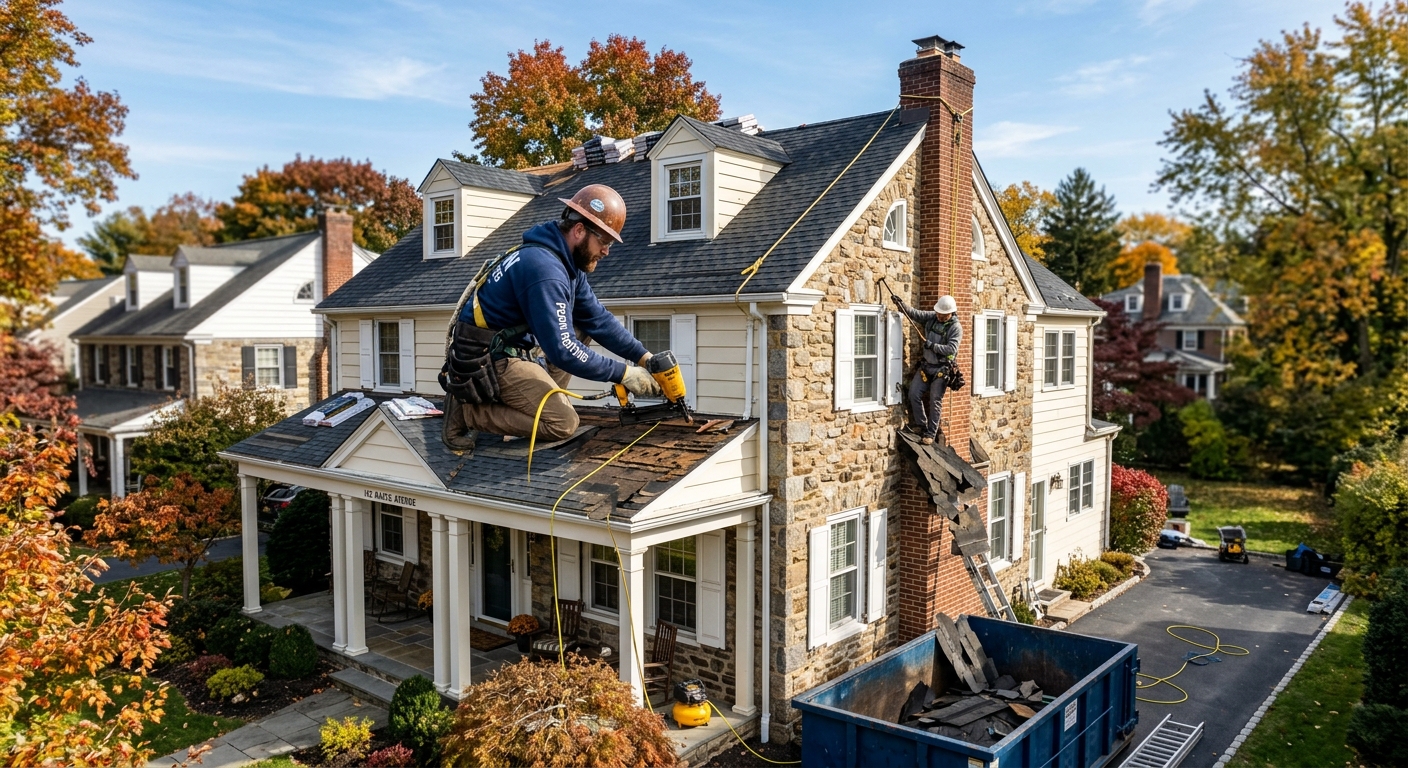
Roofing Replacement & Repair costs in Munhall — 2026
In Munhall, roof replacement and repair is shaped by a combination of a high homeownership rate and an aging housing stock, with nearly all homes built before 1980 (U.S. Census Bureau, ACS 2024). That means most roofs here aren’t just “old”—the underlying structures were built for different building codes and often under completely different roofing systems. Unlike newer suburbs, much of Allegheny County—including Munhall—faces frequent tear-offs down to the deck, and unexpected carpentry for rotten planks or skipped sheathing can be the norm rather than the exception. Homeowners need to plan for both the visible shingle price and the hidden costs underneath, because these 1900–1950 homes were not originally designed for today’s roofing standards or weights.
When you see wide price ranges for architectural shingle or metal roof jobs in Munhall, that's because so many homes here require deck repairs, chimney flashing upgrades, and even gutter replacement—parts that tend to be optional elsewhere. The most common choice here remains architectural shingles, balancing performance with Midwestern storm resistance and cost. With a median household income below the regional average (U.S. Census Bureau, ACS 2024), most residents are seeking solutions that solve water issues once without repeat repairs a few years later.
| Material / Scope |
Lifespan |
Best for |
Price range (installed) |
| Asphalt shingles — architectural (30-yr) |
25–30 yrs |
Munhall single-family homes seeking value for age and storm resistance |
$8,900–$19,000 |
| Asphalt shingles — impact-resistant (Class 4) |
30+ yrs |
Areas exposed to hail/wind, or insurance-mandated upgrades |
$14,500–$19,000 |
| Metal standing seam |
40–70 yrs |
Long-term owners & low-maintenance, steep roofs |
$21,500–$38,500 |
| Flat roof — TPO or EPDM |
15–25 yrs |
Porches, rowhouse additions, or low-slope rear sections |
$11,500–$22,500 |
| Roof repair — leak or isolated section |
n/a |
Isolated leaks, storm damage, chimney flashing |
$475–$1,800 |
Prices are estimates for a typical Munhall home and vary with roof size, pitch, decking condition and material selection.
Why gutters get replaced with the roof
In Munhall, gutters, downspouts, drip edge, and grading all work as a single system to move water away from your foundation. Many homes here have gutters and downspout setups installed decades ago, which often don’t handle today’s heavier rain or direct water far enough from the home. Replacing just the roof, without matching the gutter system to it, leaves you open to repeat problems—ice dams at the edge, fascia rot, and, most expensively, basement seepage due to water dumping right at your foundation wall. Especially in Munhall’s hilly terrain and heavy clay subsoils, improper gutter discharge often shows up as wet basement walls or even sump pump overuse.
Many roof warranties now require documented proof of working gutters and unblocked downspouts to honor future claims. This means if you keep rusty, undersized, or leaky gutters after a new roof, you may lose out on coverage if water backs up and causes damage. Most roofing contractors in Allegheny County quote full gutter replacement alongside the roof, using heavier-gauge aluminum with hidden hangers and matching oversized downspouts. For a typical single-family home here, add $2,000–$3,200 for seamless aluminum gutters and downspouts installed at the same time as the roof. Sometimes, an upgraded gutter guard system can increase this to $2,800–$4,000, but a simple, open gutter is often the right choice if large trees are not nearby.
How southwestern Pennsylvania's weather shapes roofing here
Munhall roofs don’t just get wet—they contend with intense freeze-thaw cycles and storms following the Ohio Valley track, bringing gusty winds and the occasional hail event. Allegheny County’s ground snow load is set at 30 pounds per square foot, which matters most after wet March snowstorms that linger and refreeze overnight. When snow melts on a warm attic and refreezes at the cold eave, an ice dam builds, blocking meltwater and forcing water under shingles. It’s not “old age”—it’s this ice damming, especially at the gutter line, that turns a $8,900–$19,000 new roof job into a much bigger problem if the right underlayment and ice barrier aren’t specified for the eaves.
When hail rolls in across Allegheny County, it rarely punches visible holes, but it will bruise asphalt granules, leading to premature granule loss and leaks a year or two later—well before you’d expect on a newer roof. Many insurance adjusters in Munhall now require proof of Class 4 impact-resistant shingles for full storm coverage, which can increase your project by $2,000–$4,500 over a basic architectural job but save you a full replacement after a severe storm.
Every season’s cycle of freeze-thaw, with a winter design temp down to 8 °F, stresses fastener seals and flashing, raising the odds that minor leaks turn major by spring. For flat roofs, it’s not just water ponding—it’s how ice expands seams and causes membrane splits, which often goes unchecked until a serious leak develops. Choose your materials and underlayments with both snow and storm history in mind—not just what’s “local code.”
What moves the price of a roof in Munhall
Munhall roofing prices can differ sharply for similar-looking homes, mostly because of what’s underneath. Houses built before 1980, which make up almost all of Munhall’s single-family stock, often have two or more layers of old shingles plus original plank sheathing. Only when the old roof is torn off do you discover if you’ll need to add new plywood—at $75–$150 per sheet—or just roll out underlayment. Another local factor: Allegheny County roofs are hit hard by storms from the Ohio Valley, making Class 4 shingles or thicker ice barrier at the eaves more common requests here. These upgrades can mean an extra $2,000–$4,500 depending on roof size.
Size, measured in “squares” (each 100 square feet), is a direct multiplier, but pitch is the hidden cost in Munhall. Most local homes have steeper pitches, requiring harnesses, more staging, and slower tear-off, pushing labor up by 20–30%. The region’s heavy snow load also means many quote requirements include ice barrier at eaves and valleys, not just in shaded northern exposures. Materials are the final swing—impact-resistant shingles can increase a typical roof job by 10–15%, and standing seam metal will double or even triple the total cost if you’re planning for lifetime performance.
| Factor |
Why it matters here |
Cost impact |
| Roof size in squares |
each square is 100 sq ft of roof surface |
primary multiplier |
| Pitch and access |
steep pitches need harnesses and slow the crew |
+20–30% labour |
| Existing layers to tear off |
two or more layers means full tear-off and disposal |
$500–$1,500 per layer |
| Decking condition |
rot is found during tear-off, not before |
$75–$150 per sheet |
| Ice barrier at eaves |
required where ice damming has a history |
$300–$800 |
| Material grade |
3-tab vs architectural vs Class 4 impact-resistant |
$500–$2,500 |
Permits and code requirements in Munhall
Roofing in Munhall falls under Pennsylvania’s Uniform Construction Code (UCC), which is based on the International Residential Code (IRC). Enforcement here is handled by the municipality or, if they opt out, by the PA Department of Labor & Industry. In Pittsburgh and throughout Allegheny County, replacement of roofing on more than 50% of your structure’s roof almost always triggers the need for a building permit. Minor shingle repairs over small areas generally proceed without a permit if “like-for-like” materials are used.
Every legitimate roofing contractor working in Munhall on jobs over $500 must hold a Home Improvement Contractor (HIC) registration under the Pennsylvania Office of Attorney General. Any homeowner can verify a contractor’s HIC registration at hic.attorneygeneral.gov. Written contracts are required for roofing work over $500, and by law, you have three business days to cancel once signed (under the Home Improvement Consumer Protection Act).
Insurance matters too: all roofing employers must carry workers’ compensation as required by state law. To check if a contractor’s WC coverage is in force, use the state’s WCAIS verification tool at wcais.pa.gov. Lead safety applies to houses built before 1978; contractors working on those need to follow the federal EPA Lead RRP Rule, and you can verify their certification online if you have concerns. No special trade license or county-specific permits are needed beyond these state systems and the municipal building permit.
Flat roof sections: the part most quotes get wrong
Flat and low-slope roof sections—like those often found over porches, small additions, or rear kitchen bump-outs—require a totally different approach than the pitched main roof. In Munhall’s older homes, these sections get overlooked or bid for shingles when they should get membrane roofing. On anything under about a 3/12 pitch, shingles will fail fast: water won’t drain quickly enough, ice and snow will pond, and seams open up with freeze-thaw cycles. Flat roofs in Allegheny County should get either a TPO or EPDM membrane sealed at the walls and edges, not just “roof cement.”
Expect a professional membrane replacement in Munhall to run $11,500–$22,500 for a typical single-family house porch or low-slope addition. The best membranes last 15–25 years when correctly installed—with new tapered insulation for proper drainage. Membrane jobs are more expensive up front but protect every built-in gutter and wall intersection, both of which are known weak points in our local housing stock. If a roofer quotes regular shingles for your flat or almost-flat roof, keep looking—you’re being told they don’t know how to solve a Munhall flat roof problem for the long term.
What Munhall's housing stock means for your roof
With 94.6% of Munhall homes built before 1980 (U.S. Census Bureau, ACS 2024), most existing roofs are sitting atop original plank decking, not modern plywood or engineered OSB. Houses from 1900–1950 were often built with steeper pitches—helpful for draining snow but harder and riskier to work on. Because ice barrier underlayment wasn’t in the code until long after most Munhall houses were built, you’ll rarely find it up there unless the roof’s already been replaced in the last 20 years. That means your new roof will almost always call for added ice shield and sometimes a full redecking if the old boards are gapped or rotted from decades of leaks.
Another Munhall-specific issue? Layers. By the time you’re ready for a new roof, odds are good that your house has at least two, sometimes even three, generations of shingles up there. Full tear-off is the only correct option under present code for roofs with multiple layers—resurfacing with yet another layer is no longer allowed. This adds both dump fees and labor for demolition but ultimately gets rid of rot and warping, setting your new roof up to last. Knowing the local housing timeline helps explain why Munhall jobs sometimes seem more complicated and expensive than newer suburban ones: there’s just more to replace, and more to fix, after a century of patchwork repairs and old wood finally wearing out.
Frequently asked questions — roofing in Munhall
What should a roofing quote include in Munhall?
A proper roofing quote in Munhall should be very specific. It must list brand and type of shingles or membrane, underlayment details (including ice barrier or synthetic vs. felt), total squares, exact scope (tear-off, redecking, flashing, venting, gutters), and warranty references. With almost all Munhall roofs built before 1980, make sure it spells out decking repairs ($75–$150 per plywood sheet) and old layer disposal ($500–$1,500 per layer) if these are suspected. Confirm the quote uses Munhall address and has the contractor’s HIC registration number—verify it at hic.attorneygeneral.gov. Workers’ comp insurance proof should be attached or available by request, usually as a printout from the WCAIS system. If your house predates 1978, ask about compliance with EPA lead rules. A vague quote means vague protection if issues show up later.
What is the difference between TPO and EPDM?
TPO (thermoplastic polyolefin) and EPDM (ethylene propylene diene monomer) are two leading flat roof membrane systems used around Munhall, especially on porches and additions from the pre-1950 housing stock. TPO is a white, heat-welded single-ply with high reflectivity; it helps cut cooling bills but can be more temperature-sensitive to install. EPDM is a tough black rubber sheet, often ballasted or fully adhered, known for resilience through freeze-thaw cycles. In Munhall, both offer 15–25 years of leak resistance if installed properly, with typical full replacements running $11,500–$22,500. The right choice hinges on drainage and insulation—TPO’s seams are more reliable against ponding water, but EPDM flexes more for older decks. Either beats shingling a flat surface, which never works long-term here and costs far more in repeated repairs.
How much does a new roof cost in Munhall?
For a single-family home in Munhall, expect a typical architectural asphalt shingle roof to fall between $8,900–$19,000 in 2026, with most jobs landing near $14,500. Metal standing seam will be in the $21,500–$38,500 range. Special considerations for Munhall: many roofs require tear-offs and deck repairs thanks to original construction from 1900–1950. Discovery of rotten decking is common, which can add $75–$150 per sheet. Extras like gutters ($2,000–$4,000) and attic ventilation are often needed to bring older houses up to current code and warranty standards. Always get a detailed written quote that includes tear-off, dump fees, and all extras you expect to need.
Will the crew damage my landscaping or driveway?
This is a common concern, especially in Munhall where narrow yards and tight driveways are the norm. A professional roofer should include landscape protection—plywood over walks and tarps for gardens—in their written contract, at no extra fee. Dump trailers can mark soft driveways or rutted alleys, especially after rain or snow melt. Make sure your contract states the crew is responsible for any damage. You can expect most roof jobs ($8,900–$19,000) to involve at least one heavy debris trailer. Point out any fragile landscaping before work starts; the best crews use temporary fencing or moveables to shield shrubs and perennials.
How can I tell if my roof decking is rotted?
Most Munhall homes use original plank decking from before 1980, and rot is a frequent find. Signs are subtle from inside: sagging lines between rafters, musty attic odors, or spongy spots when walking the surface (by a pro). On tear-off, rot usually reveals itself as darkened, punky boards, flaking apart at nail holes, or areas where shingles literally fall through. Plan for the possibility: decking replacement costs $75–$150 per sheet, and good roofers spell out how much is included in their quote. Don’t ignore suspected soft spots or ask for layover roofing—replacing only what’s rotted will protect your investment and meet code in Munhall.
Can a contractor cover my insurance deductible in Pennsylvania?
No contractor in Pennsylvania—including Munhall—can legally pay, “waive,” or rebate your homeowner’s insurance deductible as part of any claim or roof job. This is explicitly prohibited under the Home Improvement Consumer Protection Act (HICPA). If a roofer offers to do so or suggestively inflates invoices to absorb your deductible, they’re breaking state law and putting your own coverage at risk. On legitimate storm claims, you will still owe your deductible (for example, on a $14,500 insurance-approved shingle replacement). A trustworthy local contractor will walk you through the process and clarify up front what you’re responsible for, without any shady back-end “adjustments.”
Is ice barrier underlayment required in Munhall?
While not every part of Pennsylvania enforces ice barrier at the eaves, Munhall falls under the Pennsylvania Uniform Construction Code (UCC), and local practice aligns with Allegheny County’s history of ice damming due to freeze-thaw conditions. Technically, an ice barrier is required wherever ice damming has been a problem, especially on roofs with overhangs above heated spaces. This is nearly all Munhall homes built 1900–1950! The cost, generally $300–$800 per job, more than pays for itself in prevented leaks and warranty compliance. Insist your quote lists it by name—skipping ice shield to save a few bucks is a mistake you’ll notice every March.
Is a metal roof worth the extra cost in Munhall?
Metal roofs—mostly standing seam—are gaining popularity in Munhall, despite the higher cost ($21,500–$38,500). For homeowners planning to stay long-term, the 40–70 year lifespan and low maintenance can make it a better value, especially on historic houses with steep roofs. Metal sheds snow and resists Ohio Valley wind-driven rain better than architectural shingles. It can also improve home resale, since buyers know they won’t need a new roof soon. However, with Munhall’s median household income, many owners stick with high-quality architectural shingles because they still perform well and cost less up front. The best argument for metal is durability and energy efficiency—if that matters to you, it’s a solid investment here.
Why do roofs fail faster in southwestern Pennsylvania?
Munhall’s location at the edge of the Ohio Valley storm track, plus the region’s pronounced freeze-thaw cycles, causes roofing systems to wear out faster than in many other parts of the state. Roofing nails, flashing, and even high-end shingles are subjected to rapid and repeated expansion and contraction. The area’s ground snow load (30 psf) and sharp winter swings (down to 8 °F) make ice dams and ridge leaks common. All this accelerates granule loss, seam splitting, and underlayment failure—frequent causes of leaks that drive the need for repairs ($475–$1,800) or full replacements earlier than expected. Proper material choices and modern installation techniques counteract this—but only if your roofer knows Munhall’s climate history.