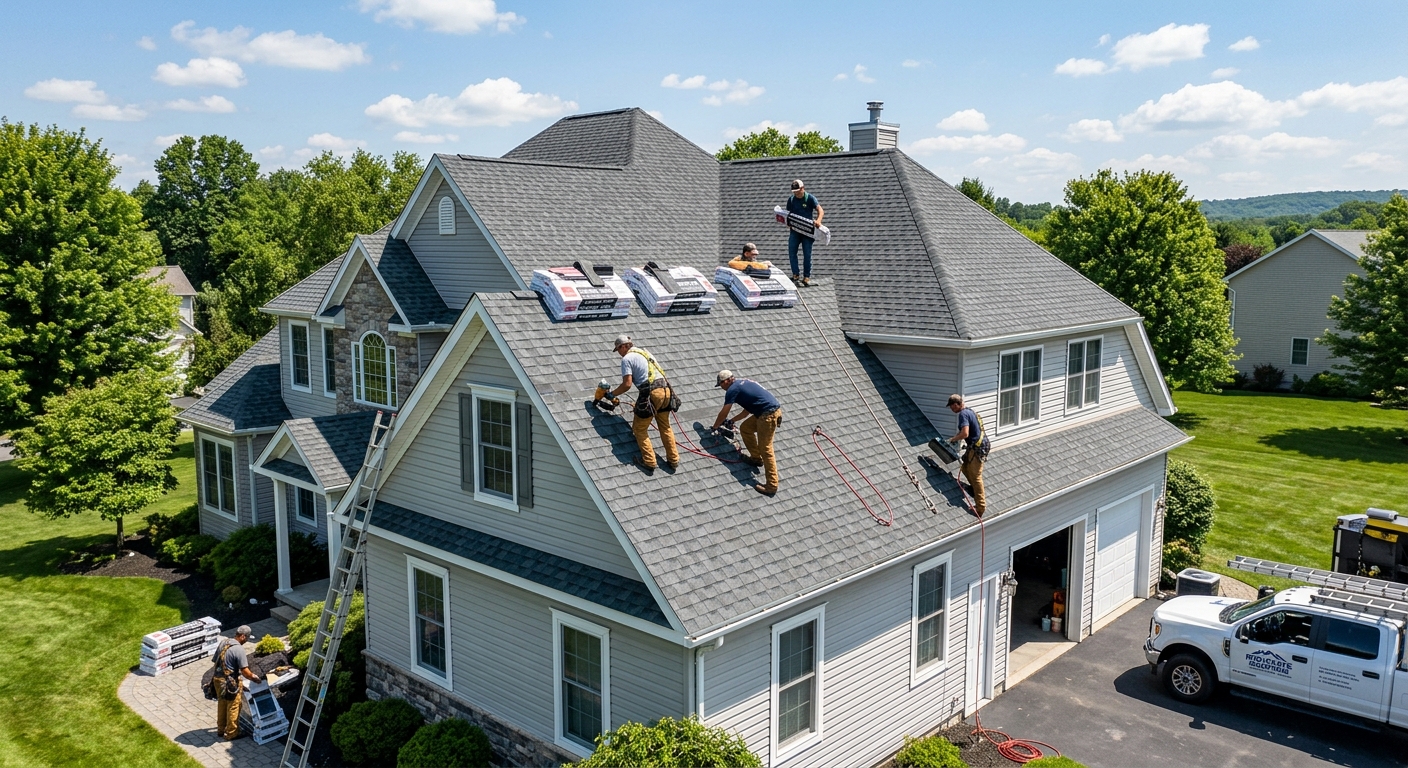
Lower Pottsgrove roofing prices by material and scope — 2026
In Lower Pottsgrove, the majority of homes are owner-occupied and built before 1980, shaping both the demand and cost of roofing. With a homeownership rate of 77.7% and nearly half the houses built prior to Reagan’s first term (U.S. Census Bureau, ACS 2024), asphalt shingle replacements drive the local market as these roofs age beyond their design lifespans. The region’s roofing demand follows the post–World War II trend seen in Abington and Cheltenham, where tract housing with simple, gabled roofs means most houses face their first or second full roof replacement by now. Here, you’re rarely dealing with steep, ornate profiles—just solid, mid-century homes due for their turn.
In Lower Pottsgrove, architectural asphalt shingles remain the default, but a steady trickle of metal and flat membrane replacements is picking up, especially as original flat roof additions from the 1970s and 80s begin to fail. Roof repair for single leaks remains common, but once you’re patching more than one spot on a roof this old, replacement is usually the smarter investment. Use the chart below for 2026 market pricing.
| Material / Scope |
Lifespan |
Best for |
Price range (installed) |
| Asphalt shingles — architectural (30-yr) |
25–30 yrs |
Standard single-family replacements |
$10,000–$21,000 |
| Asphalt shingles — impact-resistant (Class 4) |
30+ yrs |
Homes with tree cover/storm exposure |
$16,500–$21,000 |
| Metal standing seam |
40–70 yrs |
Homeowners seeking longevity, low maintenance |
$24,500–$43,500 |
| Flat roof — TPO or EPDM |
15–25 yrs |
Porches, additions, low-slope sections |
$12,500–$25,500 |
| Roof repair — leak or isolated section |
n/a |
Small leaks, flashing fixes |
$550–$2,000 |
Prices are estimates for a typical Lower Pottsgrove home and vary with roof size, pitch, decking condition and material selection.
Roofing season and lead times in Montgomery County
In Montgomery County, including Lower Pottsgrove, roofing season sets its own pace—and it isn’t year-round. Most architectural shingles need consistent daytime highs above 45°F for proper self-sealing, which means practical roof replacement runs from mid-March into early November. Crews generally aim to wrap up complex roofs by late October, since November weather can turn sharply, and reroofs done after a cold snap are at a higher risk of wind-blown tabs until spring.
Booking your roof in spring (March–May) means you’re not competing with the summer storm panic. Late summer through September is the local industry’s busiest stretch, fueled by thunderstorm damage and folks realizing winter is coming. At this point, you’ll often be quoted out four to six weeks—sometimes more if a storm hits Norristown or along the Schuylkill River. Because Lower Pottsgrove is part of the saturated Philadelphia metro roofing market, reputable crews are in high demand: expect to wait, especially for metal installs or flat membrane work, which require specialized hands. An emergency in February—when crews juggle freeze-thaw cycles, ice dams, and short daylight—typically brings overtime charges and premium pricing. Plan ahead for a tight schedule and better value; push into late fall or mid-winter only if you’ve got an active leak.
Pennsylvania code and Montgomery County permit rules for roofing
Roofing in Lower Pottsgrove falls under the Pennsylvania Uniform Construction Code (UCC), which is based on the International Residential Code (IRC). The code is enforced by your local municipality or, if a township has opted out, by the PA Department of Labor & Industry. In Montgomery County, code enforcement is local, and requirements differ by township. For example, in Norristown, replacing more than 25% of your existing roof usually requires a building permit. By contrast, some smaller repairs in Lower Merion Township—particularly asphalt shingle repairs under one square—can be done without a permit.
Before signing any contract over $500, Pennsylvania law requires your roofing contractor to hold a Home Improvement Contractor (HIC) registration from the Office of Attorney General. You can verify a contractor’s registration yourself at hic.attorneygeneral.gov. Workers’ compensation coverage is mandatory for all employers in Pennsylvania and can be checked through the WCAIS system at wcais.pa.gov. Never take a contractor’s word on insurance—verify it directly.
Be aware: Pennsylvania has no separate roofing trade license beyond HIC registration. Written contracts are mandatory over $500, and you have a three-business-day right of cancellation under the Home Improvement Consumer Protection Act. If your house was built before 1978, check your contractor’s compliance with the EPA Lead Renovation, Repair and Painting (RRP) Rule if disturbing painted surfaces—verify at certifiedrenovatorsearch.epa.gov.
Checking out a roofer in Lower Pottsgrove: what to verify
In a saturated metro market like Montgomery County, scammers and inexperienced roofers can slip through the cracks. Always verify registration and insurance yourself. For all contracts over $500, check at hic.attorneygeneral.gov for valid Home Improvement Contractor registration—never accept just a verbal claim or a number scribbled on an estimate. Confirm workers’ compensation in real time on wcais.pa.gov, since legitimate coverage is required for all employers. For homes built before 1978, use certifiedrenovatorsearch.epa.gov to ensure the contractor is EPA certified for lead-safe work.
- Home Improvement Contractor (HIC) registration (hic.attorneygeneral.gov)
- Workers’ compensation insurance, current status (wcais.pa.gov)
- General liability coverage—ask for the policy certificate with your name on it
- EPA Lead-Safe Renovator (pre-1978 homes)
- Written contract specifying scope, price, and materials
- Scope of work matches insurance adjuster’s report (if applicable)
- No large up-front deposit (never pay more than one-third upfront in PA)
- Company physical address within Montgomery County or the immediate area
- References from finished jobs in Lower Pottsgrove or neighboring townships
- Manufacturer certifications for chosen shingle or membrane
- No pressure to sign same-day or waive your right to cancel
- Clear warranty terms in writing
Red flags in Lower Pottsgrove: unmarked vehicles from out of state, contractors offering to “cover your deductible” (illegal in PA), no physical address, prices far below market rates, or high-pressure sales after storms. Door-knockers swarming after local thunderstorm damage are especially common here after summer events.
What insurance covers on a Lower Pottsgrove roof
If your Lower Pottsgrove roof is damaged—by wind, hail, or falling branches—the first step is to document everything before cleanup: take clear photos and note the date and time. Notify your insurer right away and request both a claim acknowledgment and a written scope of loss. You’ll typically get two numbers: actual cash value (your current roof’s worth after depreciation) and replacement cost (what it costs to put on a similar new roof). Your adjuster will come onsite and should walk the roof with you or your contractor to spot missed damage, especially after severe summer storms near the Schuylkill River.
After a claim, you’ll receive payment (sometimes in two installments) minus your deductible, which is your responsibility. Pennsylvania’s Home Improvement Consumer Protection Act strictly prohibits waiving or rebating deductibles; an offer to “cover your deductible” is a sign the contractor is skirting the law. You have three business days after signing a contract to cancel, giving you crucial time to review the insurer’s settlement and contractor’s proposal carefully. Always make sure the written scope matches what’s actually being repaired or replaced—insurers expect photographic proof before and after the job is done. Any cleanup or emergency tarping needed to stop active leaks should be documented as well and submitted for reimbursement when the claim is finalized.
Patching vs full replacement in Lower Pottsgrove
For Lower Pottsgrove homes—nearly half of which were built before 1980—the right call on repair versus replacement comes down to roof age, number of leaks, and long-term value. If your roof is under 15 years old with only one isolated leak (like a popped nail or failed flashing), a repair makes sense. But once shingles pass the 15–20 year mark, especially on post-war housing stock, recurrent repairs start throwing good money after bad. For example: patching two or three leaks at $1,250 each, you’re halfway to the $10,000–$21,000 range needed for a full, warrantied asphalt shingle replacement. After 25 years, shingle and underlayment failures pile up fast, and even skilled patching is a temporary fix—full replacement is the only defensible spend, especially before another Montgomery County winter.
If storm damage is the issue, document everything first—your insurer usually prefers full replacement when multiple sections are compromised. Flat roofs in this area (TPO/EPDM) age out around 20 years; ponding or blistering means membrane replacement, not basic patchwork, is needed. The table below points you to the right choice for the most common scenarios in Lower Pottsgrove:
| Situation |
Recommendation |
Typical cost |
Reasoning |
| Under 15 years, one isolated leak |
Repair |
$550–$2,000 |
Limited age and damage; spot fix is cost-effective. |
| 15–25 years, several leak points |
Replace |
$10,000–$21,000 |
Roof system aging—repeated repairs become uneconomical. |
| 25+ years, any active leak |
Replace now |
$10,000–$21,000 |
End-of-life for shingles, risk of hidden rot; replacement protects home value. |
| Storm damage, wind or hail |
Document, claim, replace |
$10,000–$21,000 |
Insurance will replace if damage is significant—repairs won't restore warranty. |
| Flat roof ponding or blistering |
Replace membrane |
$12,500–$25,500 |
Age and water intrusion—patches are a band-aid at best. |
| Active leak entering winter |
Emergency repair, schedule replacement |
$550–$2,000 |
Temporary fix buys time through freeze-thaw; replacement is long-term solution. |
What moves the price of a roof in Lower Pottsgrove
In Lower Pottsgrove, roofing bids spread out for a few specific reasons. First, the typical house here—from squat ranches to late sixties colonials—has a roof square count (100 sq ft per square) that’s easy to underestimate by eye. A 1,700 sq ft house with a 6/12 pitch rarely comes in “small”—and size has the biggest impact on cost. The difference between a 15- and 23-square roof at $700–$800/square totals thousands of dollars.
Montgomery County’s permitted snow load (30 psf) and messy freeze-thaw cycles mean code-compliant installation: two ice & water shield rolls at the eaves, extra flashing, and attention at valleys. Add in “hidden” surprises—two or more old shingle layers to tear off, bad decking, or a roof shape that needs fall protection—and labor multiplies fast. Flat roof sections, common on additions here, push into higher cost bands ($12,500–$25,500) due to specialized materials and install methods. The region’s market is thick with contractors, which limits how high prices run—but any quote much lower than average deserves close scrutiny. Use the table below to see how each key factor directly hits your roofing budget:
| Factor |
Why it matters here |
Cost impact |
| Roof size in squares |
Each square is 100 sq ft of roof surface |
Primary multiplier |
| Pitch and access |
Steep pitches need harnesses and slow the crew |
+20–30% labour |
| Existing layers to tear off |
Two or more layers means full tear-off and disposal |
$500–$1,500 per layer |
| Decking condition |
Rot is found during tear-off, not before |
$75–$150 per sheet |
| Ice barrier at eaves |
Required where ice damming has a history |
$300–$800 |
| Material grade |
3-tab vs architectural vs Class 4 impact-resistant |
$500–$2,500 |
Frequently asked questions — roofing in Lower Pottsgrove
Should I use a local roofer or a national company?
Using a local roofer in Lower Pottsgrove almost always benefits the homeowner. Local crews understand Montgomery County’s climate swings—from humid, stormy summers to rapid freeze-thaw winters—and they’re familiar with the specific permit rules and code enforcement of local municipalities. National companies may send in out-of-town crews, risking mistakes from rushed installs or missed requirements. If an issue arises in five years, a local company is still likely to be here to answer a warranty call. That said, big chains can sometimes secure bulk material pricing, but any savings are often offset by higher overhead or “one size fits all” service. Typical local rates for a full architectural shingle replacement run $10,000–$21,000. If you decide on a national brand, insist on a written local contact, get references, and ensure the installer is registered as a Home Improvement Contractor in Pennsylvania.
What is the difference between TPO and EPDM?
Both TPO (thermoplastic polyolefin) and EPDM (ethylene propylene diene monomer) are flat roofing membranes found on many additions and porches in Lower Pottsgrove. TPO is white and highly reflective, keeping attic temps down during humid Montgomery County summers, and is generally welded at the seams for leak resistance. EPDM is black, rubber-like, and slightly cheaper up front—good for flexible installations and repairs. In our local climate, TPO holds up slightly better to pooled water and UV degradation, while EPDM can tolerate foot traffic and minor tree debris. Price-wise, both fall into the $12,500–$25,500 range for a typical 1,000–1,500 sq ft install. Ultimately, choice depends on sun exposure, application complexity, and whether the install crew is more experienced with one or the other. Always get a specific warranty in writing and check for ponding risk before committing.
How do I verify a roofing contractor is registered in Pennsylvania?
In Lower Pottsgrove and anywhere in Pennsylvania, all roofing contractors doing work over $500 must hold a Home Improvement Contractor (HIC) registration issued by the Office of Attorney General. To verify, visit hic.attorneygeneral.gov and search the contractor’s business name or registration number—a legitimate company should never mind giving you this info. This registry will confirm the registration is active and provide complaint history, if any. Skip anyone who stalls, lists a family member’s name, or asks for a check made out to cash. Registration is not a substitute for experience, but it’s a legal requirement and gives you rights under the Home Improvement Consumer Protection Act. If you’re comparing bids—say, for a $16,500 architectural shingle job—it’s worth checking every company that provides an estimate.
How much does it cost to repair a roof leak in Lower Pottsgrove?
Leak repairs in Lower Pottsgrove fall right in line with the Philadelphia metro market, ranging from $550–$2,000 for a typical asphalt shingle roof. The price depends on whether it’s a one-off issue (like a torn shingle or popped nail) or a complicated leak at a valley or chimney. Repairs often go up if access is tight or skylights are nearby. If your roof is getting older—closer to 20 years—multiple repairs can push your outlay well above what you’d put into a full replacement. For basic, one-leak repairs expect the lower end of the band; for leak tracing or water that entered in multiple places, expect a number near the top. Always insist your contractor is HIC registered and get a written receipt for your records.
How do I know if my Lower Pottsgrove roof needs replacing?
If you’re noticing missing, curling, or brittle shingles—and your home was built before 1990 in Lower Pottsgrove—replacement is probably imminent. Water stains on ceilings, granule loss in gutters, or daylight visible in the attic are all warning signs seen frequently in homes from the post-war housing wave. Age is the biggest indicator: if your asphalt roof is over 20 years old, repeated repairs rarely buy much time. A typical replacement runs $10,000–$21,000 and brings both curb appeal and peace of mind for local homeowners. Have a roofer (not a handyman or storm chaser) document their inspection clearly, and if you’re in doubt after a single leak, weigh the total cost of patching against a full system warrantied install.
What's the cheapest way to replace a roof in Lower Pottsgrove?
In Lower Pottsgrove, the most affordable full replacement is a single-layer tear-off with basic architectural asphalt shingles—expect quotations starting around $10,000 for a typical ranch or colonial. To keep costs down, opt for mid-grade shingles (not three-tab, which won’t meet local HOA or insurance standards) and avoid unnecessary extras like complex ridge vents or synthetic underlayments unless required for code. Don’t skip essentials—never let a contractor re-roof over bad shingles or old leaks; it may save money today but will cost far more later. Get at least three written estimates and be wary of anyone quoting well below the band: in a saturated market like Montgomery County, undercutters often skip required labor or insurance, creating liability for the homeowner.
Does attic ventilation matter in Lower Pottsgrove's climate?
Yes, attic ventilation is a big deal for roofs in Lower Pottsgrove. Our summers are humid, winters can run cold, and with a ground snow load of 30 psf, ice damming is a recurring problem—especially in post-war homes with low attic volume. Proper ridge and soffit ventilation help keep attics dry, extend shingle life, and minimize the risk of mold or rot in decking and rafters. Inadequate airflow can void shingle warranties and trigger costly repairs down the line (roof decking replacement usually runs $75–$150 per sheet if found rotted). When getting a new roof, insist your contractor checks attic intakes and baffles rather than just selling a “vent upgrade.” Good ventilation saves money on both energy and future repairs in our local climate.
What happens if rotted decking is found after tear-off?
In Lower Pottsgrove, with its stock of pre-1980 homes, decking issues sometimes only show up after all old roofing has been removed. Legitimate contractors will stop, document the rot (photos for your record), and walk you through which sheets—often at eaves or valleys—need replacement. Each 4×8 sheet typically adds $75–$150 to the bill, depending on plywood vs. plank. Get a written change order before work continues, and never allow a crew to simply “patch” structural rot with scraps. Most insurance claims do not cover pre-existing rot, but if storm damage exposed new leaks, document everything for the adjuster. The right fix gives your replacement shingle or membrane roof a solid base that should last for decades.
What is the difference between replacement cost and actual cash value?
“Replacement cost” is what it really costs to install a brand new, code-compliant roof with today’s materials—including tear-off, disposal, and all labor. “Actual cash value” factors in age and wear: your 20-year-old shingles have depreciated, meaning the insurer might offer much less upfront for a claim. In Lower Pottsgrove, homeowners with replacement cost coverage will generally see a payout in two steps: the first check equals the actual cash value, and the second (the recoverable depreciation) comes after proof the repairs or full replacement are complete. For an architectural shingle roof, that means you’ll eventually see reimbursement up to $10,000–$21,000—less any deductible. Always clarify with your insurance agent what your policy covers and keep records of all communications and contractor invoices.