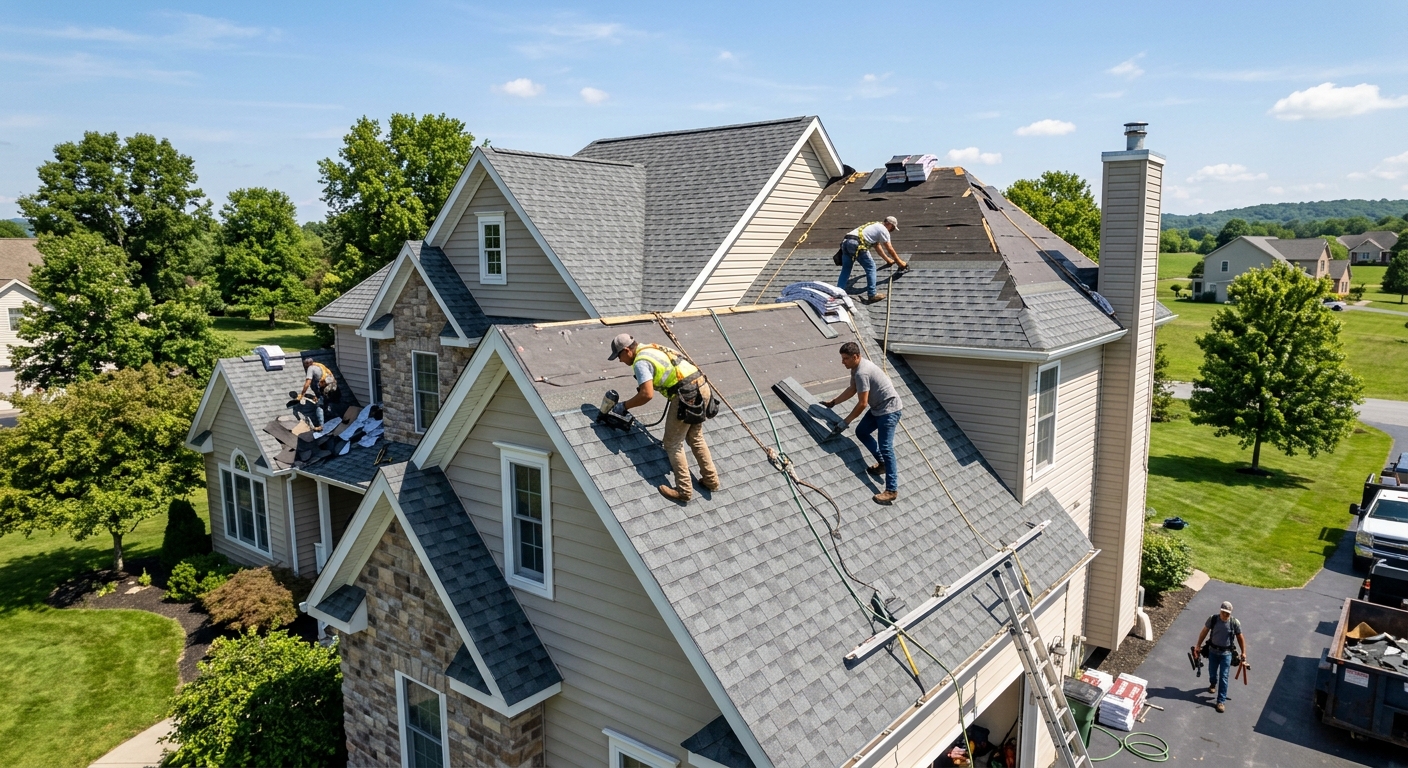
Roofing Replacement & Repair costs in New Garden — 2026
In New Garden, with its high homeownership rate and a majority of single-family homes, roof replacement is a common investment that directly protects the largest asset for most residents. Many homes here—reflecting the area's 80.1% homeownership and predominance of single-family properties (U.S. Census Bureau, ACS 2024)—still have original or second-generation roofs. The 1970s–1990s subdivisions in West Goshen and Uwchlan have created a ripple effect, swelling the need for replacements as aging asphalt systems reach end of life. What has already played out in those nearby neighborhoods is now hitting New Garden: scope often includes more than just shingles, with decking, flashings, and ridge vents under scrutiny given the era of construction. Expect both roofers and insurance adjusters to look closely at weathering, ventilation, and code updates when pricing work here.
Here is what you can expect for roofing and repair in New Garden in 2026:
| Material / Scope |
Lifespan |
Best for |
Price range (installed) |
| Asphalt shingles — architectural (30-yr) |
25–30 yrs |
Most single-family homes, HOAs since 1980s |
$11,000–$23,500 |
| Asphalt shingles — impact-resistant (Class 4) |
30+ yrs |
Ridge-line wind exposure, storm-prone lots |
$18,000–$23,500 |
| Metal standing seam |
40–70 yrs |
Long-term hold, low-pitch or accent roofs |
$27,000–$48,000 |
| Flat roof — TPO or EPDM |
15–25 yrs |
Porches, additions, low-slope transitions |
$14,000–$28,000 |
| Roof repair — leak or isolated section |
n/a |
Caught early, patchable damage under 1 square |
$600–$2,200 |
Prices are estimates for a typical New Garden home and vary with roof size, pitch, decking condition and material selection.
Pennsylvania code and Chester County permit rules for roofing
Roofing work in New Garden is regulated primarily under the Pennsylvania Uniform Construction Code (UCC), which is based on the International Residential Code. Permit requirements are enforced locally—so for jobs in the nearby West Chester Borough, for example, the Codes Department oversees permits. In practice, a full roof replacement involving any structural deck repair in West Chester triggers the permit requirement. For routine shingle repair under one roofing square, a permit isn’t required. Every municipality in Chester County may enforce these rules through their own local offices or through the PA Department of Labor & Industry if they’ve opted out. Always check with your township or borough before starting work to avoid unintentional violations.
Contractors handling jobs over $500 must hold a valid Home Improvement Contractor (HIC) registration, issued by the Pennsylvania Office of Attorney General. You can verify any registration number quickly at hic.attorneygeneral.gov. Workers’ compensation insurance is mandatory for all employers in Pennsylvania; you can confirm current coverage for any crew via the WCAIS database (wcais.pa.gov). Written contracts are required for home improvement jobs exceeding $500, and homeowners get a three business-day right of cancellation by state law. Finally, if your home was built before 1978, be sure your roofer is EPA Lead RRP-certified; you can verify credentials at the EPA search site.
What gets discovered after tear-off in New Garden
In New Garden, the reality for homes built during the 1970s–1990s boom is that surprises don’t show until the old shingles come off. First among them is rotted or delaminated plywood decking—a hidden expense that usually runs $800–$2,000 for targeted repairs, up to $2,500–$4,500 for full redecking on a typical suburban roof. In Chester County’s moderate freeze-thaw climate, poor attic ventilation causes condensation issues and can trigger ice damming along eaves, often voiding manufacturer warranties. Upgrading intake vents, baffles, and ridge vents can tack on $1,200–$2,500 to the job if the original system was inadequate or blocked over time.
Flashing failures are another frequent find, especially at chimneys, eaves returns, and where additions tie into the main roof. Reflashing a standard chimney or wall can land in the $600–$1,200 range if done at the time of reroofing. Replacing vent boots—which crack or dry out after 10–20 years—and drip edge is typically included in a full tear-off, but if missed or omitted, they represent a weak link. Allow $300–$800 for upgrading or adding drip edge and proper vent boots across all penetrations. If continuous ridge venting was skipped during the last job, expect to pay towards the higher side of the range to bring everything up to current code and warranty standards.
When to book roofing work in New Garden
Chester County’s climate gives a relatively wide roofing calendar, but the timing matters for quality and price. Shingle products require temperatures above 40°F to seal properly, making late March through mid-November ideal for replacements. April to June is peak demand in New Garden; crews are often booked solid, since many jobs are still driven by the wave of aging roofs from the 1980s and 1990s subdivisions. September and October usually mean faster scheduling and better prices, with lower humidity and moderate daytime highs—ideal for shingle adhesion and crew comfort.
February emergencies, especially after a wind event, always cost more. Suppliers may need to special order materials if demand is surging after a storm, labor is short, and ice or snow complicates setup and safety. With so many contractors operating throughout the saturated Philadelphia metro, “lead time” is less about crew shortage and more about weather and insurance backlog. For non-urgent replacements, aiming for late summer into fall usually gets you a shorter wait and a higher-attention crew. Avoiding summer’s biggest heat waves helps product quality and worker safety. If your project is urgent after a major storm, expect premium charges—especially if temporary tarping is needed while you wait for a replacement slot.
Gutters, drainage and roof longevity in New Garden
In New Garden, the moderate freeze-thaw climate and frequent summer downpours mean gutters are not just an afterthought—they’re a foundation defense. When replacing your roof, neglecting gutters and downspout performance can undermine the whole job. New shingles will shed water efficiently, and if gutters are failing, clogged, or sloped toward the house, all you’re doing is moving the problem downhill. Discharge dumping too close to the foundation quickly shows up as wet basements—a concern for homes built on the region’s variable soils.
Drip edge is now code-required on most replacements and prevents water from wicking behind gutters. Some major roofing warranties in this market also mandate that gutters and downspout discharge meet certain standards. Gutter replacement rates in Chester County run $2,400–$4,200 when bundled with a roof, with guards adding typically $1,600–$2,800. For older homes with marginal grading or trench drains, it’s often smart money to engineer discharge well away from the foundation at the time of reroofing, protecting both your home and your investment for the next 25–30 years.
Patching vs full replacement in New Garden
If your roof is under 15 years old and you spot a single leak—especially one away from valleys, chimneys, or eaves—a targeted repair is still cost-effective. But for homes from the large 1970s–1990s subdivisions, most original roofs have surpassed their design life. Multiple leaks on a 20–25 year-old roof are a clear signal: patching becomes a band-aid, not a fix. Spending $1,400 apiece for several repairs adds up fast. Three repairs in two seasons ($4,200) nearly matches the cost of an all-new system, which eliminates the need for repeat visits and solves underlying ventilation, underlayment, and flashing defects.
For active leaks over living space, especially with winter coming on, emergency repair followed by a scheduled fall or spring replacement is the prudent call. Flat roofs with persistent ponding, blistering, or seam failures rarely justify patching past 15 years old—full membrane replacement is usually the best long-term value. Insurance may help offset costs from sudden wind or hail events, but chronic leaks from wear and age are a maintenance issue and not covered. Always weigh the total spent on repairs against the remaining value of the existing roof.
| Situation |
Recommendation |
Typical cost |
Reasoning |
| Under 15 years, one isolated leak |
Repair |
$600–$2,200 |
Most shingles & underlayments still have service life; cost-effective if localized. |
| 15–25 years, several leak points |
Replace |
$11,000–$23,500 |
Core system is deteriorating—further repair is short-term and costs add up. |
| 25+ years, any active leak |
Replace now |
$11,000–$23,500 |
Shingles and flashings are past intended lifespan; risk of deeper structural damage. |
| Storm damage, wind or hail |
Document, claim, replace |
$11,000–$23,500 |
Insurance claim usually applies for sudden, major events—full replacement is eligible. |
| Flat roof ponding or blistering |
Replace membrane |
$14,000–$28,000 |
Existing membrane compromised—repairs will not restore integrity long term. |
| Active leak entering winter |
Emergency repair, schedule replacement |
$600–$2,200 |
Temporary patch prevents interior damage—plan full replacement as soon as feasible. |
How to vet a New Garden roofing contractor
When hiring in New Garden, skip the sales pitch and focus on concrete proof. Every contractor must have Pennsylvania Home Improvement Contractor (HIC) registration for jobs over $500—check their number using the state’s official portal (hic.attorneygeneral.gov). Verifying current workers’ compensation is just as crucial; the WCAIS system (wcais.pa.gov) gives you up-to-date insurance status. If your home was built before 1978, you need EPA Lead RRP certification, not just a “promise” that lead protocols will be followed—verify at the EPA search site. All legitimate jobs in Chester County come with a written contract, not a napkin estimate or handshake deal.
- Check HIC registration at hic.attorneygeneral.gov—don’t just take their word.
- Verify workers’ compensation via wcais.pa.gov for every crew onsite.
- Ask for a copy of their certificate of insurance showing your address as a certificate holder.
- Confirm EPA Lead RRP certification for pre-1978 homes.
- Request a detailed written contract—itemizing all materials and scheduled work.
- Clarify when (and if) a permit is required for your address; reputable contractors know the rules.
- Demand all manufacturer warranties in writing, not just “standard coverage.”
- Ask for references for similar projects within Chester County subdivisions.
- Be wary of any “one-day only” pricing or pressure to sign on the spot.
- Insist on a physical local address, not just a mobile phone number or generic PO box.
- Require start and end dates in writing; no open-ended promises.
- Request confirmation on material drop-off dates—no starts without all materials onsite.
Red flags in New Garden’s crowded market include: door-knocking crews after storms, out-of-area addresses with no local references, contractors pushing to waive your deductible (prohibited), signing partial contracts with missing line items, or sudden “extras” after the tear-off that weren’t discussed up front. Roofing in this market is busy; if a company can start tomorrow during peak season, ask why they have open slots.
Frequently asked questions — roofing in New Garden
What does it mean if my shingles are curling or losing granules?
Curling shingles and granule loss are red flags for aging and weathered roofs in New Garden. This area’s humid summers, combined with moderate freeze-thaw cycles, cause asphalt shingles to deteriorate faster after 20+ years—especially on those original to the 1970s–1990s subdivisions. Curling often signals that the shingle backing has dried out or lost flexibility, making leaks and blow-offs more likely during wind events. Granule loss accelerates UV damage to the underlying asphalt, shortening remaining lifespan. Repair only makes sense for isolated, localized issues on newer roofs. Otherwise, recurring symptoms suggest the system is on borrowed time. Expect to pay between $11,000–$23,500 for a full replacement if these problems are widespread. Ignoring them risks interior water damage and may void your insurance coverage for future claims.
Does attic ventilation matter in New Garden's climate?
Absolutely. In New Garden and across Chester County, attic ventilation is not just about comfort or energy savings—it’s fundamental roof health. Our moderate freeze-thaw conditions mean trapped moisture can quickly condense under the roof deck during winter, fueling rot and mold, and accelerating shingle failure from underneath. Poor ventilation is also a leading cause of ice damming, which forces water beneath shingles, causing stealth leaks that rarely start at obvious spots. Many shingle warranties demand code-level ventilation; if your attic air flow is blocked or insufficient, any manufacturer’s coverage is likely to be denied. Correcting ventilation as part of a roof replacement may add $1,200–$2,500 to the project but pays off in longer system life, better indoor air quality, and protected insulation values through our humid summers and damp winters.
Will filing a roof claim raise my premium?
In Pennsylvania—including New Garden—filing a legitimate claim for sudden storm damage (like a wind or hail event) generally won’t trigger an immediate premium hike, but you may lose a “claims-free” discount or see rates rise if severe weather drives up claims citywide. Most insurers expect some weather-related roof claims here given ridge-line winds and remnant coastal storms. If you have chronic leaks from age and deferred maintenance, those are not covered. Claiming repairs or replacements in the $11,000–$23,500 band is typical for full roof jobs. Always ask your agent how past claims affect future renewals, especially if you’re thinking about moving or refinancing—regular claims can flag your property for closer review or higher deductibles.
What is the difference between TPO and EPDM?
TPO (thermoplastic polyolefin) and EPDM (ethylene propylene diene monomer) are the two most common single-ply membranes used on New Garden’s flat or low-slope roofs. TPO is white and reflects more sunlight, which can help control attic temperatures in our humid summers; it's typically chosen for additions or commercial projects. EPDM is black, rubber-like, and excels in flexibility and lifespan, making it a good match for residential porches and low-slope transitions. Both are built for our 30-lb snow load and hold up well in freeze-thaw cycles. Lifespan for TPO and EPDM ranges 15 to 25 years, and replacement in this market runs $14,000–$28,000. Material choice often comes down to what’s existing and what builders used for your home’s era.
Does roof pitch affect the price in New Garden?
Yes, pitch is a significant cost driver for roofing in New Garden. Steeper roofs—common in Chester County’s later subdivisions—require more safety setup, material handling time, and waste factors. Low-slope and walkable roofs are less expensive per square foot. On steep (8/12 and up) or complex roofs, labor can add several thousand dollars, placing your job toward the higher end of the typical $11,000–$23,500 range for architectural shingles. Also, roofs with dormers or transitions need more flashing and detail work. Always ask your contractor to explain how pitch and complexity affect their estimate, and don’t be surprised if neighboring homes of the same footprint have bids that differ by thousands—pitch and layout are a big reason why.
What warranty should a New Garden roofer offer?
For a residential roof replacement in New Garden, expect a written manufacturer’s warranty (typically limited lifetime for shingles, 15–30 years for membranes) plus a labor warranty from the contractor, which should last at least 5 years on new installations. Premium shingle systems may include enhanced coverage for registered or certified installs—check if your roofer is officially recognized by the manufacturer. Workmanship warranty terms should be spelled out in your contract and run concurrent to major labor components. A proper warranty covers not just leaks but material defects and flashing failures, which are often the weak links after a few seasons. Most reputable contractors working within the $11,000–$23,500 price band will attach these warranties to your home’s address; don’t settle for a handshake or “verbal” guarantee.
Why is my New Garden roofing quote higher than the online average?
Many online averages ignore local labor rates, code requirements, and market saturation unique to Chester County and the Philadelphia metro area. New Garden’s roofing quotes are often higher to cover mandatory contract terms, full workers’ compensation, and the extra hazard insurance required in a region prone to periodic wind and storm events. The typical replacement now runs $18,000 for architecturals—sometimes more with steep pitches or complex layout common in newer subdivisions. If you require structural decking repair, upgraded underlayments, or premium warranties, costs move quickly to the top end of the band. Always compare apples to apples: a “basic install” quote from online calculators rarely includes tear-off, full cleanup, code-required ventilation, and 30-year transferable warranties.
How do I verify a roofing contractor is registered in Pennsylvania?
For New Garden homeowners, verifying your roofer’s credentials is straightforward. Any candidate bidding on projects over $500 must hold a Home Improvement Contractor (HIC) registration number from the Pennsylvania Office of Attorney General. Visit hic.attorneygeneral.gov and search by business name or registration number to review their legal business address, insurance, and complaint record. Registration ensures they’re both legitimate and subject to the Home Improvement Consumer Protection Act. Do not rely solely on printed ads or websites—always confirm in the official database, especially since Chester County’s saturated market draws crews from all over the region. Projects in the $11,000–$23,500 range should always use registered, insured companies to protect your legal rights and prompt warranty response.
Do I need to leave my house during a roof replacement?
In New Garden, most homeowners can stay in their house during a full roof replacement, though it’s best to plan ahead for noise and access issues. Expect early morning starts, with nail guns, prying, and crew movement causing disruption for one to two days (sometimes three for larger or complex layouts). Interior spaces shouldn’t be affected except for the occasional vibration—move fragile items from top floor walls as a precaution. Pets, young children, and anyone working from home should expect a lot of commotion. There’s no need to vacate, but discuss driveway use for material delivery and safeguard landscaping. For major jobs in the $11,000–$23,500 range, professional crews are used to coordinating around occupied homes—just make sure everyone knows the schedule and access needs in advance.