Lancaster roofing prices by material and scope — 2026
In Lancaster, the roofing market reflects the city’s older housing stock and the tight metro labor pool. About 88.0% of homes here were built before 1980, meaning most roofs have lived through more than one re-cover and many surprises sit beneath the shingles. At the same time, Lancaster’s homeownership rate is just 46.7%, so pricing pressure is real and the low-end of the market stays busy, especially for maintenance work by buyers and landlords who are less settled for the long haul.
Older homes in Lancaster County weren't built with modern ventilation or decking, so it’s common to find steep-pitch surfaces under multiple shingle layers. This drives up disposal weight and increases the chances that your project requires new deck boards. These factors mean true apples-to-apples pricing is rare—you’re usually comparing approaches as much as materials.
The table below shows what you should expect in Lancaster County for major roof scopes in 2026:
| Material / Scope |
Lifespan |
Best for |
Price range (installed) |
| Asphalt shingles — architectural (30-yr) |
25–30 yrs |
Most pitched roofs, decent curb appeal |
$9,100–$19,000 |
| Asphalt shingles — impact-resistant (Class 4) |
30+ yrs |
Areas exposed to Susquehanna River valley wind |
$15,000–$19,000 |
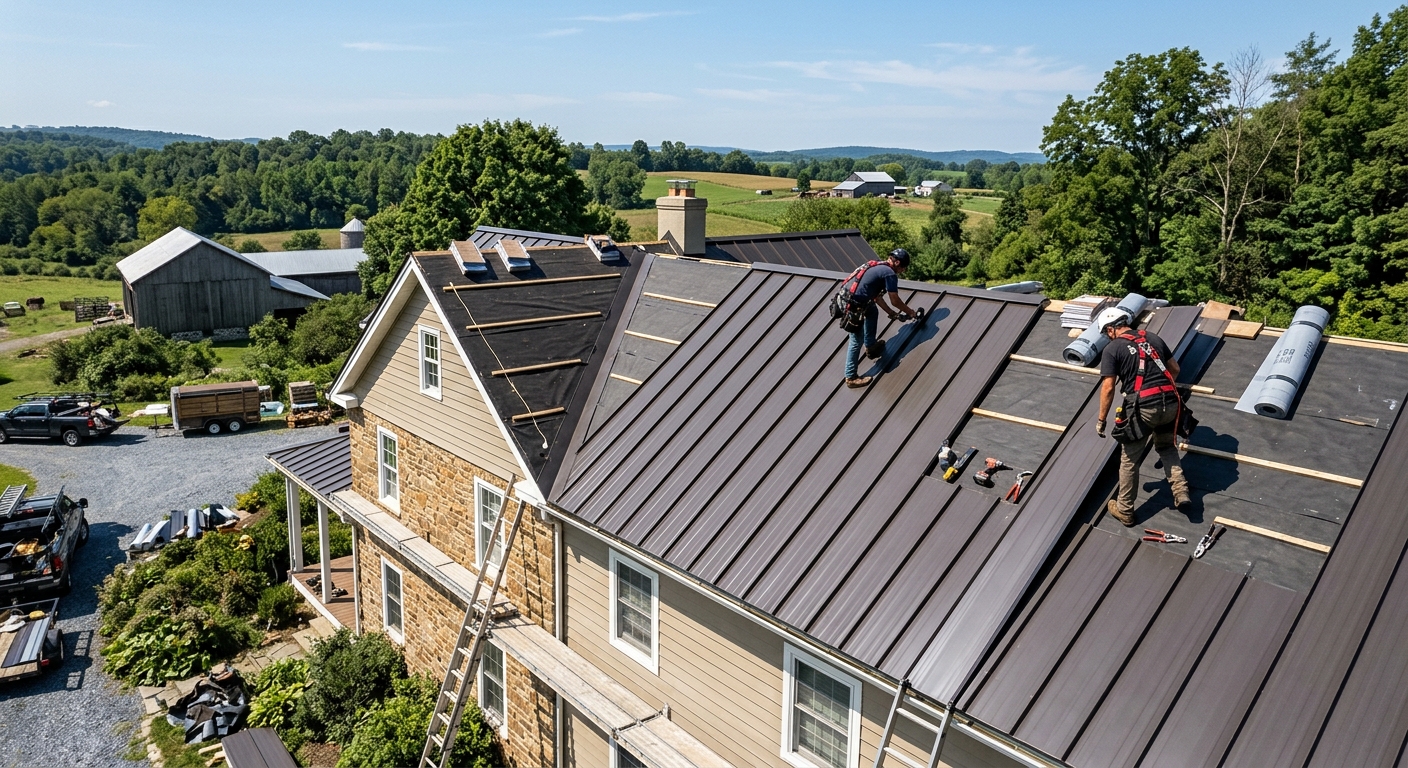
| Metal standing seam |
40–70 yrs |
Steep slopes, maximum durability |
$22,000–$39,500 |
| Flat roof — TPO or EPDM |
15–25 yrs |
Porch, rowhouse, or low-slope additions |
$11,500–$23,000 |
| Roof repair — leak or isolated section |
n/a |
Leaks, missing shingles, or small area failures |
$475–$1,850 |
Prices are estimates for a typical Lancaster home and vary with roof size, pitch, decking condition and material selection.
Pennsylvania code and Lancaster County permit rules for roofing
The Pennsylvania Uniform Construction Code (UCC), based on the IRC, governs all residential roofing work across Lancaster County. Enforcement depends on where you live. In Lancaster city, the Bureau of Code Compliance requires a permit for any roof replacement involving new sheathing or structural work. Simple roof repairs limited to swapping a few shingles often don’t require a permit, especially in the townships outside the city. But if decking needs to be replaced or if the job is more than a minor patch, expect to file for a permit in the city. Each township has its own code enforcement process, but most minor repairs proceed without any paperwork.
For roofing contractors, the state requires Home Improvement Contractor (HIC) registration on any contract over $500. Homeowners should always verify HIC registration at hic.attorneygeneral.gov before signing. To make sure a roofer covers their workers, check for mandatory workers' compensation coverage through the WCAIS system at wcais.pa.gov. Too many Lancaster-area crews are uninsured or working without registration—if you skip these checks, you’re taking a risk that state law does not protect.
Federal lead-safe rules apply for roofing work on homes built before 1978, which covers most of the local housing stock. You can verify EPA Lead RRP certification at certifiedrenovatorsearch.epa.gov.
Flat roof sections: the part most quotes get wrong
In Lancaster and surrounding towns, many older homes have flat roof sections—a back porch, kitchen addition, or a narrow rowhouse rear. These areas cannot be roofed the same way as the main, pitched portion of the house. While architectural shingles do fine on a steep roof, any slope below about 2/12 demands a membrane system like TPO or EPDM. That’s because shingles depend on shedding water, not holding it, and on a flat section water can’t drain fast enough. Ponding leads to leaks under the tabs and right into your deck boards or kitchen ceiling.
Membrane roofs handle standing water and freeze-thaw cycles better than any shingle. For a typical Lancaster flat section, replacement runs $11,500–$23,000 installed. This is higher per square foot than shingles, but skipping it means repeat leaks and deck rot. If a roofer is willing to quote architectural shingles on a 2/12 pitch or lower, they’re telling you they’ll risk a callback to save a buck upfront—a red flag in this climate.
Membranes last about 15–25 years with proper maintenance, which is shorter than metal and some shingle systems, but you’ll get that full life if installed correctly with tight seams and real drainage detail. Insist on a quote that splits out the flat roof scope, and ask for membrane specs by brand and thickness.
Why gutters get replaced with the roof
In Lancaster County, your gutters, downspouts, drip edge, and ground grading make up one interdependent water management system. Replacing a roof without also addressing gutters is a partial fix at best. Old gutters often detach when new drip edge is installed, and loose or undersized downspouts send water too close to the foundation—feeding the same basement leaks that plague many local homes, particularly under steep old roofs. Even the best roof won’t protect you if runoff dumps a few feet from the wall.
Roofing warranties in Lancaster sometimes require functional gutters and drainage, making this more than a cosmetic step. When the job is done right, gutter replacement alongside a new roof typically falls into the $1,500–$3,000 range for a standard single-family home here, with gutter guard systems running another $1,200–$2,300 if you want them added.
If a roofer is content to throw new shingles on without checking drainage, skip them. A complete roofing job in Lancaster should consider how every drop gets from the peak through the downspout and away from your basement.
The cost drivers behind a Lancaster roof replacement
Why do quotes for the same house in Lancaster sometimes show a $5,000 swing or more? The answer is in how each contractor interprets the details of your home—and which corners they might cut. For one, Lancaster County’s housing stock is heavily pre-1950, and most older houses have steep pitches, multiple past shingle-overs, and unknown deck condition until tear-off. On a house like that, you almost always end up with extra labor and increased disposal costs. For every additional shingle layer you find (not uncommon in certain Lancaster neighborhoods), expect another $500–$1,500 just for tear-off and landfill fees.
Lancaster sits in the south-central Pennsylvania climate zone, exposed to Susquehanna River valley thunderstorms that deliver wind bursts rather than deep snow. Still, code dictates a 30 psf ground snow load and 12°F winter design temp, so quality installs require ice barrier membranes at the eaves—often an overlooked upgrade that protects your deck and attic. On top of that, steep and complicated roof access adds up: higher pitches slow the crew and require more safety gear, typically adding 20–30% to labor costs. Material choices, like stepping up to Class 4 impact-resistant shingles for storm exposure, also move you to the top end of the $15,000–$19,000 range for asphalt roofing.
| Factor |
Why it matters here |
Cost impact |
| Roof size in squares |
each square is 100 sq ft of roof surface |
primary multiplier |
| Pitch and access |
steep pitches need harnesses and slow the crew |
+20–30% labour |
| Existing layers to tear off |
two or more layers means full tear-off and disposal |
$500–$1,500 per layer |
| Decking condition |
rot is found during tear-off, not before |
$75–$150 per sheet |
| Ice barrier at eaves |
required where ice damming has a history |
$300–$800 |
| Material grade |
3-tab vs architectural vs Class 4 impact-resistant |
$500–$2,500 |
Reading the warranty on a Lancaster roof
Every roofing job in Lancaster comes with two potential warranties: a manufacturer warranty and a contractor (workmanship) warranty. It’s important to know exactly what each means and where coverage can disappear. The manufacturer warranty covers defects in the shingle or metal itself—most are prorated, so coverage shrinks as years pass. Many require registration within a few weeks of installation. Installation mistakes, like bad ventilation or “layover” jobs (layering new shingles over old), usually void this warranty outright and are not rare in the Lancaster market’s older homes.
The workmanship warranty is offered by your contractor and covers installation errors. This is only as secure as the company’s longevity. If the business folds, your warranty is worthless. Honestly, a 25-year workmanship promise from a roofer who just opened shop last summer isn’t worth as much as a 10-year warranty from a dependable firm with deep Lancaster roots. Ask for warranty terms in writing and whether coverage will transfer if you sell the house—some do, some don’t, and transfer often requires notifying the company within 30 days of closing.
Neither warranty covers storm damage or leaks caused by clogged gutters or neglected attic ventilation. Read both documents carefully and file your paperwork—if you don’t register, you might not have protection when you need it.
How to compare roofing quotes in Lancaster
A proper Lancaster roofing estimate is a detailed document, not a one-page slip with a total at the bottom. There are standards here: the roof area should be stated in squares (each 100 square feet) with pitch noted. The tear-off and disposal line needs to list the layers to remove, since older local homes often have two or three. Underlayment and ice barrier should be specified by brand and coverage—if “felt” is all you see, push for more detail. Decking replacement must be priced per sheet as a contingency, since Lancaster’s old boards are often rotten underneath. Flashing work, vent boots, and chimney saddle details should be listed, not just mentioned vaguely.
The warranty section should separate the manufacturer (material) warranty from the roofer’s own labor warranty so you know what’s covered, how long, and by whom. Payment schedules should favor the homeowner—no more than 15% deposit, and the balance due only after final inspection. If you get a flat lump sum, no square count, no breakdowns, you have no way to compare one bid to the next or hold the contractor accountable if things go sideways.
| Line item |
What to look for |
Red flag if… |
| Roof area |
stated in squares, with pitch |
no measurement given |
| Tear-off and disposal |
number of layers, dumpster included |
bundled into one figure |
| Underlayment |
product type and coverage |
listed only as 'felt' |
| Ice and water shield |
coverage height at eaves |
omitted entirely |
| Decking |
per-sheet contingency price |
no allowance at all |
| Warranty |
workmanship years stated separately |
only the shingle warranty |
| Payment |
deposit under 15%, balance on completion |
large upfront cash |
Frequently asked questions — roofing in Lancaster
What's the cheapest way to replace a roof in Lancaster?
If cost is your main priority in Lancaster, focus on a standard architectural asphalt shingle roof. The current local range runs from $9,100–$19,000 depending on roof size and tear-off conditions. The truth is, you can save by picking a reputable small contractor, scheduling the job when their crew is available (not mid-summer rush), and avoiding brand upgrades that don’t add much value here. Never attempt to save by taking only the surface layer off if there’s more than one layer beneath; with Lancaster’s older homes, this leaves rot and leaks festering. Avoid “storm chaser” offers and anyone who suggests skipping permits or registration to go cheap—it’s a sign of risks that could outweigh any upfront savings. Always verify HIC registration and insurance, even for budget jobs.
Will filing a roof claim raise my premium?
In Pennsylvania, most insurers count every claim on your policy, and a roof claim caused by wind or storm in Lancaster can trigger a rate hike or even a non-renewal. While state law provides some consumer protection, there is no rule that stops carriers from increasing rates for weather-related losses. If repairs are relatively minor—say under $1,850—it’s often smarter to pay out-of-pocket rather than risk your future insurability, especially with frequent thunderstorm wind bursts here in the Susquehanna River valley. Always get an estimate from a local roofer you trust before looping your insurance in, and never let a contractor “waive” your deductible—it’s prohibited in Pennsylvania and could void your coverage.
Do metal roofs shed snow better in Lancaster?
Yes, metal standing seam roofs excel at shedding snow, which is useful in Lancaster’s climate of moderate snowfall and frequent freeze-thaw cycling. While we don’t have the deep lake-effect snows seen upstate, the regional ground snow load requirement is 30 psf, so ice and snow management is still critical. A metal roof, which typically costs $22,000–$39,500 here, will let snow and ice slide off instead of building up at the eaves. This reduces the risk of ice damming and heavy roof loads. On steep Lancaster roofs, this can extend the roof’s life and cut down on shingle repairs, but be aware that overhangs and valleys still need the right snow guards installed.
Do I need a permit to replace a roof in Lancaster?
In Lancaster city, yes—if your roof replacement involves new sheathing or any structural work, a building permit is required by the local Bureau of Code Compliance. For minor leak repairs (just a few shingles), no permit is required in most of the county’s neighboring townships. Always ask your contractor if their scope triggers a permit, and verify their information with the municipality yourself. Make sure they hold active Home Improvement Contractor (HIC) registration, which you can check at hic.attorneygeneral.gov. Any reputable company bidding a full replacement—often in the $9,100–$19,000 range—should handle the paperwork for you, but don’t just take their word for it. It protects you if a problem comes up.
How much does it cost to repair a roof leak in Lancaster?
A typical leak repair in Lancaster runs from $475–$1,850 depending on the cause and whether your roof is accessible. The bottom end is for quick fixes like swapping a few missing shingles or sealing vents, while chasing a leak across old plywood or flashing will reach the upper end. With 88.0% of Lancaster homes built before 1980, roofs here often have hidden causes behind ceiling stains, so a proper diagnosis takes time. It’s not worth spending toward the higher end unless you’re confident the fix is both thorough and addresses the real source. Always ask for photos before and after—there are too many short-term “patch and dash” jobs in this market.
Should I use a local roofer or a national company?
In Lancaster, local roofers have the edge for most projects. They know the quirks of our old, steep roofs and are used to handling multi-layer tear-offs and region-specific code compliance. While national brands can offer slicker paperwork, they may use out-of-area subs who don’t understand Lancaster’s snow load and storm conditions. Also, local firms are more likely to honor a workmanship warranty—which on an asphalt replacement might be $9,100–$19,000—since they depend on community reputation. No matter who you choose, insist on proof of HIC registration and workers’ compensation. If you want the best value and faster response to issues, stick with someone who works only in Lancaster County and the neighboring townships.
Why do roofs fail faster in south-central Pennsylvania?
Roofs in south-central Pennsylvania—including Lancaster—face pronounced freeze-thaw cycling, moderate snowfall, and sharp thunderstorm winds rolling off the Susquehanna River valley. These conditions mean materials expand, contract, and see standing water much more often than in milder climates. The 30 psf ground snow load and 12°F winter design temp may not sound extreme, but combined with old roof structures built before 1980, this stresses shingles and membranes. Many failures are linked to improper ventilation, ice dams, or poor flashing—not just material quality. Even the best current shingles (costing $15,000–$19,000 installed) won’t last if installed over an unvented attic or skipped ice barrier. Always hire a contractor that addresses these regional risks, not just the cheapest labor.
Do I need to leave my house during a roof replacement?
Most Lancaster homeowners stay home during a standard roof replacement, even if it takes several days. Expect some noise, dust, and vibration—especially since so many local homes have wood lathe and plaster ceilings that can shed grit when demo starts up top. If you work from home, plan to relocate your pets or yourself for the loudest phase. For a two-story asphalt shingle replacement (often $9,100–$19,000), most families stay in place during the process. Major flat or metal projects with full tear-off may warrant moving valuables from the attic. A good roofer will keep paths clear and secure, but warn them in advance about any fragile items or medical needs in your household.
Is a sagging roof line an emergency?
Yes, in Lancaster, a sagging roof line is a warning sign you can’t ignore—especially with how many homes date before 1950. Sagging often points to failed deck boards, overloaded rafters, or water intrusion that’s been going on for years. Leaving it unchecked risks collapse, which could mean far more than a $19,000 replacement bill. If you spot a visible dip or bow—especially after a storm or heavy snow—a contractor should inspect it the same week, not next month. Don’t just patch leaks or add another shingle layer until the underlying structure is checked out. It’s better to pay a few hundred for a proper diagnosis now than face emergency tarping or structural rebuild after the next storm.