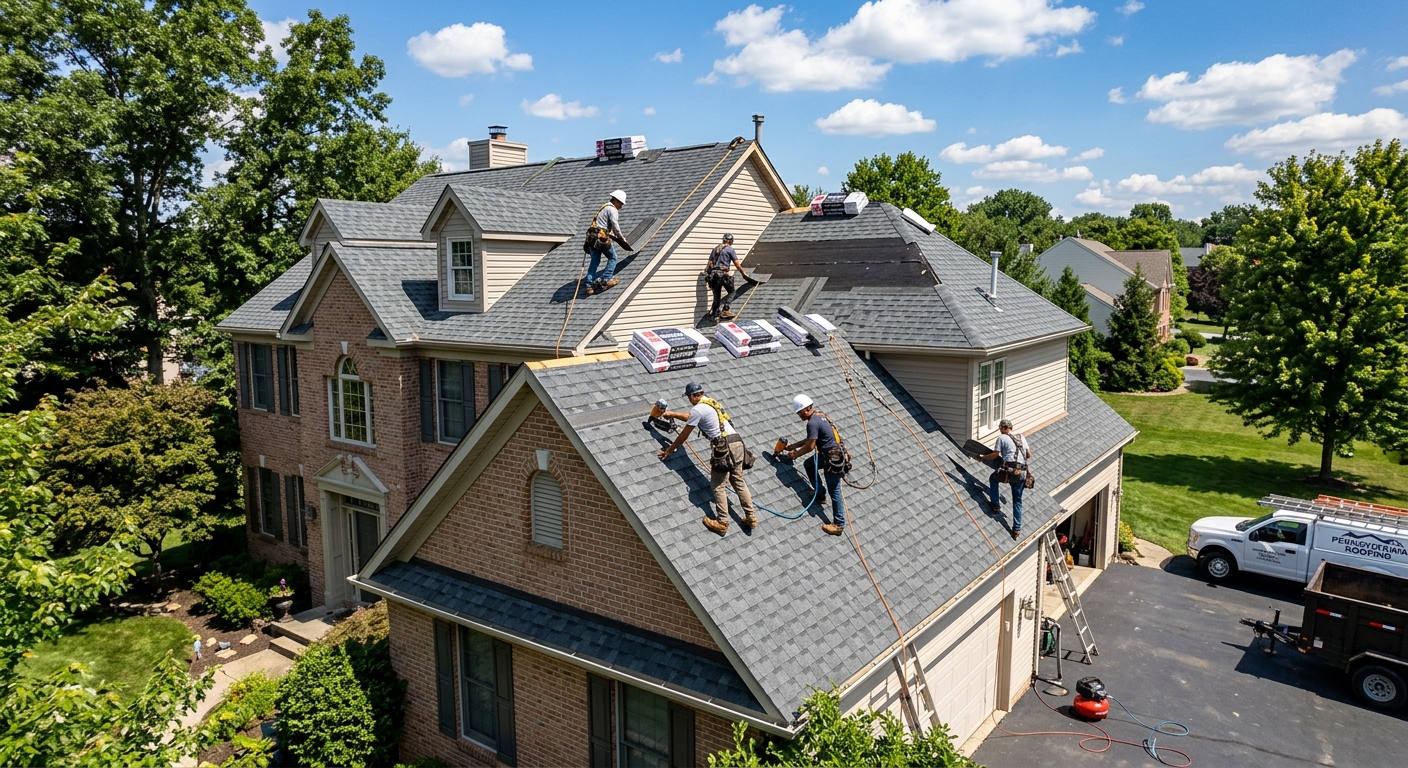
Quincy roofing prices by material and scope — 2026
In Quincy, with its modest population of 5,325 and a high homeownership rate of 75.8% (U.S. Census Bureau, ACS 2024), roof replacements tend to cluster in waves because so much of the housing stock was built between 1950 and 1980. The typical home here is a single-family stick frame with a shingle roof now reaching the end of its first or second layer—meaning what looks like a basic asphalt re-roof often becomes a full tear-off, with the possibility of decking repairs. For many Quincy homeowners, by the time the exterior shows its age, the underlying deck may have taken on water damage after decades of freeze-thaw and ridge-line winds that can lift and break old shingles. Low-slope porches, additions, or carports are common, each with their own membrane needs and price points.
Costs in Quincy also reflect the regional dominance of architectural asphalt shingles, which strike the right balance for our snow load, temperature swings, and practical maintenance—though the price sensitive will notice the jump in investment if they consider metal. Travel surcharges can show up south of Chambersburg, but local crews know how to bid these stock housing types and their quirks.
| Material / Scope |
Lifespan |
Best for |
Price range (installed) |
| Asphalt shingles — architectural (30-yr) |
25–30 yrs |
Most single-family homes, original replacement |
$8,800–$18,500 |
| Asphalt shingles — impact-resistant (Class 4) |
30+ yrs |
Homes with wind exposure; insurance break possible |
$14,500–$18,500 |
| Metal standing seam |
40–70 yrs |
Long-term keepers, snow-shedding, low maintenance |
$21,500–$38,000 |
| Flat roof — TPO or EPDM |
15–25 yrs |
Porches, additions, low-slope areas |
$11,000–$22,500 |
| Roof repair — leak or isolated section |
n/a |
Emergency leaks, spot fixes, flashing repairs |
$475–$1,750 |
Prices are estimates for a typical Quincy home and vary with roof size, pitch, decking condition and material selection.
How to compare roofing quotes in Quincy
When you get roof estimates in Quincy, the first thing to check is whether the quote actually spells out your roof size, in “squares” (one square = 100 sq ft of roof surface) with the pitch noted. On our postwar stock, with 63.7% of homes built before 1980, the difference of a single extra foot of roof width or steeper pitch quickly adds up to the tune of hundreds of dollars. Next, confirm that tear-off and disposal of old shingles is listed as a separate line item—most Quincy homes are on their first asphalt tear-off, but a few still have two layers, and each has to be stripped and dumped. Underlayment and especially ice and water shield should be named by brand and coverage.
A legitimate estimate for a Quincy roof shows decking replacement as a “per sheet” contingency, so if rot is found during tear-off, you know what you’ll pay: anything else is playing with fire. Flashing and vent boots need explicit mention, especially on the wind-exposed ridgelines we see locally. Warranties should split the shingle manufacturer’s promise (usually pro-rated) from the contractor’s own labor coverage, and payment terms always show deposit and final payment schedule, preferably no more than 15% up front. If the quote just gives one lump sum without breakout, there’s no real way to see if you’re being overcharged or left exposed during a problem.
| Line item |
What to look for |
Red flag if… |
| Roof area |
stated in squares, with pitch |
no measurement given |
| Tear-off and disposal |
number of layers, dumpster included |
bundled into one figure |
| Underlayment |
product type and coverage |
listed only as 'felt' |
| Ice and water shield |
coverage height at eaves |
omitted entirely |
| Decking |
per-sheet contingency price |
no allowance at all |
| Warranty |
workmanship years stated separately |
only the shingle warranty |
| Payment |
deposit under 15%, balance on completion |
large upfront cash |
TPO and EPDM on Quincy homes
In Quincy, it’s common for homes to have at least one “flat” section—often a rear porch, low-slope addition, or bumpout on a postwar ranch. These sections can't use architectural shingles like the main roof because, at a shallow slope, water sits and will work its way under shingle laps. EPDM (rubber) or TPO (thermoplastic) membranes are the standard for these flat areas because they form a watertight single sheet that stands up to ponding and freeze-thaw cycles much better than shingles ever could.
Membranes like TPO and EPDM last about 15–25 years, which is less than the best architectural shingles but much longer than asphalt on a low slope, where curling and leaks can show up in just a few years. For a Quincy-area flat roof replacement, prices usually span $11,000–$22,500 including tear-off and disposal of the old membrane or composite. If you get a quote to “shingle over” a section with less than 3:12 pitch (and certainly at 2:12 or lower), that’s a signal the contractor does not understand—or care about—the reality of Pennsylvania’s climate. In Franklin County’s freeze-thaw environment with repeated snow loads, a membrane system is not optional on these sections if you care about longevity or insurance coverage.
Material comparison for Quincy homeowners
Material selection in Quincy needs to fit both our climate and the era of our homes. With a regional ground snow load of 30 psf and a winter design temperature of 12 °F, the key issues are snow-shedding ability, wind-uplift resistance, and repairability. Metal standing seam excels at sliding off snow and standing up to ridge-line winds common along the Cumberland Valley, but it demands double or more the up-front investment—ranging from $21,500–$38,000 installed. Asphalt architectural shingles, at $8,800–$18,500, remain the workhorse because they handle moderate snow, are easy to repair, and match most single-layer decks built between 1950 and 1980 in Quincy.
Class 4 impact-resistant asphalt shingles do add wind and hail resistance. For homes out in the open south of Chambersburg, payback may be there, but inside the borough or with good tree cover, their higher price ($14,500–$18,500) often outweighs the benefit. Flat roof membranes (TPO/EPDM) should be reserved for low-slope or porch sections, never pitched main roofs, because they’re designed for standing water and freeze-thaw but cost more per square foot than standard shingles.
Architectural asphalt dominates Franklin County because postwar subdivisions were stick-framed with shingles in mind. These homes already have deck and structural details suited for this material; most upgrades to metal are for longer-term value and snow-shedding, not necessity. Unless your Quincy home is positioned on a bare hill (exposed to more wind and snow slide-off concerns), architectural shingles are the reliable default with sensible cost control.
| Material |
Installed cost |
Lifespan |
Cold-climate performance |
Maintenance |
| Asphalt architectural |
$8,800–$18,500 |
25–30 yrs |
Good freeze-thaw and moderate snow |
Low, occasional shingle/boot replacement |
| Asphalt Class 4 impact-resistant |
$14,500–$18,500 |
30+ yrs |
Better hail/wind, strong warranty |
Very low, more resistant to damage |
| Metal standing seam |
$21,500–$38,000 |
40–70 yrs |
Exceptional snow and wind shedding |
Minimal, check after storms |
| TPO / EPDM membrane |
$11,000–$22,500 |
15–25 yrs |
Best for ponding water/porches |
Occasional seam checks, easy patch |
What Quincy's climate does to a roof
Quincy roofs take a beating from two distinct physical challenges: persistent ridge-line winds and repeated snow loads. The geography of the Cumberland Valley means wind is funneled right through Franklin County, especially up on exposed ridges. Over time, these winds work nails loose, lift shingles’ bottom edges, and can literally flip whole shingle tabs, especially on architectural and 3-tab roofs that haven’t seen tune-ups. A single lifted edge during a February windstorm can become a leak costing $475–$1,750 to repair if flashing or boards get exposed and allow water in.
Our 30 psf ground snow load and frequent freeze-thaw cycles give rise to the most expensive local nuisance: ice dams. Heat escaping from heated Quincy homes melts snow at the ridge, which refreezes at the cold eaves, backing water up under the lower rows of shingle. You won’t always spot the problem until ceiling stains appear, and by then you might be replacing not just shingles but plywood sheathing at $75–$150 per sheet. For this reason, local roofers use ice and water shield underlayment at the eaves, even where not explicitly required by code. Hail is less common, but when it does hit, the shingle bruising caused by hard impacts can look harmless but shortens shingle life dramatically—sometimes shaving years off and accelerating a full replacement cycle to the $8,800–$18,500 band decades before you might expect it.
Pennsylvania code and Franklin County permit rules for roofing
Roofing in Quincy falls under the Pennsylvania Uniform Construction Code (UCC), which is based on the International Residential Code and overseen by the PA Department of Labor & Industry. Whether you need a permit here depends on your exact location. Within the Borough of Chambersburg, any roof work that involves changes to the structural sheathing or framing, such as replacing rotten plywood or altering rafters, requires a building permit from the local Chambersburg Codes Enforcement Office. In unincorporated areas of Franklin County, plain tear-off and replacement of asphalt shingles—without deck or framing work—is usually done with no permit.
There’s no trade-specific roofing license in Pennsylvania. However, for any roofing job costing over $500, your contractor must carry a Home Improvement Contractor (HIC) registration issued by the Pennsylvania Office of Attorney General. You can verify this directly at hic.attorneygeneral.gov. On every Quincy-area roofing job, workers’ compensation coverage is mandatory for all companies with employees—even family labor. Coverage can be verified through WCAIS (wcais.pa.gov). These are not just formalities: an unregistered or uninsured roofer is risking your house and wallet, especially during a claim or worker injury.
The cost drivers behind a Quincy roof replacement
Roofing costs in Quincy aren’t just about material; they’re shaped by specific housing and climate realities. With a majority of homes built 1950–1980, you’re almost always dealing with stick-framed structures designed for one layer of asphalt shingles. If a Quincy house has been “shingled over” a second time, the tear-off and dump fees alone can run $500–$1,500 extra per layer—money you have to spend up front just to reach the deck before any new work starts.
Our local storm exposure and snow load also come with costs. A roof with a steeper pitch might cost 20–30% more in labor, since harnesses are required and every bundle has to be hauled up by hand. If the climactic freeze-thaw cycles have compromised the roof deck, each rotten plywood sheet that must be replaced is another $75–$150. Ice barrier installation at the eaves, while not required everywhere by code, is a staple here to prevent expensive damage from ice dams—a budget line that will add around $300–$800 to an average worksheet, but saves exponentially more if water ever backs up past the gutter in January.
Material selection and manufacturer also matter. The jump from a basic architectural shingle to a Class 4 impact-resistant shingle or a standing seam metal roof can mean a $500–$2,500 or larger price gap for the same sized roof. Factor in rural travel surcharges if you’re south of Chambersburg, and it’s clear Quincy roofs are priced by more than just square footage—local exposure and housing age always come into play.
| Factor |
Why it matters here |
Cost impact |
| Roof size in squares |
each square is 100 sq ft of roof surface |
primary multiplier |
| Pitch and access |
steep pitches need harnesses and slow the crew |
+20–30% labour |
| Existing layers to tear off |
two or more layers means full tear-off and disposal |
$500–$1,500 per layer |
| Decking condition |
rot is found during tear-off, not before |
$75–$150 per sheet |
| Ice barrier at eaves |
required where ice damming has a history |
$300–$800 |
| Material grade |
3-tab vs architectural vs Class 4 impact-resistant |
$500–$2,500 |
Frequently asked questions — roofing in Quincy
Do I need to leave my house during a roof replacement?
For most Quincy homes, you do not need to leave your house during a roof replacement. The majority of projects on our local single-family stock—whether you’re getting a new architectural shingle roof or a metal standing seam—can be completed with you and your family safely inside. The loudest part of the work is the tear-off, especially on older homes built between 1950 and 1980, but even then, it’s usually just a day or two of activity and noise. If you or someone in your home is sensitive to noise or vibration, you might choose to be off-site for part of a day. Any reputable local contractor will work around your schedule and give at least a day's notice before major tear-off or when a dumpster arrives in your driveway. Full replacements, such as those in the $8,800–$18,500 range for architectural shingles, are routinely performed with residents present and utilities on. Only in rare cases—like extensive structural repairs that open your interior to the weather—do you need alternative arrangements.
Is metal roofing noisy in rain?
Metal roofs on Quincy homes are not noisy in the way many expect. Modern standing seam metal roofs, properly installed with a solid deck and quality underlayment, muffle sound far better than the old barn metal fastened straight to open rafters. In most single-family homes with attic insulation, the noise difference between a metal roof and an asphalt shingle roof is minor; if you’re finishing a second story or have a cathedral ceiling, let your contractor know so additional foam or soundboard can be added to further reduce noise. Those opting for metal are usually interested in snow shedding and longevity; while metal is more expensive (in the $21,500–$38,000 band), it won’t make your Quincy home feel like a shed in a rainstorm. If you’re ever concerned, ask your roofer where you can hear a completed local install for yourself—it’s a real-world check before you commit.
Is a metal roof worth the extra cost in Quincy?
In Quincy, a metal roof is worth the extra investment for some but not all homeowners. Metal standing seam roofs start at $21,500 and often run double the average architectural shingle replacement. They shed snow rapidly—a major bonus given Franklin County's ridge-line wind exposure and 30 psf snow load—and often last 40–70 years with little upkeep. If you plan to stay in your home long-term, or your roof is especially prone to damage from sliding snow or repeated wind-blown shingle loss, the value is clear. For owners planning to move in the next decade, though, the payback in Quincy is less certain, since buyers often price homes by age and curb appeal, not roofing material alone. Unless your home is particularly exposed, architectural shingles in the $8,800–$18,500 range remain a smart investment for most.
How many quotes should I get for a roof in Quincy?
It's always smart to get at least two, and preferably three, detailed quotes before settling on a roofer in Quincy or anywhere in Franklin County. Our market isn't as saturated as Harrisburg, so options may feel thinner, but you still want line-by-line breakdowns—roof area in squares, underlayment, specific brands, and deck replacement priced per sheet. This transparency makes it realistic to compare the $8,800–$18,500 band for architectural shingle jobs. Any estimate that’s just a lump sum doesn’t give you control or recourse if something is missed or goes wrong. Reasonable local contractors expect you to shop around and are willing to answer questions, not pressure you to sign the same day.
Can a contractor cover my insurance deductible in Pennsylvania?
No, Pennsylvania law strictly prohibits waiving or “eating” your insurance deductible on a roof claim. Under the Home Improvement Consumer Protection Act (HICPA), waiving a homeowner's deductible is illegal. If a contractor in Quincy offers to reimburse or “credit” your deductible as part of a storm damage bid—such as a roof repair or replacement claim in the $8,800–$18,500 range—they’re inviting serious legal trouble and exposing you to a denied claim or insurance fraud allegation. Always insist on a written contract and pay your share—it's the only legal and safe way to do business in south-central Pennsylvania.
Why do roofs fail faster in south-central Pennsylvania?
Roofs in Quincy and the rest of Franklin County tend to fail sooner than you’d expect from brochure lifespans due to our distinct climate mechanisms. Ridge-line winds funneled through the Cumberland Valley physically lift shingles, curl tabs, and exploit any installation shortcut. The 30 psf snow load, combined with frequent freeze-thaw cycles, causes ice dams and water backup at the eaves, especially on homes without modern ice barrier underlayment. These issues, unique to this region, contribute to more repairs (in the $475–$1,750 band) and shorter overall replacement cycles. Even the best architectural shingles may underperform their advertised years if maintenance or local upgrades are skipped.
Is ice barrier underlayment required in Quincy?
Ice barrier (or “ice and water shield”) is strongly standard—even if not always strictly required by code—in Quincy and across Franklin County, given our persistent freeze-thaw and snow-load risk. While the Pennsylvania Uniform Construction Code suggests it for all eave edges, most experienced local contractors will install at least three feet of ice barrier along the eaves on any asphalt or metal job. This upgrade, costing about $300–$800 on a standard roof, can stop damage from water backing up under shingles during ice dam episodes. If your quote omits this, get a second opinion—repairing rot after an ice dam is far more costly. On low-slope or known problem roofs, expanding coverage is money well spent.
What does it mean if my shingles are curling or losing granules?
Shingles that are curling, “cupping” at the corners, or losing lots of granules are at or near the end of their useful life—especially with the average Quincy home now sporting a roof 20–30 years old. Curling means the shingles have dried out or been repeatedly blown by wind, often through seasons of freeze-thaw. Granule loss exposes the asphalt base to UV rays and water penetration, accelerating leaks and deck rot. In this part of Franklin County, the likely next step is a full replacement in the $8,800–$18,500 range, with potential added costs if water damage has worked down to the decking ($75–$150 per sheet). If you catch granule loss or curling early, ask a reputable roofer for a true assessment—but don’t let anyone sell you repair patches when your roof is clearly failing across whole slopes.
What does roof replacement cost per square in Quincy?
In Quincy, roof replacement is typically priced per “square” (100 square feet of roof surface). For architectural asphalt shingles, the installed price usually runs $450–$650 per square, depending on the complexity and access. Metal standing seam comes in higher, from $1,050–$1,700 per square, reflecting higher material and labor costs. Flat roof membrane systems like TPO and EPDM, common on porches or additions, land in the $1,100–$1,800 per square range. These figures come from actual bids in Franklin County and reflect both material and labor. Tear-off of additional shingle layers or surprise deck repairs can bump costs beyond the base rate—always check that your quote spells out per-square charges, not just a lump sum.