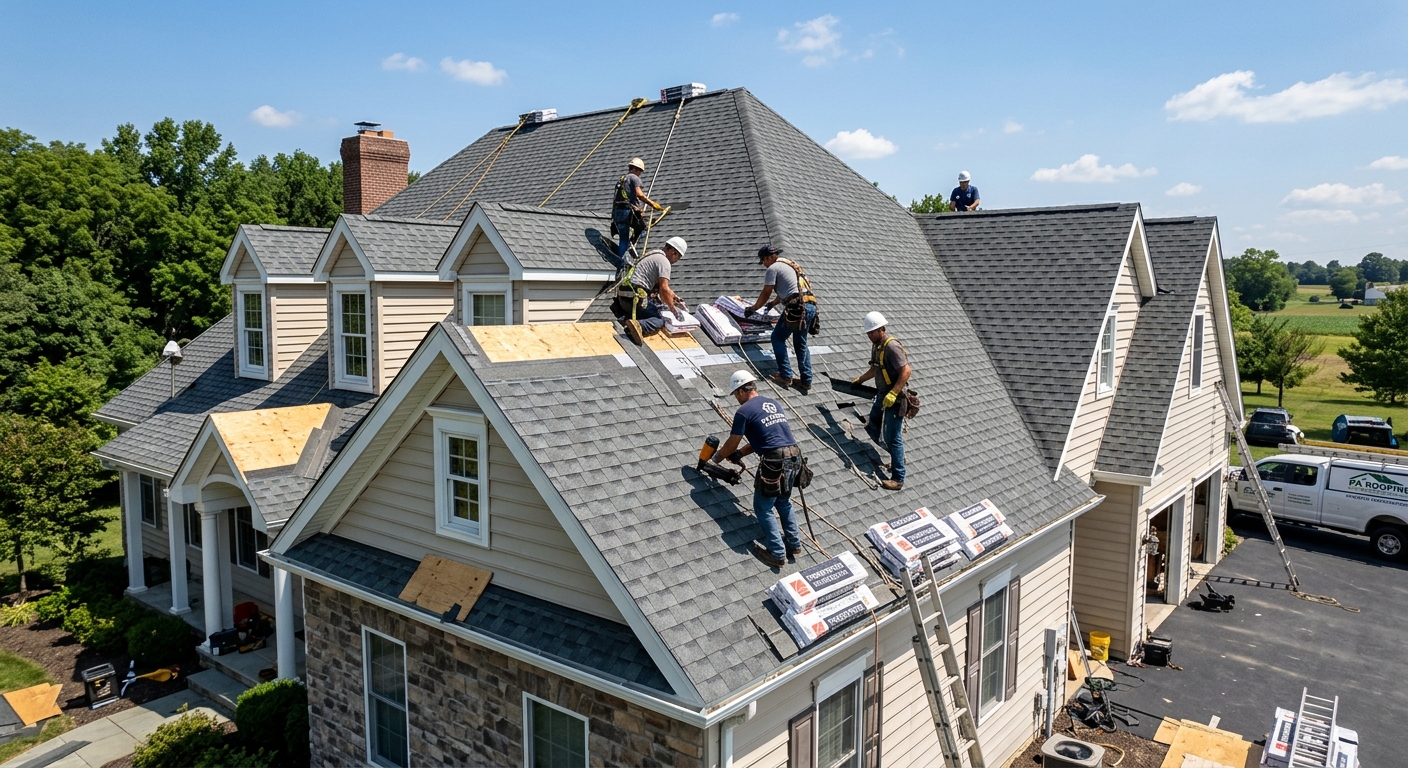
Roofing Replacement & Repair costs in Reading — 2026
In Reading Township and across Adams County, roof replacement and repair costs reflect the age and character of local homes. Many properties are owned by families with long-term plans—over 90% of households here own their home (U.S. Census Bureau, ACS 2024)—and most are single-family residences, which means larger roof spans per address. This shapes the typical job in Reading: roofs are bigger than in the city, and owners often favor durable upgrades over patch jobs.
Much of the housing around Gettysburg and Cumberland Township dates from 1940–1970 infill, which, in practical terms, means frequent full tear-offs and deck repairs when replacing the roof. The plywood or plank decking installed mid-century often reveals rot or inadequate fastening once the old shingles come off, especially if a roof has already been layered over once. In Reading, large projects involving deck repairs are much more common than “just a shingle swap.” Homeowners should be prepared for crews to discover—and quote—replacement sheathing once work begins.
Common roof replacements in Adams County use architectural asphalt shingles, as local restrictions on bright synthetic or high-gloss metal affect options in and near historic Gettysburg. For anyone considering a project in 2026, here’s what costs look like in today’s Reading market:
| Material / Scope |
Lifespan |
Best for |
Price range (installed) |
| Asphalt shingles — architectural (30-yr) |
25–30 yrs |
Standard residential replacement |
$10,500–$22,000 |
| Asphalt shingles — impact-resistant (Class 4) |
30+ yrs |
Heavier tree cover, hail risk |
$17,000–$22,000 |
| Metal standing seam |
40–70 yrs |
Longevity, low maintenance—permitted outside Gettysburg historic districts |
$25,000–$45,000 |
| Flat roof — TPO or EPDM |
15–25 yrs |
Sheds and low-slope porches |
$13,000–$26,000 |
| Roof repair — leak or isolated section |
n/a |
Localized leaks or damage, patches under 2 squares |
$550–$2,100 |
Prices are estimates for a typical Reading home and vary with roof size, pitch, decking condition and material selection.
The cost drivers behind a Reading roof replacement
When you get roof replacement quotes in Reading, the wide spread usually comes down to scope—specifically, the age and construction details common to this part of Adams County. Older decking and more frequent discoveries of rot have a real impact. Since large shares of homes date to the 1940–1970 era, expect your estimate to include a strong chance of wood replacement; every new sheet of plywood adds $75–$150 to the bill.
A big cost divider is roof size. Reading’s single-family homes typically feature larger footprints, which means higher material and labor spends per address. Contractors here calculate every “square”—that’s 100 square feet of roof surface—the number you want clearly stated on your quote.
Pitch matters almost as much as size. A steep-pitched roof, common in older Reading houses built for snow-shedding, adds up to 30% to labor costs because safety harnesses and specialized staging slow down installation. Harsh freeze-thaw cycles and a ground snow load of 30 psf in this county also mean Adams County crews must build in upgraded underlayments and ice barriers, especially on south-facing ridgelines near South Mountain, which are vulnerable to wind uplift and ice damming.
| Factor |
Why it matters here |
Cost impact |
| Roof size in squares |
each square is 100 sq ft of roof surface; Reading roofs tend to be larger |
primary multiplier |
| Pitch and access |
steep pitches need harnesses and slow the crew; common for snow in Adams County |
+20–30% labour |
| Existing layers to tear off |
two or more layers means full tear-off and disposal; common in older 1940–1970s roofs |
$500–$1,500 per layer |
| Decking condition |
rot is found during tear-off, not before; frequent in mid-century homes |
$75–$150 per sheet |
| Ice barrier at eaves |
required where ice damming has a history; real concern near South Mountain ridges |
$300–$800 |
| Material grade |
3-tab vs architectural vs Class 4 impact-resistant; most go architectural or higher |
$500–$2,500 |
Pennsylvania code and Adams County permit rules for roofing
All residential roofing work in Reading Township and the rest of Adams County follows the Pennsylvania Uniform Construction Code (UCC), which builds on the IRC as its foundation. Enforcement is handled differently depending on where you live: in Gettysburg Borough, the Gettysburg Borough Code Enforcement Office oversees permits, while other Adams County townships issue permits through their own municipal offices. If you live in Reading Township or a rural area, that means checking with your township office for permit requirements.
A building permit is typically triggered when replacing more than 25% of your roof area in Gettysburg Borough. In rural Reading Township, small shingle patch jobs under one square rarely need permits. For any contract over $500, your roofer must hold a Home Improvement Contractor (HIC) registration, which is issued by the Pennsylvania Office of Attorney General. Always verify a contractor’s registration at hic.attorneygeneral.gov before signing.
Pennsylvania law also requires every roofing crew to have workers’ compensation insurance. You can verify a company’s insurance standing in the WCAIS system (wcais.pa.gov). Never take a verbal assurance—ask for the actual insurance certificate and cross-check it.
Workmanship vs manufacturer warranty
Homeowners in Reading often conflate two very different types of warranty when choosing a roofer. Manufacturer warranties back the shingle or panel itself—covering specific product defects, but almost always on a prorated schedule, meaning the value drops each year. These warranties can look impressive on paper, promising 30 to 50 years, but they typically require prompt online registration, proper attic ventilation, and that no additional layers of shingle remain underneath. Failing to meet these standards often voids the coverage.
In contrast, a workmanship warranty covers the quality of the installation—only what the contractor directly controls. This warranty is only meaningful for as long as the company is in business and willing to honor claims. A “25-year” workmanship pledge from a two-year-old roofer carries less weight than a 10-year track record from a business rooted in Adams County. Ask in writing if the warranty transfers to the next owner if you sell; many do, but only if registered within a tight window after closing.
Key things that void both types: improper ventilation, venting clothes dryers into the attic, re-roofing over old shingles, or failing to register the warranty on time. Always get these terms in writing before signing a contract.
Snow load, ice dams and wind in Reading
South-central Pennsylvania’s roofing needs are shaped by a mix of 30 psf ground snow load, 12°F winter design temperature, and frequent freeze-thaw cycles through late winter. In Reading Township, and especially along south-facing ridgelines near South Mountain, older asphalt shingle roofs commonly suffer wind uplift as well as recurring ice dams. This specific weather exposure is different from the lighter winds and snow seen to the east.
Ice dams form when snow melts on the upper, warmer roof and refreezes near the unheated eaves, trapping water above the overhang. The water backs up under shingles, often leading to leaks that stain drywall or delaminate roof decking—both of which are discovered only during a full tear-off and can add $75–$150 per plywood sheet replaced. Persistent ice damming over decades is why Reading homes often require enhanced ice and water shield along the eaves and valleys, not just a typical rolled felt.
Reading’s elevated wind exposure on certain south- and west-facing ridgelines means higher risk of shingle tab lifting—a problem exacerbated on roofs installed pre-2000, before present uplift ratings. Upgrading to architectural shingles or adding mechanical fasteners (instead of just adhesive strips) is not just extra caution here; it’s a real defense against storm events that cost homeowners $550–$2,100 in sudden repair bills if missed during replacement.
How to compare roofing quotes in Reading
Every reputable roofing quote in Reading should break out scope and materials in detail, starting with the number of squares (each is 100 square feet), pitch, and access issues. If a quote doesn’t clearly list the tear-off and disposal by number of layers and include dumpster service, it’s not apples-to-apples with one that does. Underlayment matters in freeze-thaw-prone Adams County, so you should see products like synthetic felt or rubberized ice and water shield specified by brand and total coverage height at eaves and valleys.
Wood decking should be handled as a per-sheet contingency—expect a separate line item at $75–$150 per sheet. Flashings, pipe boots, and attic ventilation upgrades should also be itemized. Reliable companies always separate their workmanship warranty from the manufacturer's, so you know what each covers and for how long. Payment terms in Adams County should be no more than 15% down, with the balance due on completion. If you get a single lump sum price with no explanation or an unusually large upfront demand, walk away.
| Line item |
What to look for |
Red flag if… |
| Roof area |
stated in squares, with pitch |
no measurement given |
| Tear-off and disposal |
number of layers, dumpster included |
bundled into one figure |
| Underlayment |
product type and coverage |
listed only as 'felt' |
| Ice and water shield |
coverage height at eaves |
omitted entirely |
| Decking |
per-sheet contingency price |
no allowance at all |
| Warranty |
workmanship years stated separately |
only the shingle warranty |
| Payment |
deposit under 15%, balance on completion |
large upfront cash |
How to vet a Reading roofing contractor
Reading homeowners should directly verify every contractor’s Home Improvement Contractor (HIC) registration at hic.attorneygeneral.gov before signing anything. There’s no special state roofing license in Pennsylvania, only the HIC registration for jobs over $500. Ask to see proof of active workers’ compensation—they should provide an insurance certificate, which you can validate on WCAIS (wcais.pa.gov). These steps matter in Adams County’s rural market, where contractors often travel in from York–Hanover or Chambersburg, and it’s common to see out-of-area crews.
- Confirm HIC registration at the official database
- Request and verify workers’ compensation through WCAIS
- Get a written contract quoting scope and total price
- Ask for a local project address within the last 6 months
- Check for manufacturer certification on the shingle or roofing product
- Ask about warranty registration process—get it in writing
- Require certificate of liability insurance (call the agent to confirm)
- Set clear payment terms—never cash upfront beyond 15%
- Ask who performs the job—local crew or subcontractor
- Obtain a copy of the permit if your project requires one
- Demand references from similar Adams County homes
- Look for clear business address—PO Boxes or hotels are red flags
In Reading and rural Adams County, watch for these red flags: contractor uses only a cell number (no local address); pushes for large cash deposit; no proof of HIC registration; vague about liability or workers’ comp; or refuses to show a permit when required. In a thin rural market—unlike a busy metro—fly-by-night crews often show up after storms and disappear quickly.
Frequently asked questions — roofing in Reading
How far ahead should I book a roofer in Reading?
In Reading Township and the rural stretches of Adams County, spring and fall are peak seasons for major roof work. Because this area falls between denser contractor markets, local crews often book six to eight weeks out for full replacements. Travel surcharges and limited availability are common since most companies cover a wide rural radius. If you want to replace your roof with architectural shingles ($10,500–$22,000), contact roofers well before summer, or risk being bumped after a summer storm event fills the schedule. Emergency repairs ($550–$2,100) can sometimes be done sooner, but don’t count on same-day or next-day contracts during busy stretches. Always allow time for permit processing if over 25% of the roof is being replaced.
Do I need my own inspection before the adjuster visits?
In Reading and greater Adams County, having an experienced roofer inspect your roof before an insurance adjuster visits is smart, especially if your home uses older decking common in this area. Local contractors understand storm and freeze-thaw damage particular to Reading’s housing stock and can spot issues (like wind uplift or hidden deck rot) that outside adjusters might overlook. This inspection can make the difference between a minor leak patch ($550–$2,100) and approval for a full replacement ($10,500–$22,000). Some reputable roofers will do this at no charge if you’re considering hiring them, but steer clear of anyone charging inspection fees unless they provide a written scope and photos.
How do I find a reputable roofer in Reading?
Start by verifying the contractor’s Home Improvement Contractor (HIC) registration at hic.attorneygeneral.gov—this is required for any Reading job over $500. Always check for active workers’ compensation via WCAIS, because rural crews sometimes skip coverage. Look for companies with recent projects in Reading or neighboring townships, and always ask for in-writing references. For a full asphalt shingle replacement ($10,500–$22,000), don’t get pressured by “in the neighborhood” offers, especially after storms. A legitimate roofer will give a detailed estimate, list payment terms, and never refuse a request for proof of registration or insurance.
Does Reading get enough hail to justify Class 4 shingles?
Reading Township isn’t a hail hotspot compared to the Midwest, but it does see ice storms and severe winds—especially along southern and western ridgelines. While Class 4 impact-resistant shingles ($17,000–$22,000) are usually billed as “hail proof,” they’re also more tear-resistant in high-wind spots like those near South Mountain. If your house is surrounded by large overhanging trees or you’ve had multiple insurance claims for storm damage in the last decade, the upgrade might be worthwhile. Otherwise, the extra outlay doesn’t pay for itself unless a future storm event or your insurer offers a premium discount.
What's the cheapest way to replace a roof in Reading?
The lowest-legal-cost option in Reading is a basic architectural asphalt shingle replacement at $10,500–$22,000. Cutting corners—like re-roofing over old shingles instead of full tear-off—risks code problems and voids warranties, which is costly when you sell or if you file an insurance claim. Since Adams County’s mid-century decks often reveal rot, go with a contractor who quotes decking per sheet ($75–$150). Permits aren’t always needed for minor patches, but for full replacements, skipping the process can backfire at resale. Don’t be tempted by “cheaper” traveling crews; pay for a real contract and insurance, not a discount now that costs more next summer.
How do I know if my Reading roof needs replacing?
In Reading and the rest of Adams County, common warning signs include missing or curling shingles, frequent leaks after storms, and heavy granule loss in gutters. Because many homes date from the 1940–1970s, roofs here often have outdated decking or multiple existing shingle layers, both of which speed up deterioration. If leak repairs ($550–$2,100) have become a yearly expense, or if ice damming leads to stained ceilings each winter, a full replacement ($10,500–$22,000) is likely due. Always get a thorough inspection including the attic and roof deck—patches hide only what’s obvious, not rotted sheathing beneath.
How do I confirm a roofer carries workers' compensation?
You can verify any Reading roofing company’s workers’ compensation coverage directly through the state’s WCAIS website (wcais.pa.gov). Every employer in Pennsylvania must provide this insurance—especially important here in Adams County where many crews travel in from outside and cut corners. Ask for a copy of their current certificate, then check it matches what’s registered in WCAIS. This protects you from lawsuits if a laborer is injured on your job. For any project over $500, don’t take “yes” for an answer—cross-check registration, coverage status, and expiration date before work begins.
What is the best roofing material for Reading's climate?
For long-term performance in Reading’s climate—given the pronounced freeze-thaw cycle, 30 psf snow load, and historical deck construction—architectural asphalt shingles ($10,500–$22,000) or, where permitted, standing seam metal ($25,000–$45,000) are the best choices. Architectural-class shingles outperform older 3-tab ones in wind uplift and water shedding (key for those south-facing ridgelines). Historic Gettysburg districts restrict reflective metal panels, so always check with your township. Upgrading ice and water shield underlayment is just as important, especially here where ice dams are frequent.
Why is my Reading roofing quote higher than the online average?
Quotes in Reading often run higher than online “averages” because of real, local factors: larger typical single-family homes, older roofs that reveal deck problems when torn off, and travel surcharges in a thin rural market. Almost a third of houses here were built before 1980, so contractors plan for at least some sheathing replacement—sometimes hundreds or thousands extra ($75–$150 per sheet) over base labor and shingle cost. Adams County’s higher snow and wind exposure also means beefed-up underlayments and fasteners make the typical roof more expensive than generic state or national data suggests.