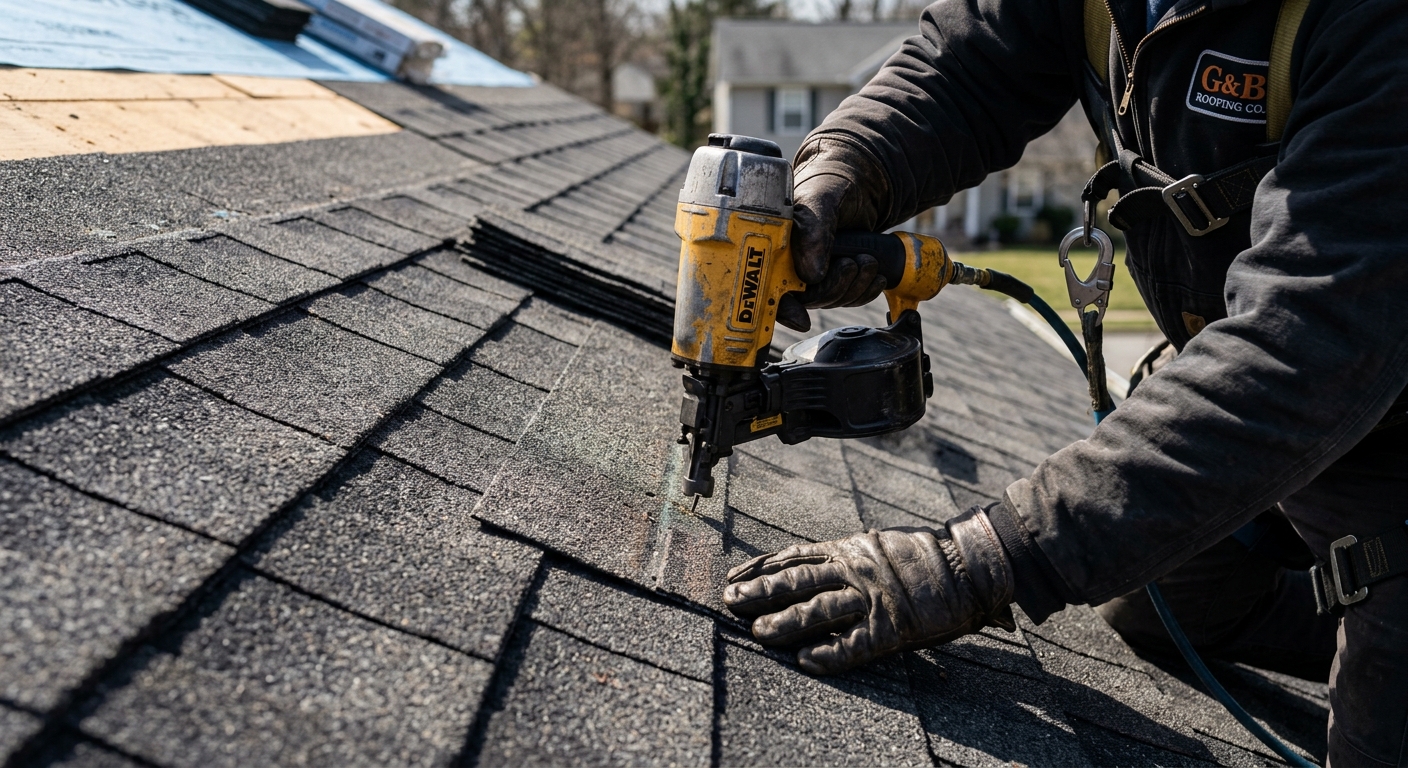
Washington roofing prices by material and scope — 2026
In Washington, just outside Greensburg, roofing costs land squarely in the Western Pennsylvania middle: enough competition to keep prices honest, with a market shaped by the area’s dominant single-family homes and aging postwar stock (U.S. Census Bureau, ACS 2024). With most owner-occupied homes built before 1980 and a homeownership rate of 86.8%, many Washington homeowners are staring down long-overdue roof replacements for the first time.
This isn’t by accident. Neighboring Hempfield and North Huntingdon’s big 1960s–1980s subdivision booms filled streets with homes built three to five decades ago. Here in Washington, that means roofers see a steady stream of original asphalt shingles hitting end-of-life and more projects that require a full tear-off down to wood or decking repair for rot—not just a quick overlay.
The table below reflects real numbers for this local housing stock—no padding, no wild outliers. If your roof needs attention, expect to see prices within these bands:
| Material / Scope |
Lifespan |
Best for |
Price range (installed) |
| Asphalt shingles — architectural (30-yr) |
25–30 yrs |
Standard gable and hip roofs, typical suburban homes |
$9,300–$19,500 |
| Asphalt shingles — impact-resistant (Class 4) |
30+ yrs |
Ridge-line homes, hail and wind exposure |
$15,000–$19,500 |
| Metal standing seam |
40–70 yrs |
Maximum longevity, low maintenance, snow shedding |
$22,500–$40,500 |
| Flat roof — TPO or EPDM |
15–25 yrs |
Low-slope and porch/garage roofs |
$12,000–$23,500 |
| Roof repair — leak or isolated section |
— |
Fixing small leaks, flashing, or wind/hail damage |
$500–$1,850 |
Prices are estimates for a typical Washington home and vary with roof size, pitch, decking condition and material selection.
What a proper Washington roofing quote contains
Every Washington homeowner should expect a roofing quote that makes sense line by line. A legitimate estimate will state your roof size in “squares” (100-square-foot increments) and mention the roof’s pitch—it isn’t enough to guess or use satellite numbers. Tear-off and disposal should be itemized, clarifying if there’s one or two layers being removed and whether a dumpster is included (it should be). Underlayment and ice barrier must be named by actual product—no generic “felt” or “membrane.”
Decking surprises—like rotted wood—should be handled as a per-sheet contingency, not bundled or ignored. Make sure flashing and vent boots are included, not left as “by others.” Warranties should clearly separate the manufacturer’s coverage from the installer's own workmanship warranty. Payment details matter: a 10%–15% deposit is reasonable, with the balance only upon completion. If an estimate is one lump sum with no square count, no breakdown, and all the specs hidden, it isn’t protecting you. Stick with the quotes that spell everything out.
| Line item |
What to look for |
Red flag if… |
| Roof area |
stated in squares, with pitch |
no measurement given |
| Tear-off and disposal |
number of layers, dumpster included |
bundled into one figure |
| Underlayment |
product type and coverage |
listed only as 'felt' |
| Ice and water shield |
coverage height at eaves |
omitted entirely |
| Decking |
per-sheet contingency price |
no allowance at all |
| Warranty |
workmanship years stated separately |
only the shingle warranty |
| Payment |
deposit under 15%, balance on completion |
large upfront cash |
Roofing warranties in Washington: what's actually covered
Every Washington roof comes with two separate warranties—one from the material manufacturer, and one from the installer. The manufacturer warranty protects you only against product defects, such as shingle granule loss or cracking, and is almost always prorated. They require prompt registration (typically within 60 days of install) and careful adherence to product instructions regarding nails, ventilation, and not putting new shingles over old ones. Coverage can be voided if an installer cuts corners, for example, by skipping attic ventilation or layering over existing shingles.
The workmanship warranty comes from the contractor—their promise that they’ll fix leaks or errors due to installation for a set time. This is only as trustworthy as the roofer’s stability. A 25-year labor warranty isn’t worth much from a company that’s only been around two years. For resale, some warranties are transferable—but only if you or the buyer file the paperwork, and often there’s a transfer fee or a deadline within 30–60 days after closing.
Any solid proposal in Washington should list both warranty terms upfront. If it sounds too good to be true, ask how long the company’s actually been in business. Don’t be afraid to walk away if the contractor can't clearly explain or document both coverages and their real limitations.
Material comparison for Washington homeowners
Material choice in Washington is about balancing snow, cold snaps, and cost. The local ground snow load of 30 psf and frigid winter design temperature of 8 °F mean that your roof has to deal with melting/freezing cycles and plenty of wet, heavy snow. Metal standing seam is the clear winner for snow shedding in this area—it allows snow to slide off rather than build up heavy drifts, reducing ice dam risk and keeping gutters safer. However, it’s a major investment, best used on simple roof lines or when you plan to stay for decades.
For the vast majority of Washington’s 1960s–1980s homes, architectural asphalt shingles have dominated because they strike a balance: affordable, proven, and easy for local roofers to install (reflecting regional contractor standards). These shingles handle local freeze/thaw cycles reasonably well, though homeowners should insist on a proper ice barrier. Flat membrane roofs (TPO/EPDM) are specialized for low-slope areas; putting them on a full-pitch house here is almost never cost-effective.
If your roof is simple and you expect average hail and wind, there’s little justification for the highest-end Class 4 impact-resistant shingles, unless you’re on an exposed ridge. Paying for standing seam metal makes sense when you want a “last roof ever,” but asphalt’s lower cost keeps it the winner for most Washington homes.
| Material |
Installed cost |
Lifespan |
Cold-climate performance |
Maintenance |
| Asphalt architectural |
$9,300–$19,500 |
25–30 yrs |
Handles freeze/thaw, needs quality ice barrier |
Annual inspection, basic shingle repair |
| Asphalt Class 4 impact-resistant |
$15,000–$19,500 |
30+ yrs |
Better hail resistance, still needs attic ventilation |
Same as standard asphalt |
| Metal standing seam |
$22,500–$40,500 |
40–70 yrs |
Excellent snow shedding, lowest ice dam risk |
Minimal (clear gutters, occasional fastener check) |
| TPO / EPDM membrane |
$12,000–$23,500 |
15–25 yrs |
Decent if low-slope, not for full-pitch |
Annual seam/penetration checks |
Washington homes and their roof lines
Washington’s housing stock is shaped by the postwar suburban wave that remade Westmoreland County. With 66.6% of homes built before 1980 (U.S. Census Bureau, ACS 2024), most local roofs sit atop side-gable or hipped forms typical of subdivisions from the 1960s through 1980s. This means medium to moderately steep pitches, most often covered in 3/8–1/2" plywood or early OSB sheathing (rather than the old plank deck you’d see in prewar Greensburg).
Ice and water shield was not standard or even required by code until relatively recent code updates, so original roofs may lack this protection at the eaves—making ice dam repairs and retrofits common. Multiple roofing layers also turn up, especially on homes that had a quick re-roof in the late 1980s or 1990s instead of a full tear-off. Most Washington homes are now facing their first or second full roof replacement, with the difference often coming down to how well previous work was done and whether deck boards have suffered from slow leaks, poor ventilation, or past ice dams.
Where the homes date from the late 1990s and 2000s, these are just reaching their first scheduled replacement, with many shingles and fasteners failing due to manufacturer quality lapses from that era.
Permits and code requirements in Washington
Roofing projects in Washington are regulated under the Pennsylvania Uniform Construction Code (UCC), which is based on the International Residential Code (IRC). Actual enforcement is handled in one of two ways: the City of Greensburg Planning and Development Department oversees permitting inside city limits, while surrounding townships run their own code enforcement offices. If a municipality has opted out, the responsibility falls to the PA Department of Labor & Industry.
Replacement of roof covering beyond ordinary repair—meaning full shingle or membrane removal and installation—generally does require a permit. Minor roof repairs, however, often do not, but always check with your township’s specific code office before starting work.
All roofing contractors working on jobs over $500 must hold Home Improvement Contractor (HIC) registration, which you can verify directly at hic.attorneygeneral.gov. Insurance is your protection—every legitimate employer must carry workers’ compensation in Pennsylvania, and you can confirm coverage through the WCAIS system (wcais.pa.gov). Do not take a contractor’s word for it; always check these records yourself and get copies of certificates before work begins.
Choosing a roofer in Westmoreland County
To hire a roofer in Washington, use registries and real documents—not just a business card and a handshake. Always confirm Home Improvement Contractor (HIC) registration for any contract over $500 on hic.attorneygeneral.gov. Ask for certificates of liability and workers’ compensation insurance, then verify the actual workers’ comp status yourself on WCAIS (wcais.pa.gov). No HIC number or missing insurance? That’s a no-go. If your roof was built before 1978, also use certifiedrenovatorsearch.epa.gov to check the EPA Lead RRP certification for any crew touching painted surfaces.
- Check HIC registration at hic.attorneygeneral.gov
- Verify active workers’ comp policy on WCAIS
- Request a current certificate of liability insurance in your name
- Ask for a written contract (over $500 is mandatory)
- Demand a line-itemized, not lump sum, quote
- Get the warranty in writing—materials and labor, both separate
- Contractor address: mail comes to a physical office, not a PO box
- Obtain references for roofs done in Westmoreland County
- Review their business history (at least 5+ years preferred)
- Check for EPA Lead RRP if your home is pre-1978
- Ask if they’ll actually pull the permit, not just say they “will if needed”
- Ensure payment terms are 10–15% deposit, rest on completion
In the Pittsburgh metro market, watch for: crews soliciting door-to-door after storms, out-of-town “storm chasers” with no real address, pressure to sign today for a “special rate,” requests for large cash down, and a lack of written contract. Those are all warning signs specific to roofing here.
Frequently asked questions — roofing in Washington
Do metal roofs shed snow better in Washington?
Metal standing seam roofs do shed snow far better than asphalt shingles in Washington’s climate. Thanks to the slippery surface and mechanical seams, most snow slides right off as soon as the sun hits, which greatly reduces ice dam risk and roof load—important with the local ground snow load of 30 psf. On hilly streets or houses with longer eaves, this can protect gutters and landscaping from heavy snow dumps. However, you pay a premium for this performance, with metal roof installation costs in Washington typically running $22,500–$40,500. For most homeowners with standard gable or hip roofs—especially if the roof has some sun exposure—the added snow-shedding of metal is a “nice to have” but not always a must, unless you’ve struggled with severe ice dams or plan for your next roof to be your last.
What does roof replacement cost per square in Washington?
In Washington, full replacement of an architectural asphalt shingle roof usually runs $930–$1,950 per square installed (a “square” is 100 square feet of roof surface, including labor, materials, tear-off, disposal, and warranty). This price band comes straight from roofing market data for Westmoreland County and will cover most single-family homes with average slopes and a full tear-off. Costs per square go up for steeper roofs, cut-up layouts, multiple layers, or complex flashing work, and may reach above $1,500 per square if you encounter rotten decking or premium shingle choices. Always insist your quote breaks down roof area and price per square—you can’t compare apples to apples otherwise.
Should I use a local roofer or a national company?
For Washington homeowners, sticking with a local roofer usually means better quality control and service. Local contractors are accustomed to the unique roof pitches and materials common in Washington and other parts of Westmoreland County. They also have a track record with local code offices and can provide referrals on actual homes nearby. National chains might offer lower promotional prices, but often sub out jobs to temporary crews with fewer local ties and less investment in reputation. Your roof isn’t an off-the-shelf commodity, especially in a climate where local knowledge of snow load and freeze/thaw cycles matters. That said, always confirm registration and insurance; even a local can go rogue. A reputable local shingle roof replacement will be in the $9,300–$19,500 band, which is the same range you might see from a chain.
Is ice barrier underlayment required in Washington?
Under the Pennsylvania Uniform Construction Code (UCC), based on the IRC, ice barrier underlayment is required for most re-roofing projects in Washington and Westmoreland County. Washington winters feature frequent freeze-thaw cycles and temperatures that drop to design lows of 8 °F; skipping this layer is just asking for leaks and damage when ice dams inevitably occur. Historic homes built before the code requirement often lack ice and water shield entirely, so proper installation at eaves and valleys during replacement is critical. Costs for a full shingle replacement here—including proper barrier—fall in the $9,300–$19,500 range. No roofing contractor should suggest omitting this step, and if they do, it’s a red flag.
How do I file a storm damage roof claim in Pennsylvania?
If your Washington home takes hail or wind damage (not unusual, since Westmoreland County sits in the Ohio Valley hail corridor), first contact your insurer to report the loss. Don’t sign anything with a roofer who finds you via storm-chasing scouts—get the claim number and have the adjuster meet you on site. Provide pictures and document all visible damage before any repairs or tarping. Only emergency work (like temporary tarping) should be done initially, and most policies will refund those reasonable costs (a typical emergency repair runs $500–$1,850). After adjuster inspection, you’ll get a claim estimate; only then should you secure multiple roof quotes for the work, ensuring the scope matches what’s covered. Remember: waiving your insurance deductible is illegal in Pennsylvania.
Will the crew damage my landscaping or driveway?
Every full roof replacement in Washington requires material delivery and debris removal, which can put landscaping, walks, and driveways at risk. Responsible contractors will state in their contract and pre-job walkthrough how they’ll protect your property—using tarp curtains, plywood panels for dumpster placement, and careful cleanup. If you’re paying in the typical $9,300–$19,500 range for a shingle roof, expect them to invest in protection too. Ask about plan for gutter guard removal/replacement and how nails and scrap will be checked for. If your job is especially tight for access, discuss this up front—most respectable companies will take “before” photos and note any concerns with you.
How much does a flat roof replacement cost in Washington?
For a flat or low-slope roof in Washington—common on porches, additions, and some mid-century homes—replacement with a TPO or EPDM membrane typically costs between $12,000–$23,500. This installed price band covers tear-off, membrane, insulation, and all new flashing/sealing. Expect the lower end for simple rectangular roofs and the higher end for complex layouts, integrated drains, or deck repair. The local climate’s freeze/thaw cycles make seams and penetrations a long-term concern; always ensure your roofer has real experience with flat roofs in Pennsylvania, not just shingles. A good flat roof in Washington should last 15–25 years with annual inspection.
Does Washington get enough hail to justify Class 4 shingles?
Washington is just east of the Pittsburgh hail corridor, so hail isn’t rare but isn’t a given every season. Exposed ridge-line roofs and open fields take more abuse. If you’re in one of those spots or replacing a roof after wind or hail loss, Class 4 impact-resistant shingles can be a smart upgrade—they cost more up front ($15,000–$19,500 for a full roof) but may get you a small break on your homeowner’s insurance, and should hold up better if another storm hits. For homes sheltered by trees or less prone to repeat hail, architectural shingles are still the sensible, cost-effective option unless your insurer requires the upgrade.
How long should a roof last in Washington?
In Washington, a properly installed architectural asphalt shingle roof should last 25–30 years, thanks to solid regional practices and moderate snow load (30 psf). The biggest factors that shorten roof life locally are lack of attic ventilation, skipped ice barrier, or poor flashing—problems that show up faster in roofs from the 1980s and earlier. Metal standing seam roofs can go 40–70 years, making them popular for “forever homes” but they require a larger up-front investment ($22,500–$40,500). For most homeowners in Westmoreland County, budgeting for a new roof every three decades is realistic, and you'll get the best lifespan by choosing a reputable installer who doesn’t rush or cut corners.