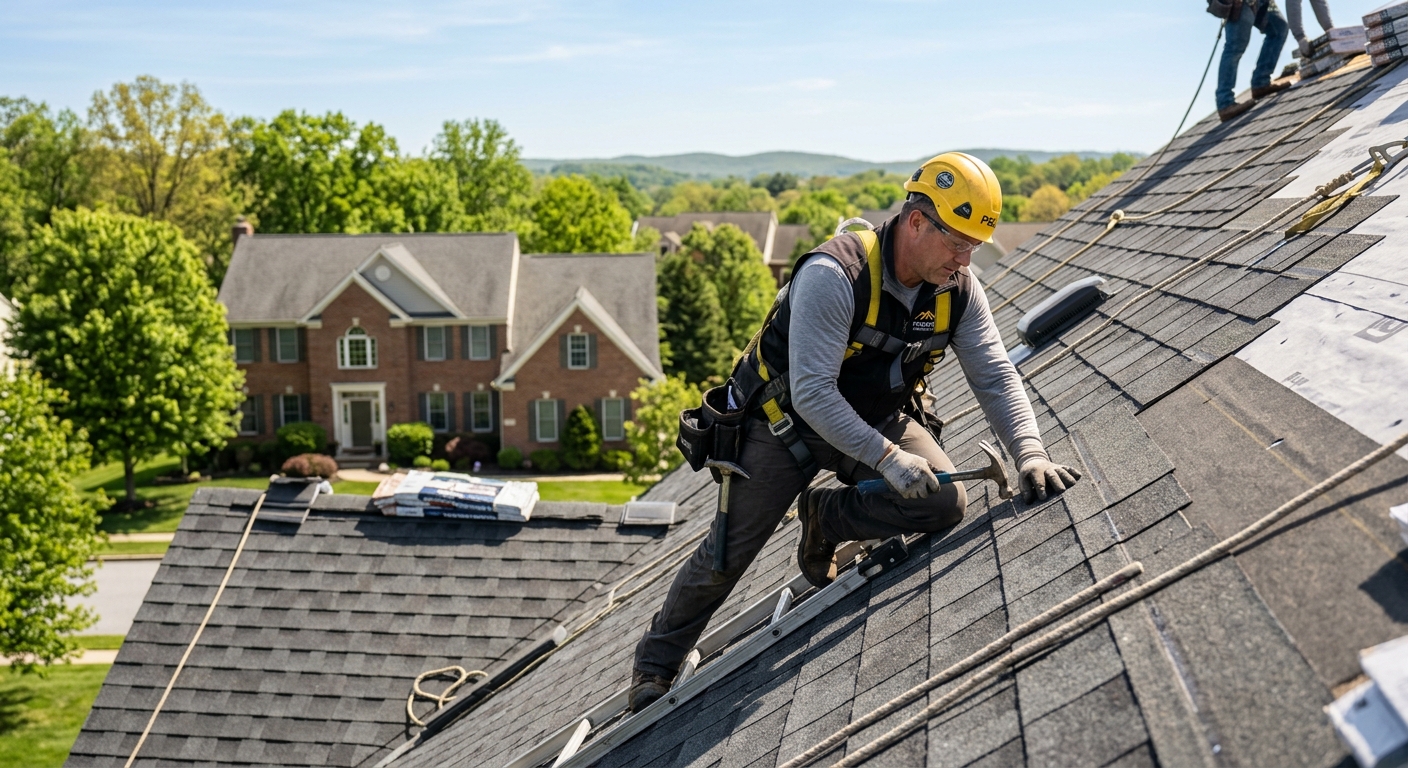
What roof replacement costs in South Lebanon in 2026
South Lebanon homeowners in 2026 face roofing needs shaped by a high homeownership rate and a housing stock where over half of all homes were built before 1980 (U.S. Census Bureau, ACS 2024). That means thousands of roofs in the township are either nearing or past their expected service life, driving a steady flow of replacements—especially asphalt shingles, which dominate here due to moderate installation costs and the repair history of postwar houses. In neighborhoods where more than seven out of every ten homes are single family houses, many owners are surprised to learn just how many suffer from outdated venting or attic insulation, compounding heat loss and ice damming issues each winter.
Lebanon’s housing stock surged between 1945–1975, so most South Lebanon roofs were installed on truss or deck systems from that era. When it’s time for replacement, the older decking often needs patching or even partial replacement, especially where past moisture has gone unseen. Many local quotes include line items for replacing sheets of roof decking, which is a realistic risk here. Ventilation upgrades should be considered on any replacement of a 1970s or earlier home, since many local attics are poorly vented, leading to shorter shingle lifespans. Because code enforcement is handled locally and may differ by township, it’s common for homeowners to need their contractor’s help determining if a permit is actually required for their scope of work.
| Material / Scope |
Lifespan |
Best for |
Price range (installed) |
| Asphalt shingles — architectural (30-yr) |
25–30 yrs |
Standard single-family replacement |
$9,800–$20,500 |
| Asphalt shingles — impact-resistant (Class 4) |
30+ yrs |
Homes exposed to ridge-line wind/hail |
$16,000–$20,500 |
| Metal standing seam |
40–70 yrs |
Long-term upgrade, limited-reside properties |
$24,000–$42,500 |
| Flat roof — TPO or EPDM |
15–25 yrs |
Low-slope additions, porches, garages |
$12,500–$25,000 |
| Roof repair — leak or isolated section |
n/a |
Spot fixes, recent leaks |
$500–$1,950 |
Prices are estimates for a typical South Lebanon home and vary with roof size, pitch, decking condition and material selection.
What South Lebanon's climate does to a roof
Roofs on the southern slopes and ridge-lines of South Lebanon are exposed to wind events rolling off the South Mountain and Cornwall upland. Unlike in lower-lying regional townships, the combination of 30 pounds per square foot ground snow load and pronounced freeze-thaw cycles means that roofs here see eave ice damming nearly every winter. The process starts when attic heat escapes (often from under-insulated 1940s–1970s bungalows), melting snow high on the roof, which re-freezes at the colder eave and clogs the gutter with ice. This forces water back under shingles and can drive leaks at the sheathing—sometimes leading to deck rot that pushes a repair into full replacement territory, often jumping from a $1,950 patch to a $9,800–$20,500 replacement.
Flat roofs, common on rear additions and porches in local postwar homes, are especially prone to blistering and membrane failure after water freezes and expands overnight, attacking seams in aging TPO or EPDM. Once ponding becomes visible, waiting may turn a small leak fix into a $12,500–$25,000 membrane job. Wind events along the township’s higher elevations routinely strip ridge shingles and drive rain laterally under laps, particularly on older three-tab systems. Hail is less common here than north of Interstate 81, but when it comes, it bruises shingle mats—leaving granule loss and a pathway for UV aging, but often no visible holes. That sort of hidden damage usually isn’t caught until a leak or scheduled replacement.
What a proper South Lebanon roofing quote contains
A reliable South Lebanon roofing estimate will spell out more than just a lump sum; it should break down roof area in squares, describe the pitch, and itemize tear-off and disposal costs with the number of layers and a dumpster clearly included. Underlayment should be named by product type and coverage percentage, not just as “felt.” For homes built before 1980, many need additional ice and water shield coverage at the eaves due to the frequency of freeze-thaw cycles here. Decking is often an unknown until tear-off, so watch for a contingency price per sheet—something too vague or missing altogether is a red flag.
Flashing, vent boots, and any planned ventilation corrections should be listed. Warranties demand their own lines: the shingle manufacturer’s warranty is not a substitute for a clear statement of the roofer’s own workmanship guarantee. The payment schedule should specify a modest deposit (never more than 15%) and balance due on completion. Quotes missing the square count or lumping labor and material together aren’t apples-to-apples; with Lebanon County’s range of roof ages and deck conditions, details matter for fair comparison.
| Line item |
What to look for |
Red flag if… |
| Roof area |
stated in squares, with pitch |
no measurement given |
| Tear-off and disposal |
number of layers, dumpster included |
bundled into one figure |
| Underlayment |
product type and coverage |
listed only as 'felt' |
| Ice and water shield |
coverage height at eaves |
omitted entirely |
| Decking |
per-sheet contingency price |
no allowance at all |
| Warranty |
workmanship years stated separately |
only the shingle warranty |
| Payment |
deposit under 15%, balance on completion |
large upfront cash |
What insurance covers on a South Lebanon roof
In South Lebanon, if your roof is damaged by wind or hail—both real risks given our exposed ridge lines—the first step before any cleanup is to take detailed photos of the damage and interior leaks. Insurers expect thorough documentation showing both the problem and the undisturbed debris field. After claim submission, your carrier will assign an adjuster, who will generate a scope of loss and determine whether your policy pays actual cash value (depreciated) or replacement cost (full). If you receive the “actual cash value” first, the insurer releases the balance after you submit an invoice confirming replacement done.
A crucial consumer protection in Pennsylvania is the Home Improvement Consumer Protection Act. Any job over $500 requires a written contract, and you always have a 3 business-day right of cancellation. This matters if you feel rushed after a storm or pressured by a roofer to “sign today.” Never sign a work order on the spot—take the time to check scope and pricing against your adjuster’s report.
Waiving a homeowner’s insurance deductible is prohibited under Pennsylvania law. If any roofer offers to “eat your deductible,” that is a clear violation and a reason to walk away. Insurers interpret this as fraud, and you could find yourself stuck with denied claims and no recourse. South Lebanon doesn’t see the storm-chaser traffic of counties closer to big cities, but after major wind events, expect some rapid out-of-town pitching. Take your time, document everything, and never be pressured into on-the-spot signatures or cash payments.
Patching vs full replacement in South Lebanon
If you’re deciding between repair and replacement in South Lebanon, start with the age of the roof and the pattern of problems. If your system is under 15 years old and you’ve got one isolated leak—maybe a wind-lifted shingle or damaged flashing—a straightforward repair for $500–$1,950 makes sense. But if a 20-year-old roof starts to leak in several spots, especially after a typical Lebanon County winter, patching almost always becomes an expensive cycle: two or three rounds of $1,250 repairs quickly total north of $3,000–$4,000, nearly half the cost of a new shingle system.
Houses built between 1945 and 1975 are now seeing their third or fourth roof, so if you have multiple active leaks, granule loss, and attic staining, you’re wasting money by continuing to repair. For flat roofs, visible ponding or blistering after a winter usually means the membrane is shot; patching in these cases is almost always a temporary fix with poor dollars spent. Any fresh leak found in fall or early winter should be stabilized right away—wait and you risk deck and insulation damage that could double your repair costs by spring.
| Situation |
Recommendation |
Typical cost |
Reasoning |
| Under 15 years, one isolated leak |
Repair |
$500–$1,950 |
Most shingles still viable; targeted fix saves money. |
| 15–25 years, several leak points |
Replace |
$9,800–$20,500 |
System at end of life; repairs compound, not solve. |
| 25+ years, any active leak |
Replace now |
$9,800–$20,500 |
Deck may be compromised; no lasting repair value. |
| Storm damage, wind or hail |
Document, claim, replace |
$9,800–$20,500 |
Covered loss; insurance process usually supports replacement. |
| Flat roof ponding or blistering |
Replace membrane |
$12,500–$25,000 |
Blisters mean membrane failure; patch will not hold. |
| Active leak entering winter |
Emergency repair, schedule replacement |
$500–$1,950 |
Prevent further damage; full project after season. |
Checking out a roofer in South Lebanon: what to verify
Before signing any contract in South Lebanon, verify the roofer’s Home Improvement Contractor (HIC) registration through the Pennsylvania Office of Attorney General’s official site (hic.attorneygeneral.gov). Always check workers' compensation insurance status through the Pennsylvania WCAIS database (wcais.pa.gov)—it’s mandatory for anyone with employees. For homes built before 1978, ensure the firm is EPA Lead RRP certified; the federal registry is available online. If there’s any talk of mold or mitigation, look for training under IICRC S520 (for mold) or S500 (for water damage restoration), since those are the recognized standards.
- Active HIC registration checked at hic.attorneygeneral.gov
- Workers’ compensation verified on wcais.pa.gov
- Written contract for any job over $500 (required by state law)
- EPA Lead RRP certification for pre-1978 homes
- Physical business address in or near Lebanon County
- References from recent South Lebanon clients
- Manufacturer certifications (e.g., shingle installer program badge)
- Detailed line-item quote (not just a lump sum)
- Product and labor warranties stated separately
- No requests for cash payment upfront
- Proof of liability insurance, with you as certificate holder
Watch for these red flags in Lebanon County: roving crews with out-of-state plates, no address in the county, vague references, high-pressure post-storm tactics, or any suggestion of waiving your insurance deductible. In a moderate suburban market like Lebanon, local reputation and verifiable paperwork matter more than a slick flyer.
Permits and code requirements in South Lebanon
South Lebanon enforces the Pennsylvania Uniform Construction Code (UCC), based on the International Residential Code. The code authority is the PA Department of Labor & Industry, but it’s enforced by the local municipality unless they have opted out—in that case, L&I handles permitting.
Within Lebanon city, any roof replacement involving structural decking or truss work requires a building permit. If you live in a Lebanon County township, like North Lebanon, small repairs under one roofing square (typically patching less than 100 sq. ft.) don’t trigger a permit, but you should still ensure proper code compliance. Separate township offices in the county handle their own permits and inspections; always confirm with your code office before starting work.
For all contracts over $500, Pennsylvania requires the roofer to hold active Home Improvement Contractor (HIC) registration—verify directly at hic.attorneygeneral.gov. Never take a paper copy or a sales pitch as proof. Workers' compensation insurance must be verified on the Pennsylvania WCAIS system, especially if there are any workers on site. There’s no special roofing trade license or statewide electrical, plumbing, or HVAC license; municipal rules vary, so your roofer should be able to cite township requirements by name and furnish all paperwork before work starts.
Frequently asked questions — roofing in South Lebanon
Is ice barrier underlayment required in South Lebanon?
Ice barrier underlayment isn’t mandated on every roof by the Pennsylvania Uniform Construction Code (UCC), but in South Lebanon it’s practically expected due to our 30-psf ground snow load and the regular ice damming along eaves. Most code inspectors in Lebanon County expect to see at least two rows of ice and water shield (typically about 3–6 feet up from the eaves, depending on overhang and pitch). Skipping this step exposes homeowners to leaks on even brand-new shingle roofs, especially on older homes built before 1980. Expect a quality contractor to include ice barrier installation in their quote, and budget for it as part of your replacement price. You’ll see it covered within a typical replacement range of $9,800–$20,500.
How much does it cost to repair a roof leak in South Lebanon?
Roof leak repairs in South Lebanon typically range from $500–$1,950 depending on the leak’s cause and how much decking or structural repair is required. A simple flashing reseal or shingle patch usually comes in on the lower end, while substantial repairs (involving older decking or hidden water damage, which is common given the area’s large stock of pre-1980 homes) will hit the upper band. Remember, repeated spot repairs on older roofs may add up quickly, and it’s worth asking your contractor for a photo or video of the leak source before green-lighting any work—especially if your system is more than 20 years old. Those with active leaks entering winter should consider an emergency fix now, then plan on a larger project in spring.
What warranty should a South Lebanon roofer offer?
A reputable South Lebanon roofer should offer a clear workmanship warranty, commonly five to ten years, in addition to the manufacturer’s warranty on the shingle or membrane. This is important because the manufacturer typically covers just the product, not the labor or any installation error. The workmanship warranty is especially critical on older homes with imperfect decks or less-than-ideal ventilation. For an asphalt shingle roof replacement costing $9,800–$20,500, ensure you get both warranty terms in writing—ideally, with manufacturer registration (where required) to avoid paperwork surprises down the line. Never accept a quote where only the manufacturer’s coverage is cited and the contractor’s own labor is silent or missing.
Why do roofs fail faster in south-central Pennsylvania?
Roofs in south-central Pennsylvania, including South Lebanon, are up against frequent freeze-thaw cycles, wind-driven rain along ridge-lines, and older attic insulation that often allows excess heat to escape. This leads to ice damming, shingle lift, and water intrusion at flashing and valleys—accelerating granule loss and underlayment rot compared to neighboring lowland counties. Many homes built before 1980 didn't have modern attic ventilation standards, so trapped heat and moisture shave years off a typical system’s life. Replacing a roof here often means budgeting for some deck repair too—so an architectural shingle system hits the local price band of $9,800–$20,500 in part because of this early wear.
How much does a flat roof replacement cost in South Lebanon?
The cost of replacing a flat roof system (TPO or EPDM membrane) in South Lebanon generally falls between $12,500–$25,000 for a typical residential footprint used on garages, porches, or low-slope additions. The final figure depends on how many layers must be removed, whether there’s any wet insulation to replace, and if the roof structure itself saw moisture intrusion from freeze-thaw expansion. Don’t be surprised if a quote for an older addition includes “per sheet” deck replacement: hidden rot is common in the area’s 1950s–1970s builds. The price is higher than for shingle repairs, but buying a full membrane gives you a 15–25 year reset on leak risk.
What does it mean if my shingles are curling or losing granules?
Curling and granule loss signal that your shingles are aging out, either due to UV exposure, improper attic ventilation, or a brittle shingle mat—common on Lebanon County homes built before 1980 that may never have seen a proper vent upgrade. Curling lets wind-driven rain get under the tab, causing leaks that show up after storms or winter thaw. Granule loss exposes the asphalt, letting in water and sunlight, which accelerates break-down. If several tabs are curling or more than a few handfuls of granules show in your gutter, it’s time to weigh replacement. For most South Lebanon homes, architectural shingle replacements fall into the $9,800–$20,500 band.
Will filing a roof claim raise my premium?
Not every roof claim will trigger a premium increase in Pennsylvania, but multiple claims within a short window or claims that insurers classify as “preventable” (such as for deferred maintenance on an already-worn roof) could lead to a surcharge or non-renewal. In South Lebanon, storm-driven damage—wind or hail especially—is generally considered “no-fault,” and most policies handle the claim at replacement cost. But if you’ve patched leaks repeatedly (say, with a run of $500–$1,950 repairs) and then file after a clear maintenance lapse, you’re at higher risk for an uptick. Always document storm dates and damage causes before calling the adjuster, so your claim is classified accurately.
What happens if rotted decking is found after tear-off?
If your roofer discovers rotted decking in South Lebanon after removing shingles, the best contractors will stop work, document the problem with photos, and update you with a per-sheet replacement cost (commonly laid out as a contingency line in the original contract). This is not unusual for homes in the area, given the widespread 1945–1975 building era. You can expect a modest added cost per sheet, but reputable companies only charge for the sheets actually replaced. For a full roof replacement in the $9,800–$20,500 band, it’s reasonable to expect a few hundred dollars per sheet if you have hidden water or pest damage in isolated spots.
Is metal roofing noisy in rain?
Metal standing seam roofs in South Lebanon aren’t typically “noisy” with rain, provided they’re installed correctly—with a solid deck, appropriate underlayment, and attic insulation buffering the impact. Older outbuildings with exposed metal on open framing will sound tinny, but the vast majority of residential installs won’t give you rain hammer. If you’re paying in the $24,000–$42,500 range for a full standing seam install, demand confirmation about how the roof is detailed and ask to see a local house in the area for an in-person sense of sound. For most single-family homes, noise is minimal and not the factor television makes it out to be.