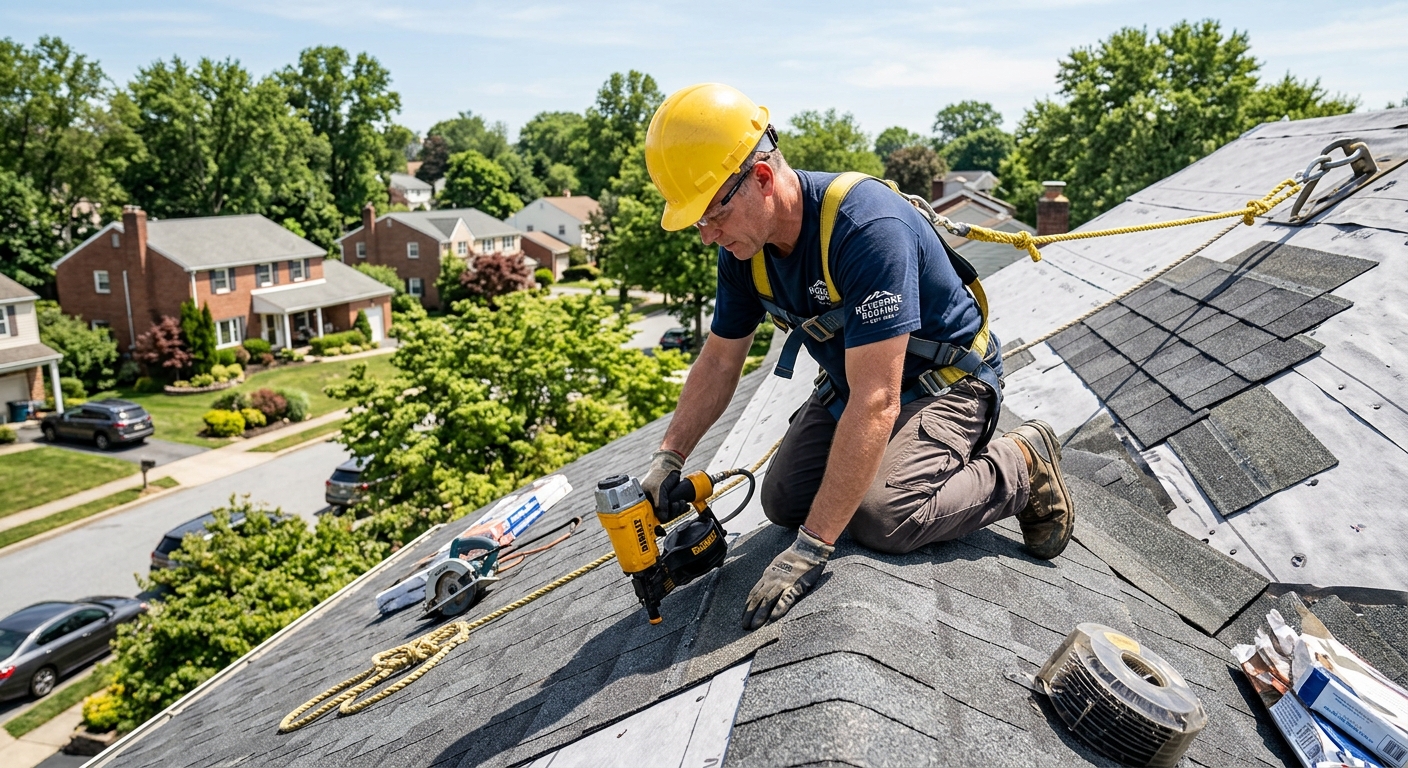
What roof replacement costs in Upper Leacock in 2026
Upper Leacock’s roofing market in 2026 is shaped by two important factors: a high percentage of single-family homes and a majority of homes built before 1980 (U.S. Census Bureau, ACS 2024). This means most roofs here are well past their first layer of shingles, and typical replacement jobs involve navigating steep pitches and several old layers. It’s common to reveal wood planks or multiple shingle layers during tear-off, which can increase both complexity and cost compared to surrounding areas with newer housing. Roofing crews in Upper Leacock know to plan for significant tear-off labor and more extensive dumpster needs, which is baked into the local price structure.
Here in Lancaster County, the dominance of older homes often means heavier sheathing replacement and specialized staging, especially when dealing with steep rooflines. Amish and Mennonite crews remain highly competitive on asphalt shingle jobs but may not always provide the detailed quotes needed if decking issues arise mid-job. With wind bursts from the Susquehanna River valley more likely to rip off loose or brittle shingles, most homeowners opt for architectural shingles, but high-end jobs increasingly use standing seam metal for longevity.
| Material / Scope |
Lifespan |
Best for |
Price range (installed) |
| Asphalt shingles — architectural (30-yr) |
25–30 yrs |
Older frame houses, typical replacement |
$9,400–$20,000 |
| Asphalt shingles — impact-resistant (Class 4) |
30+ yrs |
Wind-exposed sites, hail concerns |
$15,500–$20,000 |
| Metal standing seam |
40–70 yrs |
Long-term owners, heavy storm exposure |
$23,000–$40,500 |
| Flat roof — TPO or EPDM |
15–25 yrs |
Porches, low-slope additions, garages |
$12,000–$24,000 |
| Roof repair — leak or isolated section |
n/a |
Small leaks, shingle blow-off, flashing replacement |
$500–$1,900 |
Prices are estimates for a typical Upper Leacock home and vary with roof size, pitch, decking condition and material selection.
What a proper Upper Leacock roofing quote contains
A reliable roofing estimate in Upper Leacock tells you, in plain numbers, exactly what you are paying for. It starts with the roof area measured in “squares,” which is 100 square feet of roof surface—the only way to honestly compare different quotes on steep, older roofs common here. A good quote breaks out the cost of tearing off old layers (often more than one in our older housing stock), includes dumpster rental, and specifies the exact brand or type of underlayment and ice guard used. All sheet decking replacement should be listed at a per-sheet price—there’s too much era-typical rot in Lancaster County to pretend this is a guess. Quotes must also spell out separate warranty terms: what is covered on labor by the contractor, and what comes from the manufacturer.
If you only get handed a lump sum, with no measurement or item breakdown, you’ll have no idea if you’re being underbid or overcharged. When an estimate uses terms like “felt underlayment” or just lists “tear-off” with no detail, it likely means corners will be cut or surprises tacked on later. The payment schedule should never front-load costs—deposits over 15% are unusual here, and any demand for large cash up front is cause to walk away.
| Line item |
What to look for |
Red flag if… |
| Roof area |
stated in squares, with pitch |
no measurement given |
| Tear-off and disposal |
number of layers, dumpster included |
bundled into one figure |
| Underlayment |
product type and coverage |
listed only as 'felt' |
| Ice and water shield |
coverage height at eaves |
omitted entirely |
| Decking |
per-sheet contingency price |
no allowance at all |
| Warranty |
workmanship years stated separately |
only the shingle warranty |
| Payment |
deposit under 15%, balance on completion |
large upfront cash |
What Upper Leacock's climate does to a roof
Roofs in Upper Leacock have to contend more with sudden wind bursts than with long, heavy snow loads. The Susquehanna River valley funnels summer thunderstorms that can rip architectural shingles right off old, steep-pitched Lancaster County roofs. Shingles installed over multiple older layers, which is common in our pre-1950 stock, lose their grip faster when shaken by wind, increasing the frequency of leak repairs, often in the $500–$1,900 range.
The local ground snow load of 30 psf and winter design temperature of 12°F combine with frequent freeze-thaw cycling—snow melts at the ridge but refreezes at the cold eave, creating ice dams on homes without modern underlayment. On Upper Leacock’s many older roofs, it’s common to see water back up and seep between the original planking, leading to hidden rot and sheathing replacement. Ignoring proper ice and water shield here to save costs can land you in the $75–$150 per sheet replacement zone unnecessarily. Unlike the deep-snow counties north of here, though, full-roof ice barriers aren’t usually needed—just coverage at the eaves.
Localized hail doesn’t always punch through shingles in Upper Leacock, but will “bruise” them—damage that’s often missed until moisture starts leaking in. With so much original construction on homes before modern standards, the blend of wind and freeze-thaw means that roof replacement here almost always requires a focus on wind ratings and robust leak barriers, not just snow.
Roofing permits in Upper Leacock: what you need before work starts
Roofing work in Upper Leacock follows the Pennsylvania Uniform Construction Code (UCC), which is enforced by individual municipalities or, in cases where a township has opted out, by the PA Department of Labor & Industry. In Lancaster County townships—including Upper Leacock—you typically do not need a building permit for minor roof leak repairs, such as replacing a few shingles. However, any full roof replacement that requires new sheathing or structural work does require a building permit, as it would in nearby Lancaster city.
Before signing any contract over $500, a roofing contractor in Upper Leacock must be registered with a Home Improvement Contractor (HIC) number from the Pennsylvania Office of Attorney General. Homeowners can verify this registration at hic.attorneygeneral.gov. Insurance isn’t optional, either—workers’ compensation coverage is mandatory for all employers in Pennsylvania, and you can verify a contractor’s coverage status via the WCAIS portal at wcais.pa.gov. If a contractor can’t provide proper registration or current workers’ comp documentation, move on. For roofs on homes built before 1978, ensure the contractor is trained for safe handling under the EPA Lead RRP Rule, verifiable at certifiedrenovatorsearch.epa.gov.
Roof age and construction era in Upper Leacock
With over 56% of Upper Leacock’s housing stock dating before 1980 (U.S. Census Bureau, ACS 2024), most roofs here land squarely in the era of steep pitches, wood plank or early plywood decking, and multiple previous shingle layers. The typical scenario is an asphalt shingle roof installed directly over planking, with another layer or two above it, especially on homes from the 1930s to the 1950s. This makes every replacement job a matter of first removing stubborn layers and then checking for damaged, gapped decking beneath—common after decades of freeze-thaw and minor leaks that have never been properly rebuilt.
Ice barriers at the eaves were not a code requirement until well after most homes here were built, so unless a full replacement was done in the last twenty years, it’s rare to find one properly present. Homeowners tackling their first replacement now are often surprised by what is uncovered—decking that is not only out of spec for today’s shingle fasteners, but too gapped for any membrane to seal. As a result, many Upper Leacock roof jobs include a contingency per-sheet price for new decking and extra dumpster runs for hauling away every old layer. Properly scoped jobs will price for modern underlayment and correct number of replacement sheets.
Storm damage and insurance claims in Upper Leacock
If your roof in Upper Leacock is damaged by a wind burst or thunderstorm, take photos before you start cleanup. Insurers want proof of condition before any emergency repairs, like tarping, are done. The next step is to get a clear, written scope of loss from your insurance adjuster. Be sure you understand the difference between actual cash value (what your roof is worth today) versus replacement cost (what it costs to put on a new equivalent roof)—many older roofs here are valued at the lower, depreciated rate unless you pay to upgrade your coverage.
Once your claim is initiated, expect the adjuster to inspect for wind-bent shingles, damaged underlayment, and hidden decking problems under older materials. Get your own detailed, line-item estimate from a reputable Upper Leacock roofer before agreeing to any settlement; insurers often miss damage unique to steep or multi-layered local roofs. Under the Home Improvement Consumer Protection Act (HICPA), your roofing contract must be in writing if the job exceeds $500, and you have a 3-business-day right to cancel once you sign. Pennsylvania law prohibits any contractor from waiving or “covering” your insurance deductible—if someone offers, that’s not a deal, it’s a legal violation and grounds to walk away. Restoring your roof after a storm here often means ensuring unseen damage, especially to decking and flashing, is actually included in the adjuster’s scope, not just what’s visible from the ground.
What moves the price of a roof in Upper Leacock
Price variation for roof replacement in Upper Leacock comes down to concrete factors unique to Lancaster County’s built landscape and building history. The size of the roof, measured in squares, is always the main driver. But in our market, steep-pitched, pre-1980 roofs typical here slow crews down—it takes more time and extra equipment for safety harnesses and scaffolding, especially where roof lines are steep and access is tight between old houses or additions.
The number of previous shingle layers also dramatically increases labor and disposal costs. On Upper Leacock’s older homes, finding two or three existing layers is common. Removing and disposing of just one additional layer can add $500–$1,500, and you can bank on seeing this upcharge in most real local jobs. Decking condition is harder to pin down until tear-off, but every sheet of rotten plank or plywood replaced adds anywhere from $75–$150. Eave areas almost always need an ice barrier installed to combat freeze-thaw cycles, an historic issue for Lancaster County, with a typical cost bump of $300–$800 reflected in most detailed quotes for homes here.
| Factor |
Why it matters here |
Cost impact |
| Roof size in squares |
each square is 100 sq ft of roof surface |
primary multiplier |
| Pitch and access |
steep pitches need harnesses and slow the crew |
+20–30% labour |
| Existing layers to tear off |
two or more layers means full tear-off and disposal |
$500–$1,500 per layer |
| Decking condition |
rot is found during tear-off, not before |
$75–$150 per sheet |
| Ice barrier at eaves |
required where ice damming has a history |
$300–$800 |
| Material grade |
3-tab vs architectural vs Class 4 impact-resistant |
$500–$2,500 |
Frequently asked questions — roofing in Upper Leacock
Can I inspect my own roof safely?
Yes, but be cautious. In Upper Leacock, the majority of homes have steep roof pitches typical of Lancaster County’s pre-1980 housing stock, which means walking the roof can be dangerous, especially if there are multiple shingle layers or signs of age. Using binoculars from the ground, you can spot missing shingles or bent flashing. If you must use a ladder, always tie it off and have another adult steady it. Watch for soft decking, especially after freeze-thaw cycles that can cause hidden rot. For anything beyond a basic visual inspection—like checking for wavy roof lines or popped nails—pay for a professional assessment. Most small repairs, such as sealing a minor leak, can run $500–$1,900, but a slip is worth much more than any savings.
Do metal roofs shed snow better in Upper Leacock?
They do. Metal standing seam roofs are gaining popularity in Upper Leacock, especially for homes exposed to snow and freeze-thaw cycling. The smooth surface and interlocking panels encourage snow to slide off quickly once the sun returns or temperatures rise above freezing. This lessens the risk of ice dam formation at the eaves, a common issue on older local homes with traditional shingles. Metal is a costlier investment—expect $23,000–$40,500 for installation—but it offers decades of durability and dramatically reduces snow and ice buildup, which preserves both the roof and gutters from unnecessary water damage.
How do I file a storm damage roof claim in Pennsylvania?
Start with photos—document every area affected by storms before any cleanup or emergency tarping. Contact your insurance provider as soon as possible and get an adjuster’s written scope of loss that identifies damage specific to Upper Leacock’s older, often steeply pitched roofs. Understand whether your policy pays actual cash value or replacement cost, as this impacts what you’ll receive for your claim. In Pennsylvania, every contract over $500 requires a written agreement, and the law bars any contractor from waiving your deductible. If you’re told “we’ll eat your deductible,” find another roofer—that’s illegal here. Standard emergency repairs typically run $500–$1,900.
Are there historic district rules affecting roofing in Upper Leacock?
As of now, Upper Leacock itself does not define dedicated historic districts with special roof material rules the way Lancaster city does. However, many homes here are pre-1950 and may be subject to township-level requirements if located near public right-of-ways or in visually sensitive areas. In practice, most local replacements use architectural asphalt or standing seam metal, with a typical replacement cost in the $9,400–$40,500 range depending on materials and details. Ask your township code enforcement officer if you have an unusually styled historical house or are unsure about visible roof changes.
Should I use a local roofer or a national company?
In Upper Leacock, local roofers often beat national companies on cost and responsiveness. Many crews here specialize in steep, layered roof tear-offs and are more familiar with Lancaster County’s mix of plank decking and ice dam history. National chains may under-scope local challenges, leading to costly change orders mid-job. A typical architectural shingle roof runs $9,400–$20,000, but locals are usually faster to spot hidden rot or code quirks. Always insist on a detailed, written contract (required by state law) and verify registration at hic.attorneygeneral.gov.
Does roof pitch affect the price in Upper Leacock?
Absolutely. Many Upper Leacock homes have steep-pitched roofs common in older Lancaster County housing. These slow down crews, require safety harnesses, and sometimes even temporary scaffolds. As a result, you can expect a price increase of 20–30% in labor costs compared to lower-pitched roofs. For example, a typical asphalt shingle replacement that might be $15,500 on a walkable roof could push towards the higher end of the $9,400–$20,000 range if the pitch is steep and access is difficult.
How long does a roof replacement take in Upper Leacock?
Most single-family homes in Upper Leacock are completed in 2 to 4 days, but it can stretch to a week for large or especially steep roofs, or if bad weather delays progress. Multiple old shingle layers, rotten planks, and custom flashing around dormers or porches take extra time. Local Amish and Mennonite crews are competitive but prioritize quality over speed. For more complicated jobs using metal, expect removal and installation costs in the $23,000–$40,500 range and a timeline up to a full week.
How much does a flat roof replacement cost in Upper Leacock?
For porches, sheds, and low-slope additions, flat roof replacement with TPO or EPDM membrane is common in Upper Leacock. These jobs are usually less expensive than a full pitched roof, but not by much if decking is shot—a real risk with older homes. Expect to pay between $12,000–$24,000 for a flat roof replacement, with costs on the lower end if decking and underlying structure are sound, and higher if the tear-off reveals major rot or complex tie-ins with pitched roofs.
How much snow load can a Upper Leacock roof handle?
Local codes base roof design on a ground snow load of 30 pounds per square foot (psf) in Upper Leacock. Most homes built or significantly reroofed in recent decades were constructed for at least this load, but older homes—especially those with plank decking or structural rafter repairs—may not reach that standard without upgrades. If you have concerns about sagging or see regular ice damming at the eaves, ask your roofer during a replacement (costing between $9,400–$20,000 for asphalt) to inspect structure and sheathing and recommend reinforcement if necessary.