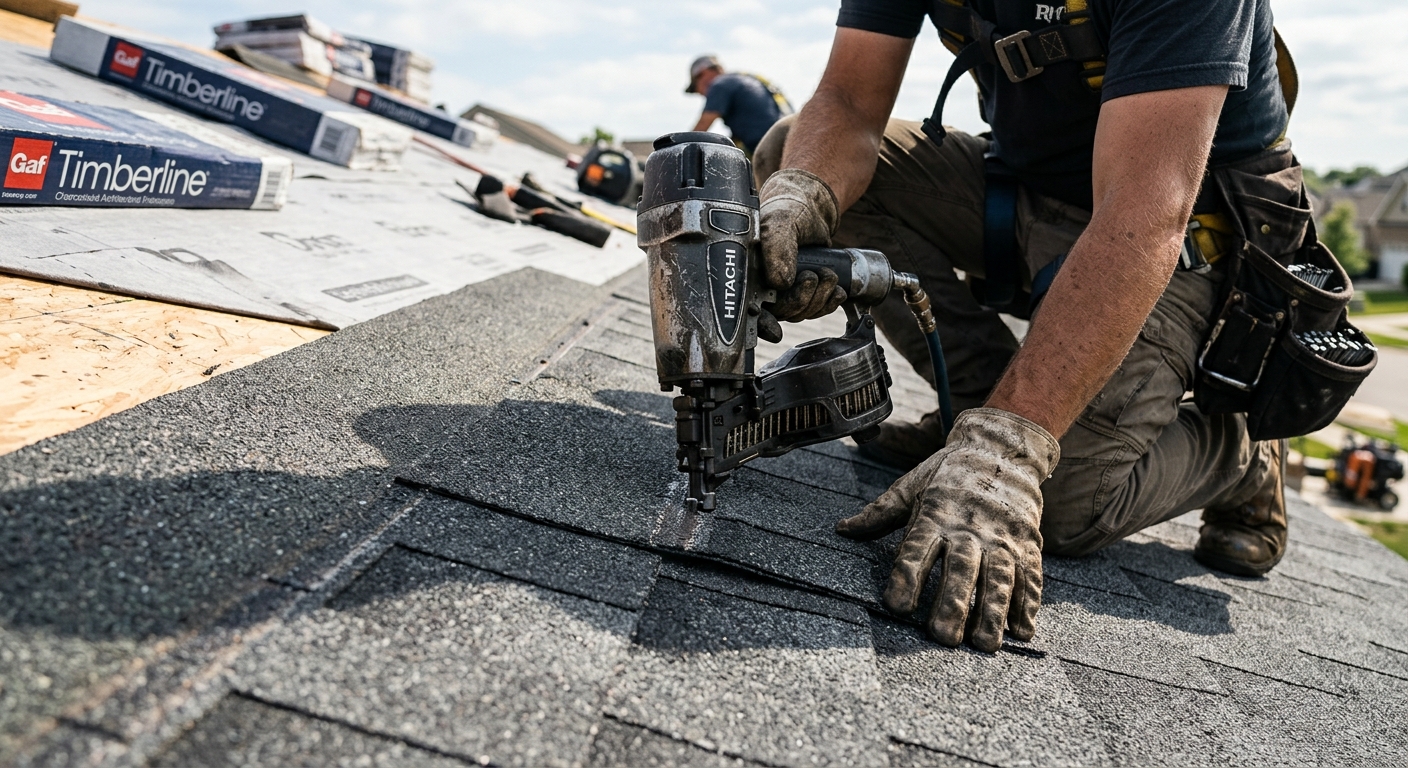
West Lampeter roofing prices by material and scope — 2026
In West Lampeter, your roofing costs will land in a band driven by the home styles and age found throughout the township. Most homes here are owner-occupied, and the median income is well above the statewide average (U.S. Census Bureau, ACS 2024). That makes high-quality roof replacements common, and you’ll notice a concentration of architectural shingles, since homeowners tend to invest for the long haul.
Much of Lancaster County’s housing stock is pre-1950, and West Lampeter is no exception. That translates to steeper roof pitches and quite a few homes that have seen two or even three layers of previous shingles. When we tackle a replacement here, it’s rarely just a single-layer tear-off; expect some surprises like underlying wood rot or planking under those old layers. That has a real impact on time, labor, and waste disposal—and it’s reflected in local prices.
Below are typical roofing costs for West Lampeter homes in 2026. These are real bands you’ll see in quotes from reputable contractors based in this area:
| Material / Scope |
Lifespan |
Best for |
Price range (installed) |
| Asphalt shingles — architectural (30-yr) |
25–30 yrs |
Typical pitched roofs, budget and resale value |
$10,000–$21,000 |
| Asphalt shingles — impact-resistant (Class 4) |
30+ yrs |
High-wind or hail exposure, insurance discounts |
$16,500–$21,000 |
| Metal standing seam |
40–70 yrs |
Long-term performance, minimal maintenance, snow shedding |
$24,500–$43,500 |
| Flat roof — TPO or EPDM |
15–25 yrs |
Low-slope additions, porches, garages |
$12,500–$25,500 |
| Roof repair — leak or isolated section |
n/a |
Single leaks, flashing issues, minor storm damage |
$550–$2,000 |
Prices are estimates for a typical West Lampeter home and vary with roof size, pitch, decking condition and material selection.
Checking out a roofer in West Lampeter: what to verify
Hiring a roofer in West Lampeter means checking more than website promises. In Pennsylvania, all roofing contracts over $500 require a Home Improvement Contractor (HIC) registration from the Office of Attorney General—verify at hic.attorneygeneral.gov. Ask for proof of workers’ compensation insurance and check it yourself on WCAIS (wcais.pa.gov). If your home was built before 1978, be sure the contractor can show you a current EPA Lead RRP certification, verifiable at certifiedrenovatorsearch.epa.gov.
For West Lampeter’s housing stock, don’t be shy about digging into details before hiring. The market is crowded—Lancaster–York–Harrisburg contractors often knock on doors right after storms, so always slow down and check credentials first. A written contract is required in Pennsylvania for work over $500, and you have three business days to cancel under state law.
- HIC registration found at hic.attorneygeneral.gov
- Written contract required for any job over $500
- Proof of workers’ compensation insurance; verify at wcais.pa.gov
- EPA Lead RRP certification for homes built pre-1978 (certifiedrenovatorsearch.epa.gov)
- Deposit under 15% of contract total
- Local office or verifiable local address
- Physical samples of proposed roofing material
- Itemized estimate with square footage and pitch
- Clear breakdown of tear-off, underlayment, and waste disposal
- Decking replacement price-per-sheet included
- Manufacturer and workmanship warranty terms explained separately
- No vague “storm damage deals” or offers to cover deductibles
Red flags in Lancaster County’s roofing market: high-pressure door-to-door pitches after thunderstorms, cash-only deals, out-of-area cell numbers, refusal to provide registration or insurance, and anyone offering to “waive your deductible.”
Storm damage and insurance claims in West Lampeter
If your West Lampeter roof is hit by a thunderstorm’s wind burst—a real risk along the Susquehanna River valley—the right next steps make all the difference. First: before any emergency tarping or cleanup, photograph all visible damage from the exterior and inside, especially if you have water stains or wet insulation. Then contact your insurer to file a claim. Insist on a written, itemized scope of loss from the adjuster—this spells out what will be covered and how repairs or replacements are calculated (actual cash value or replacement cost).
In Pennsylvania, any roof contract over $500 must be in writing under the Home Improvement Consumer Protection Act (HICPA), and you get a three business-day cancellation window. Be wary: state law prohibits a contractor from waiving or “covering” your insurance deductible. If anyone offers to eat your deductible, walk away—it’s a real legal risk for both you and the contractor. Every reputable roofer knows this and will price your job straight, so your out-of-pocket matches your insurance policy, not a too-good-to-be-true promo.
Expect your insurer to send out an adjuster to inspect the damage. Share your documentation and do not allow any work to begin before that visit—removing debris or damaged shingles too early can jeopardize your claim. Once the scope is agreed, your settlement typically starts at actual cash value (ACV), with the remaining balance for replacement released after the job is complete and all paperwork is submitted. Get every agreement in writing, keep all communications, and never sign over your entire claim check before work starts.
Reading a roofing estimate line by line
The best way to protect yourself on a West Lampeter roof job is to know exactly what is—and isn’t—written into your estimate. Reputable quotes start with roof area measured in “squares” (100 sq ft each), always with the pitch stated. Your line items should separate out tear-off and disposal (including dumpster), list the exact underlayment or ice/water barrier product, and add a price-per-sheet contingency for any rotten decking discovered. Flashing and vent boots must be called out, not lumped under “misc.” Warranty coverage should always show a separate workmanship years line versus the shingle manufacturer’s warranty. As for payment, deposits over 15% are a red flag—most West Lampeter contractors work on a small deposit and balance due after completion.
Beware of estimates that show only a lump-sum figure with no square count, no mention of number of layers, or don't explain what happens if rotten decking turns up. You simply can’t compare these apples-to-oranges.
| Line item |
What to look for |
Red flag if… |
| Roof area |
stated in squares, with pitch |
no measurement given |
| Tear-off and disposal |
number of layers, dumpster included |
bundled into one figure |
| Underlayment |
product type and coverage |
listed only as 'felt' |
| Ice and water shield |
coverage height at eaves |
omitted entirely |
| Decking |
per-sheet contingency price |
no allowance at all |
| Warranty |
workmanship years stated separately |
only the shingle warranty |
| Payment |
deposit under 15%, balance on completion |
large upfront cash |
Material comparison for West Lampeter homeowners
In West Lampeter, your material decision needs to handle real winter: ground snow loads hit 30 psf and the design low is 12 °F. Metal roofs still shed snow the fastest—useful on steep pitches and farmhouses—with a lifespan that can outlast you, but the ticket price is higher. Asphalt architectural shingles remain popular because they’re a solid balance of cost, warranty, and appearance. Their moderate lifespan (25–30 years) handles our conditions well, provided roof ventilation is correct. For low-slope or flat roofs, TPO and EPDM belong: they’re reliable in freeze-thaw and allow for quick leak repairs. Impact-resistant Class 4 shingles cost extra but rarely pay off here, since hail claims are less common than wind-driven damage in our river valley.
Asphalt is king in Lancaster County for a reason: Amish and Mennonite crews install them fast and at very competitive prices on older frame homes. That labor availability gives homeowners better value per installed square than metal and allows more frequent updates when old layers accumulate.
| Material |
Installed cost |
Lifespan |
Cold-climate performance |
Maintenance |
| Asphalt architectural |
$10,000–$21,000 |
25–30 yrs |
Good: handles freeze-thaw, resists wind if installed well |
Low, check for algae |
| Asphalt Class 4 impact-resistant |
$16,500–$21,000 |
30+ yrs |
Extra shingle durability; storm resilience |
Low, clean gutters |
| Metal standing seam |
$24,500–$43,500 |
40–70 yrs |
Excellent: sheds snow, resists ice dams |
Very low, occasional fastener check |
| TPO / EPDM membrane |
$12,500–$25,500 |
15–25 yrs |
Withstands freeze/thaw, water-tight seams |
Check seams, occasional cleaning |
Permits and code requirements in West Lampeter
Roofing work in West Lampeter is governed by the Pennsylvania Uniform Construction Code (UCC), drawn from the International Residential Code. Municipalities in Lancaster County—including townships like West Lampeter—enforce the code independently, unlike the City of Lancaster, which has its own Bureau of Code Compliance.
In the city, replacing your entire roof, especially if new sheathing or structural work is required, needs a building permit. For minor repairs in the townships—such as replacing a few shingles after a storm—a permit isn’t usually required. When hiring, make sure your roofer holds an active Home Improvement Contractor (HIC) registration. You can—and should—look this up at hic.attorneygeneral.gov.
Ask for a current certificate of workers’ compensation insurance and check it yourself at wcais.pa.gov. It’s required for every employer on a roofing crew. If your place was built before 1978, verify that your contractor has an EPA Lead RRP certification at certifiedrenovatorsearch.epa.gov—federal law applies here. You’re entitled to a written contract for any job over $500, including a three business-day cancellation period. Always get documentation and keep copies.
What West Lampeter's housing stock means for your roof
West Lampeter’s housing is older than most suburban townships in Pennsylvania, with 34.6% of homes built before 1980 and a visible number closer to the pre-1950 side (U.S. Census Bureau, ACS 2024). This era of construction means steeper roof pitches and, almost always, original plank decking rather than plywood or OSB. Many of these homes saw their first asphalt shingle roof laid directly over old wood shakes, and it’s not rare to find three layers of shingles before we start tear-off.
If your home is in one of the older neighborhoods, you can expect that roof projects will uncover issues like split planks, gaps, or undersized framing. Full tear-off back to the deck is usually the right approach, and you may end up replacing some or all of that decking—something to ask about up front. Ice and water barriers weren’t code when these roofs went on, so a modern install must include them along eaves and valleys for Lancaster County’s freeze-thaw cycles.
For homes built since the late '70s, you’re more likely to see plywood decking and a single prior layer. If your house is from a 1990s–2000s subdivision, your first replacement will be more predictable, but it’s still smart to budget for a few sheet replacements along eaves or around chimneys, especially where old leaks went unnoticed.
Frequently asked questions — roofing in West Lampeter
What warranty should a West Lampeter roofer offer?
A reputable West Lampeter roofing contractor will provide two distinct warranties. First, you should receive a material warranty from the shingle or metal manufacturer—architectural shingles typically carry 30 years of coverage for manufacturing defects. More importantly, demand a workmanship warranty: this means the contractor stands behind the actual installation. In Lancaster County, five to ten years is the expectation; some offer fifteen, but only if they have a long local track record. Don’t settle for a quote that mentions only the product warranty. Workmanship defects (like improper flashing or missed fasteners) show up fast in our freeze-thaw climate, so this protection counts. A roofer offering a full replacement (in the $10,000–$21,000 range) should print both warranties into your contract, with coverage periods stated in years. Clarify whether call-out or minor repairs are included during the warranty window.
How long do architectural shingles last compared to 3-tab?
In West Lampeter, architectural (sometimes called "dimensional") shingles are now the standard, and for good reason. Compared to old-style 3-tab shingles, which lasted 15 to 20 years in this climate if you were lucky, architectural types hold up reliably for 25–30 years—even longer with regular attic ventilation and prompt repairs. The extra thickness and layered construction let them shrug off wind gusts common along the Susquehanna River valley, and resist granule loss under freeze-thaw stress. Most quotes for replacement now use architectural, with costs between $10,000–$21,000 installed. If your current roof is still 3-tab, it’s likely at or past end of life, and you’ll see an upgrade to architectural on your next go-round—it’s simply better for Lancaster County roofs.
How can I tell if my roof decking is rotted?
You often won’t know for sure until the old shingles come off, but there are warning signs West Lampeter homeowners can check. Look in your attic for water stains, dark streaks, or if you can push a screwdriver easily through the wood—those are clear signs of rot. On the outside, soft spots underfoot on the roof, or visible sagging between rafters, also point to bad decking. With so much housing here built before 1980, it’s not rare to find original plank decks with splits or big knotholes after stripping the shingles. That’s why a good roof estimate always includes a per-sheet decking price as a contingency, usually built into a quote for a roof in the $10,000–$21,000 range. Insist on seeing a few digital photos during tear-off so you can judge the repair scope before paying for extra work.
How much does a new roof cost in West Lampeter?
For a typical West Lampeter home, a full asphalt architectural shingle replacement usually falls between $10,000–$21,000. The most common number we see in signed contracts is about $16,500. This reflects not just material and labor, but the particular realities of our area: steep roof pitches, older homes with multiple layers, and sometimes hidden surprises like deck rot or the need for upgraded flashing. Metal standing seam roofs start higher, from $24,500–$43,500, and are most likely on large, steep, or rural properties. Always get a detailed estimate with all line items broken out so you’re not surprised by extras.
Does roof pitch affect the price in West Lampeter?
Absolutely. The steeper the roof, the higher your replacement cost in West Lampeter—labor and safety gear increase dramatically once you get above a 6/12 pitch, and many of the township’s pre-1950 homes push well above that. A steep slope means more time, more staging, and sometimes extra crew for safe tear-off and disposal. Many local estimates show a premium for anything 8/12 or steeper. That can add 10–20% to a job that would otherwise fall near the base of the $10,000–$21,000 asphalt shingle band. Always have the estimator walk the roof and measure the actual pitch; don’t settle for a flat number found on Google Earth.
Do I need a permit to replace a roof in West Lampeter?
It depends where exactly your home is, and what the scope is. In Lancaster city, a replacement that involves new sheathing or any structural work requires a building permit from the Bureau of Code Compliance. If you’re in a West Lampeter or other township and are just doing shingle replacement or isolated repairs, permits are often not required—especially for minor patches or a few shingles after a storm. Always double-check with your local township office just to be safe, and confirm that your contractor carries current Home Improvement Contractor registration (verify at hic.attorneygeneral.gov) and workers’ compensation insurance (check at wcais.pa.gov). When in doubt, call before anyone tears off shingles.
Does attic ventilation matter in West Lampeter's climate?
It matters more than many homeowners think. West Lampeter’s winter design temperature (12 °F) and typical 30 psf of snow load add up to long freeze-thaw cycles, and attic moisture is a real threat. Proper ridge and soffit ventilation prevents condensation that can rot the roof deck, and it extends the life of asphalt shingles—protecting your investment in roofs costing $10,000–$21,000. Poorly ventilated attics can also bake shingles in summer, leading to shorter lifespans. Always ask your roofer to inspect attic insulation and venting during your estimate, and insist that any quote (especially on an older home) includes upgrades if needed.
What is the difference between replacement cost and actual cash value?
Replacement cost covers the full price to put a new roof on your West Lampeter home, matching current materials and installation—often between $10,000–$21,000 for asphalt architectural shingles. Actual cash value (ACV) subtracts depreciation for age and wear; if your roof is 20 years old and you file a storm claim, you’ll get far less upfront. Most insurance checks start with the ACV, then pay out the remainder—the depreciation—when you provide proof the roof was replaced. Read your policy carefully, and be wary of anyone offering to “cover your deductible,” which is not permitted by Pennsylvania law.
How far ahead should I book a roofer in West Lampeter?
Roofers serving West Lampeter generally stay busiest from late spring through early fall. For full replacements (say, $10,000–$21,000), two to six weeks’ lead time is common in May through September. Emergency repairs—especially after a thunderstorm—can often be done sooner, but line up a formal estimate for full replacement as early as you can. For metal or flat roof membrane jobs, allow extra time for material orders and custom fabrication. Don’t feel pressured by door-knockers after storms; reputable Lancaster County contractors will schedule you promptly but never demand next-day decisions or fat deposits.