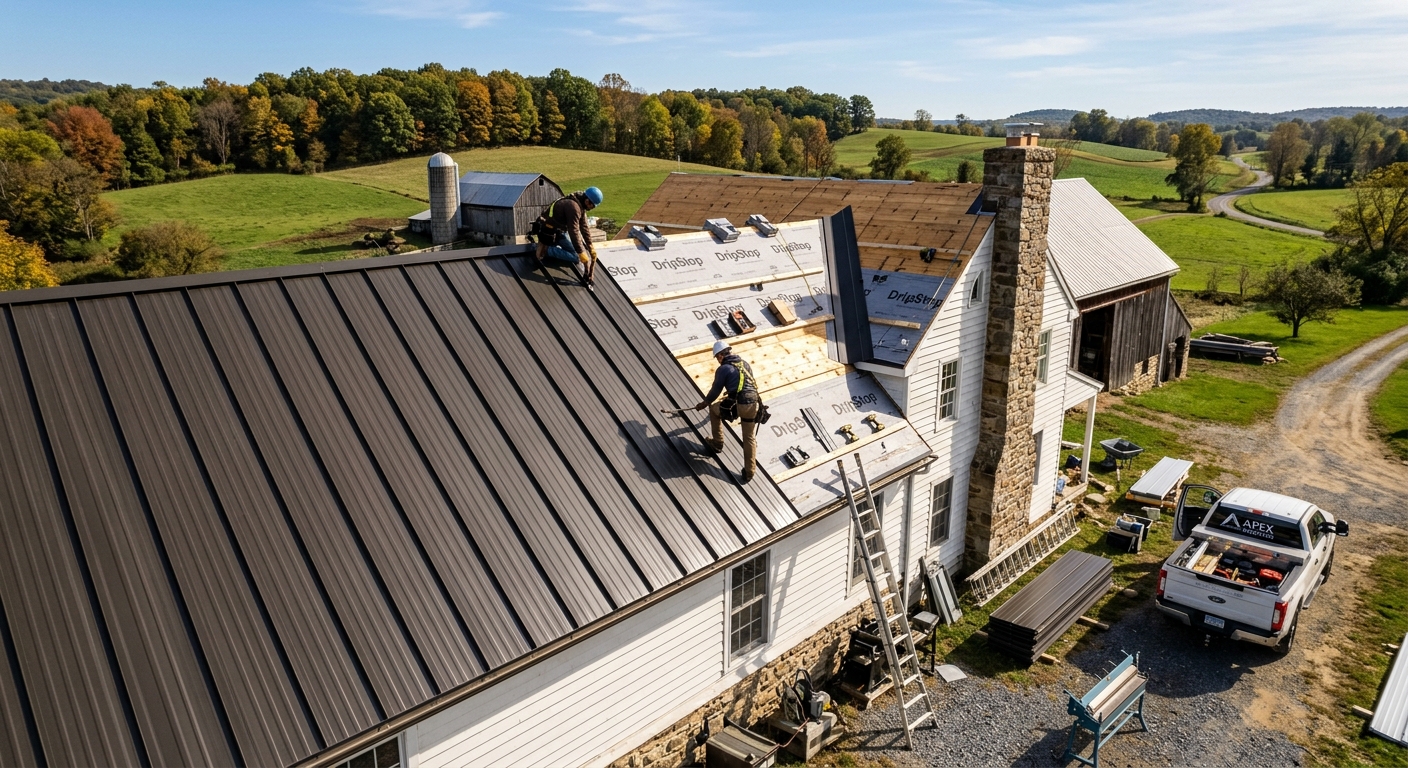
What roof replacement costs in Exeter in 2026
Exeter's roofing costs in 2026 reflect real conditions in Luzerne County — a region where most homes are over forty years old, according to the U.S. Census Bureau (ACS 2024), meaning a high share of roofs on their second or third replacement. With over 80% of Exeter households owning their homes, most buyers here weigh long-term durability and value, not just short-term fixes.
The most common roof scenario is a Wilkes-Barre or Hazleton-style early-1900s row or twin home, which means narrow roof lines, steeper-than-average pitches, and attics that were seldom insulated or actively ventilated at original construction. This typically increases the complexity and cost of both re-roofing and modern vent upgrades on Exeter’s older homes — it's rarely just a simple shingle-over. Patch repairs on these roofs tend to be short-lived, with underlying wood decking often needing partial or full replacement by the time a crew is onsite.
Replacement costs here are set not just by material, but by the house type that dominates the neighborhood: old construction with aging venting and access limitations. Below is a breakdown of what you’ll pay, as of 2026, for a typical job in Exeter:
| Material / Scope |
Lifespan |
Best for |
Price range (installed) |
| Asphalt shingles — architectural (30-yr) |
25–30 yrs |
Most homes, affordable and reliable |
$8,800–$18,500 |
| Asphalt shingles — impact-resistant (Class 4) |
30+ yrs |
Wind-prone or tree-covered roofs |
$14,500–$18,500 |
| Metal standing seam |
40–70 yrs |
Permanent roof, snow shedding |
$21,500–$38,000 |
| Flat roof — TPO or EPDM |
15–25 yrs |
Row homes, garages, low-slope porches |
$11,000–$22,500 |
| Roof repair — leak or isolated section |
n/a |
One leak, one area |
$475–$1,750 |
Prices are estimates for a typical Exeter home and vary with roof size, pitch, decking condition and material selection.
Repair or replace? A decision guide for Exeter roofs
For Exeter homeowners, most roofs were last replaced when Ronald Reagan was President. That means you're rarely deciding on a first roof; more likely, you’re dealing with a tired assembly atop a wood-framed twin or row home, often with aging insulation and venting. If your shingle roof is under 15 years old and you find just one active leak (especially after wind or minor tree limb impact), repair makes sense—especially with local repair costs running $475–$1,750. But if your home has a roof over 25 years old, even a single leak almost always spells the point of no return—patches may delay, but costs add up fast and water finds new entry points.
To illustrate: If you pay for three repairs in five years, that’s already $1,425–$5,250, easily outpacing the early edge of a full replacement at $8,800—money better spent resetting the roof system. Early-1900s homes here also mean older decking and limited ventilation, making repeat repairs riskier long-term due to hidden wood damage. If you’re staring down another winter with a mystery drip, put the money toward full replacement. Flat roofs typical of row homes and garages in Exeter rarely survive blistering or ponding after 20 years; membrane replacement is usually the safe bet.
| Situation |
Recommendation |
Typical cost |
Reasoning |
| Under 15 years, one isolated leak |
Repair |
$475–$1,750 |
Modern shingles still in expected life, spot-fix is cost-effective |
| 15–25 years, several leak points |
Replace |
$8,800–$18,500 |
Multiple failures signal end of system life in Exeter’s aging stock |
| 25+ years, any active leak |
Replace now |
$8,800–$18,500 |
Underlying wood is at risk—no repair truly seals it |
| Storm damage, wind or hail |
Document, claim, replace |
$8,800–$18,500 |
Insurable events trigger replacement, not patching |
| Flat roof ponding or blistering |
Replace membrane |
$11,000–$22,500 |
Seams have failed; patches don’t last with ponding |
| Active leak entering winter |
Emergency repair, schedule replacement |
$475–$1,750 |
Stop water ASAP; plan for replacement after thaw |
Timing a roof replacement in Exeter
Roofing in Exeter is deeply seasonal. In Luzerne County’s climate, shingle jobs are most reliable from April through October—daytime highs above 45°F are needed for proper sealing, and spring or early fall provide the best weather windows for both shingles and crew safety. If you start a project late in October, be prepared for cold snaps that can force adhesives and underlayments to behave unpredictably.
The Scranton–Wilkes-Barre–Hazleton metro is a crowded contractor market—solid crews book up quickly. If you call in April, you can usually schedule within two to six weeks; by late May into September, some reputable outfits are already booking out to October, especially after a local storm. Expect longer wait times if you require a full deck replacement or specialized ventilation upgrades common on Exeter’s older homes. Emergency jobs in February are both logistically tougher—with snow-covered roofs, frozen shingles and daylight limits—and typically cost more than a scheduled September replacement, sometimes by 15–20%, even for basic tasks (you’ll still see the price fall within the $8,800–$18,500 band, but toward the high end for winter work).
Best advice: plan ahead if you can. Late summer is prime for timing your replacement before price bumps and weather risks ramp up.
Roofing permits in Exeter: what you need before work starts
In Exeter, the Pennsylvania Uniform Construction Code (UCC), based on the International Residential Code, governs roofing work. The code is enforced by each municipality in Luzerne County—including Exeter and neighboring towns—unless a municipality has opted out, in which case enforcement falls to the PA Department of Labor & Industry.
In practical terms: a full roof replacement that involves structural decking repairs typically triggers the need for a building permit, as is standard throughout the Wilkes-Barre area. If you’re only patching asphalt shingles over a small area (under one square), nearby Hazleton municipalities regularly allow that work without a building permit. But for anything more—full re-roofs, deck repair, or major ventilation changes—you should expect a formal permit process.
Pennsylvania requires roofing contractors to hold a Home Improvement Contractor (HIC) registration from the Office of Attorney General for contracts over $500. You can verify a contractor’s registration status yourself at hic.attorneygeneral.gov. Mandatory workers’ compensation insurance coverage for any employer can be checked through the state’s WCAIS database (wcais.pa.gov).
If you own a pre-1978 home, know that EPA lead paint rules may also apply—verify renovator credentials at certifiedrenovatorsearch.epa.gov.
The cost drivers behind a Exeter roof replacement
In Exeter, what you pay for a new roof ties directly back to your home’s era and construction quirks. Row and twin homes from the early 1900s usually mean steep pitches, narrow multi-level work areas, and multiple roof layers from decades of patchwork—each tear-off and access hurdle boosts your labor bill more than in modern suburban homes. As a result, even a straightforward architectural shingle job here typically lands close to $14,500, while the same materials on a wide, single-layer suburban ranch could shave thousands off the price.
Another big driver is roof size: every square (100 sq ft) adds direct cost for material, disposal, and labor. Contractors also factor in the region’s 40 psf ground snow load—building to handle this pushes up both underlayment and labor requirements, because code expects a roof that can shrug off heavy accumulations and minimize ice dam formation. Ice barriers, in particular, are no longer optional after Wilkes-Barre’s history of severe ice-dam events.
If your roof needs new decking, expect to pay per plywood or plank sheet replaced—this often comes as a surprise on Exeter’s older homes with aging wood and hidden rot. Material choice also plays a clear role: architectural shingles run less than impact-rated Class 4, and TPO or EPDM membranes on flat roofs carry additional costs for correct substrate preparation and drainage fixes.
| Factor |
Why it matters here |
Cost impact |
| Roof size in squares |
each square is 100 sq ft of roof surface |
primary multiplier |
| Pitch and access |
steep pitches need harnesses and slow the crew |
+20–30% labour |
| Existing layers to tear off |
two or more layers means full tear-off and disposal |
$500–$1,500 per layer |
| Decking condition |
rot is found during tear-off, not before |
$75–$150 per sheet |
| Ice barrier at eaves |
required where ice damming has a history |
$300–$800 |
| Material grade |
3-tab vs architectural vs Class 4 impact-resistant |
$500–$2,500 |
Exeter homes and their roof lines
Exeter’s roofs are built on bones that date back—69.4% of homes here were built before 1980 (U.S. Census Bureau, ACS 2024). That means the typical roofline you’ll see is steep, often with a 9/12 to 12/12 pitch, which matches the row houses and twins that define the county’s architectural style. These steeper pitches aren’t just a cosmetic detail: They require more material per square foot of living space, more safety equipment for workers, and increase labor time—factors that push costs higher than in low-pitch ranches.
Most of these older roofs originally had plank decking—narrow, solid lumber boards—beneath the shingles, not plywood or OSB. Decades of humidity, patch repairs, and minimal attic venting put these decks at risk for rot and partial collapse, especially around the eaves, valleys, and chimneys. Re-roofing crews in Exeter often find themselves swapping out multiple sheets or planks, which can add both material and labor cost above what you’d see in newer tract developments.
For homes built long before modern building codes, ice and water barriers at the eaves (to fight ice damming) weren’t installed—and multiple layers of old roofing often hide structural issues until tear-off. If your home hasn’t been comprehensively stripped since its original build, don’t be surprised by the “surprise” of a second or even third roofing layer. That translates to more disposal volume, more tear-off time, and added permit scrutiny.
Snow load, ice dams and wind in Exeter
What makes Exeter roofs uniquely susceptible to damage isn’t just the snow, but how snow and wind behave in the Wyoming Valley. The region’s 40 psf ground snow load forces a steeper, heavier roof design than many other Pennsylvania counties. Here, snow doesn’t just rest on your shingles; snowmelt runs down to the cold eave and freezes, forming an ice dam. Water then backs up, leaks beneath the shingles, and soaks the original wood decking—especially problematic on early-1900s homes that weren’t built with ice barriers. If you skip installing a modern ice and water shield (costing $300–$800 for a mid-size roof), you risk not just stained plaster, but rot and mold cleanup that can overwhelm even a full deck replacement budget.
Ridge-line winds, funneled along the Wyoming Valley, regularly blast Wilkes-Barre, Kingston, and nearby Exeter, pulling at starter shingles and ridge caps in ways not seen south of the mountains. This means shingle blow-off isn’t a rare event; it’s part of life. Homeowners investing in Class 4 impact-resistant shingles ($14,500–$18,500 for a full install) do so because repeated storm damage, not once-in-a-decade hail, is the bigger budget threat.
Wind-driven rain and ice intrusion on these valley roofs create leak patterns that can go undetected until the entire attic is saturated. Hail, while not as common as wind or snow, still bruises the matting beneath the shingle surface. Bruised shingles won’t leak right away but age out and shed granules fast—pushing up replacement timelines and making “wait and see” the most expensive approach for Exeter’s homes.
Frequently asked questions — roofing in Exeter
What does it mean if my shingles are curling or losing granules?
Curling shingles or heavy granule loss usually signal the end of your roof’s lifespan in Exeter, especially on homes built prior to 1980. While our valley’s frequent freeze-thaw cycles speed up this aging process—working granules loose and causing edges to lift—these signs almost always point to underlying age or ventilation trouble, not just a bad batch of shingles. You might see a few loose granules in your gutters after heavy rain, but if you’re seeing bald spots or lots of shingle edges curling upward, budget for more than spot repairs. Fixing isolated patches won’t hold up on a roof nearing 25 years old; a full replacement runs $8,800–$18,500 in Exeter. Consider a professional attic assessment as well: Poor airflow accelerates aging here. Sometimes effective ventilation upgrades can help your next roof last its full lifespan.
How much deposit should I pay a roofer upfront?
Pennsylvania law, under the Home Improvement Consumer Protection Act, limits the deposit for roofing or any home improvement contract to one-third of the total contract price, and only after the contract is signed. For a typical roof replacement in Exeter, often priced around $14,500, that means no more than about $4,800 up front. Never pay the whole amount before work starts. If your contractor requests a larger deposit, or cash before materials are even delivered, that’s a signal to look for someone else. In our saturated Luzerne County market, reputable roofers can readily supply references, and you’ll get a written contract—required on all jobs over $500. Save final payment for after the job and municipal inspection are complete.
Will the crew damage my landscaping or driveway?
A careful roofing crew in Exeter uses plywood or tarps to protect flower beds, shrubs and driveways—especially crucial in tightly packed neighborhoods with old concrete walks and limited access. That said, there is always some risk of scuffed siding, dented aluminum gutters, or flat spots on decade-old lawns when old shingles come down. If you’re having a full tear-off and install (costing $8,800–$18,500 for most Exeter homes), clarify how debris will be handled: Will the dumpster block your drive overnight? Will the crew use a chute, or toss tear-offs onto tarps? Request these answers in writing before you sign, and consider relocating cars, patio furniture, or hanging planters until the job is wrapped.
Why do roofs fail faster in northeastern Pennsylvania?
Northeastern Pennsylvania, and Exeter in particular, faces roof wear from repeated freeze-thaw cycles, heavy snow load (40 psf), and wind-driven rain funneled through the Wyoming Valley. The combination of historic housing stock—where nearly 70% of homes predate 1980—and modern climate challenges speeds up the decline of even high-quality installations. This means shingles that might last 30–40 years elsewhere commonly need replacing at 20–25 years here. If your Exeter home is pushing 25 years on a current roof, prepare for a needed replacement in the $8,800–$18,500 range. A little preventive ventilation or new attic insulation can slow the process, but the timeline is as much about what’s overhead as what’s underfoot in our county.
What does roof replacement cost per square in Exeter?
Roofers in Luzerne County quote by the “square”—100 square feet of roof area. For an asphalt shingle replacement (the most common job in Exeter), expect a per-square rate ranging from about $440–$685, depending on pitch, access, tear-off layers and material grade. That number is calculated straight from the price band of $8,800–$18,500 for an average home (20–27 squares typical for a twin or row). Metal and flat roof jobs track higher per square, but the same labor and debris hauling curve applies. Always ask for a contract that spells out the precise size measured and how layers of tear-off or decking repairs will be handled if found during the job.
Does homeowner's insurance cover roof replacement in Exeter?
In Exeter, homeowners' insurance typically covers roof replacement only if the damage is sudden, accidental, and caused by a covered peril—like a hail storm, wind-driven shingle loss, or a fallen tree limb. It won’t pay for replacement just because your shingles are old or curled. If you suffer storm loss, document the damage immediately and contact your insurer; you may qualify for a full or partial roof payout in the $8,800–$18,500 range. Beware: intentionally inflating repair estimates or attempting to waive your deductible is prohibited under Pennsylvania law. Before filing, get a local contractor’s assessment, so you can tell the difference between an insurable loss and normal wear and tear that’s on you.
What's the cheapest way to replace a roof in Exeter?
The cheapest legal way is to fully strip the old roofing and install architectural asphalt shingles from any reputable local contractor—skipping premium upgrades or designer metal options. For an average-size home in Exeter, that’s the bottom end of the market at about $8,800. Avoid stacking new shingles atop old; code and past experience in older Luzerne County homes show that multiple layers hide rot and drive up future costs. DIY isn’t realistic here due to access, code, and disposal constraints. If you must economize, ask the contractor about basic grade materials, but don’t cut out ice and water barrier at the eaves or skip needed ventilation: repairs from water intrusion later nearly always outstrip “savings” up front.
How do I verify a roofing contractor is registered in Pennsylvania?
Pennsylvania requires any contractor working on jobs over $500—including roofing in Exeter—to carry a Home Improvement Contractor (HIC) registration issued by the Office of Attorney General. You can verify this yourself, in real time, at hic.attorneygeneral.gov. Don’t take a photo of a card or a handshake as proof—use the database. It’s also smart to check the contractor’s workers’ compensation status at WCAIS, required for every employer, and get a copy of their liability insurance binder before any deposit changes hands. If your replacement job will run $8,800–$18,500, insist on these basics. Real outfits provide documentation before they even schedule a ladder up to your roof.
Are impact-resistant shingles worth it in Exeter?
Impact-resistant (Class 4) shingles cost more—roughly $14,500–$18,500 for a full install on an Exeter home—but they’re often worth the extra in the Wyoming Valley market. Wind runs the ridgelines here hard, and it’s not uncommon to lose entire sections of cheap shingle during a spring or fall blow. Class 4s withstand hail bruising and repeated wind uplift, reducing the chances you’ll need multiple insurance claims or rapid patch jobs every year or two. On older row homes and steep pitches, insurance discounts are rare, but peace of mind, especially if mature trees overhang your house, can justify the cost. For homes exposed directly to the valley wind channel, the upgrade is one of the few that pays for itself in fewer repairs and fewer weekend headaches.