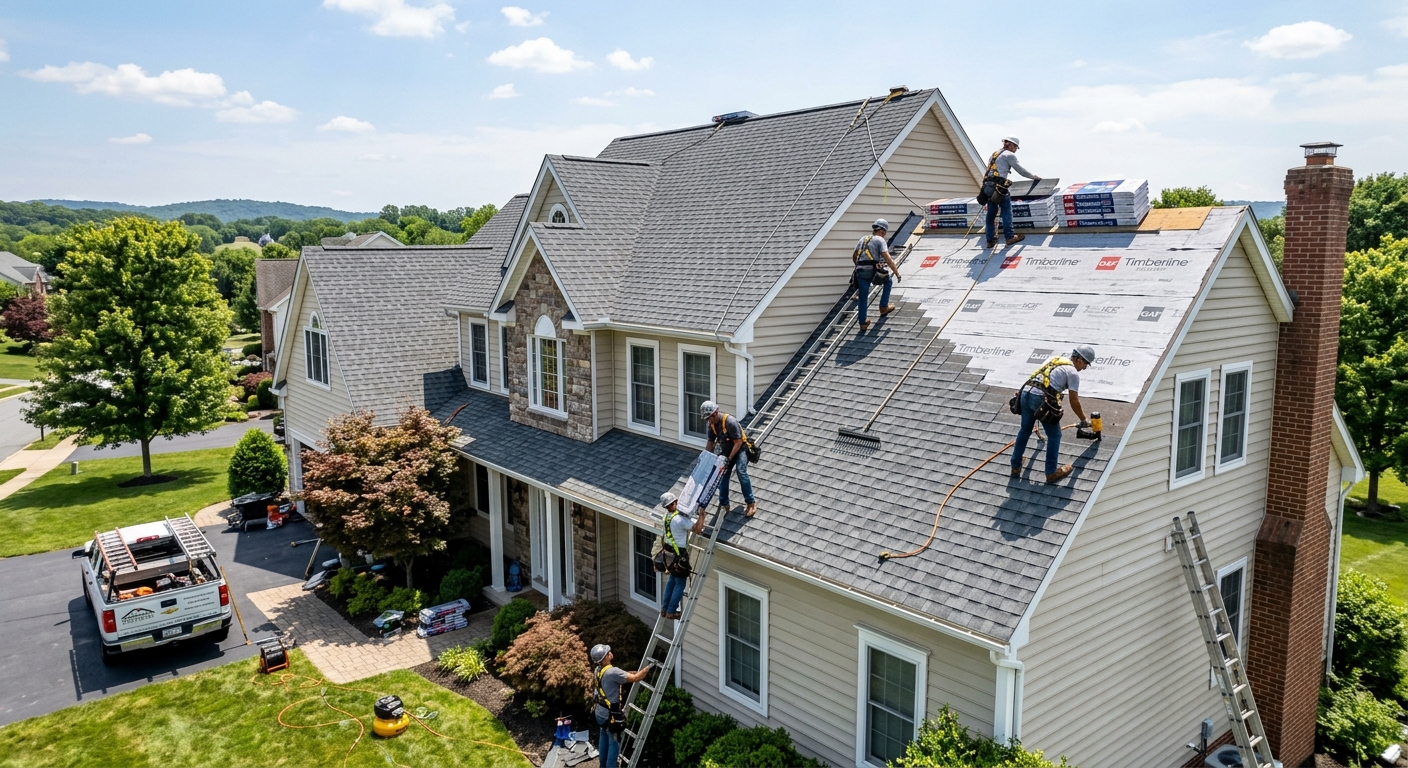
Whitpain roofing prices by material and scope — 2026
In Whitpain, where more than 80% of homes are owner-occupied and the median household income tops $161,000 (U.S. Census Bureau, ACS 2024), homeowners tend to invest in the long-term condition of their properties—and that includes roofs. Large postwar neighborhoods in neighboring Abington and Cheltenham have set a pattern of 1950s-1970s homes hitting the end of their original roof lifespans, and Whitpain’s similar housing stock means many roofs are now 25–40 years old, often on their second or third set of shingles. Here, roof replacements are more common than quick patches, with many homes large enough for full-tear-off projects and new architectural shingles or metal upgrades.
Those tract homes translate to broad, moderately pitched roofs that typically call for full replacements rather than isolated shingle fixes. If you live in a classic Whitpain two-story, expect your project to closely mirror these scope and cost ranges:
| Material / Scope |
Lifespan |
Best for |
Price range (installed) |
| Asphalt shingles — architectural (30-yr) |
25–30 yrs |
Standard roof replacement on postwar single-family |
$11,500–$24,500 |
| Asphalt shingles — impact-resistant (Class 4) |
30+ yrs |
Homes in woodsy areas or near open spaces |
$19,000–$24,500 |
| Metal standing seam |
40–70 yrs |
Premium upgrades on architecturally significant homes |
$28,000–$50,000 |
| Flat roof — TPO or EPDM |
15–25 yrs |
Modern additions, porches, or commercial-style flats |
$14,500–$29,000 |
| Roof repair — leak or isolated section |
n/a |
Fixing a minor leak or single area of damage |
$600–$2,300 |
Prices are estimates for a typical Whitpain home and vary with roof size, pitch, decking condition and material selection.
Why two Whitpain roofing quotes can differ by 40%
In Whitpain, it’s common for two reputable roofers to give bids that differ by several thousand dollars for what looks like the same job. That’s not just a matter of markup. Most Whitpain homes are sizable postwar single-families—often with 25–35 roofing squares instead of the 18–20 you might find in smaller suburbs. Because project scale is large, any difference in material or labor calculation gets magnified. For instance, asphalt shingle replacement can swing from $11,500–$24,500 depending on tear-off, decking repairs, or a switch to Class 4 impact shingles.
Roof pitch and access are other big differentiators here: many two-story Colonial or split-level homes in Whitpain have moderately steep slopes. Crews need more time, more harnesses, and jobs can run a full extra day—which directly adds labor. And because southeastern PA’s 30 psf ground snow load means code enforcement expects ice barrier at eaves (especially where older insulation leaves cold roof edges), a quote that includes insulated underlayment protects you against ice damming, but it costs more up front.
Frequent coastal rainstorms, especially for homes nearer to Norristown and Upper Merion, also drive up costs if multiple layers of old roofing must come off—removal and disposal is priced per layer. Decking repairs are rarely fully predictable, since rot is uncovered only after tear-off, adding to your final number.
| Factor |
Why it matters here |
Cost impact |
| Roof size in squares |
Each square is 100 sq ft of roof surface; Whitpain homes often 25–35 squares |
Primary multiplier |
| Pitch and access |
Steep pitches need harnesses and slow the crew |
+20–30% labour |
| Existing layers to tear off |
Two or more layers means full tear-off and disposal per square |
$500–$1,500 per layer |
| Decking condition |
Rot is found during tear-off, not before, often in 1960s–70s houses |
$75–$150 per sheet |
| Ice barrier at eaves |
Required where ice damming has a history—common in older insulation layouts |
$300–$800 |
| Material grade |
3-tab vs architectural vs Class 4 impact-resistant |
$500–$2,500 |
Roofing permits in Whitpain: what you need before work starts
In Whitpain, roofing projects are governed by the Pennsylvania Uniform Construction Code (UCC), enforced by your municipal office or, in rare cases, by the state Department of Labor & Industry for municipalities that have opted out. The UCC is based on the International Residential Code and lays out what work requires a permit.
If your roof work involves replacing more than 25% of the existing surface—as with most full shingle or flat roof replacements—you will likely need a building permit. For minor repairs (such as a single patch under one roofing square, a situation more typical in Lower Merion Township), a permit may not be necessary. The municipal codes office will make the call, and they are the authority issuing your permit.
All roofing contractors working on contracts over $500 in Pennsylvania must have Home Improvement Contractor (HIC) registration. You should verify this registration at hic.attorneygeneral.gov before hiring anyone. For insurance, including mandatory workers’ compensation, check their status using the WCAIS database (wcais.pa.gov). Insist on seeing documentation—if a roofing company cannot show it, do not sign a contract. These steps protect you both legally and financially if anything goes wrong on your project.
Timing a roof replacement in Whitpain
Late spring through early fall is prime season for roof replacements in Whitpain. Shingle manufacturer warranties require proper thermal sealing, which won’t happen reliably if you install below 40°F—so March through October are preferred. Most jobs are completed May through September, when the temperature, humidity, and longer days let a crew move efficiently.
Whitpain is part of a highly competitive Philadelphia metro roofing market. While you have lots of contractor options, that also means quality crews can book up three to six weeks out during peak season, especially after late spring thunderstorms. If a bad July storm rolls through Abington or up the Schuylkill valley and damage is widespread, expect even longer waits for reputable firms.
Emergency work—especially in winter—will always command a premium: if you need service in February, icy conditions and short daylight mean premiums both for labor and for the risk of working around snow or frost. By contrast, a planned replacement in late September is often less expensive, as crews try to fill their calendar before winter. If your roof is already at the end of its life, avoid putting off the job until cold weather corners you into an emergency call.
Asphalt, metal or membrane — what suits a Whitpain roof
In Whitpain, the practical winner for most homes remains architectural asphalt shingles. They’re not just cheap per square foot; their 25–30 year lifespan matches the needs of the area’s wood-framed, pitched-roof homes built from the 1950s onward. The region’s 30 psf ground snow load and 14°F winter design temperature are well within the performance envelope of modern architectural shingles. Metal standing seam roofs perform even better with snow shed and can last well into a second generation of homeownership, but the up-front installed cost—$28,000–$50,000—keeps metal a premium option for custom homes and major upgrades, not standard replacements.
TPO and EPDM membranes are ideal for the flat sections you sometimes find over additions or porch roofs, thanks to simple drainage and resistance against pooling water. But unless your home or outbuilding truly has a flat or low-slope roof, there’s no reason to pay for single-ply materials.
Asphalt dominates here because HOAs and township guidelines support it, and it fits the look and cost structure set by decades of postwar suburban development. The only time to reach for impact-resistant (Class 4) shingles is if your property is at risk from overhanging trees or, in the rare event, recurring hail. Otherwise, that upcharge is better put toward ventilation or attic insulation.
| Material |
Installed cost |
Lifespan |
Cold-climate performance |
Maintenance |
| Asphalt architectural |
$11,500–$24,500 |
25–30 yrs |
Excellent, with underlayment; handles 30 psf snow |
Annual gutter clear, shingle inspection |
| Asphalt Class 4 impact-resistant |
$19,000–$24,500 |
30+ yrs |
Better hail and branch resistance, same snow load |
Minimal; same as above |
| Metal standing seam |
$28,000–$50,000 |
40–70 yrs |
Exceptional for snow shed, will not ice dam |
Occasional fastener and coating check |
| TPO / EPDM membrane |
$14,500–$29,000 |
15–25 yrs |
Best for flat or low-slope surfaces only |
Check for punctures, re-seal seams |
What Whitpain's climate does to a roof
Whitpain’s roofs take a real beating from the physical mechanisms specific to southeastern Montgomery County’s weather. Proximity to the Schuylkill River valley exposes homes—especially in Norristown and Upper Merion—to thunderstorm winds that can rip caps and tabs off older shingles. Shingle bruising from hail doesn’t always punch a hole but will leave weak points that lead to future leaks; if you spot granule loss after a storm, it’s worth a $600–$2,300 professional inspection and repair rather than waiting for a major failure.
Ground snow load here averages 30 psf, which means any weak underlayment or aged flashing around eaves or valleys is subject to ice damming cycles: snow melts above the attic, runs down to the cold eave, then freezes and forces water back up beneath shingles. This hidden seepage typically shows up as leaks or stains inside as late as March, prompting costly deck or insulation repairs that can quickly escalate to a $11,500–$24,500 replacement when unseen rot is found beneath the surface.
Humidity and moderate freeze-thaw cycles—common during March and November—accelerate deck and fascia deterioration, particularly on homes with original 1960s eaves. The cost of ignoring this is rarely limited to cosmetic fixes; a flat roof that ponds for more than 48 hours post-storm may be a candidate for a membrane tear-off and new TPO or EPDM, which in Whitpain runs about $14,500–$29,000. The upshot: Stick with code-required ice barrier at eaves and address wind, snow, and thermal cycling in your roof plan or pay more for the next “surprise” repair.
Patching vs full replacement in Whitpain
If you own a typical Whitpain home—a 1960s–1970s single-family with architectural shingles—knowing when to repair or fully replace is simple math and history. If a roof is under about 15 years old and the issue is a single leak or minor damage, a targeted repair (usually $600–$2,300) is sensible. For roofs in the 15–25 year range with several leaks or widespread shingle losses, repair costs can quickly eat up a replacement budget: two or three repairs in a single calendar year could run $4,000–$6,000, close to what you’d spend on a full new roof at $11,500–$24,500.
Once you cross the 25-year mark on a shingle roof in Whitpain or see any leak that gets inside before winter, put your dollars toward replacement—the home’s value and insurance won’t reward ongoing temporary fixes. Storms that damage 30% or more of a roof almost always get a “replace” decision, not patch, especially if you expect to be in the home more than a couple years.
| Situation |
Recommendation |
Typical cost |
Reasoning |
| Under 15 years, one isolated leak |
Repair |
$600–$2,300 |
Still within roof lifespan; local fix extends service |
| 15–25 years, several leak points |
Replace |
$11,500–$24,500 |
Multiple repairs approach replacement cost |
| 25+ years, any active leak |
Replace now |
$11,500–$24,500 |
Roof at end of effective life, hidden rot likely |
| Storm damage, wind or hail |
Document, claim, replace |
$11,500–$24,500 |
Insurer expects replacement beyond patching |
| Flat roof ponding or blistering |
Replace membrane |
$14,500–$29,000 |
Systemic failure—not repairable by patching |
| Active leak entering winter |
Emergency repair, schedule replacement |
$600–$2,300 |
Quick fix buys time, but plan for full replacement |
Frequently asked questions — roofing in Whitpain
How long should a roof last in Whitpain?
If you’re in Whitpain and your home has architectural asphalt shingles (the most common type here), expect a typical lifespan of 25 to 30 years—assuming the roof is installed to code and maintained. The region’s snow load (30 psf) and humid summers mean shingles here will not last as long as in drier climates. Metal roofs, while much more expensive (from $28,000–$50,000), can easily reach 50 years or more. Flat roofs (TPO/EPDM) tend to need replacement after 15–25 years, especially if ponding or ice damming is an issue. If your house was last roofed in the 1990s or earlier and you’re seeing leaks, you’re overdue—don’t expect another decade out of original materials in this area.
What does roof replacement cost per square in Whitpain?
In Whitpain, the installed cost per square (100 square feet of roofing) for architectural asphalt shingles ranges from about $460–$700 per square, reflecting total project costs of $11,500–$24,500 for the full job. Larger or steeper roofs, or those needing substantial tear-off, will push you toward the upper end of the range. Premium metal roofing runs higher—frequently around $1,100–$1,500 per square. Every quote should detail labor, material, tear-off, and disposal, since those factors drive costs in Whitpain more than in rural suburbs.
How do I find a reputable roofer in Whitpain?
Always start by verifying a contractor’s Home Improvement Contractor (HIC) registration with the Pennsylvania Office of Attorney General at hic.attorneygeneral.gov; don’t take a business card at face value. Next, request proof of current workers’ compensation coverage—they can show you verification from the WCAIS system. In Whitpain, where roof replacements often reach $19,000 or more and many homes are on their second or third roof, demand a written contract (required by the Home Improvement Consumer Protection Act for jobs over $500) with all terms detailed. Strong references in Montgomery County and physical office presence (not just a PO box) help weed out storm chasers or unlicensed outfits.
Does Whitpain get enough hail to justify Class 4 shingles?
Most homes in Whitpain are not exposed to frequent hail events. While severe storms can happen, the area averages far fewer large hailstorms than western or northern Pennsylvania. Unless your property is more exposed—such as at the edge of open fields or with overhanging trees dropping branches—the upgrade to Class 4 impact-resistant shingles (from $19,000–$24,500 total) usually isn’t needed. Standard architectural shingles, properly installed, will handle most local weather. Reserve Class 4 upgrades for areas identified by your insurer as high hail risk or if you want the reassurance against tree fallout.
How long does a roof replacement take in Whitpain?
A typical roof replacement in Whitpain takes 2–4 days, weather permitting. Most homes here are two-story with a roof size of 25–35 squares, and crews need extra time for safe tear-off, especially if unexpected plywood or flashing repairs are discovered. Emergency winter jobs take longer and are often higher-priced, since labor in freezing weather is premium and daylight is short. Always clarify with your contractor if your project is quoted at the low or high end (from $11,500–$24,500), as jobs that run long from surprise repairs can bump up your total timetable and cost.
What is the difference between replacement cost and actual cash value?
On Whitpain homeowner insurance policies, “replacement cost” means you’re compensated for what it costs to put on a new roof of similar materials today, without deduction for age or wear. “Actual cash value” deducts for depreciation based on your roof’s age and condition. That means if you have a 20-year-old architectural shingle roof (common in Whitpain) and suffer storm damage, actual cash value might only pay half—leaving you to cover the rest out of pocket. Since a replacement here runs $11,500–$24,500, what your insurer pays depends directly on this policy difference.
Are impact-resistant shingles worth it in Whitpain?
In most Whitpain neighborhoods, standard architectural shingles are the cost-effective and widely accepted choice. Impact-resistant (Class 4) shingles add upgrade costs (often $2,000–$5,000 to a project total), but unless your home is tucked under mature hardwoods or in an odd wind corridor, you seldom get back that investment. Insurers in Montgomery County do not always credit you for Class 4s, and the local hail risk does not justify the spend for most homes. Reserve this option if your past insurance claims involved tree limbs or puncture damage.
What's the cheapest way to replace a roof in Whitpain?
For Whitpain, the lowest-priced replacements are straightforward tear-offs with standard architectural asphalt. Avoiding upgrades like synthetic underlayments or extended warranties keeps you towards $11,500, but beware that the cheapest bid sometimes skips critical ice barriers or ventilation. If your home is simple-pitched and large, and you don’t need decking repair, you’re a good candidate for a no-frills replacement. That said, the cheapest job isn’t always the best value; shoddy installation or skipped flashing details leads to leaks that can cost several times more ($600–$2,300 per repair) in the following years.
Do I need a permit to replace a roof in Whitpain?
For most full roof replacements in Whitpain—work that covers more than 25% of your roof—you will need a building permit, as required by the Pennsylvania Uniform Construction Code and enforced through your municipality. Minor repairs, where less than a square of roofing is touched, might not require a permit, but that’s rarely the case in full tear-offs typical of Whitpain’s large, mature homes. Permit costs and requirements can be confirmed with your local municipal office. Never let a contractor start work without a permit if one is required; jobs started without one can delay insurance claims or home sales. Total replacement costs (from $11,500–$24,500) should always include proper permitting.