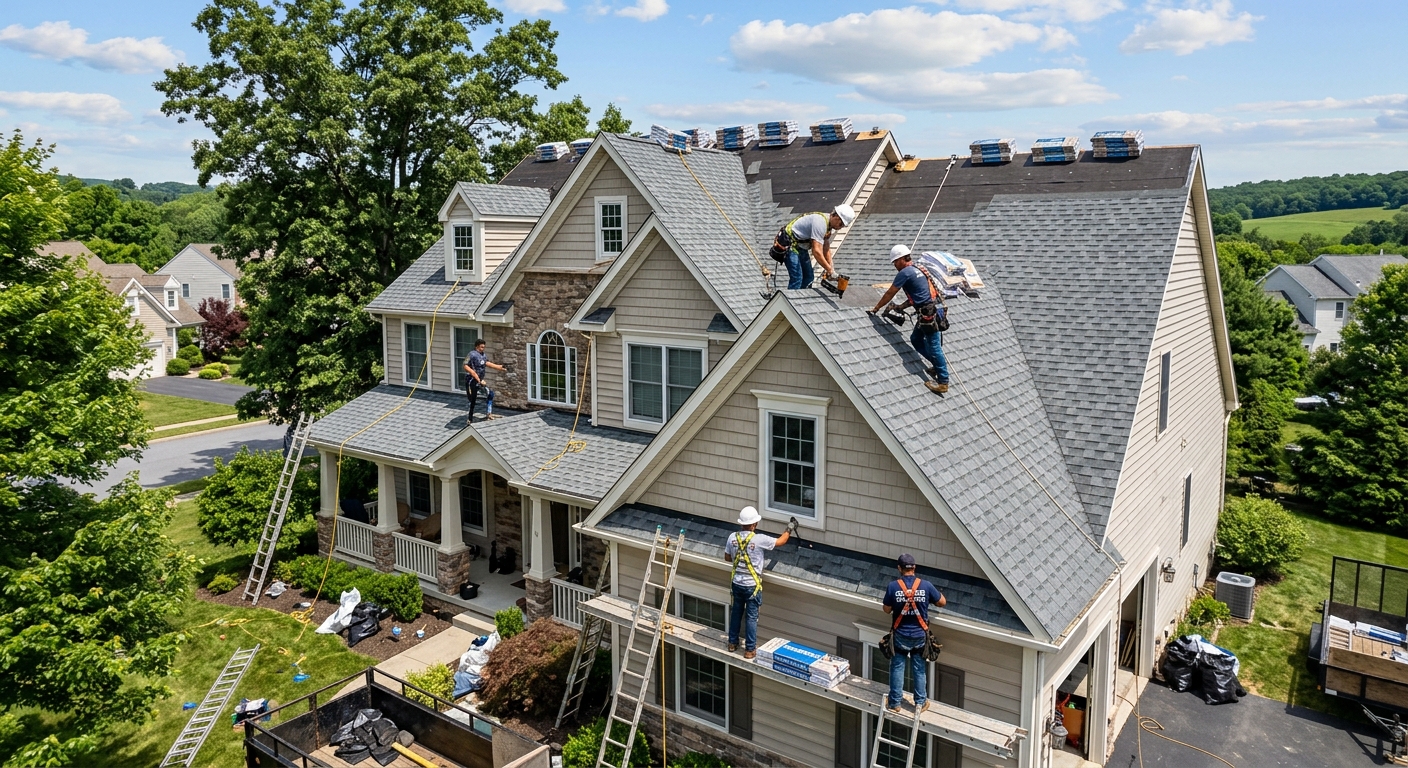
What roof replacement costs in Blakely in 2026
Blakely’s housing stock, shaped by its history as part of the Scranton–Wilkes-Barre metro, means most homeowners are working with older, single-family houses—71.6% of homes fit that profile (U.S. Census Bureau, ACS 2024). Two out of three owners live in homes built before 1980, and the median household income sits at $62,065. When budgeting for a new roof in Blakely, these realities affect both project size and what is often discovered once you tear back the shingles.
Scranton and Old Forge, which dominate local construction trends, are filled with early-1900s wood-frame row homes and duplexes. This means it’s common for Blakely roofs to require more than just a new layer of shingles; discovering rotten plank decking or unknown multiple layers from reroofs past is standard. Expect a higher chance you’ll need to replace sheathing or address sagging rafters—expenses that newer suburbs avoid. If your home fits this era and style, build deck repairs into your expectation from the start.
The result is that roof replacement prices in Blakely are often above what you see in national averages—especially once deck and flashing fixes are included. Here’s what a homeowner can expect for typical jobs in 2026:
| Material / Scope |
Lifespan |
Best for |
Price range (installed) |
| Asphalt shingles — architectural (30-yr) |
25–30 yrs |
Standard pitched roofs |
$8,900–$18,500 |
| Asphalt shingles — impact-resistant (Class 4) |
30+ yrs |
Steep, tree-exposed homes |
$14,500–$18,500 |
| Metal standing seam |
40–70 yrs |
Steep slopes, snow, longest life |
$21,500–$38,500 |
| Flat roof — TPO or EPDM |
15–25 yrs |
Rowhome and low slope additions |
$11,000–$22,500 |
| Roof repair — leak or isolated section |
n/a |
Small leaks, minor wind damage |
$475–$1,800 |
Prices are estimates for a typical Blakely home and vary with roof size, pitch, decking condition and material selection.
Storm damage and insurance claims in Blakely
In Blakely, roof storm damage typically means wind or ice damming, both common thanks to the ridge-line winds that sweep the Lackawanna Valley. If your home takes on damage, your best move is to start with evidence—take detailed photos before anyone clears a shingle or hauls debris. Insurance claims here often move swiftly, but only if you have a clear before-and-after record of your loss.
Once your claim is in, expect the insurer to send an adjuster to inspect and generate a written “scope of loss.” Pennsylvania policies are commonly paid as actual cash value (ACV) initially, with the full replacement cost reimbursed after the work is done and you submit proof. Make sure you get a signed contract with your roofer—state law here, under the Home Improvement Consumer Protection Act, requires a written contract for any job over $500, and you are entitled to cancel within three business days if you need to reconsider.
Some contractors may offer to “cover your deductible” to win your business. In Pennsylvania, waiving or rebating an insurance deductible is prohibited—that’s a red flag and deals like this can void your claim or worse. Stick with contractors who know the law and don’t ask you to sign anything unusual. Before you authorize work, verify your chosen roofer carries mandatory workers’ compensation insurance—this protects you from liability if anyone is hurt onsite.
The Blakely market is full of roofers listing Scranton addresses, so do not hesitate to check for valid Home Improvement Contractor registration at the Attorney General’s website. The best contractors will walk you through the claim, work from your written scope, and never pressure you to skip steps for the sake of speed.
Reading a roofing estimate line by line
Most Blakely homeowners haven’t seen many roofing quotes, and a surprising number are written in ways that hide real detail. The right estimate should spell out your roof's measurement in “squares” (100 square feet per square), the pitch, and whether your existing shingles, decking, and flashing are factored into the job. Tear-off, disposal, and underlayment need to be itemized, with brand or type named—not just generic terms like “felt.”
Decking replacement is a wildcard for older homes, especially with common wood plank underlayments dating to the 1900s. Your quote should name a per-sheet price for new plywood or OSB—if this is missing, expect to be upcharged mid-job. Look for clear distinctions between material warranties (say, 30-year from the shingle manufacturer) and the roofer’s own workmanship guarantee. Payment terms matter: reputable Blakely roofers rarely ask for more than 15% down, with the balance due only when you’re satisfied and the job is complete.
If any line on the quote seems vague, like “replace roof per code—$14,000,” walk away. Without square count, pitch, and separate pricing for each phase, you can’t compare that proposal to anything else. Here’s how to spot what matters in a local estimate:
| Line item |
What to look for |
Red flag if… |
| Roof area |
stated in squares, with pitch |
no measurement given |
| Tear-off and disposal |
number of layers, dumpster included |
bundled into one figure |
| Underlayment |
product type and coverage |
listed only as 'felt' |
| Ice and water shield |
coverage height at eaves |
omitted entirely |
| Decking |
per-sheet contingency price |
no allowance at all |
| Warranty |
workmanship years stated separately |
only the shingle warranty |
| Payment |
deposit under 15%, balance on completion |
large upfront cash |
Roofing permits in Blakely: what you need before work starts
If you’re replacing your Blakely roof, especially a full tear-off or switching materials, local rules are specific. Under the Pennsylvania Uniform Construction Code (UCC), which is enforced by municipalities or by the PA Department of Labor & Industry in opted-out areas, a building permit is typically required for a full roof replacement on one- to four-family homes in Scranton. For straightforward shingle repair over a small area, no permit is needed in either Scranton or Dunmore.
Before signing any contract, you should make sure your contractor is properly registered. Pennsylvania requires Home Improvement Contractor (HIC) registration for any roofing contract over $500—always verify at hic.attorneygeneral.gov. Don’t just take a business card; check that their registration is active under the homeowner lookup. For insurance, every roofer with employees must carry workers’ compensation—verify their compliance yourself through the WCAIS portal (wcais.pa.gov). This is your backstop against liability if someone is injured on your property.
Every contract in Pennsylvania for work over $500 must be in writing, under the Home Improvement Consumer Protection Act. You also have a legal right to cancel the project within three business days—no questions asked, no penalty. These rules are strictly local, and every reputable Blakely roofer knows and follows them.
Snow load, ice dams and wind in Blakely
Blakely falls squarely in northeastern Pennsylvania’s snow belt, facing a ground snow load of 40 pounds per square foot and winter lows down to 4°F. Those numbers aren’t just for code paperwork—they drive real roof design, especially given the ridge-line winds that sweep through Scranton and up into Archbald’s hilltop neighborhoods. When wind blows snow across pitched roofs and it piles up at the eaves, attic warmth can melt the lowest layer and then cause refreezing at the gutter. This forms an ice dam: water backs up under shingles and seeps inside, often unseen until it ruins plaster or insulation.
Ice and water shield isn’t optional here. Blakely roofs should have at least the first three to six feet at the eave fully covered by this membrane. Skimp on this and you’re almost guaranteed to face leak repairs costing $475–$1,800. Even “hail-resistant” shingles can show hidden bruising from wind-driven ice, which lowers effective lifespan by letting water in years before the warranty is up. Metal roofs, while costlier, shed snow instantly—this is why you see newer installations in exposed spots. But asphalt shingles are more typical, which means careful ice barrier and correct attic insulation count for more than simply upgrading to thicker material.
Wind-driven storms also mean that gable and ridge vents need to be tight and boots reshimmed regularly. A minor leak caused by a failed boot or wind-pulled flashing can spiral—given the age of many Blakely homes—into thousands in repairs if not caught in the first freeze-thaw cycle. Winter performance here is all about managing what lurks below the shingle line.
Blakely homes and their roof lines
The character of Blakely’s housing stock is set by its construction era: a full 76.0% of homes here were built before 1980 (U.S. Census Bureau, ACS 2024). Many have the steeply pitched roofs, wood plank decking, and multiple reroof layers typical of early-1900s local building. Unlike the OSB or plywood used in modern subdivisons, you’re dealing with one-inch-thick boards spaced to allow ventilation—a detail that often leads to deck sag or rot once two or three layers of asphalt have been added over decades.
Ice guard barriers weren’t required by code back then, so unless the roof was recently redone with full tear-off, you might find only a rosin felt underlayment or, at best, tar paper at the eaves. It’s not unusual for older Blakely roofs to hide two (even three) layers—strip shingles from the 1960s, three-tabs, and more recent architectural layers stacked by past owners “just to get through another year.” That stack accelerates deck decay and invites leaks at hidden valleys or plumbing vents.
Because of this era and the likelihood of aged plank decking, thorough tear-offs and sheathing repairs are routine local practice. This all translates to more careful estimating, more contingency for wood replacement, and an expectation that your roof job will be a little more involved than a new-build town just across the county.
Material comparison for Blakely homeowners
Choosing the right roof in Blakely isn’t about style—it’s about what stands up to 40 psf snow loads and bitter 4°F winter events. Asphalt architectural shingles, dominating in Scranton and Dunmore, owe their popularity to cost and familiarity among local contractors: they work well with the region’s typical roof pitches and are easiest to patch if a valley leaks. Metal standing seam, while more expensive, is unbeatable in snow-shedding and longevity, especially on exposed hilltop homes that see the worst of the wind and drift. Flat membrane (TPO/EPDM) is for low-slope sections and rowhome add-ons; you won’t get strong snow evacuation here, but you will get resilience against ponding and a seamless surface.
Where the math doesn’t support spending up: paying for premium impact-resistant asphalt (Class 4) on a protected in-town roof with no overhanging trees or hail history. You’ll spend $14,500–$18,500 for a gain you might never need. Conversely, replacing a Blakely roof with a basic architectural shingle—at $8,900–$18,500—is almost always the most cost-effective move for homes built before modern codes required more expensive options. Metal shines only when you need the long view (40+ years) or snow slides threaten your eaves regularly.
| Material |
Installed cost |
Lifespan |
Cold-climate performance |
Maintenance |
| Asphalt architectural |
$8,900–$18,500 |
25–30 yrs |
Good with proper underlayment |
Periodic flashing, shingle patch |
| Asphalt Class 4 impact-resistant |
$14,500–$18,500 |
30+ yrs |
Better wind/hail durability |
Similar to standard asphalt |
| Metal standing seam |
$21,500–$38,500 |
40–70 yrs |
Exceptional snow shedding |
Minimal, check fasteners |
| TPO / EPDM membrane |
$11,000–$22,500 |
15–25 yrs |
Flat roofs, resists ponding |
Returns/seams checked annually |
Frequently asked questions — roofing in Blakely
How do I verify a roofing contractor is registered in Pennsylvania?
Pennsylvania’s Home Improvement Contractor (HIC) registration is required for any roofing contract over $500. In Blakely, you can verify a roofer’s registration number directly at hic.attorneygeneral.gov. Enter your contractor’s business name or registration number and make sure their status is marked “Active”—this database is run by the state Attorney General. It’s also smart to ask for a copy of their workers’ compensation certificate and check it at the WCAIS website, especially if anyone besides the owner will be working. Registration is your protection: if a contractor can’t show you proof, you’re exposed to shoddy work or even scams. With roof replacements starting at $8,900–$18,500 here, protecting your investment is worth two minutes of online checking.
What underlayment should be used on a Blakely roof?
For Blakely’s snow load and freeze-thaw cycles, code-minimum underlayment is rarely enough. The best practice is to use a fully-adhered ice and water shield for at least 3 to 6 feet from the eave (sometimes up to the ridge in valleys), with a high-quality synthetic or heavy tar-felt rolled above that. The underlayment is your last line of defense against ice dam water backing up beneath shingles during the 4°F winter lows. Many pre-1980 homes here still have old rosin paper or thin #15 felt—a major risk. Modern tear-offs typically include this upgrade, so if your quote doesn’t detail brand and coverage, ask. Skipping this detail can mean repairs of $475–$1,800 later if water finds a weak spot.
How long should a roof last in Blakely?
While a standard architectural asphalt roof is rated for 25–30 years, Blakely’s exposure to heavy snow and frequent freeze-thaw means many roofs only deliver 22–26 years before repairs or replacement become necessary. Metal standing seam can stretch to 40–70 years if properly installed, but very few local roofs last past their nameplate life due to attic heat, ice dams, and multiple previous layers. If your last replacement was mid-1990s or earlier, budget for $8,900–$18,500 for a new roof now. Ask for photo documentation during tear-off—previous decay is common in our older stock.
Why do roofs fail faster in northeastern Pennsylvania?
It’s usually not the material, but hidden damage from our snow load and ice damming. Blakely’s older homes were rarely insulated to modern standards, causing uneven melt at the roof edge. Warm air escaping up into unvented attics means snow melts above the living areas and refreezes at the eaves—water backs up, seeps under shingles, and rots wood. Over decades, this leads to soft eaves, leaks, and even interior plaster damage, often years before you’d expect failure from age alone. A minor repair starting at $475–$1,800 can turn into a deck replacement if chronic ice dams aren’t dealt with.
How do I file a storm damage roof claim in Pennsylvania?
Start with photos—document every shingle, flashing, and gutter that’s been disturbed before cleaning up. In Blakely, you then call your home insurer, open a claim, and schedule their adjuster for inspection. Never let a contractor initiate repairs beyond emergency tarping until your written scope of loss is issued. Per Pennsylvania law, you must sign a written contract for roofing work over $500 and you get a 3-day right to cancel. Never agree to let the roofer “cover your deductible”—this is illegal and can void your claim. Final payments are usually held back until after the work is inspected. Typical storm repairs here are $475–$1,800 for patching, with full replacements billed according to your policy type.
What warranty should a Blakely roofer offer?
A reputable Blakely roofing contractor should provide two warranties: the manufacturer’s material warranty (often 25–30 years for architectural shingles) and a separate workmanship or labor warranty (commonly 5–10 years, sometimes more). Always insist on the workmanship coverage in writing—it’s this local warranty that covers things like flashing or improper shingle nailing, which are much more likely to fail than the materials themselves. Full roof replacement in Blakely typically runs $8,900–$18,500, so losing labor coverage after year two is no bargain. If a contractor tries to blur these together, ask for specifics.
How far ahead should I book a roofer in Blakely?
For full replacement, Blakely roofers usually book two to eight weeks out, depending on the time of year and whether a storm just rolled through the county. Emergency repairs for active leaks may be handled within a day or two, but typical summer and fall schedules fill quickly—especially given the number of small-family contractors serving the Scranton area. The earlier you can decide and lock in a slot, the more likely you are to avoid short-notice premiums. With replacement costs often $8,900–$18,500, the best teams book fastest—don’t wait for visible leaks before you start making calls.
Is a metal roof worth the extra cost in Blakely?
Metal standing seam can be a smart investment for some Blakely homes, but not all. At $21,500–$38,500, it’s a sizable jump over asphalt shingles. Where it pays: exposed hilltops that get the full force of Lackawanna Valley winds and ridge-line snow, or owner-occupied homes where you’ll stay long enough to realize the 40–70 year lifespan. For lower, tree-protected in-town homes, asphalt usually makes more economic sense. Metal eliminates plowing snow off the eaves and nearly ends ice dam worries, but insulation in the attic and proper ventilation still matter most to prevent leaks.
Why is my Blakely roofing quote higher than the online average?
Most national averages understate what you’ll pay in Blakely for a few reasons. Our homes trend older—76.0% built before 1980—which means most replacements are not “strip and shingle,” but require decking repairs and far more labor. Ridge-line winds and high snow load force more ice/water barrier and flashing work than milder climates. Add in the saturated Scranton contractor market, where reputable outfits document old plank decks and fix what’s revealed, and prices often exceed generic online calculators by 20–30%. That’s why full replacements here trend toward $14,500–$18,500 even for average homes.