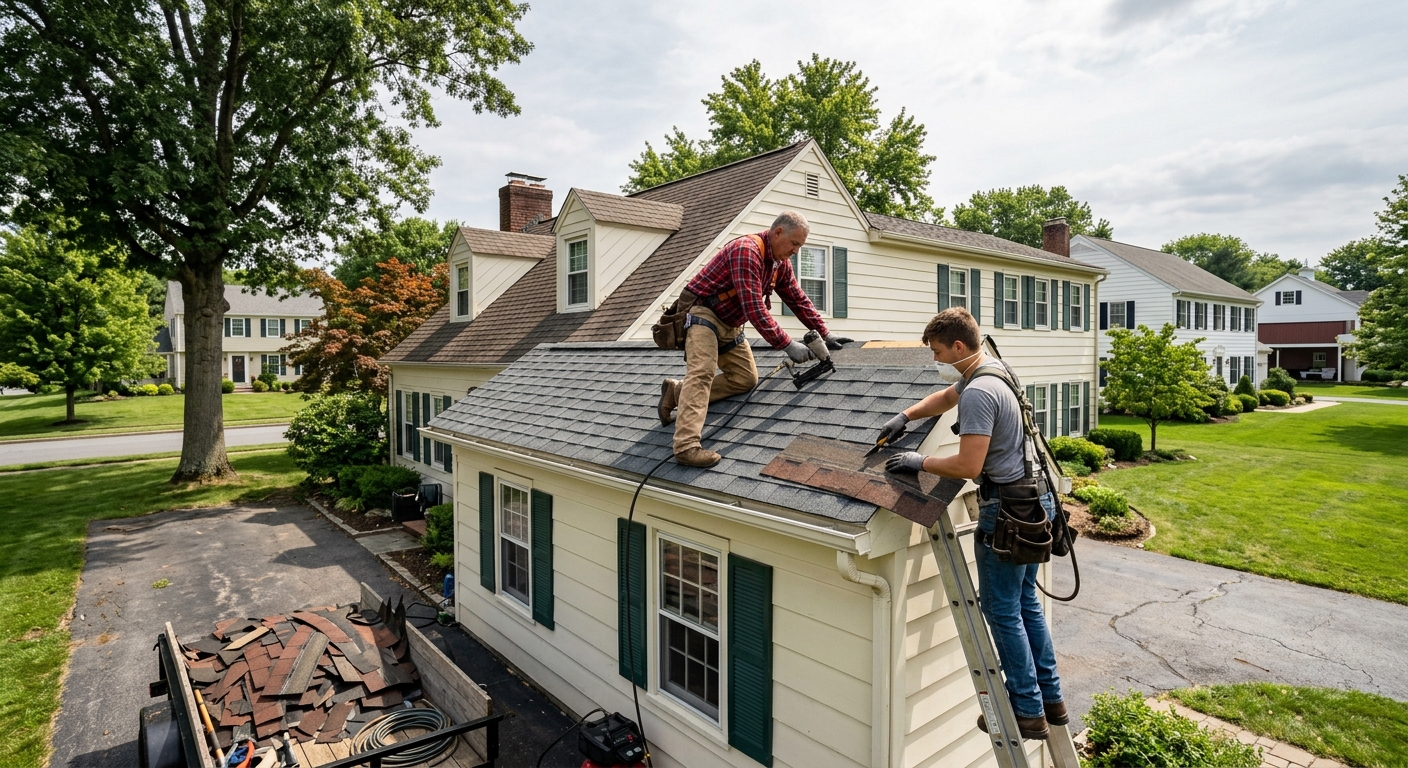
Derry roofing prices by material and scope — 2026
Derry’s roof replacement costs reflect the area’s housing trends and climate realities. With 53.9% of homes built before 1980 and a homeownership rate of 65.1% (U.S. Census Bureau, ACS 2024), much of the current demand is for full-roof replacements as original asphalt systems near the end of their lifespan. Homeowners in Derry often see similar needs as those in neighboring Lower Paxton and Swatara, where post‑World War II suburban tracts mean large numbers of roofs age out together—driving up both demand and urgency for replacements.
Roofers here see plenty of asphalt shingle jobs simply because Harrisburg-area homes are typically wood-frame on moderate-sized suburban lots. When replacement is needed, most roofs are 20–30 squares, with scope driven by the age and local storm exposure—especially wind along the Susquehanna corridor. In Derry, it’s common for full-tear-offs (removing all layers) to be needed, especially on homes from the late 1960s and 1970s where past overlays were popular but now create extra disposal costs.
Metal and membrane systems are increasingly quoted, but most Derry homeowners choose architectural shingles unless the house has flat or very low-slope sections. Metal is usually reserved for higher-budget projects or where snow-shedding is critical.
| Material / Scope |
Lifespan |
Best for |
Price range (installed) |
| Asphalt shingles — architectural (30-yr) |
25–30 yrs |
Most Derry single-family homes |
$9,800–$20,500 |
| Asphalt shingles — impact-resistant (Class 4) |
30+ yrs |
Wind-prone or tree-heavy areas |
$16,000–$20,500 |
| Metal standing seam |
40–70 yrs |
Snow management, max durability |
$23,500–$42,500 |
| Flat roof — TPO or EPDM |
15–25 yrs |
Porches, additions under 3/12 pitch |
$12,500–$24,500 |
| Roof repair — leak or isolated section |
n/a |
Flashing, small sections, minor storm damage |
$500–$1,950 |
Prices are estimates for a typical Derry home and vary with roof size, pitch, decking condition and material selection.
Choosing a roofer in Dauphin County
Dauphin County homeowners should always verify a roofing contractor’s credentials before signing anything. State law requires roofers to hold Home Improvement Contractor (HIC) registration for contracts over $500—check this at hic.attorneygeneral.gov before proceeding. For projects involving employees, ask for proof of workers’ compensation insurance and confirm it through WCAIS (wcais.pa.gov). Written contracts are required by the Home Improvement Consumer Protection Act (HICPA) for jobs above $500, giving you a 3 business-day right to cancel.
In Derry and surrounding townships, roofers don’t need a trade license, but proper registration and insurance are non-negotiable. Storm-driven demand can attract less-reputable outfits or “door knockers,” especially after wind events along the Susquehanna corridor. Be methodical and ask for proof—not just a business card.
- Verify HIC registration at hic.attorneygeneral.gov
- Check for written workers’ compensation coverage (wcais.pa.gov)
- Ask for a copy of the signed contract (required for jobs over $500)
- Insist on a physical business address (not just a PO box)
- Request recent references from Derry or adjacent townships
- Ask who will be on site (no unannounced subcontractor swaps)
- Insist on a detailed scope of work, including material specifics
- Check that no one asks you to sign insurance proceeds over directly
- Decline “waived deductible” offers (illegal under HICPA)
- Confirm the company’s lead-safe certification for pre-1978 homes (EPA registry)
- Request a copy of warranty (both labor and manufacturer)
- Be wary of anyone requesting large up-front payments
Red flags in Dauphin County’s crowded market: unsolicited door-knocking after storms, refusal to give evidence of insurance or HIC registration, no references from Derry jobs, and vague estimates with only a “ballpark” final price.
Roofing season and lead times in Dauphin County
Dauphin County’s roofing calendar is defined by freeze-thaw cycles and moderate winter lows. Shingle installation in Derry is typically scheduled from late March through early November, when temperatures are high enough for proper asphalt sealing (ideally 40°F or warmer, with roof surface in the sun). The main rush begins after the winter thaw in April and peaks in September–October, as homeowners scramble to get work done before overnight frost returns.
In this saturated metro market, lead times for a full replacement in spring and fall often run 3–5 weeks, especially after major wind storms in the Harrisburg–Carlisle corridor. For a job planned in the summer, expect a bit less wait—but don’t count on next-day slots once busy season is underway. Derry doesn’t see the labor crunch of more remote counties, but true emergencies (like active leaks during a February freeze) will carry a premium compared to jobs slotted in mild weather.
Flat roof membranes have a similar window—colder weather means adhesives won’t set right, so urgent work on a low-slope porch in January requires temporary repairs until spring. Urgent repairs or emergency tarping cost more in the off-season, while a planned replacement in September is far more budget-friendly, with less chance of weather delays.
What moves the price of a roof in Derry
Roofing quotes in Derry often diverge for reasons tied to the region’s age and roof construction. Many jobs here involve houses from the 1960s–1980s, which means there may be two or even three layers of shingles to tear off. Removal and disposal alone can run $500–$1,500 per layer, especially if the existing roof has been “overlaid” more than once—a construction trend common in Dauphin County’s post-war tracts.
Snow load and storm exposure shape the build. Derry’s 30 psf ground snow load, plus pronounced freeze-thaw cycles, mean a quality ice barrier at the eaves and proper attic ventilation matter more here than downstate. Wind along the Susquehanna corridor can also justify Class 4 impact-resistant shingles (costing $16,000–$20,500 for a typical home), but the choice between architectural and impact-rated systems should be based on tree exposure or location atop a ridge.
Within the same material class, quotes change based on roof size (most Derry houses are 20–30 squares), steepness, and access. A 9/12 pitch roof on a two-story colonial means more safety gear, slower production, and potentially higher replacement cost than a 6/12 ranch. If rot is found in the decking after tear-off—which can’t be confirmed until shingles are peeled—budget another $75–$150 per sheet replaced.
| Factor |
Why it matters here |
Cost impact |
| Roof size in squares |
Each square is 100 sq ft of roof surface; tract homes here often 20–30 squares |
Primary multiplier |
| Pitch and access |
Steep pitches need harnesses and slow the crew |
+20–30% labor |
| Existing layers to tear off |
Two or more layers means full tear-off and disposal; common in postwar tracts |
$500–$1,500 per layer |
| Decking condition |
Rot is found during tear-off, not before; common with homes built before 1980 |
$75–$150 per sheet |
| Ice barrier at eaves |
Required where ice damming has a history; freeze-thaw is common |
$300–$800 |
| Material grade |
3-tab vs architectural vs Class 4 impact-resistant; long pays off if wind exposed |
$500–$2,500 |
Flat roof sections: the part most quotes get wrong
A surprising number of Derry homes—especially those with postwar additions or enclosed porches—have a section of roof that’s near-flat (under 3/12 pitch). These sections cannot be properly protected by shingles, though some contractors offer that option to cut time or cost. Installing shingles on a low slope leads to premature failure and water infiltration, as water can’t shed fast enough to avoid ponding and ice damming—problems worsened by our freeze-thaw cycle.
Flat roof areas require a membrane system, typically TPO or EPDM. These are designed for continuous water exposure and have a typical lifespan of 15–25 years when properly installed, for a cost of $12,500–$24,500 depending on the size and transitions. Drainage is everything: a minimal slope and well-placed scupper or downspout keep water moving off the roof. If a roofer tries to install asphalt shingles on a section less than 3/12, it’s a sign they’re not meeting local standards—or not prepared to warranty that work when leaks arise.
Look for a crew that distinguishes between flat, low slope, and main roof systems in their estimate. It’s a clear sign they know the climate and housing stock of Derry. Overlooking this detail is the easiest way to end up paying for another “repair” long before you should.
Asphalt, metal or membrane — what suits a Derry roof
Derry’s winter design temperature of 12°F and 30 psf ground snow load both push the case toward reliable snow management and durability. Asphalt shingles—especially architectural style—dominate the Harrisburg-area market because most homes here are mid-century wood-frame with simple, moderate-pitch designs. Asphalt is less expensive ($9,800–$20,500) and offers adequate performance if properly installed with ice barrier and ridge ventilation.
Metal standing seam systems outperform asphalt for snow shedding and can last 40–70 years, but at an installed price of $23,500–$42,500, the investment rarely pays off for most single-family homes unless you plan on decades of ownership or have constant ice dam trouble. For flat or low-sloped sections, neither asphalt nor metal is suitable—membrane systems (TPO/EPDM) are necessary to prevent leaks and pooling, with costs between $12,500–$24,500 for a typical job.
Asphalt roofing remains dominant because it fits the local climate and construction profile: it’s affordable, compatible with the vast majority of home designs, and handles the region’s moderate snowfall if installed to code. The only time to pay the premium for metal is if you’re on a steep pitch with consistent snow load, or you want a truly “last roof” solution. Membrane is only for flat or near-flat areas. Unless you’re right on the ridge or have extensive tree overhang, Class 4 impact shingles rarely return their cost.
| Material |
Installed cost |
Lifespan |
Cold-climate performance |
Maintenance |
| Asphalt architectural |
$9,800–$20,500 |
25–30 yrs |
Good with ice barrier; moderate snow load okay |
Periodic inspection, replace damaged shingles |
| Asphalt Class 4 impact-resistant |
$16,000–$20,500 |
30+ yrs |
Best if trees overhang or near ridge; wind/hail resistant |
Same as architectural |
| Metal standing seam |
$23,500–$42,500 |
40–70 yrs |
Excellent shed for snow and ice; ideal for freeze-thaw |
Check for fastener movement, repaint if scratched |
| TPO / EPDM membrane |
$12,500–$24,500 |
15–25 yrs |
No seaming issues in cold if properly installed; for flat only |
Annual check for seals, clear drains |
Pennsylvania code and Dauphin County permit rules for roofing
Roofing work in Derry and throughout Dauphin County falls under the Pennsylvania Uniform Construction Code (UCC), which draws from the International Residential Code (IRC) as adopted by the Commonwealth. The authority for code enforcement depends on the municipality: In Harrisburg, it’s the City of Harrisburg Department of Building & Housing Development, while the townships (including Derry) operate their own code offices. Always check with your local township office or, if your municipality opted out, compliance is enforced by the PA Department of Labor & Industry.
A building permit is usually required for major roofing work—complete tear-offs, full replacements, major structural repairs, or adding new roof layers. Simple repairs (replacing a handful of shingles, minor flashing fixes) may not need a permit, but any job that changes the roof system or structure probably will.
All contractors for jobs over $500 must be registered with the Pennsylvania Office of Attorney General as Home Improvement Contractors (verify at hic.attorneygeneral.gov), and must supply a written contract under HICPA. You can check proof of workers’ compensation insurance through the WCAIS system (wcais.pa.gov), which is mandatory for all Pennsylvania roofing employers. There is no trade license for roofers, no statewide plumbing, HVAC, or electrical licence by state law, and no state-specific license for mold removal or restoration.
Frequently asked questions — roofing in Derry
How much does it cost to repair a roof leak in Derry?
Roof leak repairs in Derry generally fall in the range of $500–$1,950, with the most common jobs around $1,250. The exact price depends on where the leak is located (for example, a plumbing vent collar, chimney flashing, or valley detail), how accessible the site is, and whether there’s any decking or underlayment damage. Ice-dam related leaks after severe winters can push the repair toward the higher end of the range. Large sections or multiple problem spots cost more. It’s wise to avoid temporary “patch jobs” that put off the real fix—especially since freeze-thaw cycles in Dauphin County can turn small leaks into major rot quickly. A reputable local roofer will diagnose the water entry point, check attic and decking condition, and show you photos of any hidden damage before quoting.
What underlayment should be used on a Derry roof?
For Derry, the right underlayment is dictated by our freeze-thaw winters and snow load. At a minimum, you want synthetic underlayment on the full deck—either a high-quality synthetic or traditional felt. For the bottom of the roof (at the eaves), ice and water barrier is required by code in areas like Dauphin County prone to ice damming. Most local jobs use “peel and stick” membrane covering the first 3–6 feet up from the edge. If your roof replaced for $16,000–$20,500 includes labor and architectural shingles, confirm on the contract that both the synthetic (or felt) and ice barrier layers are called out. A contractor skipping this step is cutting corners that will cost you first time a winter thaw hits.
Does Derry get enough hail to justify Class 4 shingles?
Derry sits in a region where hail large enough to damage roofs is rare, but wind and falling branches from tree-lined lots can still cause shingle impact damage. Class 4 impact-resistant shingles, which cost between $16,000–$20,500 for a typical replacement, are best justified if your home is close to mature trees or exposed than if fearing hail. If your roof regularly gets scattered debris after storms, or if you’re right along the ridge where wind drives branches onto the house, they’re worth considering. Otherwise, standard architectural shingles are more cost-effective for most Derry households—hail alone doesn’t drive enough claims to warrant the upgrade in this part of Dauphin County.
What does it mean if my shingles are curling or losing granules?
Curling or excessive granule loss is a sign that your asphalt shingles are nearing the end of their service life—a common issue here since over half of Derry homes were built before 1980. Curling often points to heat buildup, poor ventilation, or simply old age. Granule loss means the shingles are no longer UV-protected and are weakening fast, increasing risk of leaks. If you notice these problems across much of your roof, it’s time to plan for a replacement. A typical new architectural shingle roof in Derry ranges from $9,800–$20,500. If the problem is isolated to a small area, a targeted repair (under $1,950) can buy you time, but ignore these signs too long and you risk hidden rot and higher replacement costs when water gets under the system.
Will the crew damage my landscaping or driveway?
Crews in Derry take precautions, but any roof replacement—especially using tear-off methods—has risks to shrubs, flowers, and paved areas. Shingle and debris fall can flatten delicate plants or mark concrete. Responsible roofers use tarps to catch material and will plan where dump trailers or dumpsters are parked to avoid rutting lawns. Large jobs (over $16,000) often include plywood driveway protection in the estimate. It’s best to discuss onsite protection and clean-up with your contractor upfront and mark out any prized plantings. For older driveways, alert the crew of low points or cracks before they unload heavy deliveries. While most skilled crews leave a yard looking as good as when they started, ask for photos of past Derry jobs to confirm.
Do I need my own inspection before the adjuster visits?
In Derry, if you’re filing an insurance claim for roof damage, having an experienced roofer inspect before the adjuster arrives can save time and argument—especially with storm, wind, or tree limb claims. The roofer can mark problem areas, take photos, and help you understand if repairs (often $500–$1,950) or a full replacement (up to $20,500) is justified by the damage. While it’s not required, a contractor familiar with local insurance protocols will know what items are commonly covered for Derry homes. Just make sure they don’t ask you to sign a contract that assigns your insurance proceeds to them (“AOB” agreements), since Pennsylvania consumer law prohibits this practice under HICPA.
How much does a new roof cost in Derry?
A new architectural asphalt shingle roof in Derry typically costs $9,800–$20,500, with most projects for a 20–30 square home landing around $16,000. Steeper pitches, multiple shingle layers to tear off, decking repairs, and higher material grades will push costs higher, especially on older homes built before 1980. Metal systems are available, but at $23,500–$42,500, are usually reserved for lifetime investments or snow-shedding needs. Flat roof membrane replacements (TPO/EPDM) for porches and additions run $12,500–$24,500. Always get a detailed quote covering underlayment, insulation, and debris disposal, and avoid the lowest bid if it skips these essentials.
Is ice barrier underlayment required in Derry?
Yes. Due to freeze-thaw cycles and our ground snow load of 30 psf, ice and water shield (an impermeable underlayment) is mandated by code at the eaves in Derry and across Dauphin County. This membrane prevents water that backs up from ice dams from entering at the roof edge—a problem that can otherwise lead to leaks and rot in the sheathing and walls. A reputable estimate for architectural shingles (~$16,000 for a typical Derry home) will include at least the first 3 feet (more on lower-pitched roofs) of ice barrier. Any quote skipping this is cutting corners and risks code violations and future moisture problems.
Are storm-chasing roofers a problem in Derry?
After wind or hail storms, Derry and other Dauphin County townships do see an uptick in “storm chasers”—contractors (sometimes with out-of-state plates) who go door to door offering quick repairs, often pushing urgent-seeming contracts or “waived deductible” offers. This is a classic sign of a saturated market, especially just after ridge-line winds along the Susquehanna. Often, the repairs are superficial and disappear when you need warranty help. Local contractors with HIC registration, verifiable insurance, and references on Derry homes provide far more reliable service—even if their quote for a roof repair is $1,250–$1,950. Always verify credentials and be wary if pressured to sign anything on the spot.