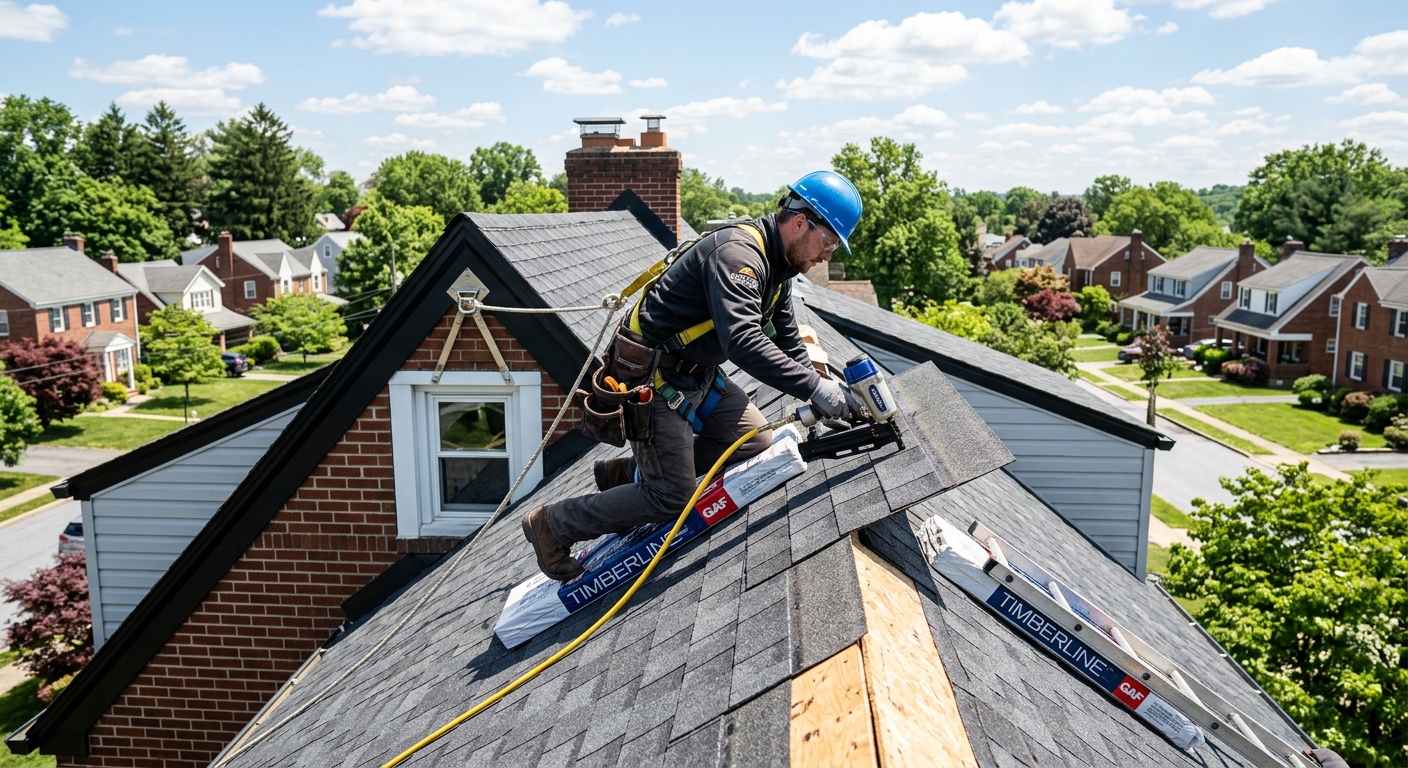
What roof replacement costs in East Vincent in 2026
In East Vincent, roof replacement is a major project facing many homeowners, especially as the majority of homes are single-family structures with a high homeownership rate (U.S. Census Bureau, ACS 2024). This shapes demand, as most owners are responsible for their own exterior, and few rely on rental property management for repairs. Large 1970s–1990s subdivisions in nearby West Goshen and Uwchlan mean many roofs are now nearing or exceeding their original design life, and similar suburban development patterns span much of East Vincent. As a result, contractors see a wave of first or second roof replacements—most commonly for asphalt shingle systems—rather than small, piecemeal repairs. That difference means larger jobs, more full-tear-offs, and a distinct pricing structure compared to markets with mostly pre-1950 housing, where small repairs dominate.
Here’s what you can expect for typical roof replacement and repair costs in East Vincent in 2026, across common materials and roof types:
| Material / Scope |
Lifespan |
Best for |
Price range (installed) |
| Asphalt shingles — architectural (30-yr) |
25–30 yrs |
Suburban single-family, HOAs, typical replacement |
$11,500–$24,000 |
| Asphalt shingles — impact-resistant (Class 4) |
30+ yrs |
Wind-prone ridge lines, increased hail resistance |
$18,500–$24,000 |
| Metal standing seam |
40–70 yrs |
High-end homes, long-term owners |
$27,500–$49,000 |
| Flat roof — TPO or EPDM |
15–25 yrs |
Low-pitch additions, porches, commercial-type roofs |
$14,500–$28,500 |
| Roof repair — leak or isolated section |
— |
Localized storm or leak repair |
$600–$2,300 |
Prices are estimates for a typical East Vincent home and vary with roof size, pitch, decking condition and material selection.
Repair or replace? A decision guide for East Vincent roofs
Deciding between repairing or fully replacing your roof in East Vincent comes down to age, leak source, and how many times issues have come up. Most homes here were built or roofed from the late 1970s through the 1990s, so you are likely looking at shingle roofs now in their final third of lifespan. If your architectural shingle roof is under 15 years old and has one leak—often at a flashing or vent—a focused repair in the $600–$2,300 range makes sense. But once a roof is 20 to 25 years old, the original material is at or beyond design life, and signs of trouble (widespread granule loss, curling, several leaks) make further repairs a band-aid at best.
Let’s run a worked example: if you’re spending $1,450 (the typical repair cost) two or three times over a couple years, you’ll quickly approach $4,350—a serious dent in the cost of a full replacement, which starts around $11,500. Throwing good money after bad on an aging roof rarely pays in the long run, especially before our damp, freeze-thaw winter pattern kicks in. For homes with construction prior to 1980, original decks and underlayments may also be substandard by today’s code, so repairs often uncover hidden problems that a replacement would address outright.
| Situation |
Recommendation |
Typical cost |
Reasoning |
| Under 15 years, one isolated leak |
Repair |
$600–$2,300 |
Local defect, roof otherwise sound |
| 15–25 years, several leak points |
Replace |
$11,500–$24,000 |
End of shingle life, multiple failures indicate systemic wear |
| 25+ years, any active leak |
Replace now |
$11,500–$24,000 |
Roof has exceeded useful life; spot repairs will not hold |
| Storm damage, wind or hail |
Document, claim, replace |
$11,500–$24,000 |
Insurance may cover total replacement—tarp and prevent further damage |
| Flat roof ponding or blistering |
Replace membrane |
$14,500–$28,500 |
Systemic membrane failure—patches rarely last |
| Active leak entering winter |
Emergency repair, schedule replacement |
$600–$2,300 |
Minimize water intrustion, plan full fix in better weather |
East Vincent homes and their roof lines
Most East Vincent homes emerged from the same building boom that shaped West Goshen and Uwchlan—subdivisions built from the late 1970s into the 1990s. Only about 41.7% of homes here predate 1980 (U.S. Census Bureau, ACS 2024). That means the typical re-roof involves standard-pitch, truss-framed houses with plywood or early OSB decking (not the old planks you’d find elsewhere in Chester County). In the table above, nearly every job is a 30-year architectural shingle tear-off: one layer, over sheathing, with starter strip and drip edge installed or retrofitted over the last few decades.
Few roofs in these neighborhoods have multiple shingle layers, since most municipalities and the prevailing code discourage doubling up—especially since 1990. First-time replacements (now common as these homes hit 25–40 years) often expose issues with attic ventilation or moisture from modern insulation upgrades, but not the shifty, hand-built deck transitions you’d expect on a prewar farmhouse. Ice and water shield barrier wasn’t universally required in the 1980s subdivisions here, so a first re-roof is also an opportunity to address vulnerable eaves and valleys that can otherwise drive up your repair bills down the road. In short, your East Vincent reroof is about catching up to today’s standards, not wrestling with multiple eras of patchwork construction.
Pennsylvania code and Chester County permit rules for roofing
All residential roofing in East Vincent is governed by the Pennsylvania Uniform Construction Code (UCC), which follows the International Residential Code as its base. Enforcement is handled at the municipal level—so the local township, not the state, sets permitting rules unless it has opted out, in which case the PA Department of Labor & Industry steps in.
In nearby West Chester Borough, a permit is required for full roof replacement if structural deck repair is part of the job. Like-for-like shingle repairs under one square can usually be completed without a permit. Surrounding townships have similar enforcement, though it’s always best to double-check office policies before starting. Contractors must be registered as Home Improvement Contractors (HIC) with the Pennsylvania Office of Attorney General for jobs over $500. You can (and should) verify HIC registration at hic.attorneygeneral.gov. Written contracts are mandatory for jobs over $500 under the Home Improvement Consumer Protection Act, giving you a three-business-day cancellation window.
For work performed by employees (not the owner personally), Pennsylvania requires all contractors to carry workers’ compensation insurance, which you can verify through WCAIS (wcais.pa.gov). If you’re in a pre-1978 house, federal EPA Lead RRP certification also applies. Roofing isn’t a separately licensed trade—registration and permits are the main protections here. If a contractor can’t provide documentation on demand, keep looking.
Snow load, ice dams and wind in East Vincent
Chester County’s climate shapes the way a roof protects your home, and in East Vincent, several physical forces are at play that don’t impact all of Pennsylvania equally. The area’s ground snow load is 30 pounds per square foot, enough to weigh down even sturdy trusses after a few winter storms. Here’s why it matters: as snow accumulates on your roof, warmer air from your attic melts the snow near the top, sending water down to refreeze at the colder eaves. This process, especially on north-facing or shaded pitches, creates ice dams—thick ridges that prevent meltwater from draining. Water backs up under shingles and soaks the plywood deck below, often leading to hidden rot and repairs in the $600–$2,300 range for just a small leak. Multiply that over a severe winter, and you’re at replacement-level costs.
Wind events are another East Vincent reality. Many homes are sited along open ridge lines and the Chester Valley, where localized gusts can lift shingles or peel back entire roof sections. Even the best architectural shingles lose granules over time, but a sudden wind burst from a coastal system can leave enough damage for insurance to warrant a full replacement—often in the $11,500–$24,000 range. Hail, while not common every year, bruises shingle backs, reducing waterproofing without immediate visible damage; issues may only appear months later. For all these threats, correct underlayment—especially ice and water shield along eaves—can save thousands. Skip it, and the climate will break through by the next deep freeze.
What gets discovered after tear-off in East Vincent
On East Vincent’s typical single-layer, late-20th-century roofs, most surprises aren’t visible until the shingles come off. The most common hidden cost is rotted plywood decking—a real risk given the region's moderate freeze-thaw cycle and humid summers. Every deck board replaced usually runs $600–$2,300 for labor and material, depending on how many sheets need to go. That multiplies fast if leaks have been festering unnoticed at eaves or valleys.
Ventilation is next—older attics often lack modern ridge and soffit vents. Poor ventilation in our climate leads to condensation in winter, which drives both deck decay and the ice damming that wrecks shingles from below. Upgrading to proper ridge venting can add $600–$2,300, but without it, even a brand new roof can void its own shingle warranty. Drip edges and flashing upgrades at chimneys or wall intersections—usually not part of original 1980s builds—may be discovered as missing, damaged, or shot, running another $600–$2,300 per section corrected. Rubber vent boots and skylight seals, too, are cheap now but expensive to revisit post-shingles.
The upside: few East Vincent homes have multiple shingle layers or the horror stories buried in much older housing stock. It’s usually about catching up to code, not correcting 70 years of improvisation. Expect some contingencies in your quote, and ask what’s included versus what is “discovered”—it’s the only way to avoid final-invoice shock.
What insurance covers on a East Vincent roof
If a storm rolls through East Vincent and damages your roof, insurance can cover a full replacement—but only if you follow the right steps. First, document everything before any cleanup: take photos and videos of shingles in the yard, tarped sections, or visible leaks. Call your insurer and request a written scope of loss before you authorize any repairs. Expect them to send an adjuster to inspect; don’t rely on a contractor’s estimate alone, since insurance may calculate differently.
Your payout depends on how your policy handles claims: actual cash value covers current value minus depreciation, while replacement cost tries to fully fund a new roof less your deductible. That deductible is your share of the repair cost. In Pennsylvania, waiving a homeowner’s deductible is prohibited—it’s a red flag if a contractor offers to “cover your deductible” as part of the deal. Not only will this cost you your protection under the Home Improvement Consumer Protection Act, it can also void your claim or land both you and the contractor in legal trouble. The best practice: pay your deductible out-of-pocket and insist on a written contract outlining the full scope and who is responsible for what. This way you stay within state rules and protect your home’s value, especially if selling or refinancing in the future.
Frequently asked questions — roofing in East Vincent
What underlayment should be used on a East Vincent roof?
Given East Vincent’s snow load and the risk of ice damming from repeated freeze-thaw cycles, roofers should use a high-quality ice and water shield along all eaves and valleys, extending at least 24 inches inside the warm wall. Standard roofing felt meets code as a minimum, but synthetic underlayment provides much better moisture resistance for our humidity and heavy summer rains. For homes with lower pitch or previously documented leaks, a full synthetic layer is the safest investment. While this can add several hundred dollars to your project, it protects the sheathing and attic from subtle water penetration that can trigger repairs down the road—sometimes reaching the $600–$2,300 range for even a small leak left unchecked.
What does roof replacement cost per square in East Vincent?
The typical architectural asphalt roof replacement in East Vincent runs $11,500–$24,000 installed. Since most local roofs are between 20–30 squares (2,000–3,000 square feet), you’re looking at roughly $575–$800 per square for a standard tear-off and install. This range reflects local labor, code compliance, and a typical Chester County house construction style—truss-framed with a walkable slope and not too many architectural complications. Specialty materials like standing seam metal drive the price much higher per square. Always ask for a clear written price by square as part of your contract.
Is a sagging roof line an emergency?
A sagging roof on an East Vincent home can signal serious deck or structural truss issues below the shingles—especially given how suburban homes here were built in large developments where quality sometimes varied. If this sag is accompanied by recent leaks, cracked drywall, or doors going out of square, don’t wait—water damage or failed truss connectors may be ongoing, risking collapse under a 30 psf snow load. The right move is to call a roofer or structural professional immediately for assessment; a typical spot repair starts at $600–$2,300, but significant correction can escalate into full replacement costs. Acting quickly can keep the project in the repair zone and prevent further damage through our high-precipitation, freeze-prone winters.
What is the difference between replacement cost and actual cash value?
In East Vincent, as across Pennsylvania, most replacement policies pay out the full cost to restore your roof—minus your deductible—so you can put new shingles on without dipping deeper into savings. That’s called replacement cost: it’s based on today’s material and labor rates, often in the $11,500–$24,000 range for our area. Actual cash value only pays the depreciated value, deducting for age and wear—potentially leaving you thousands short, especially since many roofs in our area are now 20+ years old and well past halfway through their expected lifespan. Before the next wind or hail storm, check which you have; the payout difference is real money when a claim happens.
How far ahead should I book a roofer in East Vincent?
Most East Vincent roofers book out 2–6 weeks in advance during peak late spring to early fall season. Demand is driven higher by the wave of aging 1970s–1990s houses needing full replacements—often at once after a ridge-line wind event. If you’re hoping for a replacement in May or June, call for estimates before snow fully melts. Emergency repairs for leaks or storm damage are usually handled within 1–2 days, with temporary tarping options in the $600–$2,300 range to keep you protected until full work can be scheduled. Don’t wait until visible damage accelerates; the earlier you’re on the books, the better the scheduling and price transparency you’ll get.
Are there historic district rules affecting roofing in East Vincent?
Unlike some neighboring townships or older boroughs, East Vincent does not have widespread historic district ordinances limiting roof material choices or colors. Most housing here was built after 1970 and isn’t regulated for historic preservation purposes—re-roof projects can usually choose from modern asphalt, metal, or flat membrane materials so long as local permitting and code standards are met. That said, if your home pre-dates 1980 (about 41.7% do per the U.S. Census Bureau, ACS 2024), and is in an individually identified historic area, reach out to the township office before signing a contract. Typical architectural asphalt jobs move ahead at $11,500–$24,000 without additional restrictions.
Does roof pitch affect the price in East Vincent?
Roof pitch absolutely affects the price of a new roof in East Vincent. Steep roofs (over 7/12 pitch) require more safety measures, staging, and labor time, especially on the standard truss-framed houses abundant here. Most 1970s–1990s subdivisions have moderate pitches that keep costs in the area’s standard range, around $11,500–$24,000 for a full architectural asphalt replacement. A particularly steep or complex roof, with dormers or valleys, can add 10–20% to labor costs. If you’re receiving bids, confirm the contractor is factoring in your actual roof geometry, since a flat bid can be misleading for homes with above-average pitch or architectural detail.
How do I find a reputable roofer in East Vincent?
Start by verifying Home Improvement Contractor registration at hic.attorneygeneral.gov; in Pennsylvania, every roofer working on jobs over $500 must be listed here. Ask for proof of workers’ compensation insurance, which you can double-check at wcais.pa.gov, and insist on a written contract per the state’s Home Improvement Consumer Protection Act. A local roofer with recent jobs in East Vincent will know the nuances of our housing stock and municipal permit routines—don’t be shy about asking for addresses or references. Most long-established companies can produce documentation and samples quickly. On price, beware of bids far below the standard $11,500–$24,000 range for an architectural asphalt project, as they may signal cut corners or inadequate insurance.
What causes ice dams on East Vincent roofs?
Ice dams in East Vincent happen when attic heat escapes through the roof, melting snow at the ridge. This water trickles down and refreezes at the colder eaves, building up layers of ice that back up future meltwater right beneath your shingles. Our moderate winter design temperature (14°F) and frequent snow-melt-refreeze cycles create prime conditions for this, especially on north-sloping or poorly ventilated roofs. The consequences can be severe: water pushes up under the shingles and saturates the plywood, leading to leaks costing $600–$2,300 or more per event, or outright rot that requires full-section replacement in the spring. Preventing ice dams comes down to insulation, ventilation, and a proper ice and water shield—a triple defense that pays for itself in a single thaw cycle.