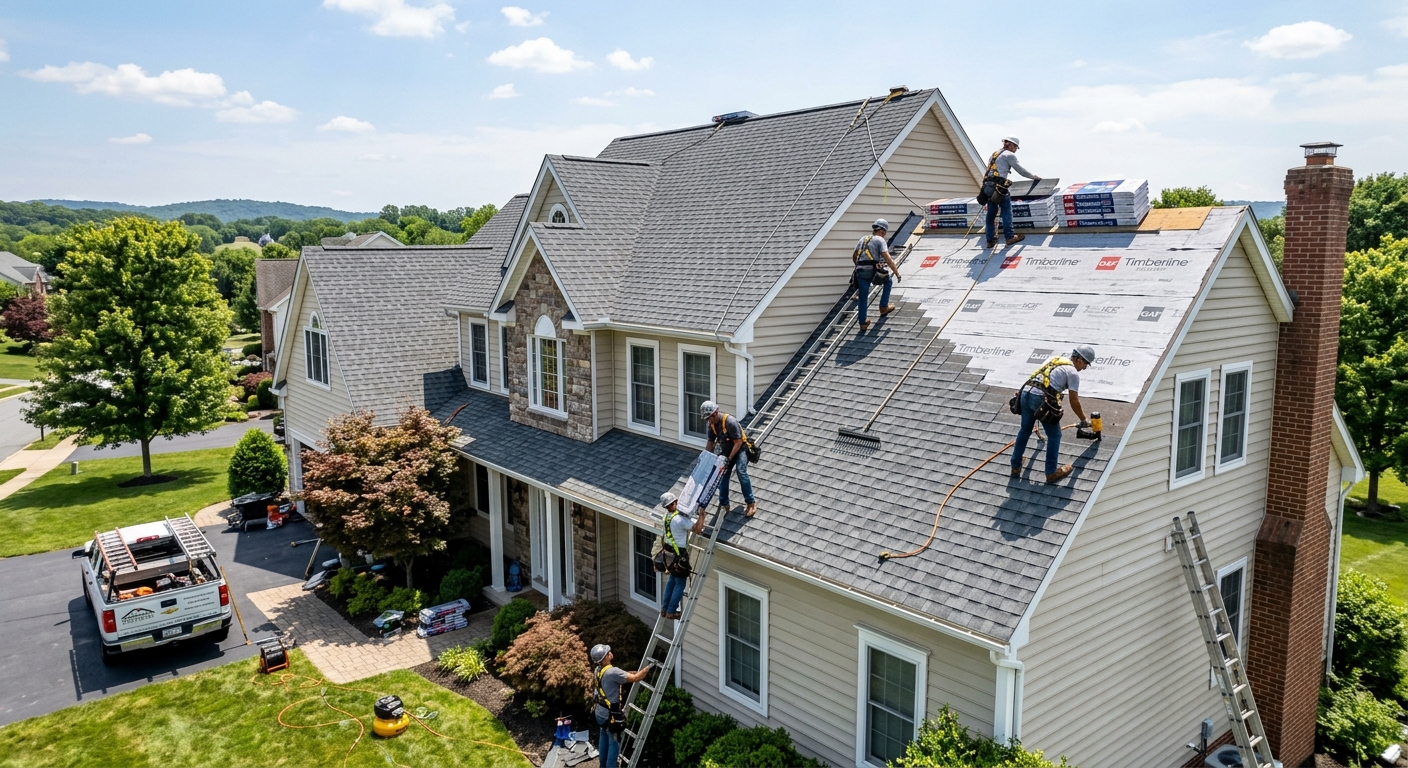
What roof replacement costs in Franconia in 2026
In Franconia, a township where 84.3% of households own their homes and the typical household income sits at $110,065 (U.S. Census Bureau, ACS 2024), most of the roofs are architectural asphalt shingles installed on post-war suburban housing. This local development history shapes the market—nearly half the homes were built before 1980, which means many roofs have already seen one or two replacements. In neighborhoods similar to Abington and Cheltenham, tract housing patterns mean replacements are typically full-roof projects, not just patchwork repairs, since uniform appearance and HOA guidelines often influence scope. In Franconia, this culture drives steady demand for full shingle roof replacements and sets specific expectations about material choices and durability.
If you’re considering your options today, here’s what you can expect to pay for each type of system or service. These numbers reflect Franconia’s actual market—not averages from other states or cities:
| Material / Scope |
Lifespan |
Best for |
Price range (installed) |
| Asphalt shingles — architectural (30-yr) |
25–30 yrs |
Most single-family homes in post-war developments |
$10,500–$22,000 |
| Asphalt shingles — impact-resistant (Class 4) |
30+ yrs |
Homes with risk of hail or falling limbs |
$17,000–$22,000 |
| Metal standing seam |
40–70 yrs |
Long-term investment, low-maintenance needs |
$25,500–$45,500 |
| Flat roof — TPO or EPDM |
15–25 yrs |
Porches, low-slope additions, rowhouse rears |
$13,000–$26,500 |
| Roof repair — leak or isolated section |
— |
Localized leaks, flashing, small areas |
$550–$2,100 |
Prices are estimates for a typical Franconia home and vary with roof size, pitch, decking condition and material selection.
Roofing permits in Franconia: what you need before work starts
For Franconia homeowners, roofing projects fall under the Pennsylvania Uniform Construction Code (UCC), which is enforced locally by each township or borough unless they have opted out, in which case enforcement defaults to the PA Department of Labor & Industry. If your project involves replacing more than 25% of your existing roof surface—common for complete tear-offs—a building permit is typically required before work can begin. Smaller repairs under one roofing square can usually be completed without a building permit, mirroring permit requirements in nearby Lower Merion Township.
Pennsylvania does not issue a dedicated roofing license, but a contractor must have Home Improvement Contractor (HIC) registration from the Pennsylvania Office of Attorney General for any residential contract over $500. You can and should verify a roofer’s HIC standing at hic.attorneygeneral.gov. Workers’ compensation coverage is mandatory for all Pennsylvania employers. You can check a contractor’s insurance status directly through WCAIS (wcais.pa.gov), ensuring every worker on your property is covered. These verification steps protect you—the homeowner—from liability if an injury occurs during your project.
For any home built before 1978, work that disturbs painted surfaces must comply with the federal EPA Lead RRP Rule. You can confirm whether your contractor is EPA-certified at certifiedrenovatorsearch.epa.gov. Make these checks before signing any contract and insist on seeing the actual permit if your project scope requires one.
Repair or replace? A decision guide for Franconia roofs
Deciding whether to repair or replace a roof in Franconia is not just about the visible problem—it's about the age of your roof, your history of repairs, and the typical service life for materials on houses built during the postwar boom. Roofs from before 1980 (common in this area) may be near the end of their expected lifespan, especially if past repairs have simply covered leaks without addressing underlying wear. For example, spending $1,500 every two years to chase down leaks, over eight years, adds up to $6,000—more than half the cost of a new architectural shingle system, while leaving you with no warranty on the patchwork. After 25 years, replacing is prudent.
Isolated, recent leaks—especially on roofs under 15 years old—are often worth repairing. Multiple leaks on a 20-year-old Franconia roof, especially if you see granule loss, missing shingles, or sagging, point you toward replacement. Storm or wind damage on a younger roof is typically replaced through insurance, not just patched up. If you have a flat or low-slope section with ponding and blisters, replacement with a proper membrane is the only long-term answer, not more patchwork.
| Situation |
Recommendation |
Typical cost |
Reasoning |
| Under 15 years, one isolated leak |
Repair |
$550–$2,100 |
Likely storm, flashing, or nail pop—not general failure |
| 15–25 years, several leak points |
Replace |
$10,500–$22,000 |
System approaching end of life; piecemeal repair uneconomical |
| 25+ years, any active leak |
Replace now |
$10,500–$22,000 |
Decking and underlayment deterioration; risk increases each year |
| Storm damage, wind or hail |
Document, claim, replace |
$10,500–$22,000 |
Insurance claim likely covers more than a repair would |
| Flat roof ponding or blistering |
Replace membrane |
$13,000–$26,500 |
Surface beyond local patching; risk of interior damage grows |
| Active leak entering winter |
Emergency repair, schedule replacement |
$550–$2,100 |
Prevent interior water damage until full job is possible |
Roofing season and lead times in Montgomery County
In Montgomery County, the roofing season is defined by our temperate climate and humid summers. Prime replacement time runs from late March to late November—cold snaps usually hold off until December, and proper shingle sealing depends on daytime temperatures staying above 40°F. Summer is peak season, but September and October are when many homeowners schedule replacement to avoid winter leaks. In Franconia, demand tracks school calendars: families often rush for last-minute summer work, while late fall is filled by real estate closings and pre-winter emergencies.
Since the Philadelphia metro market is saturated, especially in inner suburbs, you'll find that reputable contractors often book out 3–6 weeks in advance from April through October. Emergency repairs in February or March—when shingles won’t seal and crews work in freezing rain—can land you a $550–$2,100 bill for a temporary patch, with permanent fixes waiting until proper weather returns. Proactive scheduling in late summer to early fall not only locks in better availability but also lets crews work around Franconia’s frequent late-season thunderstorms.
If you can plan, aim for a window when daytime temperatures are mild and the best crews are not yet fully booked. Waiting for true busy season may mean settling for whoever can squeeze you in fast.
Workmanship vs manufacturer warranty
When you hire a roofer in Franconia, you’re likely to be offered two types of warranty—but they’re not the same. The manufacturer’s warranty covers the roofing material itself. For architectural shingles, that’s most often a 30-year prorated warranty against material defects, not installation error. That coverage is only honored if the roof is installed to strict guidelines: proper attic ventilation, no layering over old shingles, and, for many brands, registration soon after installation. If you flip your house, these warranties may or may not transfer to the new owner—read the fine print and have the contractor submit the transfer paperwork promptly.
The workmanship warranty is from the company you hire. It covers installation faults for anywhere from 2 to 25 years, but the value is only as strong as the business itself. A company offering a 25-year workmanship warranty that’s been around for two years can’t make any promises you’ll be able to collect. In Franconia, most reputable local roofers offer 10 years. Keep your contract and require written proof—a handshake or verbal promise won’t help if the company is gone.
Warranties are voided for lack of attic ventilation, failure to register the product, or if you re-roof over the old system. Get every item in writing, know the deadlines, and don’t assume the manufacturer's warranty covers improper installation.
Low-slope and flat roofs in Franconia
In Franconia, it’s common to see a main steep-pitch roof paired with a flat or low-slope membrane section on a porch, addition, or rowhouse rear. These sections cannot be shingled like the rest of the roof—if a contractor suggests asphalt shingles for a 2/12 pitch, that’s a clear indicator standards are being stretched and you should look elsewhere. Shingles on low slopes fail fast: wind-driven rain gets under tabs, and ice damming is more severe in our 30-inch frost depth climate than most realize.
Flat roof sections require TPO or EPDM membranes, both rated for 15–25 years when installed by experienced crews. Membrane systems cost more than basic shingles—$13,000–$26,500 for a typical Franconia low-slope area—but deliver proper drainage, resist ponding and blistering, and meet manufacturer warranty conditions. Neglecting your flat roof can lead to water infiltration not just above the membrane, but inside wall cavities and living spaces below.
Drainage details matter: scuppers, tapered insulation, and correct flashing. Avoid patchwork fixes—if age or ponding is evident, replacement of the full membrane is the right move in this market.
Filing a roof claim after a Pennsylvania storm
If your Franconia home is hit by storm damage—common in our Schuylkill River valley corridor—you need to document before clean-up: take photos of shingles in the yard, water stains, and the full roof from multiple angles. Next, request a written scope of loss from your insurer, and understand the difference between actual cash value (depreciated) and replacement cost coverage. Pennsylvania insurers typically send an adjuster to inspect and confirm storm-related loss.
It’s illegal in Pennsylvania for a contractor to offer to waive your deductible as part of a repair or replacement—the Home Improvement Consumer Protection Act (HICPA) prohibits this, and any company making that offer is putting you at insurance risk. Instead, expect to pay your deductible out of pocket, and do not be tempted by fast-talking storm chasers from out of state.
Always get a written contract (required for any job over $500 in Pennsylvania), and remember you have a three business-day right of cancellation once you sign. Some insurers start with a partial payment (the actual cash value), releasing the remainder when you show proof the roof is complete. Hire a contractor who is HIC-registered and has current workers' comp—verified as described above. Don’t skip these checks: a claim handled right protects your investment and future insurability.
Frequently asked questions — roofing in Franconia
What does roof replacement cost per square in Franconia?
In Franconia, the most common roof system is architectural asphalt shingles. The total job price ranges from $10,500–$22,000 for a typical single-family home. Roof pricing is usually quoted “per square,” where a square equals 100 square feet of roof area. On average, a square of architectural shingles installed in this township falls between $475–$750, materials and labor included. This is on the higher end compared to remote Pennsylvania counties, reflecting not just material costs but also the higher labor rates and demand in Montgomery County. Tear-off, replacement of rotten decking, and complex roofs (steep pitch or cut-up layouts) increase the all-in per-square rate. Any quote below that is likely skipping key code requirements or using unregistered subcontractors.
How much snow load can a Franconia roof handle?
Franconia roofs are built to withstand a ground snow load of 30 pounds per square foot, just as required by code in southeastern Pennsylvania. This is sufficient for typical winter events in Montgomery County, which rarely see sustained deep snow but do experience heavy, wet storms and freeze-thaw cycles. Most asphalt shingle systems on original post-war tract homes, as common in this area, are designed for 25–30 years’ service within those limits. If you’re seeing sagging or interior cracks, it’s time for a full replacement—expect costs around $10,500–$22,000 if addressing both load and age.
What happens if it rains mid-replacement?
In Franconia, roofers watch the forecast closely—summer thunderstorms can pop up fast around the Schuylkill River valley. If rain moves in during your replacement, experienced crews will cover exposed sections using heavy tarps or synthetic underlayment to prevent water intrusion. Emergency tarping or temporary repairs usually add $550–$2,100 to your project bill. Reputable companies anticipate these risks and schedule tear-off for dry spells whenever possible. Any water infiltration during installation can void your workmanship warranty and produce longer-term deck damage, so don’t hesitate to ask your contractor how they’ll handle a sudden downpour.
Why is my Franconia roofing quote higher than the online average?
You may find online averages seem low compared to your Franconia roofing estimates. Here in Montgomery County, labor costs are higher and code compliance is strictly enforced—especially around complete tear-off and reinstallation, which most online sources understate. Post-war homes in Franconia often require upgrades to attic ventilation or replacement of older sheathing, which can add to cost. Our local range for architectural asphalt shingle replacement runs $10,500–$22,000. Internet prices often miss the real cost of labor, insurance, and required Home Improvement Contractor (HIC) registration you must have here. Cheaper quotes usually reflect cut corners or unregistered operators—both a liability and a gamble with your home.
What if my insurer denies my roof claim?
If your carrier denies your Franconia roof claim, it’s usually because the insurer determined your damage was from wear, not a specific storm—common for roofs nearing the expected 25- to 30-year lifespan. If you still need to address leaks or visible damage, a targeted repair runs $550–$2,100 here. Before authorizing any repair, ask your roofer for photographs, a written explanation of condition, and a detailed receipt—documentation that may help if you appeal or if a future storm adds more evident damage. If your claim was denied in error, you can formally contest it, but you’re still on the hook for repairs in the meantime.
Can I install new shingles over old ones in Pennsylvania?
In Pennsylvania, the building code allows a single layer of new shingles over an old one on pitched roofs if no significant deck defects are present and local code enforcement permits it. In Franconia’s aging post-war housing stock, this isn’t always wise—re-roofing over old shingles can void manufacturer warranties, shorten lifespan, hide rot, and trip up future repairs. For the typical Franconia home, a full tear-off and replacement (costing $10,500–$22,000) is the right choice unless your existing deck is pristine. Confirm with your local township if re-roofing is allowed for your situation—it varies by municipality.
What are the signs of hail damage on a roof?
After a hailstorm in Franconia, look for bruised or missing shingles, shattered granules exposing black mat, and shiny spots where impact broke the surface. These are most visible on architectural asphalt roofs, the dominant system here. Hidden leaks may take months to appear, so check attics for daylight spots or moisture after storms. A professional assessment and photo documentation are necessary to file a claim—most storm-damage replacements run in the $10,500–$22,000 band, with insurance often covering the job if the loss is verified. Don’t ignore potential hail hits; they reduce lifespan and are easiest to fix soon after the event.
Are storm-chasing roofers a problem in Franconia?
Yes, especially after big southeast Pennsylvania storms, out-of-town “storm chasers” show up offering quick, cheap roof jobs in Franconia. These companies often skip HIC registration or workers' comp, which is required by state law. Shortcuts in installation or warranty leave many homeowners footing the bill for future problems. Local, HIC-registered contractors will quote within the established price range—$10,500–$22,000 for most full replacements—and provide written contracts. Always verify a roofer’s registration at hic.attorneygeneral.gov before hiring. If the offer seems too good to be true, it’s likely to cost you more in the long run.
What underlayment should be used on a Franconia roof?
For Franconia homes, code and climate demand high-quality underlayment. Synthetic underlayment is now standard under architectural shingles—it resists ripping and lasts longer than old asphalt felt, especially during humid summers and freeze-thaw cycles. Ice and water shield should always be installed at eaves (minimum 24 inches inside the warm wall) and valleys, since southeastern Pennsylvania experiences periodic heavy rain, sleet, and melting ice. These details protect your investment—roofs installed without them risk leaks and voided warranties. On a typical replacement in this market—$10,500–$22,000—the quality of the “hidden” layers matters as much as the visible shingles.