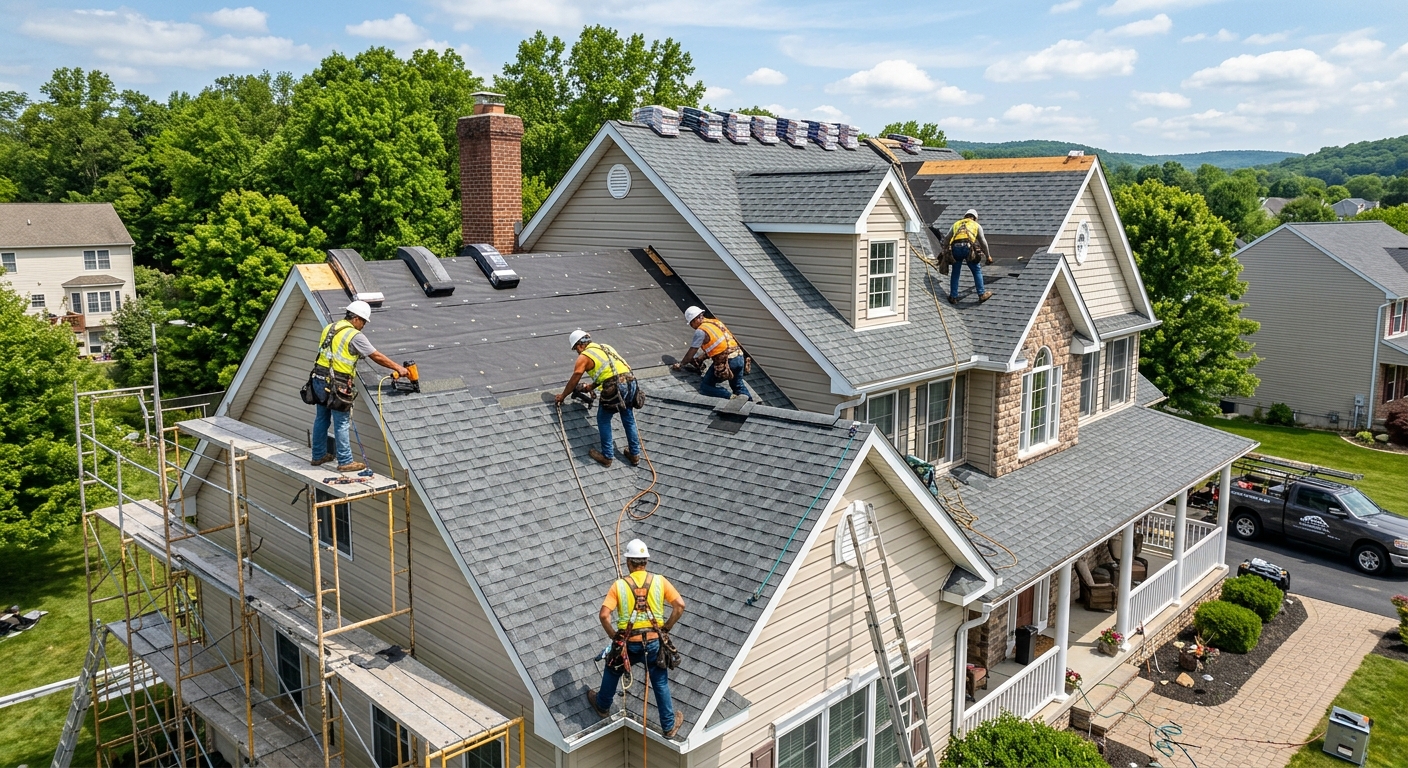
Roofing Replacement & Repair costs in Lower Macungie — 2026
Lower Macungie’s roofing market stands out due to its large number of long-term owner-occupied homes and a high median household income, both driving expectations for quality and durability. With 84.7% of homes owner-occupied and a median income of $116,750 (U.S. Census Bureau, ACS 2024), most roofing projects here are approached as long-term investments rather than cap-ex for resale. Many subdivisions were built just after World War II, and large tracts in neighboring South Whitehall and Upper Macungie now influence roofing demand in Lower Macungie. In practice, this means most replacement jobs (especially asphalt shingles) follow consistent scopes—full tear-off, repair of decking as needed, and installation of architectural or upgraded shingles. If your home is part of one of these postwar tracts, the odds are high that your roof layout is familiar to the local crews, making installation predictable and reducing labor-intensity compared to older or custom homes. At the same time, the high homeownership rate here means buyers expect follow-through: most projects go beyond the bare minimum, including critical details like ice/water barriers and new flashing, especially given regional snow load concerns. The table below outlines installed pricing for common roofing materials and scopes in Lower Macungie for 2026.
| Material / Scope |
Lifespan |
Best for |
Price range (installed) |
| Asphalt shingles — architectural (30-yr) |
25–30 yrs |
Most Lower Macungie homes in postwar developments |
$10,500–$22,500 |
| Asphalt shingles — impact-resistant (Class 4) |
30+ yrs |
Homes near ridgelines, exposed to wind/hail |
$17,500–$22,500 |
| Metal standing seam |
40–70 yrs |
Up-market replacements; long-term owners wanting low maintenance |
$25,500–$46,000 |
| Flat roof — TPO or EPDM |
15–25 yrs |
Additions, porches, occasional townhome |
$13,500–$27,000 |
| Roof repair — leak or isolated section |
n/a |
Minor storm damage, early intervention repairs |
$550–$2,100 |
Prices are estimates for a typical Lower Macungie home and vary with roof size, pitch, decking condition and material selection.
Gutters, drainage and roof longevity in Lower Macungie
An effective roof in Lower Macungie isn’t just about shingles—gutters, downspouts, drip edge, and property grading all work together as the home’s water management system. Shingle replacement without attention to gutters is only a partial fix. In this area, clogged or undersized gutters can push rainwater down exterior walls or pool it next to your foundation, especially on lots where grading is flat or pushes water toward finished basements. This can sour a roof job quickly: a beautiful new roof is worthless if runoff is allowed to backwash beneath the edge or erode soil at the drip line. More than one basement water issue in Lower Macungie began life as a neglected gutter-elbow or missing downspout extension. Some manufacturer warranties on both shingles and underlayment in the Lehigh Valley require “adequate positive drainage”—meaning the roof must be paired with functioning, correctly-sized gutters and downspouts. For a typical re-roof, seamless aluminum gutter replacement (including downspouts and basic guards) typically ranges from $2,200–$4,200 alongside a full roof project. Adding leaf guards or larger downspouts for areas beneath overhanging trees may push the total higher. If your roofline collects dead leaves or suffers from repeated ice damming, ask your contractor to walk you through options for upgraded guards or heat cables—it’s almost always more cost-effective to do these with a roof replacement, not after.
Pennsylvania code and Lehigh County permit rules for roofing
Roofing in Lower Macungie is governed by the Pennsylvania Uniform Construction Code, as set by the Pennsylvania Department of Labor & Industry and enforced locally by the township or, in some cases, by L&I if a municipality opts out. In Allentown—the county seat and nearby metro center—a building permit is required for structural roof replacement or for installing new roofing over existing layers. Small repairs, such as replacing a handful of shingles to fix a leak, generally do not demand a permit. Each township in Lehigh County, including Lower Macungie, runs its own code office, so requirements can differ slightly, but the main benchmarks remain consistent: full tear-offs or adding a new layer over the old one will virtually always trigger the need for a permit. For homeowners, due diligence starts with verifying that your roofing contractor holds a valid Home Improvement Contractor (HIC) registration, issued by the Pennsylvania Office of Attorney General—check their registration at hic.attorneygeneral.gov before you sign a contract over $500. You should also confirm current workers’ compensation coverage for any contractor with employees; this can be checked through the WCAIS system at wcais.pa.gov. Pennsylvania law protects you via the Home Improvement Consumer Protection Act: for any contract above $500, a written contract is required, including a three-day right of cancellation—no exceptions. Also, anyone offering to waive your insurance deductible is breaking state rules. There is no additional trade-specific roofing license for Pennsylvania. Lead-safe practices become mandatory for homes built before 1978—verify any contractor’s EPA Lead certification at certifiedrenovatorsearch.epa.gov.
Timing a roof replacement in Lower Macungie
The typical roofing calendar in Lower Macungie follows northeastern Pennsylvania’s climate, with the added complexity of a busy Lehigh Valley metro market. Proper shingle sealing relies on both temperature and daylight—April through October is prime time, with May through early September offering the consistently warm days that architectural shingles need for heat-activated sealing. Scheduling in mid- to late-fall is still possible, but as temperatures drop below 40°F, especially overnight, shingle adhesive may not activate fully. In winter, snow loads and frequent freeze-thaw cycles make it risky for both installation quality and worker safety; it’s also when backlog spikes due to storm and ice damage calls.
With Lehigh County’s density of roofing contractors, most reputable crews are booked solid from late spring through early autumn—anywhere from 2 to 8 weeks out, with wait times peaking after summer hail or wind events along the South Mountain corridor. If an emergency roof replacement is needed in February, expect additional costs for labor, weatherproofing, and materials staging. In contrast, a planned replacement in September lets you lock in the crew, pick dates, and often catch year-end manufacturer promotions. Beat the rush by contacting contractors in late winter, before the market’s annual backlog piles up. You’re less likely to get stuck with leftover materials or rushed work. Ultimately, the combination of local climate and market saturation shapes your window for the best price and install quality.
Snow load, ice dams and wind in Lower Macungie
Lower Macungie sits in Lehigh County, directly exposed to wind funnels along South Mountain and the Trexler Hills—patterns that punish ridge-line roofs and lift shingles in ways that neighbors one county west rarely see. The regional ground snow load of 40 psf and a winter design temperature down to 4°F mean heavy, dense snow will accumulate and linger. Here’s where the local damage diverges: thick snow settles on roof pitches, then radiant heat from a moderately insulated attic melts the bottom snow layer. This meltwater backs up at the unheated eave, re-freezes, and forms an ice dam. Water pools behind the ice ridge, finds nail holes, and then seeps into attic insulation and ceilings. Insurance adjusters here are used to seeing leaks a full month after the last snow, with repairs for water-damaged decking often coming in at $550–$2,100 (roof repair band).
Contractors familiar with Lower Macungie routinely add “ice and water shield” at eaves and in valleys—an underlayment that self-seals around fasteners to prevent these leaks. Unlike single-layer felt, it’s the best shot at keeping old tracts with modest attic insulation dry through March. Hail doesn’t usually punch holes here, but the wind channeling along the ridges will bruise, crease or tear-off tabs—leaving roofs that look undamaged but fail faster. If you’re priced at the low end for a re-roof, make sure upgraded underlayment is included; skipping it can cost you a lot more in mid-winter repairs. Older homes in Lower Macungie with decking from the 1950s are especially prone to rot after just one or two seasons of ice-damming, driving up repair bills and shaving years off what would otherwise be a 25-year roof.
Why two Lower Macungie roofing quotes can differ by 40%
In Lower Macungie, pricing gaps between roofing quotes aren’t random—they reflect the specifics of the home and the quirks of the Lehigh Valley market. With so many tract-built homes from the postwar era, a big variable is whether your house’s last roof was done “to code” or just to pass inspection. For example, if your home has two prior shingle layers, Pennsylvania’s Uniform Construction Code demands a complete tear-off, which drives labor and disposal costs up by $500–$1,500 per additional layer. Many repair jobs only reveal existing rot in the decking after the tear-off, and sheets that need replacing typically add $75–$150 each to the bill.
Snow load is another regional cost-driver; with 40 psf as the design limit, code-compliant underlayment and ice/water shields are standard, not optional. Upgrading to a full-coverage ice barrier in problem areas (such as eaves or low-slope valleys under South Mountain’s wind band) might add $300–$800 but can save thousands in mid-winter water damage. The type and grade of shingle—3-tab, architectural, or impact-resistant (for homes exposed to wind-driven debris)—also means a difference of up to $2,500 on a full job. Contractor overhead isn’t just about labor; Lower Macungie’s high permit compliance rates and regulatory scrutiny mean your neighbor’s “cheap” quote may lack the right workers’ comp or insurance.
| Factor |
Why it matters here |
Cost impact |
| Roof size in squares |
Each square is 100 sq ft of roof surface |
Primary multiplier |
| Pitch and access |
Steep pitches need harnesses and slow the crew |
+20–30% labor |
| Existing layers to tear off |
Two or more layers means full tear-off and disposal |
$500–$1,500 per layer |
| Decking condition |
Rot is found during tear-off, not before |
$75–$150 per sheet |
| Ice barrier at eaves |
Required where ice damming has a history |
$300–$800 |
| Material grade |
3-tab vs architectural vs Class 4 impact-resistant |
$500–$2,500 |
Choosing a roofer in Lehigh County
For Lower Macungie homeowners, the difference between a well-executed roof and a legal headache is usually found in the paperwork and the crew, not just the bid price. Always start your vetting with Pennsylvania’s Home Improvement Contractor (HIC) registration—look up your candidate at hic.attorneygeneral.gov to see their status and any disciplinary actions. Next, check that their workers’ compensation coverage is current through the state’s WCAIS system (wcais.pa.gov). For homes built before 1978, especially in older sections of the township, confirm that the roofer is EPA Lead RRP certified. These steps cut through empty claims of “licensed and insured” that circulate in the dense Allentown–Bethlehem market. Read the full written contract (required under state law for jobs over $500); it should specify scope, timeline, materials, and payment schedule. Get every change in writing. And if the price seems too good to be true, it often omits critical items like ice barriers or gutter integration—details that come back to haunt you on the first snow melt.
- Verify HIC registration at hic.attorneygeneral.gov
- Confirm active workers’ compensation on wcais.pa.gov
- Ask for EPA Lead RRP proof for pre-1978 homes
- Require a written contract for jobs over $500
- Check local permit paperwork before start of work
- Request references from recent Lehigh County jobs
- Insist on proof of general liability insurance
- Clarify scope: full tear-off, decking repair, underlayment
- Ask who provides dumpster and material staging
- Demand documentation of all change orders
- Walk the property with foreman for high-risk areas (decks, landscaping)
- Make sure all warranty material is delivered with final invoice
Five red flags in Lehigh County’s busy roofing scene: door-knocker “storm damage” offers after wind events, pressure to sign without local references, generic contracts with no address, requiring large cash deposits up front, and refusal to document workers’ comp insurance. Always pause if you’re rushed to a check on day one—there’s no shortage of established installers locally.
Frequently asked questions — roofing in Lower Macungie
How can I tell if my roof decking is rotted?
Roof decking rot usually reveals itself during the tear-off phase, but there are some early warning signs you can spot. In Lower Macungie, look for spongy soft spots when you walk the roof (if safe), sagging between rafters, long-term roof leaks inside, or visible staining in the attic. Roofers here often find previously hidden rot in 1950s- and 1960s-era homes, especially at the eaves where ice dams are common. A full tear-off is the only way to assess every sheet, so don’t trust a quote that guarantees no decking replacement before inspection. If rot is found, expect to pay $75–$150 per 4x8’ sheet to replace affected decking, on top of your main roof costs. Experienced contractors will include an allowance in your contract and only bill what’s actually replaced. If your quote skips this entirely, get a second opinion.
Will filing a roof claim raise my premium?
Filing a roof claim in Pennsylvania, including Lower Macungie, can affect your insurance premium—especially if the claim is for wind or hail damage, which are tracked regionally by insurers. While your own claim history matters, a spike in claims from a big storm in the Lehigh Valley metro can trigger premium hikes for entire ZIP codes, not just those who claimed. Remember, insurance is for major, sudden damage—not slow leaks from old age. For repairs in the $550–$2,100 range, ask yourself if the premium bump is worth it before you file. Multiple claims in a short window can mark your home as “high risk.” Some homeowners see no immediate increase, but rates are adjusted annually based on cumulative claims, so local storm events matter.
Are storm-chasing roofers a problem in Lower Macungie?
Yes, storm-chasers follow damage along the South Mountain and Trexler Hills corridor and target Lower Macungie after wind or hail events. Door-knockers often show up within 48 hours offering “free roof inspections” or promising to cover your deductible—which is illegal in Pennsylvania. These crews may not carry proper HIC registration or active workers’ compensation, putting you at risk. They sometimes do the bare minimum to collect insurance proceeds, then disappear before warranty work. A legitimate roofing contractor in the Lower Macungie–Allentown–Bethlehem market will have recent, local references and a fixed office nearby. Verify at hic.attorneygeneral.gov and never pay more than a modest deposit up front. Stick with crews whose insurance, registration, and paperwork are all in order—even if the price is slightly higher. Roof repairs from storm events typically cost $550–$2,100; don’t compound your problem by picking a contractor who vanishes after payment.
Why do roofs fail faster in northeastern Pennsylvania?
Roofs in Lower Macungie face unique challenges compared to other regions, mainly due to the area’s 40 psf snow load and severe ice-dam exposure. The cycle of dense snow accumulation, melting, and refreezing at the eaves means even a well-installed architectural shingle roof can develop leaks and rot at the decking joints beneath the surface. Add in frequent wind surges along local ridgelines, and shingle lifespans can shrink compared to the manufacturer’s rating. If your asphalt roof is aging and repairs are starting to add up (often $550–$2,100 per incident), don’t delay the replacement—patchwork only goes so far here. Upgrading to thicker ice/water shield and ensuring attic ventilation can make a 5–10 year difference in performance. Local crews know these patterns, so always ask what climate-specific details they’re including in their scope of work.
Does roof pitch affect the price in Lower Macungie?
Absolutely—pitch directly impacts labor and materials costs in Lower Macungie. Steeper roofs are common in some postwar developments, and any roof that requires harnesses, scaffolding, or added fall protection slows the crew, increasing labor by 20–30%. Some specialties, like metal roofing, are even more sensitive to pitch. Crews may also need additional underlayment on steep valleys, especially with the regional ice-dam risk. If you’re comparing quotes, check labor line items—identical houses may have different pitches that swing the total price from $10,500 up toward $22,500. Don’t be surprised if your neighbor’s “simple” job came in much lower; site specifics here drive price.
How much does a new roof cost in Lower Macungie?
For asphalt architectural shingle replacement, the typical range in Lower Macungie is $10,500–$22,500, depending on roof size, pitch, number of layers to tear off, and extras like new decking or upgraded ice barrier. Metal standing seam starts much higher at $25,500–$46,000, but that’s a 40–70 year roof, best for owners planning to stay long-term. Flat TPO and EPDM membranes, usually on additions or low-slope sections, come in at $13,500–$27,000. Most homes built after World War II fall in the “predictable” scope, but older homes or those along storm corridors can run higher. Always insist on a written, line-item bid that spells out what’s included.
Are impact-resistant shingles worth it in Lower Macungie?
Impact-resistant (Class 4) shingles are a smart investment for parts of Lower Macungie exposed to wind and occasional hail—particularly along the ridgelines and open exposures near Trexler Hills. While the upfront installed price runs from $17,500–$22,500, you get extended lifespan and better protection from wind-driven debris. Standard architectural shingles might last 25–30 years under ideal conditions, but Lower Macungie homes face fast-moving storms and debris that can shorten that window. Some insurers may offer small premium reductions for Class 4 upgrades, but check with your carrier first. If tree limbs or flying debris have been problems in past storms, the peace of mind is often worth the upgrade.
Will the crew damage my landscaping or driveway?
There’s always risk, but experienced crews in Lower Macungie know to use plywood protection for flower beds, shield fragile shrubs, and manage debris using chute systems into dumpsters staged on driveways. Most contracts exclude deliberate damage, but good roofers will walk the property with you first and mark off “no-go” areas. If you have a stamped concrete or paver driveway, insist it be noted on the contract for extra care—composite dumpster mats are a good ask. For most typical roof replacements ($10,500–$22,500), the end result involves a few brown grass patches or minor ruts, not permanent harm. If your home sits tight to property lines, ask about off-hour or street parking plans. Never trust a crew unwilling to plan around your landscaping.
How do I verify a roofing contractor is registered in Pennsylvania?
In Pennsylvania, including Lower Macungie, all roofing contractors taking jobs over $500 must carry a Home Improvement Contractor (HIC) registration, issued by the Office of Attorney General. Before signing any contract, check your roofer’s HIC number at hic.attorneygeneral.gov—a simple search provides their status, company names, and any disciplinary records. Make sure the name on your contract matches what’s in the registry. For any crew with employees, confirm current workers’ compensation at wcais.pa.gov. Unregistered or un-insured contractors may be well below market price (sometimes $550–$2,100 for repair work), but any injury or property damage could come right back to you. Always insist on paperwork before any deposit changes hands.