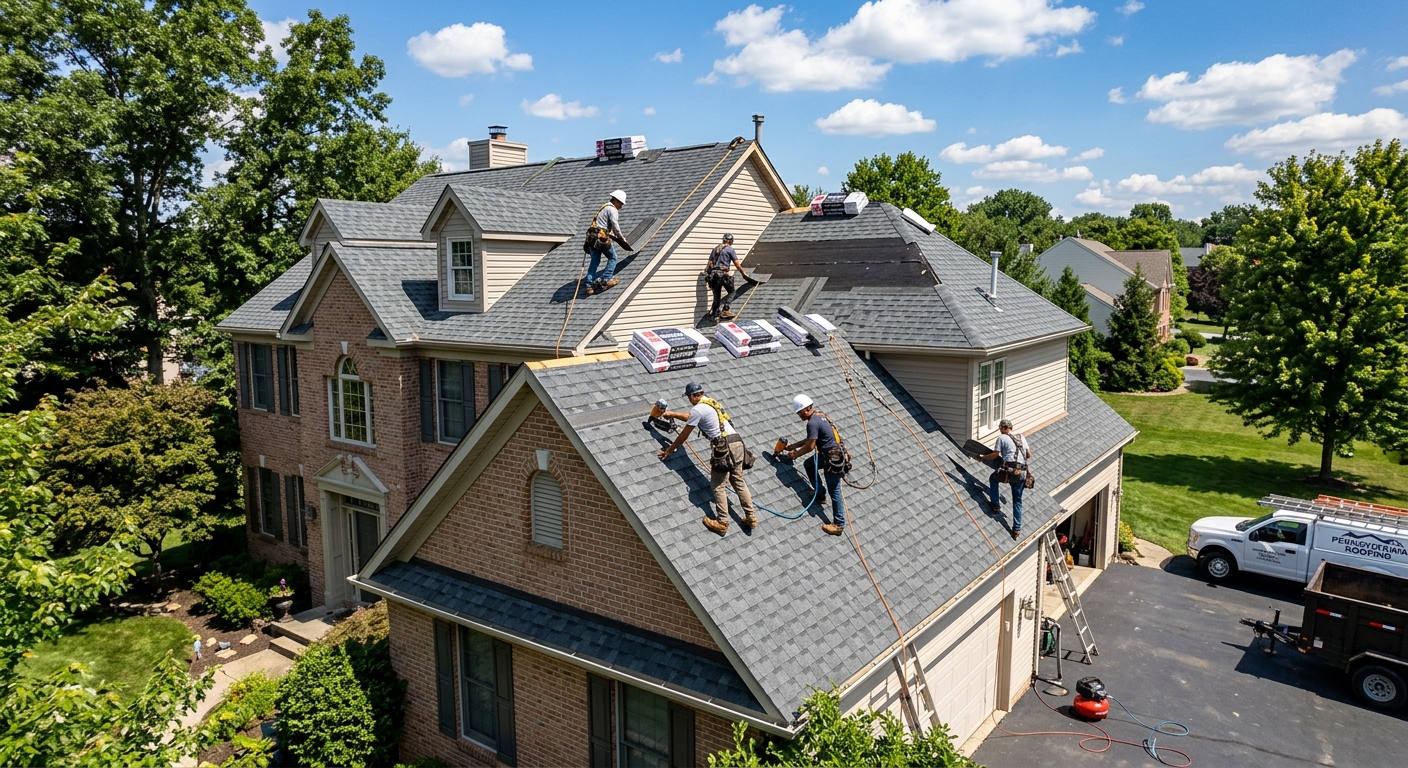
What roof replacement costs in Williams in 2026
Williams has a sizable population of homeowners, and with a homeownership rate of 77.6% (U.S. Census Bureau, ACS 2024), replacing or repairing a roof is a common project in the township. Many single-family homes here were built in the decades after World War II, which means a significant number of roofs are reaching the end of their lifespan and need replacement. That puts roof work front and center for area households, especially given today’s median household income of $99,135. Most roofs I see in Williams trace back to the same era as Palmer Township’s rapid expansion, so expect asphalt shingles to be the default—both for their cost and for how well they fit the rooflines here.
Because these homes were built in tract subdivisions and saw their first or second re-roofing at roughly the same intervals, whole-neighborhood projects are routine and bids come in competitive. Larger roofs and steep pitches add to the bill, but the relatively uniform construction makes pricing more predictable. If you’re budgeting for a replacement in Williams, here’s what to expect:
| Material / Scope |
Lifespan |
Best for |
Price range (installed) |
| Asphalt shingles — architectural (30-yr) |
25–30 yrs |
Mid-century pitched roofs |
$10,000–$21,500 |
| Asphalt shingles — impact-resistant (Class 4) |
30+ yrs |
Storm-prone sites, long-term ownership |
$16,500–$21,500 |
| Metal standing seam |
40–70 yrs |
Snow shedding, minimal maintenance |
$24,500–$43,500 |
| Flat roof — TPO or EPDM |
15–25 yrs |
Low-slope or addition roofs |
$13,000–$25,500 |
| Roof repair — leak or isolated section |
n/a |
Local damage, newer roofs |
$550–$2,000 |
Prices are estimates for a typical Williams home and vary with roof size, pitch, decking condition and material selection.
Choosing a roofing material for Williams's climate
In Williams, the region’s 40 pounds per square foot ground snow load and winter design temperature of 4°F create real demands on roof materials. Metal roofing stands out for its unmatched ability to shed snow, but the upfront cost is well above the norm for Northampton County, with installed prices from $24,500–$43,500. That’s why architectural asphalt shingles, with typical installed costs of $10,000–$21,500, are so prevalent here—they fit the budget and the pitched roofs that dominate Bethlehem and Easton housing.
Flat membrane roofs (TPO/EPDM) really only make sense for additions or low-slope sections. While they handle ponding water and winter freeze well in the short run, they simply don’t match the shingle roof’s lifespan in our climate. Impact-resistant shingles cost more ($16,500–$21,500) but are warranted for hail and high winds; still, most homes in Williams don’t see enough severe hail to justify the extra cost unless you’re on a wind-exposed ridge.
Architectural asphalt shingles dominate because they provide solid snow resistance and the best price-performance match for our mid-century houses. Metal makes sense on upper-slope ridgeline homes with repeated ice dam or snow slide problems, but for most Williams homes, asphalt is the winner.
| Material |
Installed cost |
Lifespan |
Cold-climate performance |
Maintenance |
| Asphalt architectural |
$10,000–$21,500 |
25–30 yrs |
Good, with proper attic ventilation |
Low — inspect after each winter |
| Asphalt Class 4 impact-resistant |
$16,500–$21,500 |
30+ yrs |
Better in wind, holds up in hail |
Low — annual check for storm scars |
| Metal standing seam |
$24,500–$43,500 |
40–70 yrs |
Excellent snow/ice slide-off |
Minimal — check fasteners, keep valleys clear |
| TPO / EPDM membrane |
$13,000–$25,500 |
15–25 yrs |
Fair — needs perfect install, careful monitoring |
Medium — monitor seams, clear drains |
When a Williams roof is worth repairing — and when it isn't
If your roof was installed after 2010 and you discover one isolated leak or missing shingle, a repair for $550–$2,000 can extend the life of your system with no downside. However, homes in Williams built before 1980 (35.7% of housing stock) often have roofs reaching or passing the 25-year mark. For these, repairing multiple leak points or ongoing issues usually just delays the inevitable and adds up fast. For example: two repairs per winter at $1,300 each quickly surpass half the cost of a full replacement ($10,000–$21,500)—and you’re still living on borrowed time.
Storm damage is different, especially in forked ridge-line areas prone to wind events. In these cases, document everything for insurance and lean toward full replacement when decking or structure is compromised. Flat roofs with ponding or blistering almost always indicate a failing membrane. Here are some common scenarios in Williams:
| Situation |
Recommendation |
Typical cost |
Reasoning |
| Under 15 years, one isolated leak |
Repair |
$550–$2,000 |
Roof is still young; repair is cost-effective |
| 15–25 years, several leak points |
Replace |
$10,000–$21,500 |
Patching adds up, roof nearing end of service |
| 25+ years, any active leak |
Replace now |
$10,000–$21,500 |
Roof has aged out, more issues will follow |
| Storm damage, wind or hail |
Document, claim, replace |
$10,000–$21,500 |
Insurance may pay; damage often widespread |
| Flat roof ponding or blistering |
Replace membrane |
$13,000–$25,500 |
Typical sign roof has outright failed |
| Active leak entering winter |
Emergency repair, schedule replacement |
$550–$2,000 |
Prevent further water/ice intrusion now |
Workmanship vs manufacturer warranty
When you sign for a roof in Williams, you’re typically getting two warranties—one from the manufacturer and the other from the contractor. Don’t confuse them. The manufacturer warranty covers the shingles or membrane for defects, usually on a prorated schedule; after the first 10–15 years, payout drops steeply. These warranties only protect you if the shingles were installed per instructions, and most get voided if there’s improper attic ventilation, skipped underlayment, or layering over old shingles.
The workmanship warranty covers errors in installation—from poor flashing to missed fasteners. This guarantee only lasts as long as the company does. A “lifetime” or 25-year workmanship warranty offered by a two-year-old firm isn’t a promise I’d bank on. Look for a 10-year warranty from a contractor with a solid, visible presence in Northampton County. Most reputable companies transfer these warranties to new owners—if you register the change, often within 60 days of resale. Missing these deadlines, or adding a satellite dish or new vent later, can void both warranties. Make sure you get all warranty terms in writing and register them with the manufacturer immediately after install.
The scope items Williams homeowners don't budget for
Even the most detailed roofing quote in Williams can miss items that bump the final bill. Rotted roof decking is the single biggest hidden cost; tearing off those mid-century shingles often uncovers plywood softened by ice dam leaks. Expect to pay another $700–$2,500 for modest areas of repair, and much more if rafters or multiple sheets need replacing. Another common surprise is inadequate attic ventilation. Our cold climate means poor ventilation leads to massive ice dams—and if your last roofer skipped this, it may have already voided your shingle warranty, requiring a new ridge vent (typically $450–$1,200).
Don’t forget replacement of flashing at chimneys and walls; this is usually $300–$1,500 depending on material and difficulty. Boots at plumbing vents and bath fans go brittle with age and cause leaks; replacements add $75–$300 each. Metal drip edge (now code-required) is another $300–$900 on most Williams homes. Make sure your quote calls out each of these—or expect add-ons once the tear-off begins. Proper budgeting for these items will prevent unpleasant surprises and push your job toward a long, leak-free run.
Permits and code requirements in Williams
Williams falls under the Pennsylvania Uniform Construction Code (UCC), which is based on the International Residential Code and enforced locally by each municipality or, in some cases, by the PA Department of Labor & Industry. If your home is in the Williams area of Northampton County, you can expect to need a building permit for any full roof replacement that includes new sheathing—especially if you’re within Bethlehem’s oversight. Patch repairs limited to shingle replacement and minor sections generally don’t require a permit in Easton, but always check with your township’s code office before work begins.
Homeowners should only hire contractors who are registered as Home Improvement Contractors (HIC) with the Pennsylvania Office of Attorney General, which is a must for contracts over $500. You can easily verify a roofer’s HIC registration at hic.attorneygeneral.gov. Workers’ compensation insurance is mandatory for all employers handling roofing in Pennsylvania, and you can confirm compliance online with the state’s WCAIS system (wcais.pa.gov) before any work starts.
If your home was built before 1978 and the project will disturb painted surfaces, federal EPA Lead RRP rules apply—verify your contractor’s certification at certifiedrenovatorsearch.epa.gov. No other trade licenses are required or issued for roofers in this jurisdiction beyond HIC registration, giving you one less hoop to jump through as a homeowner.
How northeastern Pennsylvania's weather shapes roofing here
Roofing in Williams, Northampton County means dealing head-on with the realities of a 40 pounds per square foot snow load and regular winter design temperatures down to 4°F. In the Lehigh Valley, storm exposure isn’t theoretical—ridge-line winds barrel across Forks and Lower Saucon, pulling shingles and metal panels loose. When wind-driven rain blows under a lifted shingle, water travels sideways across the deck and, if attic ventilation is poor, condenses inside insulation—leading to rot that pushes replacement from a modest $550–$2,000 repair to a complete $10,000–$21,500 re-roof.
Ice dams are another constant threat. When attic heat escapes due to inadequate ventilation—a problem found in many Palmer Township-era roofs—snow on the upper roof melts, flows down, and freezes at the cold eave. This ice then forces meltwater back under the shingles, causing hidden leaks that rot decking and breed mold below. In Williams, we combat this with special ice-and-water shield underlayment covering the entire eave, not just the first three feet. Skimping here is a false economy—without these measures, you’re back to repair costs or, worse, repeat replacement well before the 25-year mark. Hail isn’t frequent, but high ridge areas sometimes see small hail that bruises the shingle mat without leaving a visible hole, gradually shortening the roof’s life—a problem solved only with a Class 4 shingle or a metal roof (at a premium cost). In short, the weather here doesn’t just wear roofs down; it picks at every weak spot.
Frequently asked questions — roofing in Williams
How long does a roof replacement take in Williams?
For most single-family homes in Williams, a standard architectural asphalt shingle roof replacement typically takes between two and four days from the time the crew arrives to final cleanup. Older homes built before 1980 (which make up roughly 35.7% of local housing) may add a day or two if substantial rotted decking is discovered at tear-off and needs repair. Weather delays — especially from wind or rain along Lehigh Valley ridges — can push the job back, but professional contractors working in Northampton County aim to wrap up quickly to minimize exposure. For metal standing seam roofs, expect the project to stretch to one to two weeks due to extra installation labor and detailed flashing. Completing unforeseen repairs as they arise (at an extra $550–$2,000) is what usually adds time. Communication from your contractor is critical; a clear timeline keeps surprises in check.
What's the cheapest way to replace a roof in Williams?
In Williams, the most cost-effective way to replace a roof is with architectural asphalt shingles rather than going for high-end or specialty products. These shingles not only fit the local housing stock but also fall into the lower end of replacement costs — typically $10,000–$21,500 for a complete job. You can save a bit by scheduling during the off-season, but beware of cutting corners: skipping necessary items like drip edge or ridge vent to lower upfront costs almost always leads to ice dam problems or water intrusion down the line, costing you far more in repairs. Also, don’t be tempted by contractors offering to “waive your deductible” or work without proper HIC registration; that’s prohibited in Pennsylvania and can void your homeowner protections.
How much does a flat roof replacement cost in Williams?
For homes in Williams with low-slope or flat areas—often additions or garages—a full replacement with a TPO or EPDM membrane typically runs $13,000–$25,500 in 2026. The amount depends on total square footage, how many penetrations (vents, skylights, hatches) need to be flashed, and whether new insulation or rotted decking is found at tear-off. Flat roofs are less forgiving in our local climate, since ponding water will blister weak seams and repeated freeze-thaw cycles force repairs. Unlike shingle roofs, membrane systems need more attentive maintenance, but a good install at that price can buy you 15–25 years of peace of mind in Williams.
How long should a roof last in Williams?
For an architectural asphalt shingle installation—the dominant material on Williams homes since the post-World War II building boom—you should expect 25 to 30 years if installed correctly and the attic is well ventilated. Metal standing seam roofs last far longer, often 40–70 years, but come at a much higher installed price ($24,500–$43,500). Flat roof membranes like TPO or EPDM have shorter lifespans, typically 15–25 years. Severe weather events, ice dam formation, and general wear in our specific climate can cut these lifespans short, especially if maintenance is deferred or prior installation was sub-standard.
Does homeowner's insurance cover roof replacement in Williams?
Most policies for Williams-area homes cover roof replacement only if the damage results from a sudden event—like high wind tearing off shingles or hail bruising the mat—rather than gradual wear. Storm damage is not uncommon along the Lehigh Valley escarpments, so always document and photograph any affected areas right after a storm. Your policy will typically pay out for a full replacement in these cases, which runs $10,000–$21,500 or more, but won’t cover a roof simply aging out. Be aware: Pennsylvania prohibits waiving your deductible, and your claim is subject to a professional roof inspection and, sometimes, adjuster approval.
What is the best roofing material for Williams's climate?
For Williams homes, architectural asphalt shingles remain the best all-around match for local climate and housing type—they’re able to manage the region’s heavy snow loads, resist moderate wind, and don’t break the bank at $10,000–$21,500. Metal standing seam is unbeatable for heavy snow and ice slide-off, but its high cost isn’t justified except on ridge-line properties with persistent drift and ice dam problems. For flat or low-slope roofs (often additions), TPO or EPDM membranes are the right fit—otherwise, asphalt dominates for good reasons rooted in Williams’s mid-century construction and budget requirements.
What should a roofing quote include in Williams?
A thorough roofing quote for your Williams home should itemize all tear-off, disposal, and installation labor, specify the shingle or membrane type (including model and warranty details), and list every component—ice and water shield, underlayment, flashing, vent boots, drip edge, and ridge vent if needed. It should explicitly state whether rotten decking is included or billed extra; decking repair commonly adds $700–$2,500 if required. Confirm the quote includes both material and workmanship warranty information, permit fees if applicable, and the total timeline from start to finish. Pennsylvania law requires a written contract for any work over $500 and gives you a three-day right to cancel.
Does attic ventilation matter in Williams's climate?
It matters a great deal. Williams sees winter lows down to 4°F, and the combination of mid-century construction and heavy post-storm snow loads means poor attic ventilation can cause ice dams. These block the eave, force meltwater under shingles, and rot roof decking from below, leading to repeated leak repairs that can push you toward a full replacement at $10,000–$21,500 well before the warranty period is up. Upgrading attic ventilation—ridge and soffit vents—during roof replacement is standard best practice in this region for lasting performance.
How do I confirm a roofer carries workers' compensation?
In Pennsylvania, including Williams, every employer working on your roof must have active workers’ compensation insurance before starting. To verify, ask your roofer for their coverage certificate, then cross-check it yourself on the WCAIS system at wcais.pa.gov. This gives you a live, official record from the state, not just a paper printout or an email. Proper coverage protects you from liability if a worker is injured on your property—a risk never worth taking to save a fraction of a replacement ($10,000–$21,500). Never accept excuses if the contractor hesitates to provide proof.