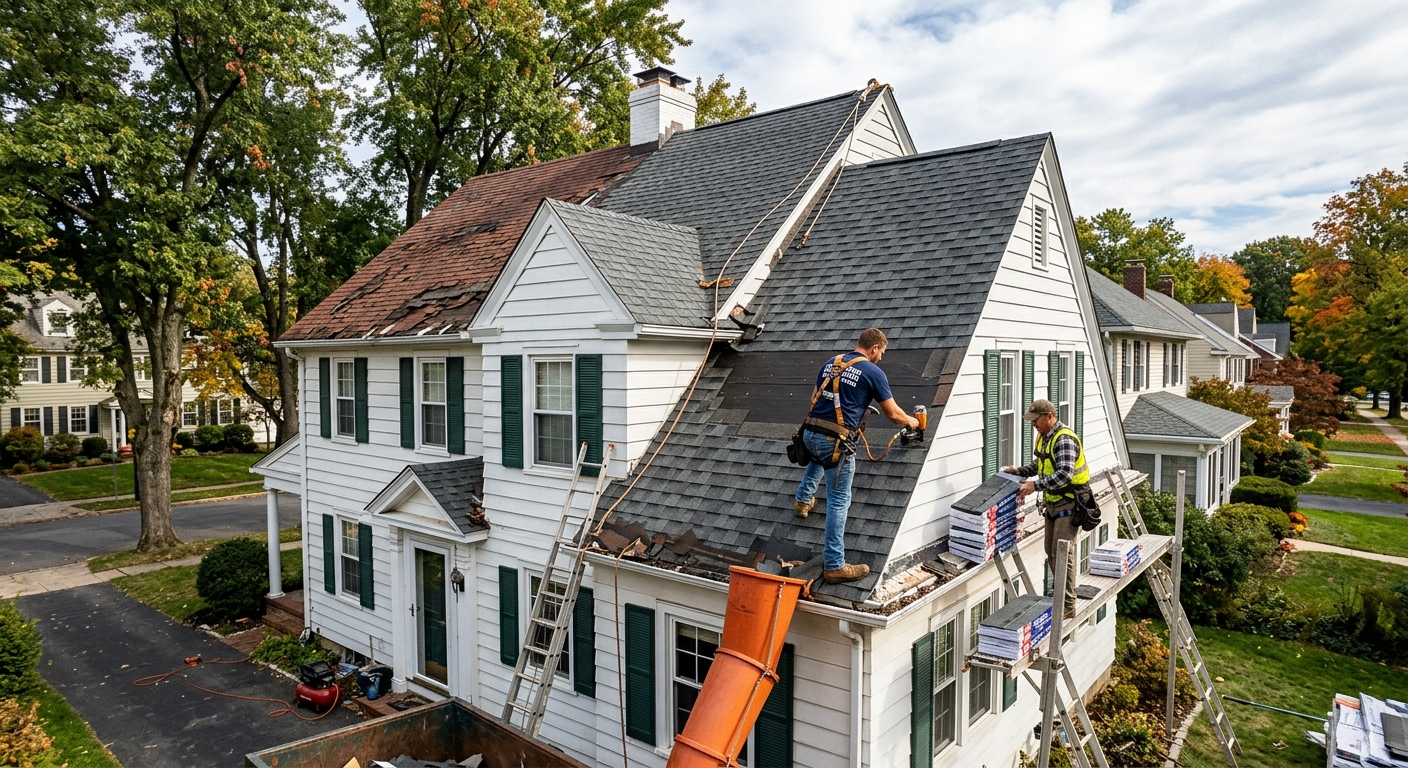
Unity roofing prices by material and scope — 2026
Unity homeowners should know that the price of a new roof depends on the materials chosen and the specific scope of work for homes here. With 79.0% of homes in Unity being single-family (U.S. Census Bureau, ACS 2024), the market is dominated by traditional pitched roofs and wide ranches that commonly use asphalt shingles. The high homeownership rate of 80.3% (U.S. Census Bureau, ACS 2024) means most residents are looking at roofing costs as a direct investment in their property value and long-term maintenance.
Like nearby Hempfield and North Huntingdon, Unity saw significant subdivision development between the 1960s and 1980s. This means a large number of homes are now reaching the natural end of their first or second shingle roof's service life and will be due for full replacement, not just isolated repairs. Roofers in Unity routinely plan for complete tear-offs and address decking replacement more often than in newer construction markets, since layers from previous jobs and older materials accumulate over time.
Below is a detailed breakdown of costs and lifespan by material for the Unity market in 2026. This should help set your budget expectations for repair and replacement projects:
| Material / Scope |
Lifespan |
Best for |
Price range (installed) |
| Asphalt shingles — architectural (30-yr) |
25–30 yrs |
Standard single-family home replacement, suitable for most Unity subdivisions |
$9,400–$19,500 |
| Asphalt shingles — impact-resistant (Class 4) |
30+ yrs |
Ridge-line homes facing hail and wind storms, higher long-term value |
$15,500–$19,500 |
| Metal standing seam |
40–70 yrs |
Owners seeking extra longevity and lower maintenance, modern farmhouses |
$22,500–$40,500 |
| Flat roof — TPO or EPDM |
15–25 yrs |
Porches, additions, low-slope sections on midcentury or split-level homes |
$12,000–$23,500 |
| Roof repair — leak or isolated section |
n/a |
Localized problems not requiring full reroofing |
$500–$1,850 |
Prices are estimates for a typical Unity home and vary with roof size, pitch, decking condition and material selection.
What gets discovered after tear-off in Unity
In Unity, the quoted price for a new roof sometimes becomes a higher final invoice once the shingles come off. The most common reason is rotted roof decking—a hidden problem in homes built before 1980, which make up 60.8% of Unity's housing (U.S. Census Bureau, ACS 2024). Decay can lurk under shingles for decades, especially around valleys, chimneys, or where gutters have backed up. Replacing plywood decking as found typically adds $120–$220 per sheet, depending on thickness and today's lumber market. For a typical 1,600-square-foot home, it’s not rare to see 2–10 sheets needing replacement.
Many Unity homes from the big 1960s–80s buildout have inadequate attic ventilation. This is not just a matter of efficiency—poor airflow in our cold, snowy climate is a recipe for ice dams. Once ventilation is corrected (often by adding or improving ridge venting and soffit intake), costs range from $450–$1,200 depending on attic size and the amount of cutting or baffle installation required. Neglect here voids most shingle warranties and leads to premature failure near the eaves.
Don’t overlook flashings: Chimney, skylight, and wall flashings get destroyed or covered up during a full tear-off. Replacing all flashings runs $350–$950 in a standard shingle job. Rubber vent boots (which crack well before the shingles) are typically $55–$125 each to swap for new. Drip edge (the metal that closes off the shingle edge and steers runoff) adds $340–$600 for most Unity homes.
Most of these cannot be seen—or priced—until shingles are off, but they are regular finds in full replacement jobs in our area.
TPO and EPDM on Unity homes
In Unity, many homes have a flat or low-slope section—sometimes it’s a rear addition, sometimes a porch or breezeway—making them different from the typical steep main roof. These flat sections cannot reliably shed water with standard asphalt shingles, especially through Pennsylvania’s heavy winter freeze-thaw. On slopes under 3:12 (especially anything at 2:12 or less), shingles will wick water, leak at the slightest snow buildup, and fail in a few years. That’s why you see TPO or EPDM membranes used on these portions: they’re continuous, fully adhered, and built to shed pooled water.
Ponding water—when melt or rainfall can’t escape quickly enough—chews through shingle and felt seams and eventually soaks the substrate, leading to rot and severe interior leaks. EPDM and TPO, on the other hand, last 15–25 years if installed right and inspected occasionally. For a typical Unity flat roof (12–25 squares), the fully installed price is $12,000–$23,500, which is in line with a full shingle replacement but delivers better long-term performance for tricky roof sections.
If you get a quote for shingles on a 2/12 pitch porch or addition, know you’re being sold a solution that will not last. A Unity roofer recommending TPO or EPDM for your low-slope is showing job-site experience—and you’ll get more life and fewer headaches as a result.
Roofing permits in Unity: what you need before work starts
Roofing in Unity falls under the Pennsylvania Uniform Construction Code (UCC), which draws from the International Residential Code as the construction standard for residential homes. Enforcement is handled either by your township's code enforcement office or directly by the PA Department of Labor & Industry, depending on whether Unity Township has a code authority in place or has opted out. For roof replacement that involves structural changes, tear-off, or new decking, permits may be required prior to work—check directly with the Unity municipal office or the Pennsylvania Department of Labor & Industry for the latest requirements. Simple repairs that don’t involve decking seldom require a permit.
Pennsylvania does not have a specific trade license for roofing, but any roofing contract over $500 must be performed by a contractor registered as a Home Improvement Contractor (HIC) with the Pennsylvania Office of Attorney General. You can and should check your contractor's registration status at hic.attorneygeneral.gov before signing anything. Roofing contractors must carry workers’ compensation insurance by law; for verification, ask for policy documents or check directly via WCAIS (wcais.pa.gov). Never hire a roofer who cannot show this proof.
By law, your contractor must give you a written contract for jobs over $500, and you have a three-business-day right of cancellation under the Home Improvement Consumer Protection Act.
Unity homes and their roof lines
Unity’s housing stock reflects the big wave of Pittsburgh metro-area suburban expansion—most notably from the 1960s through the 1980s. With 60.8% of homes built before 1980 (U.S. Census Bureau, ACS 2024), many roofs are now at their second or even third shingle layer, especially in early subdivisions and older ranches. Homes of that era tend to have 4:12 to 7:12 roof pitches—steep enough to shed snow, but not as sharp as century-old Victorians seen elsewhere. Decking on these homes is typically 3/8" or 1/2" plywood, but plank decking is still found on houses from the earliest years of the boom, which can complicate underlayment and shingle installation.
Ice and water shield was not a code requirement at the time these homes were built, so it’s rarely present beneath first-generation shingles or second-overs. As a result, original eaves are prone to water intrusion from ice damming—a familiar hazard with the local freeze-thaw cycle. Many Unity roofs have two, even three layers of shingles, which complicates tear-off and disposal (a retrofit reality, not just a contractor talking point). When replacing, expect to return to the sheathing, address ventilation and ice barrier shortfalls, and reset the system to today’s standards. If your home is from the late-90s wave, you’re likely facing your first full replacement, and condition will reflect both material used and how well past repairs addressed these older construction details.
Gutters, drainage and roof longevity in Unity
Roofing in Unity is as much about moving water as it is about shingles. Our hills, clay and shale soils, and heavy snows make poorly drained water a quick path to both roof leaks and basement seepage. Gutters catch runoff and steer it to downspouts, but if those dump right at the foundation—or if the gutters themselves are undersized, damaged, or poorly sloped—roof water ends up undermining your home’s structure and making a mess below grade.
During a full roof replacement, it’s almost always sensible to consider new seamless aluminum gutters. Matching the gutter system to the new drip edge and roof perimeter, with proper sized downspouts and splash blocks or drains that lead at least 6 feet from the wall, protects your entire investment. Many roofing warranties—including those from leading shingle manufacturers—require properly functioning gutters as a condition for roof coverage. For a typical Unity home, full gutter replacement alongside a new roof runs $2,100–$3,600, depending on home perimeter and downspout count. Skipping this part or delaying it by a year or two often leads to “mysterious” wet spots in the basement or ruined landscaping, driving up costs down the line.
What a proper Unity roofing quote contains
Reading a Unity roofing quote should not require a leap of faith. Start by looking for your actual roof measurement—stated in "squares" (100 square feet of roof area)—and for the roof pitch. If the quote doesn’t state both, you have no way to compare bids. Tear-off and disposal should spell out how many layers are being removed, whether dumpster fees are included, and how much is set aside for plywood replacement—typically quoted per sheet as a contingency. Underlayments and ice barriers should list product names and coverage, not just "felt" or "membrane."
All flashing work (chimney, wall, step and counter) and vent boot replacements should be itemized. Some older Unity homes will require heavy flashing updates, especially where previous jobs layered new metal over old without removal. A proper quote always explains the manufacturer’s material warranty and the contractor’s own workmanship guarantee—these are separate items and serve different purposes.
Payment terms matter: a deposit should not exceed 15%, with the balance due once the job is complete. If you get a lump sum bid with no measurement, no product names, and an up-front demand for a large payment, look elsewhere. You need to be able to hold the contractor to specifics, not just a grand total.
| Line item |
What to look for |
Red flag if… |
| Roof area |
stated in squares, with pitch |
no measurement given |
| Tear-off and disposal |
number of layers, dumpster included |
bundled into one figure |
| Underlayment |
product type and coverage |
listed only as 'felt' |
| Ice and water shield |
coverage height at eaves |
omitted entirely |
| Decking |
per-sheet contingency price |
no allowance at all |
| Warranty |
workmanship years stated separately |
only the shingle warranty |
| Payment |
deposit under 15%, balance on completion |
large upfront cash |
Frequently asked questions — roofing in Unity
Are impact-resistant shingles worth it in Unity?
In Unity, investing in impact-resistant Class 4 shingles makes sense if your home is exposed on a ridge or has taken hail or wind damage before. Westmoreland County sits just east of the main Ohio Valley storm corridor, and homes here occasionally see strong winds and hail that can shred standard 30-year shingles in just a few minutes. The price difference, typically $15,500–$19,500 for a Class 4 installation versus standard architectural shingles, pays off if you are concerned about deductible claims or want to maximize the odds of your new roof surviving the next big storm. For sheltered homes, the upgrade is less critical, but in high-exposure locations, it’s worth considering for peace of mind.
Does roof pitch affect the price in Unity?
Absolutely. Steep roofs (over 8:12 pitch) in Unity require harnesses, extra setup, and far more time per square, which pushes the price up compared to a walkable 4:12 or 6:12 roof. Most Unity subdivision homes fall between 4:12 and 7:12, keeping jobs manageable and prices steady in the range of $9,400–$19,500 for standard architectural shingle replacement. Very flat roof sections (under 3:12 pitch) cost more if shingled and will not last—instead, a proper TPO or EPDM install runs $12,000–$23,500. If a contractor glosses over pitch and gives a one-size-fits-all bid, that’s a sign of inexperience.
Is a sagging roof line an emergency?
In Unity, if you see a roof line sagging or drooping, it’s a serious structural concern, especially given how many homes here were built before modern framing practices and have older 3/8" or 1/2" decking. Sagging usually means rotten sheathing, compromised rafters (sometimes from long-term leaks), or undersized framing—common in stock from the 1960s through early 1980s. While not every dip is an instant collapse risk, it should be inspected immediately. At minimum, the cost of addressing a local repair (if limited to sheathing) runs $500–$1,850, but structural repairs will be more. Don’t re-shingle a sagging roof without solving the underlying problem.
Can I install new shingles over old ones in Pennsylvania?
Pennsylvania’s residential code (UCC) does allow up to two layers of shingles in most cases, but this is almost never a good idea in Unity. With so many homes built before 1980 and carrying two or more existing layers, “shingle-overs” can void your new shingle warranty, trap hidden deck rot, and overwhelm older framing with excess weight. Tear-off also exposes roof deck problems that can’t be fixed from above. Most reputable Unity contractors quote full removal, and the price for a proper new shingle roof—including tear-off—will be in the $9,400–$19,500 band. Savings from skipping tear-off rarely last long.
What should a roofing quote include in Unity?
Your Unity roofing quote should clearly state the measured roof area (in squares), pitch, specific products for underlayment and ice barrier, the number of existing layers to be removed, and a per-sheet price for any sheathing replacement. All new flashings and vent boots should be itemized, and both the manufacturer’s material warranty and contractor’s workmanship warranty must be listed separately. For a typical Unity replacement, a quote in the $9,400–$19,500 range should break down every significant step so you know exactly what you’re paying for. Avoid lump-sum bids that leave you guessing about hidden extras or overages.
Does homeowner's insurance cover roof replacement in Unity?
Insurance in Unity typically pays for roof repair or replacement only if the damage results from a covered peril—like hail, windstorm, or falling limbs—not just normal wear or age. Westmoreland County’s bouts of gusty weather can trigger claims, but your insurer will want to see proof the roof was sound before the event and may prorate for age. The “replacement cost” payout for a full shingle roof is commonly around $15,500, but if your roof is already worn, you may only receive the depreciated value. Always review policy specifics and document the roof’s age and prior work before a claim is needed.
How much snow load can a Unity roof handle?
Unity roofs are designed using Pennsylvania’s code standard, which calls for a ground snow load of 30 pounds per square foot. For standard residential construction with 4:12 to 7:12 pitches (typical in Unity homes), this provides a good safety margin against snow accumulation. However, flat or low-slope sections can see more weight buildup, especially when melting and refreezing cycles create ice dams. If your roof hasn’t been updated since the 1970s, have a contractor check framing and decking during any major work. Snow or ice weight rarely causes collapse in roofs built to code, but deferred repairs can allow damage to start subtle and end expensive—roof repair for sagging or leaks starts at $500–$1,850.
How much does a new roof cost in Unity?
Most Unity homes will see new 30-year architectural shingles installed for $9,400–$19,500 total, depending on roof size, pitch, and how much decking needs replacement. Upgrading to impact-resistant shingles or standing seam metal bumps costs significantly—Class 4 shingle systems are $15,500–$19,500, while metal roofs run $22,500–$40,500. Porches or flat roof additions that need TPO/EPDM membrane should budget $12,000–$23,500. For basic leak repairs, plan on $500–$1,850. Always demand a detailed quote so you see every cost up front.
Will the crew damage my landscaping or driveway?
Roof replacement in Unity involves heavy foot traffic, ladders, and dumpsters—if your contractor doesn’t use plywood, tarps, and clear staging, you could see flattened plants or scuffed walks. Responsible local crews protect shrubbery, lay down boards to disperse weight on your lawn, and keep dumpsters on wood runners to avoid cracking old driveways. Damage can mean costly repair, especially with mature landscaping common in older Unity subdivisions. Ideally, your contract should specify exactly what site protection steps are included. If repair is needed, you’ll see it itemized—many Unity contractors factor a small contingency (roughly $200–$500) for minor site damage in the main quote so there’s no surprise after the job is done.