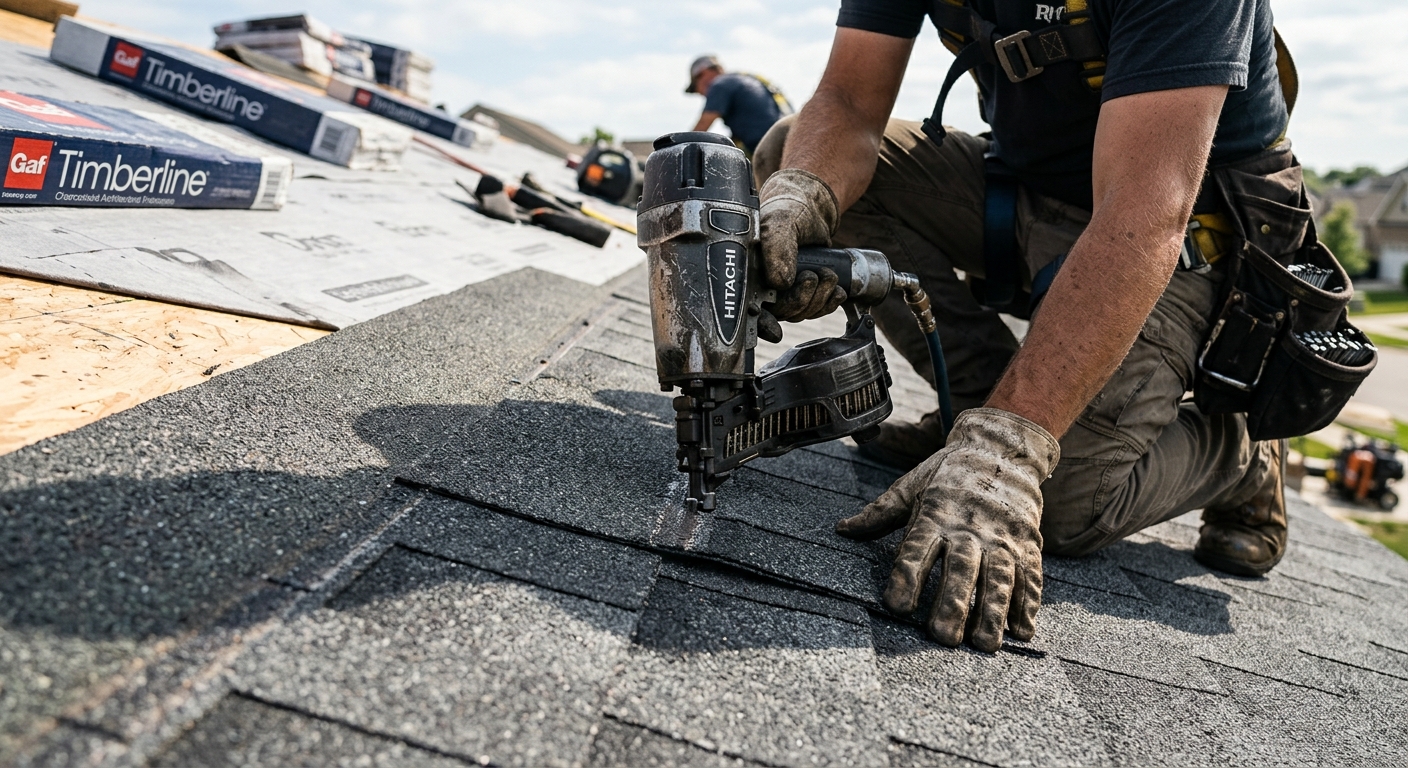
West Norriton roofing prices by material and scope — 2026
In West Norriton, replacing a roof is a significant investment shaped by the area’s housing stock and climate. With 56.2% of homes built before 1980 and a homeownership rate of 66.5% (U.S. Census Bureau, ACS 2024), there’s steady demand for roof replacements on older single-family homes where aging materials and past installation practices catch up. Post-World War II tract housing patterns in nearby Abington and Cheltenham are mirrored here, translating to a patchwork of 25- to 40-year-old shingles now reaching the end of their lifespans. That means more full replacements—often down to the decking—than cosmetic repairs.
The typical West Norriton roof is neither sprawling nor steep but tends to have a mix of sloped surfaces and the occasional flat rear addition or porch. Asphalt architectural shingles remain the go-to due to local development preferences and HOA covenants in surrounding townships. Metal roofs and membrane systems are rare except where conditions really call for them. Because of the unified Philadelphia metro market, you’ll see price competition at the install level, but codes and local standards mean labor and permitting don’t drop with cut-rate bids.
| Material / Scope |
Lifespan |
Best for |
Price range (installed) |
| Asphalt shingles — architectural (30-yr) |
25–30 yrs |
Standard single-family re-roof |
$9,900–$21,000 |
| Asphalt shingles — impact-resistant (Class 4) |
30+ yrs |
Areas with severe wind/hail |
$16,000–$21,000 |
| Metal standing seam |
40–70 yrs |
Enhanced snow/wind performance |
$24,000–$42,500 |
| Flat roof — TPO or EPDM |
15–25 yrs |
Low-slope porches, additions |
$12,500–$25,000 |
| Roof repair — leak or isolated section |
n/a |
Spot patching |
$500–$2,000 |
Prices are estimates for a typical West Norriton home and vary with roof size, pitch, decking condition and material selection.
Reading the warranty on a West Norriton roof
When you buy a new roof in West Norriton, you’re usually getting two separate warranties, but it’s easy to blur the lines. The manufacturer’s warranty covers the roofing materials for defects—think shingle granules that wash off by year five, or a membrane that cracks before its time. These warranties are almost always prorated. That means after ten years, you won’t get a new roof if something fails; you’ll get compensated for the remaining portion, often just the material itself, not labor. You’ll want to ask whether registration is required (it often is, within 30–90 days after installation) and whether the warranty carries over if you sell your house. Most do transfer once, sometimes with a modest fee, but only if you fill out the paperwork promptly.
The workmanship warranty is different—this is the roofer’s promise to fix mistakes in installation. In West Norriton, you’ll see everything from 2-year to so-called “lifetime” labor warranties. What matters isn’t the years, it’s the company’s local track record. A 25-year warranty from a new outfit is realistically less valuable than a straightforward 10-year warranty from a contractor who’s been serving Montgomery County for decades. Most of these warranties exclude issues caused by poor attic ventilation, insufficient flashing, or layering new shingles over old ones. Failing to register or transferring ownership without notice will usually void coverage. Always get any warranty terms in writing with your contract, separate from the fine print handed down from the shingle maker.
Asphalt, metal or membrane — what suits a West Norriton roof
In West Norriton, your roofing choice comes down to what works for the home, the climate, and your priorities for cost and longevity. Southeastern Pennsylvania’s ground snow load is 30 psf and winter design temperatures can dip to 14°F, but we’re not in the state’s snow belt. Metal roofs, with their superior snow-shedding, are great if you have a high-visibility home on a hill or want the roof to outlast your mortgage, but for most, the math doesn’t add up: you’d pay at least $24,000–$42,500 for standing seam, often double asphalt.
Asphalt architectural shingles win here because they deliver 25–30 years of reliable protection at a price—$9,900–$21,000—that HOA-controlled and post-war development in Montgomery County was tailored for. You’ll rarely find Class 4 impact shingles installed unless wind or hail exposure justifies the extra $16,000–$21,000 price tag. Flat (low-slope) porches and additions are another story; TPO and EPDM membranes are required to prevent ponding and leaks, as asphalt isn’t built for standing water.
| Material |
Installed cost |
Lifespan |
Cold-climate performance |
Maintenance |
| Asphalt architectural |
$9,900–$21,000 |
25–30 yrs |
Withstand 30 psf snow, ice-barrier at eaves |
Periodic moss removal, inspect flashings |
| Asphalt Class 4 impact-resistant |
$16,000–$21,000 |
30+ yrs |
Resists hail bruising better, same snow load |
Similar to regular asphalt |
| Metal standing seam |
$24,000–$42,500 |
40–70 yrs |
Sheds snow quickly, less ice dam risk |
Check fasteners every 10–15 yrs |
| TPO / EPDM membrane |
$12,500–$25,000 |
15–25 yrs |
No freeze-thaw splitting; seams can fail |
Keep drains open, seal seams as needed |
TPO and EPDM on West Norriton homes
Flat roofs aren’t just a downtown concern—they show up all over West Norriton as porches, bump-out additions, or rear sections tacked onto older homes. Low slope means water won’t drain fast, so a typical shingle system won’t cut it: shingle tabs cup and leak, and felt underlayment can trap moisture. Membrane systems like TPO (thermoplastic polyolefin) and EPDM (rubber) are engineered for these surfaces. Their single-sheet design eliminates most seams, limiting the most common cause of flat roof leaks.
Ponding—when melted snow or rainwater sits on the surface—is a real problem during our freeze-thaw cycles. TPO and EPDM handle these conditions better than modified bitumen or rolled roofing, as long as the drains and scuppers are open and the seams are well-welded or taped. Expect a well-installed flat membrane on a West Norriton porch or addition to last 15–25 years, at a total cost of $12,500–$25,000 depending on size and tie-ins. If a contractor suggests re-shingling a 2/12 or flatter pitch, that’s a clue they’re overlooking basic building science—and you’re likely to see failure within five years. Choose membrane where it counts, and you’ll avoid most chronic leak callbacks.
Permits and code requirements in West Norriton
In West Norriton, roofing work falls under the Pennsylvania Uniform Construction Code (UCC), which is based on the IRC and enforced by municipalities throughout Montgomery County. Here, if you’re replacing more than 25% of an existing roof surface, a building permit is typically required. Minor repairs—patching an isolated leak or replacing a few shingles—generally don’t trigger the same requirement, but anything bigger will. Permits are issued by the local code enforcement office itself, or by the PA Department of Labor & Industry if the municipality has opted out, as the code authority empowers.
Statewide, roofing contractors don’t need a trade license, but Home Improvement Contractor (HIC) registration is mandatory for any contract over $500. You can easily verify a contractor’s HIC registration through the Attorney General’s online registry at hic.attorneygeneral.gov. Insurance isn’t just ‘a good idea’—workers’ compensation is required for any contractor with employees, and coverage can be checked any time via WCAIS (wcais.pa.gov). Every job over $500 also requires a written contract under the Home Improvement Consumer Protection Act, and you legally have a three business-day right to cancel. For pre-1978 homes, check that the contractor is certified for lead-safe practices using the EPA’s database.
The cost drivers behind a West Norriton roof replacement
Comparing roof quotes in West Norriton, you’ll see real differences—and not just because one company “runs leaner.” Local housing trends and climate requirements set the baseline. Because over half the homes here date before 1980, you’re more likely to uncover two or even three layers of old roofing during tear-off. Each additional layer means higher dump fees and labor, often adding $500–$1,500 per layer to the bill. Roof size is the primary cost multiplier, as most homes are mid-sized colonials or ranches, not sprawling custom builds.
If you have a steeper pitch (common in some original sections), installation is slower and safety equipment is mandatory. This pushes labor costs up by 20–30% over a similar single-story ranch. Likewise, deck repairs are a wild card: once the crew opens up, expect to pay $75–$150 for each plywood sheet replaced. Local weather, with a 30 psf snow load and repeated freeze-thaw cycles, also makes an ice barrier at the eaves smart insurance—usually an extra $300–$800. Material choice is the last lever. Jumping from 3-tab to architectural shingles, or to Class 4 impact-resistant, can stack on $500–$2,500 depending on roof size.
| Factor |
Why it matters here |
Cost impact |
| Roof size in squares |
Each square is 100 sq ft of roof surface |
Primary multiplier |
| Pitch and access |
Steep pitches need harnesses and slow the crew |
+20–30% labour |
| Existing layers to tear off |
Two or more layers means full tear-off and disposal |
$500–$1,500 per layer |
| Decking condition |
Rot is found during tear-off, not before |
$75–$150 per sheet |
| Ice barrier at eaves |
Required where ice damming has a history |
$300–$800 |
| Material grade |
3-tab vs architectural vs Class 4 impact-resistant |
$500–$2,500 |
How southeastern Pennsylvania's weather shapes roofing here
West Norriton roofs are repeatedly tested by a climate that’s mild compared to the Poconos, but punishing in its own way. The Schuylkill River valley pulls in thunderstorm wind at angles that tear shingles free in ways calmer counties never see. That’s why Class 4 impact shingles or even metal panels are the norm only on the most exposed sections, and why a standard architectural shingle replacement here—typically $9,900–$21,000—will be spec’d with extra fasteners near ridgelines or vent stacks. Hail strikes in the Philadelphia metro rarely punch obvious holes, but they bruise asphalt, breaking the bond and shortening shingle life by years. You won’t see the damage until granules begin to slough away months later, and your warranty claim gets sticky if not documented early.
Winter’s real risk is freeze-thaw cycling. With 30 psf ground snow load and nights down to 14°F, ice dams can form at the eaves whenever snow is slow to melt and attic heat leaks out near gutters. Warm air from inside melts snow; meltwater runs to the cold eave, freezes, and blocks drainage, forcing water up under the shingles and into the home. That’s why Montgomery County code and best practice require ice/water barrier in these zones—an extra $300–$800, but not negotiable for old homes with iffy attic insulation. Don’t let a roofer talk you into skipping it, or “saving” by omitting drip edges; these omissions are why roof repairs, costing $500–$2,000 per call, are steady business here.
Frequently asked questions — roofing in West Norriton
Does homeowner's insurance cover roof replacement in West Norriton?
Insurance in West Norriton may help pay for roof replacement, but only if the damage is the result of a covered peril and not just age or normal wear. For instance, if an insured thunderstorm event sends shingles flying from your roof—a genuine risk here due to Schuylkill River valley winds—your insurer may approve the claim. However, policies don't cover general deterioration, poor workmanship, or gradual leaks in aging shingles, which is common given that over half the housing stock here dates to before 1980. You'll still need to pay your deductible (waiving it is prohibited by state law), and insurers often pay out the actual cash value unless you have replacement cost coverage. If you do get a claim approved, expect a typical full replacement on an architectural shingle roof to cost $9,900–$21,000. Always get damage documented quickly and never authorize repairs until your adjuster has seen the roof up close.
Why do roofs fail faster in southeastern Pennsylvania?
Roofs in West Norriton and the southeastern corner of Pennsylvania fail faster partly due to moderate freeze-thaw cycles and the humid, storm-prone summer climate. The frequent fluctuation just above and below freezing in winter encourages ice damming at roof eaves, which can drive water under shingles and into attic spaces, especially in homes built pre-1980. Combine this with heavy summer sun and the high local winds from Schuylkill River valley storms, and even architectural shingles tend to show their age closer to the lower end of their 25–30 year rating. National averages don’t account for how local drainage, attic ventilation, and past material choices interact. When leaks appear or sections start to curl, repairs start at $500–$2,000, but whole replacements are often needed sooner in this particular region.
How much does it cost to repair a roof leak in West Norriton?
Roof leak repairs in West Norriton, whether it’s a minor shingle replacement or sealing around a vent, generally fall into the $500–$2,000 range. The final price depends on the complexity of the leak, attic access, and whether rot was allowed to spread or water pooled on a flat section. Many repairs are on homes built before 1980 where prior patch jobs have failed and multiple shingle layers complicate the process. If you’re quoted much less, be wary—cheap repairs often skip proper flashing or underlayment, leading to bigger problems later. On historic homes, unique trim or steep access may push costs up, while small, easily isolated repairs on a ranch roof can be at the lower end. For anything involving storm damage, be sure your contractor documents everything for insurance purposes, as that may turn a repair call into a full roof claim.
How much does a flat roof replacement cost in West Norriton?
If you have a flat or low-slope porch, bump-out, or addition in West Norriton, a full membrane replacement is typically in the $12,500–$25,000 range. Price varies by size, perimeter detail, roof height, and the need to tie into adjacent sloped sections or historic facades. Given the freeze-thaw cycles and humidity, it’s vital to avoid cheap rolled roofing in favor of TPO or EPDM, which last longer and have fewer seams to fail. Roofers must also build in positive drainage to keep ponding at bay, something that’s often skipped when a quick overlay is done by amateurs. Expect the higher end of the price band if decking repairs or complex flashing are needed. A correctly installed flat roof system, built to Montgomery County code, should last 15–25 years without chronic leak calls.
Can I install new shingles over old ones in Pennsylvania?
In Pennsylvania, including West Norriton, you are allowed by code to install new shingles over a single existing layer under certain conditions. However, municipal regulations and roofers with any standards will usually recommend a full tear-off, especially for homes older than 1980 where hidden rot, brittle decking, or past leaks are common. Layering can save upfront cash—since labor and dump fees are reduced—but you’ll compromise long-term roof life and potentially void your manufacturer and labor warranties. For a typical architectural shingle install, saving a small amount now could mean paying full price ($9,900–$21,000) again much sooner than expected. Most contractors in Montgomery County don’t offer a warranty on layered jobs beyond a year or two, so the small initial savings rarely pay off.
How much deposit should I pay a roofer upfront?
In West Norriton and throughout Pennsylvania, state law requires that deposits for home improvement work—including roofing—never exceed one-third of the project price, and no contractor may request full payment before the job begins. For a typical architectural shingle roof replacement here, in the $9,900–$21,000 range, the initial deposit should land between $3,300 and $7,000, with the balance due upon completion and your sign-off. Contracts over $500 require a written agreement under Pennsylvania’s Home Improvement Consumer Protection Act, which outlines your payment schedule and consumer rights. Avoid any roofer who wants a large deposit in cash or gives vague details on timing—legitimate companies in Montgomery County have the credit and supplier relationships to wait until materials are delivered and work is underway.
Will the crew damage my landscaping or driveway?
Roof replacement is messy, and in West Norriton where mature trees and tight driveways are common, your property needs protection. Reputable crews will use plywood, tarps, and catch bins to shield plants, walkways, and driveways from falling shingles or nails. Still, minor scuffs or occasional crushed plants can happen, especially on homes built before 1980 where access can be tight. If heavier materials for a metal roof or flat membrane system are delivered, ensure the contract spells out site protection. Replacing cracked concrete or landscaping after the fact can easily cost hundreds, but most reputable Montgomery County roofers include daily cleanup and final magnet sweeps in their standard price band—expect this to be factored into your quoted price of $9,900–$21,000 for a typical shingle job.
Can I inspect my own roof safely?
While you can do a quick visual check with binoculars from the ground in West Norriton, climbing on your own roof—especially one over a story high or with a pitch above 6/12—is risky. Many homes here were built before 1980 and have steep, older shingle surfaces that can be slick with moss or granule loss. If you suspect issues, it’s safer to invest in a professional inspection, usually $150–$400, which may be credited toward repairs in the $500–$2,000 range. Pros in Montgomery County have the safety equipment and know where to look for soft decking, faulty flashing, or hidden rot. For peace of mind, stick to a ground-level look and call in a contractor for anything beyond a quick gutter or vent glance.
What is the best roofing material for West Norriton's climate?
For most West Norriton homes, architectural asphalt shingles are the smart choice. They handle our 30 psf ground snow load, shed water well in frequent freeze-thaw, and are accepted by the vast majority of HOAs in tract housing developments—matching the dominant local look. Metal standing seam roofs do a superior job shedding snow and resisting wind but come at double or more the cost ($24,000–$42,500) and rarely have the curb appeal or HOA buy-in for most postwar homes here. For flat or low-slope sections, TPO or EPDM membrane systems are the only reliable bet. Unless you have a historic showpiece or custom home, stick to architectural shingles for best value, with upgrades only where storm or design needs justify spending more.