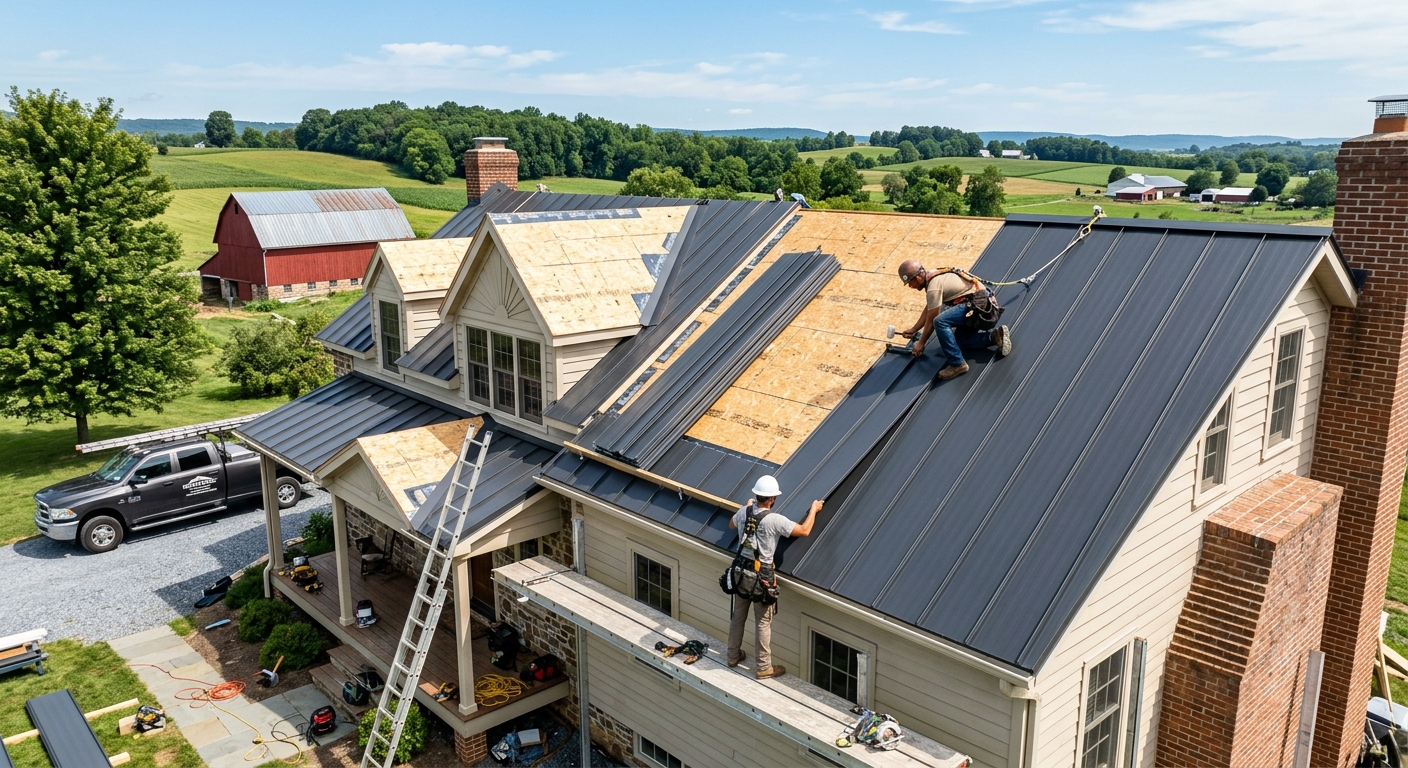
Roofing Replacement & Repair costs in Salisbury — 2026
Salisbury stands out from rural Pennsylvania communities with its high homeownership rate and predominance of single-family housing—factors reflected in its active roofing market. With most of the area’s 4,071 owner-occupied homes (U.S. Census Bureau, ACS 2024) built before 1980, many Salisbury roofs have already seen one or more replacements. That means project scopes here tend to involve full tear-off rather than simply adding a second layer—upping both labor and disposal needs.
South Whitehall and Upper Macungie’s post‑World War II suburban tracts have set the pattern for Salisbury as well: large neighborhoods with similarly sized homes, standardized roof designs, and a local industry built to handle high volumes of architectural shingle replacements efficiently. This standardization keeps unit pricing tighter here than in areas with mixed housing stock or steeper pitches on every block, and it makes it easier for homeowners to compare like-for-like bids.
| Material / Scope |
Lifespan |
Best for |
Price range (installed) |
| Asphalt shingles — architectural (30-yr) |
25–30 yrs |
Standard Salisbury ranch or colonial |
$10,000–$21,000 |
| Asphalt shingles — impact-resistant (Class 4) |
30+ yrs |
Areas prone to wind or hail |
$16,500–$21,000 |
| Metal standing seam |
40–70 yrs |
Long-term upgrade, snow slide zones |
$24,000–$43,000 |
| Flat roof — TPO or EPDM |
15–25 yrs |
Porches, additions, low-slope ranch roofs |
$12,500–$25,000 |
| Roof repair — leak or isolated section |
n/a |
Local leaks, ridge cap failure, flashing |
$550–$2,000 |
Prices are estimates for a typical Salisbury home and vary with roof size, pitch, decking condition and material selection.
Pennsylvania code and Lehigh County permit rules for roofing
Roofing work in Salisbury falls under the Pennsylvania Uniform Construction Code (UCC), which is based on the International Residential Code. Enforcement is either by the responsible municipal office or, in townships that have opted out, by the PA Department of Labor & Industry. In communities like nearby Allentown, a building permit is required for structural roof replacement or installing new roofing over existing layers. However, if you're simply repairing a small leak and only replacing a handful of shingles, that work is typically done without a permit in Allentown—check with your local office, as Lehigh County townships operate their own code enforcement.
For contracts over $500, Pennsylvania requires that roofing contractors hold a Home Improvement Contractor (HIC) registration, issued by the Office of Attorney General. Homeowners can (and should) verify their contractor’s registration status at hic.attorneygeneral.gov before signing any agreement. Written contracts are required by the Home Improvement Consumer Protection Act for work above this amount, and you have a three-business-day right of cancellation.
Employers in Pennsylvania must carry workers’ compensation insurance, either through the private market or as a self-insurer. To check if your contractor maintains required coverage, use the WCAIS system at wcais.pa.gov. Don’t accept vague assurances—an up-to-date registration and workers’ comp certificate protect you from liability during your roof project.
Repair or replace? A decision guide for Salisbury roofs
For Salisbury homeowners, deciding between repairing or fully replacing your roof depends on age, leak pattern, and material condition. Homes built before 1980, which make up the bulk of the Salisbury stock, are usually on at least their second layer of roofing. If your current roof is under 15 years old and you have an isolated leak—often at a flashing or vent—a repair is the clear choice, both for cost and practicality.
When leaks multiply on a 15–25 year-old shingle roof, the balance tips. Spending $1,250 on three separate repairs in two years already adds up to $3,750—money that would have gone a long way toward a full replacement at $16,500. For roofs older than 25 years, any active leak almost always signals the end for the current system, especially since nearly three-quarters of Salisbury’s homes are pre-1980 and shingle warranties cap out here. Flat roofs showing ponding or blistering, common on ranch additions and porches, are rarely fixable for long.
| Situation |
Recommendation |
Typical cost |
Reasoning |
| Under 15 years, one isolated leak |
Repair |
$550–$2,000 |
Still within service life; targeted fix is cost-effective |
| 15–25 years, several leak points |
Replace |
$10,000–$21,000 |
Roof nearing end of life, repairs stack up quickly |
| 25+ years, any active leak |
Replace now |
$10,000–$21,000 |
At or past design lifespan for nearly all area homes |
| Storm damage, wind or hail |
Document, claim, replace |
$10,000–$21,000 |
Insurance typically covers replacement, not patchwork |
| Flat roof ponding or blistering |
Replace membrane |
$12,500–$25,000 |
Blistered or ponded membranes can't be reliably repaired |
| Active leak entering winter |
Emergency repair, schedule replacement |
$550–$2,000 |
Prevent interior damage now; full replacement after thaw |
What insurance covers on a Salisbury roof
When severe wind or hail hits the Salisbury area, start by photographing every visible sign of roof damage—missing shingles, dented gutters, or torn flashing—before moving debris or scheduling any repairs. Insurance adjusters need clear documentation of the loss as it looked right after the event. Next, file the claim and request a written scope of loss; this details what your policy will cover for “actual cash value” (depreciated) and “replacement cost” (full, minus deductible).
Expect an insurance adjuster to visit your property. They will inspect both the exterior and any interior leaks. Once you have the scope, share it with your roofer—this avoids the mistake of starting work based on incomplete or misunderstood coverage.
If a contractor in Pennsylvania offers to “cover your deductible” or says you won’t pay out-of-pocket, walk away. The Home Improvement Consumer Protection Act prohibits waiving homeowner insurance deductibles. Accepting such an offer isn’t just illegal—it’s a red flag that the company may cut corners elsewhere on your job or involve you in insurance fraud. Always insist on a written contract (required by HICPA for work over $500) and verify the contractor’s registration at hic.attorneygeneral.gov before any deposit changes hands. No reputable roofer in the Salisbury area will object to you double-checking this paperwork.
Water management on a Salisbury roof
A complete roof job in Salisbury covers more than just shingles or membrane. Gutters and downspouts are a critical part of the water system, channeling runoff well away from your home—and with Salisbury’s older housing stock, ignoring gutters during a roof replacement is a shortcut that leads to much bigger problems. If downspouts dump water near the foundation, you'll soon see basement leaks and, in worst cases, structural settling. Local shingle warranties may actually require proof of functional drainage for coverage to stay valid.
When budgeting for a new roof, plan for gutter replacement or at least thorough rehanging and cleaning. Most Salisbury homes with standard roof lines and single-story eaves can expect seamless aluminum gutter replacement to run $2,500–$4,500 when paired with a full roof job. If you’re dealing with constant basement dampness or noticing overflow during storms, it’s usually a sign both the roof and the water management system need to be addressed as one. Cutting corners here is like fixing only half a problem.
What moves the price of a roof in Salisbury
Quotes for the same roof in Salisbury can diverge by thousands of dollars, even on neighboring homes. The local market, centered on Allentown and Bethlehem, is packed with contractors, but that doesn’t mean pricing is uniform. One key factor is the large, similar houses built in the post‑World War II era—crews know the layouts and can work more efficiently, which helps control labor costs for asphalt shingle jobs, keeping the starting point for most projects around $10,000.
That said, weather is no afterthought here. Salisbury, like the rest of northeastern Lehigh County, sits in a climate demanding a 40 psf ground snow load. Add the severe ice-dam exposure and you see why area roofers include ice-and-water shield at the eaves, a must for insurance and peace of mind, which shows up as an extra line item of $300–$800 on many proposals. Storm exposure is another wild card—ridge-line winds funneling along South Mountain create sudden, localized roof failures, which can spike prices for urgent replacements or repairs.
Finally, existing conditions matter. Many Salisbury homes have at least two layers of shingles; local code and crew reality both dictate a full tear-off if this is the case, adding $500–$1,500 per extra layer in disposal and labor. Decking repairs for hidden rot average $75–$150 per plywood sheet—something no estimator can truly price until the old roof is removed.
| Factor |
Why it matters here |
Cost impact |
| Roof size in squares |
each square is 100 sq ft of roof surface |
primary multiplier |
| Pitch and access |
steep pitches need harnesses and slow the crew |
+20–30% labour |
| Existing layers to tear off |
two or more layers means full tear-off and disposal |
$500–$1,500 per layer |
| Decking condition |
rot is found during tear-off, not before |
$75–$150 per sheet |
| Ice barrier at eaves |
required where ice damming has a history |
$300–$800 |
| Material grade |
3-tab vs architectural vs Class 4 impact-resistant |
$500–$2,500 |
Roofing season and lead times in Lehigh County
In Salisbury and the Lehigh Valley, the roofing year is shaped by Pennsylvania’s long heating season and harsh winter lows. Asphalt shingles need a few days of 50°F-and-rising to seal properly—a window that typically opens up in late March and closes in early November. Emergency repairs and tarping do happen in winter, but anything more involved will cost more; crews have to battle cold, snow, and shorter daylight, so every job in February is a scramble that can easily run $1,250 extra for labor and weather protection.
This region’s dense contractor market, anchored by Allentown–Bethlehem, means most firms have several crews but are booked solid from April through October. Expect lead times of 2–3 weeks for full replacements during the spring and fall rush, with emergency repairs fit in as gaps allow. Storm events can push those wait times longer. Planning ahead is everything here—scheduling a full replacement for September or October often gives the best price, a smooth process, and a fresh roof just in time for the Lehigh County snow load and freeze-thaw cycle.
Frequently asked questions — roofing in Salisbury
Does Salisbury get enough hail to justify Class 4 shingles?
While Salisbury isn’t a high-frequency hail area compared to the Midwest, it does see severe storms with occasional hail—especially with ridge-line winds that can drive even small stones deep into your roof system. For homeowners who want the peace of mind (or sometimes get a small break on insurance), Class 4 impact-resistant shingles make sense, particularly on exposed roofs or if you’ve had shingle bruising before. Upgrading an average Salisbury roof to Class 4 impact-resistant shingles typically runs $16,500–$21,000. For many, it’s less about hail alone and more about added protection against wind and larger debris during the area’s storms.
How long does a roof replacement take in Salisbury?
For most single-family Salisbury homes, a straightforward asphalt shingle replacement is done in two days—sometimes one, if weather cooperates and the roof is a simple design common to local post-WWII subdivisions. Complex roofs or jobs requiring significant decking repair can run three or four days. Spring and fall have the quickest turnarounds. However, in the height of the season, you may wait 2–3 weeks from contract to crew arrival because of the metro Lehigh Valley’s high contractor activity. Flat roof or metal installations can add another day or two, and emergency replacement in winter, when labor and material handling slow down, can add $1,250 or more to both lead time and final price.
What does roof replacement cost per square in Salisbury?
A “square” is 100 square feet of roof. In Salisbury, most shingle replacement quotes come in at $500–$800 per square installed for architectural asphalt shingles, with higher-end options like Class 4 impact-resistant shingles or standing seam metal running more. This reflects everything—materials, labor, underlayment, disposal, and warranty—so you aren’t comparing apples to oranges with lower “bare labor” or “materials only” prices. The prevalence of mid-century homes in Salisbury means fewer surprises with roof geometry, keeping square pricing more predictable than in older or heavily remodeled markets.
Do metal roofs shed snow better in Salisbury?
Metal standing seam roofs are highly effective at shedding snow in Salisbury’s climate, especially under the area’s 40 psf ground snow load and frequent freeze-thaw cycles. Unlike shingles, which can hold drifts and ice dams at the eaves, smooth metal panels encourage snow to slide off—sometimes all at once, so snow guards are often recommended above entries. For homeowners planning to stay long-term or with low-pitch roofs liable to leak under snow weight, the upgrade to metal (typically $24,000–$43,000) is well worth considering, especially on porches and additions where shingle systems tend to fail first in heavy winters.
How much does a flat roof replacement cost in Salisbury?
Flat or low-slope roofs—most common on Salisbury’s porch additions and some mid-century ranch homes—require either TPO or EPDM single-ply membranes. A full tear-off and new membrane installation in Salisbury falls in the $12,500–$25,000 range for an average-sized flat. If the substrate or insulation below needs repair, costs trend toward the upper end. Flat roofs demand careful drainage and extra attention to edge flashing because Salisbury’s freeze-thaw cycle and ponding rains will quickly break down a sloppy install. Don’t skip the inspection for membrane blisters or soft spots when deciding if it’s time to replace rather than repair.
What should a roofing quote include in Salisbury?
In Salisbury (and under Pennsylvania law), any roofing quote over $500 must come with a written contract spelling out all materials (type, brand, warranty), scope of tear-off, underlayment, flashing, disposal, and cleanup. Gutters and ventilation should be addressed—at a typical cost of $2,500–$4,500 for seamless gutters if needed. Look for the contractor’s HIC registration number (verify at hic.attorneygeneral.gov), proof of insurance, timeline, and all payment terms. The local market is competitive, so you don’t need to put up with vague or incomplete bids—detailed proposals protect you and ensure apples-to-apples comparison.
How do I confirm a roofer carries workers' compensation?
Pennsylvania requires all roofing employers to carry workers’ compensation, and Salisbury homeowners should always check this. You can verify a contractor’s policy directly through the state’s WCAIS database at wcais.pa.gov. The process is quick—search by business name or policy number and you’ll see if coverage is active. Don’t accept just a paper certificate, as these can expire or be faked. This matters because if a worker gets injured on your roof and the company isn’t covered, you could be liable. Any reputable roofer will provide their HIC registration and help you check their insurance, especially when you’re investing $10,000–$21,000 in a new roof.
How do I file a storm damage roof claim in Pennsylvania?
If your Salisbury home suffers storm damage, document the roof, gutters, and exterior before any cleanup—clear photos and video are key. Contact your insurer, describe the loss, and ask how to proceed. Pennsylvania requires a written contract and that no contractor can waive your deductible, so ignore anyone who offers that. After filing, expect a visit from your adjuster for a scope of loss, including “actual cash value” and “replacement cost” line items. Share your adjuster’s paperwork with your chosen roofer to align repair scope and avoid surprises. Full roof replacements after major storms commonly settle around $16,500, depending on your policy and deductible.
How can I tell if my roof decking is rotted?
Rotted roof decking is a hidden headache, especially on Salisbury’s older homes. Signs include a soft, spongy feel underfoot, uneven dips along the roof line, or dark stains in the attic. If you’ve had repeated leaks or can see water staining on ceiling drywall, it’s likely the decking is compromised. During tear-off, contractors in this area routinely find and replace rotted sections at $75–$150 per plywood sheet. Unfortunately, you usually won’t know the full scope until the old roofing is off. If a contractor claims to guarantee no decking replacement before seeing what’s under your shingles, get a second opinion—it’s a promise they can’t keep in Salisbury’s housing stock.