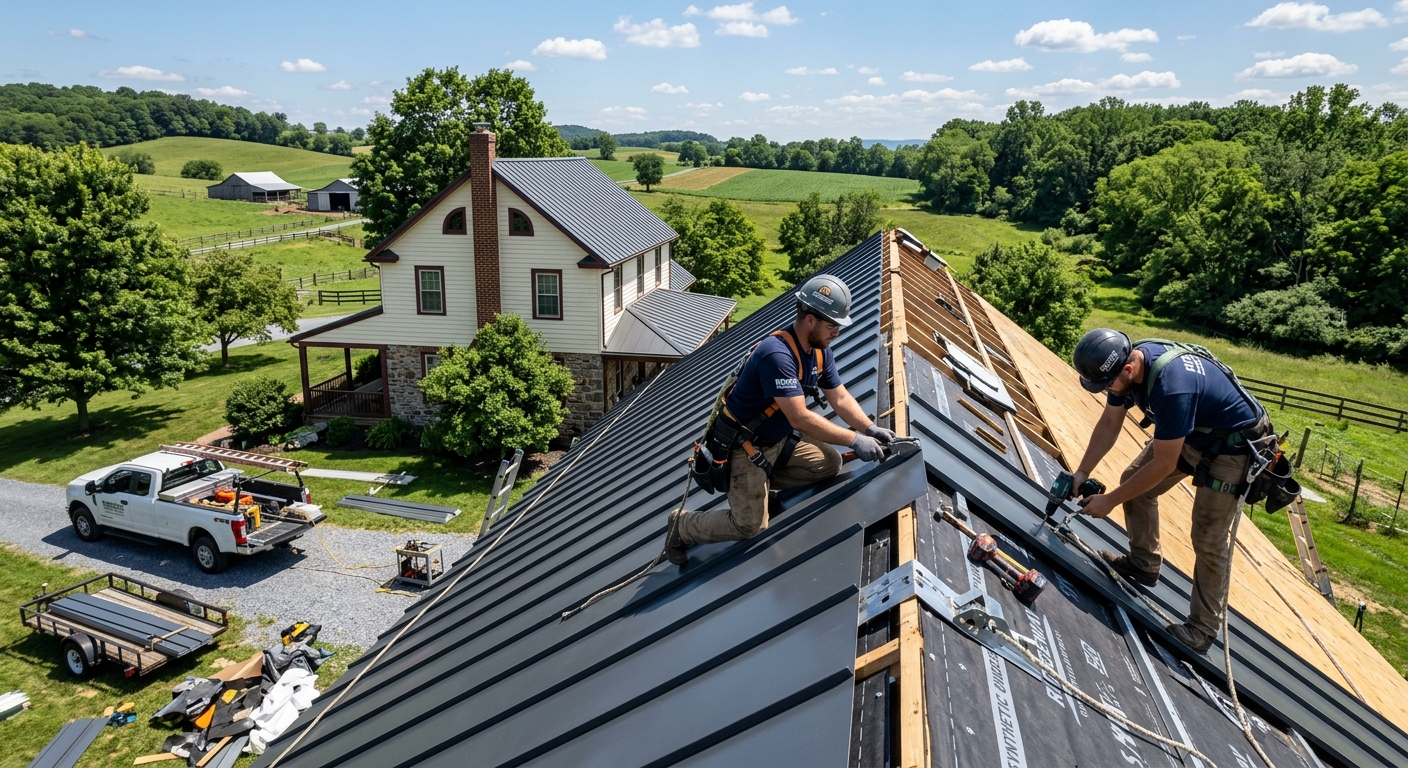
Plum roofing prices by material and scope — 2026
Plum’s roofing costs reflect the demands of a mostly owner-occupied housing stock and a large share of homes built before 1980 (U.S. Census Bureau, ACS 2024). The prevalence of single-family houses means full roof replacements are common, not small patch jobs. As most homes in Plum were framed between 1900 and 1950, roofers here often find hidden issues below old shingles: weak or rotted planks, outdated ventilation setups, or layers of older roofing. That history means that what starts as a simple "tear-off and replace" often requires new decking or structural repairs, especially on steep hipped or gable roofs.
This older housing stock affects labor and material choices—homeowners considering roof work should factor in the potential for unexpected repairs. Adding new plywood or stabilizing framing is routine after removing original wood shakes or multiple shingle layers. Combined with the broad market of contractors bidding, prices tend to align closely with these realities of age and size. See the table for typical installed costs for roofing solutions in Plum.
| Material / Scope |
Lifespan |
Best for |
Price range (installed) |
| Asphalt shingles — architectural (30-yr) |
25–30 yrs |
Most Plum single-family homes |
$9,900–$21,000 |
| Asphalt shingles — impact-resistant (Class 4) |
30+ yrs |
Homes near trees; wind/hail exposure |
$16,000–$21,000 |
| Metal standing seam |
40–70 yrs |
Long-term owner, steeper slopes |
$24,000–$42,500 |
| Flat roof — TPO or EPDM |
15–25 yrs |
Porches, garages, mid-century homes |
$12,500–$25,000 |
| Roof repair — leak or isolated section |
N/A |
Flashing, boot leaks, spot fixes |
$500–$2,000 |
Prices are estimates for a typical Plum home and vary with roof size, pitch, decking condition and material selection.
Timing a roof replacement in Plum
Roofing in Plum is closely tied to weather and contractor availability. The western Pennsylvania climate brings a narrow window for ideal roof work. Asphalt shingles seal best when daytime highs are above 50°F, typically late March through early November. Most Plum replacements happen between April and October, when dry spells and moderate temperatures let the adhesives set so the shingles don’t lift in winter winds. Late summer and September fill up quickly with bookings—contractors here, working in a dense Allegheny County market, stack jobs before early frosts arrive.
If a leak appears in January or February, emergency repairs are possible, but you’ll pay a premium—materials can be brittle and safety setups are more complex on icy or snowy surfaces. Urgent winter work risks shingle adhesion problems, so repairs or partial replacements ($500–$2,000) often stand in for full replacements until spring.
Booking in Plum isn’t usually a months-long wait, thanks to so many available roofing crews. But after a windstorm or hail event, local contractors get flooded with calls—be wary of outfits from outside Allegheny County going door-to-door. For a planned replacement, aim for late spring or early fall for the best crew attention and weather fit. True emergency work carries a premium but saves your interior from bigger disaster.
What gets discovered after tear-off in Plum
Even the best-drafted roofing quote in Plum can’t reveal what lurks beneath layers of old shingles or shakes. In neighborhoods with pre-1950 framing, once the old roof comes off, it’s common to find rotted decking—old tongue-and-groove planks that have softened around chimneys, valleys, or eaves. Replacing rotten wood typically runs an added $400–$1,400 for a section, depending on how widespread it is. Some homes reveal multiple layers of shingles, which require full tear-off and disposal at added cost.
Poor attic ventilation is the next surprise. Southwestern Pennsylvania’s cold winters (design temp 8°F) and regular snow cover mean warm attic air can melt snow from below, refreezing it at cold eaves and causing ice dams. Lack of baffles, blocked vents, or no ridge vent can drive up attic—and roof—temperatures, risking both shingle warranties and real deck damage. Upgrading ventilation to code and modern standards often adds $500–$1,200 for ridge vent, soffit vents, or attic fans if needed.
Flashing at chimney and wall junctions in Plum’s older homes is often worn out or missing—modern aluminum or steel flashing can add $300–$900. Boots around plumbing vents dry out and crack, especially on steeper, south-facing roofs; replacement is usually rolled into the main job, but several add $100–$250 each. Drip edge and ice barrier code requirements also come into play, adding materials and labor. Setting aside a realistic contingency budget is wise: age and climate here mean surprises are more common than not.
Choosing a roofer in Allegheny County
The saturated contractor market in Greater Pittsburgh means Plum homeowners have lots of options—both good and not-so-good. For any roofing contract over $500, Pennsylvania requires the company to be registered as a Home Improvement Contractor (HIC) through the Office of Attorney General (verify at hic.attorneygeneral.gov). Workers’ compensation is mandatory for all employers—always check via the WCAIS system (wcais.pa.gov). A written contract is required (per the Home Improvement Consumer Protection Act), and you must be given a 3-day right to cancel. On homes built before 1978, check that your roofer is certified under the federal EPA Lead RRP Rule.
- Check the roofer’s HIC registration status at hic.attorneygeneral.gov
- Verify current workers’ compensation coverage at wcais.pa.gov
- Request references from recent Plum or Allegheny County jobs
- Ensure you get a written contract (required for work over $500)
- Ask about experience with pre-1950s roof framing and decking repairs
- Confirm liability insurance—ask for a certificate
- Find out what’s included: tear-off, disposal, flashing, vent work
- Demand clarity on change-order pricing (e.g., deck or vent upgrades)
- Check supplier receipts or contracts to confirm the quoted shingle type
- Get a timeline for work, and know who your site foreman will be
- If your house is pre-1978, verify EPA RRP lead certification
- For major jobs, ask about the payment schedule—don’t pay in full upfront
Red flags for Allegheny County: aggressive door-knockers after storms, companies with no physical business address in the county, pressure to sign same-day, lack of verifiable HIC number, and contractors pushing you to waive your insurance deductible (which is illegal in Pennsylvania).
Permits and code requirements in Plum
Pennsylvania’s Uniform Construction Code (UCC), based on the International Residential Code, sets the standards for roofing in Plum. The code is enforced by the PA Department of Labor & Industry, or by the municipality itself if it hasn’t opted out. In practice, for Pittsburgh and surrounding Plum, the Department of Permits, Licenses, and Inspections handles code enforcement in the county seat and often covers nearby municipalities.
In Pittsburgh, roof work that replaces more than 50% of the roof area typically requires a building permit. Minor shingle repairs over a small area may go ahead without a permit as long as they are like-for-like swaps. Homeowners should confirm with their township or the city if their project triggers permit requirements.
Always verify your contractor’s Home Improvement Contractor (HIC) registration via hic.attorneygeneral.gov. For workers’ compensation insurance, confirm active coverage through the WCAIS database (wcais.pa.gov). By law, contracts over $500 require written agreements and you have three business days to cancel. Federal EPA Lead RRP rules apply to homes built before 1978—ensure your crew is certified if disturbing painted surfaces.
Material comparison for Plum homeowners
Plum’s winter design temperature of 8°F and a 30 pounds-per-square-foot ground snow load drive the material choices for roofs. Architectural asphalt shingles remain the dominant option here—they’re affordable, durable for western Pennsylvania snow, and cost-effective for the area’s mostly mid-century, moderate-pitch homes. Metal standing seam roofs shed snow well; with Allegheny County’s mix of hills and frequent freeze-thaw cycles, metal is ideal for long-term owners, but only justifies its $24,000–$42,500 price if you plan to stay 30+ years.
Flat roofs (mainly found over garages, porches, or some mid-century stock) require TPO or EPDM membrane—not shingles. Their lifespan and price suit small, low-slope scenes but are not an upgrade worth considering for a sloped main house.
Impact-resistant Class 4 asphalt is best for homes under heavy tree cover or exposed to hail—closer to the Ohio Valley storm track—but otherwise, standard architectural shingles hold up for decades at a better price. Metal can outperform in snow shedding but adds cost and changes the look. For most homeowners in Plum, architectural asphalt is the right balance—proven for local snow and storms, costed for the realities of replacement on older homes.
| Material |
Installed cost |
Lifespan |
Cold-climate performance |
Maintenance |
| Asphalt architectural |
$9,900–$21,000 |
25–30 yrs |
Good ice/snow tolerance; seals well |
Inspect after storms; clean gutters |
| Asphalt Class 4 impact-resistant |
$16,000–$21,000 |
30+ yrs |
Better hail/wind protection |
Standard; extra shingle cost |
| Metal standing seam |
$24,000–$42,500 |
40–70 yrs |
Sheds snow/ice well; lowest risk of ice dams |
Minimal—inspect fasteners, flashing |
| TPO / EPDM membrane |
$12,500–$25,000 |
15–25 yrs |
No shingle blow-off; good for low slope |
Keep membranes clear of debris |
How southwestern Pennsylvania's weather shapes roofing here
Allegheny County sits in the direct path of Ohio Valley storm tracks, which means Plum roofs regularly face strong wind surges and the occasional hail burst. The physical result? Even if hail doesn’t leave obvious holes, it can crush the asphalt mat inside the shingle—causing early granule loss, “bruised” areas, and leaks that might show up weeks later. Repairing these bruises or replacing entire slopes often lands in the $500–$2,000 repair band, sometimes more if rot develops underneath.
The 30 pounds-per-square-foot ground snow load means heavy, wet snows can sit on roofs for days. At the eave, normal attic heat leaks cause snow to melt from below, then refreeze at the cold, overhanging gutter line—building up ice dams. Once water backs under shingles, it soaks deck wood and insulation. Locally, shingle manufacturers require self-adhered ice barrier at the eaves because standard underlayment alone won’t protect against backup. Missing this step can void warranties and cause rot—sudden leaks after a cold snap might mean a replacement, not just patchwork.
With plenty of century-old housing, older flashing and venting often fail in hard wind-driven rain. Chimney leaks, especially, can run hidden for months till they stain ceilings or rot framing—at which point that $500–$2,000 repair quickly branches into full flashing and deck replacement ($9,900–$21,000 for an entire roof). Simply put, the weather here exposes shortcuts and means top-quality underlayment, flashing, and ventilation are not extras—they’re mandatory.
Frequently asked questions — roofing in Plum
Should I use a local roofer or a national company?
Local roofers are usually the best choice in Plum for several reasons. The older housing stock here often throws up surprises—deck repairs and attic vent problems during tear-off—that national chains may overlook or only address at extra (sometimes inflated) cost. Local contractors know exactly which suppliers stock the architectural shingles that fit Allegheny County standards, are familiar with permitting from the Department of Permits, Licenses, and Inspections, and have a track record in Plum neighborhoods. Most importantly, if there’s any issue (like a leak around new flashing), a local crew is far more responsive for warranty repairs than a chain sending someone in from out of town. Pricing is competitive: expect $9,900–$21,000 for most full replacements, which is right in line with national averages for our area.
Is a metal roof worth the extra cost in Plum?
Metal standing seam roofs run $24,000–$42,500 in Plum, about double or more compared to asphalt. They’re worth it if you expect to own your home for decades, want minimal maintenance, or struggle with heavy snow buildup or persistent ice damming—metal sheds snow clean. But metal’s high price makes it a poor investment if you plan to sell in the near future, as resale doesn’t fully recoup the extra outlay here. Most single-family homes in Plum are served well by architectural asphalt, which already holds up to regional storms and snow. Metal is not necessary for code or insurance discounts in Plum and can alter the aesthetic if you live in a neighborhood of shingle roofs.
Is ice barrier underlayment required in Plum?
Yes, for any full roof replacements in Plum, ice barrier underlayment is effectively required by manufacturers for warranty compliance, and inspectors expect it at the eaves starting at the drip edge—especially given our 8°F winter design temperature and 30 psf ground snow load. This self-adhered membrane prevents ice dam water from seeping under shingles and rotting the deck. Not using ice barrier can not only void your warranty but also lead to leaks and added costs in the first freeze-thaw cycle. It adds a few hundred dollars to a standard job—on a $16,000 roof, that’s money well spent compared to the risk of a $2,000 repair down the line from water backups.
What underlayment should be used on a Plum roof?
For Plum homes, roofing pros recommend a synthetic underlayment over the full deck plus a peel-and-stick ice barrier from the eave edge up at least 24" inside the warm wall. This matches the 30 psf snow demand and coping with freeze-thaw cycles. On older homes, especially those with deck repairs, a robust underlayment stops leaks from blow-off or wind-driven rain—both are common in the Ohio Valley storm pattern. Synthetic underlayments resist wrinkling and have better traction for installers in Pennsylvania’s spring and fall weather windows. On a replacement costing $9,900–$21,000, you want underlayment that turns a 20+-year roof into real protection, not a gamble.
How much snow load can a Plum roof handle?
Most Plum homes were designed for a ground snow load of 30 pounds per square foot, in accordance with the regional code figures used by the Pennsylvania Uniform Construction Code. That’s enough to handle nearly two feet of heavy wet snow before concerns arise, but wind-drift or blocked valleys can pile much more on certain sections. Roofing replacements here do not require structural upgrades unless serious rot or sagging is uncovered, but if your home is over 80 years old, plan for possible reinforcement costs. Clearing heavy snow from low-slope sections adds years of life and avoids calls for sudden repairs in the $500–$2,000 range.
What does roof replacement cost per square in Plum?
In roofing, a "square" equals 100 square feet of surface. For Plum, replacing an asphalt architectural shingle roof generally costs $550–$850 per square, all-in. So a typical 30-square roof lands at $16,000–$21,000, depending on pitch, removal needs, and material choice. Metal stands much higher, from $1,100–$1,400 per square, usually not justifiable unless you want a 40+ year solution and are fine with the up-front investment. Flat roof membrane comes in between those, at roughly $800 per square installed. Always ask for a breakdown and verify that repair contingencies (decking, flashing, ventilation) are listed in the bid.
Can a contractor cover my insurance deductible in Pennsylvania?
No—waiving or covering a homeowner’s insurance deductible is prohibited by law in Pennsylvania under the Home Improvement Consumer Protection Act. If a contractor offers to “eat” your deductible after hail or wind damage in Plum, that is illegal and a major red flag. This scam is common in the saturated Allegheny County market after every big storm, and it exposes homeowners to fines and voided policies. Acceptable practice is to pay your deductible out-of-pocket and use your claim check for actual repairs, which run $9,900–$21,000 for full roof replacement and $500–$2,000 for spot repairs here.
What does it mean if my shingles are curling or losing granules?
Curling shingles or heavy granule loss on your Plum home usually signal the end of the roof’s reliable service. Our climate has regular freeze-thaw cycles, wind, and summer sun—all speed up the aging of 20+ year-old shingles, especially those installed before the last two decades. Curling lets wind-driven rain soak under, while missing granules speed up UV breakdown and leaks. It’s usually smarter to budget for a full replacement in the $9,900–$21,000 range, especially if your roof is over two decades old, rather than continuing to spend on patch-after-patch repairs.
What happens if it rains mid-replacement?
Rain in the middle of a roof replacement in Plum is not uncommon, especially during spring and late summer. Reputable local contractors carefully schedule tear-offs only when the forecast allows, and always keep tarps on hand. If sudden weather hits, they’ll secure exposed sections with heavy tarps and ensure all underlayment is in place. In the worst case—unexpected storm and a half-exposed interior—emergency tarping or dry-in services run $500–$2,000, but fast action prevents much more costly interior damage. Make sure your contract spells out the crew’s weather procedures, and don’t be afraid to postpone if the weather’s turned.