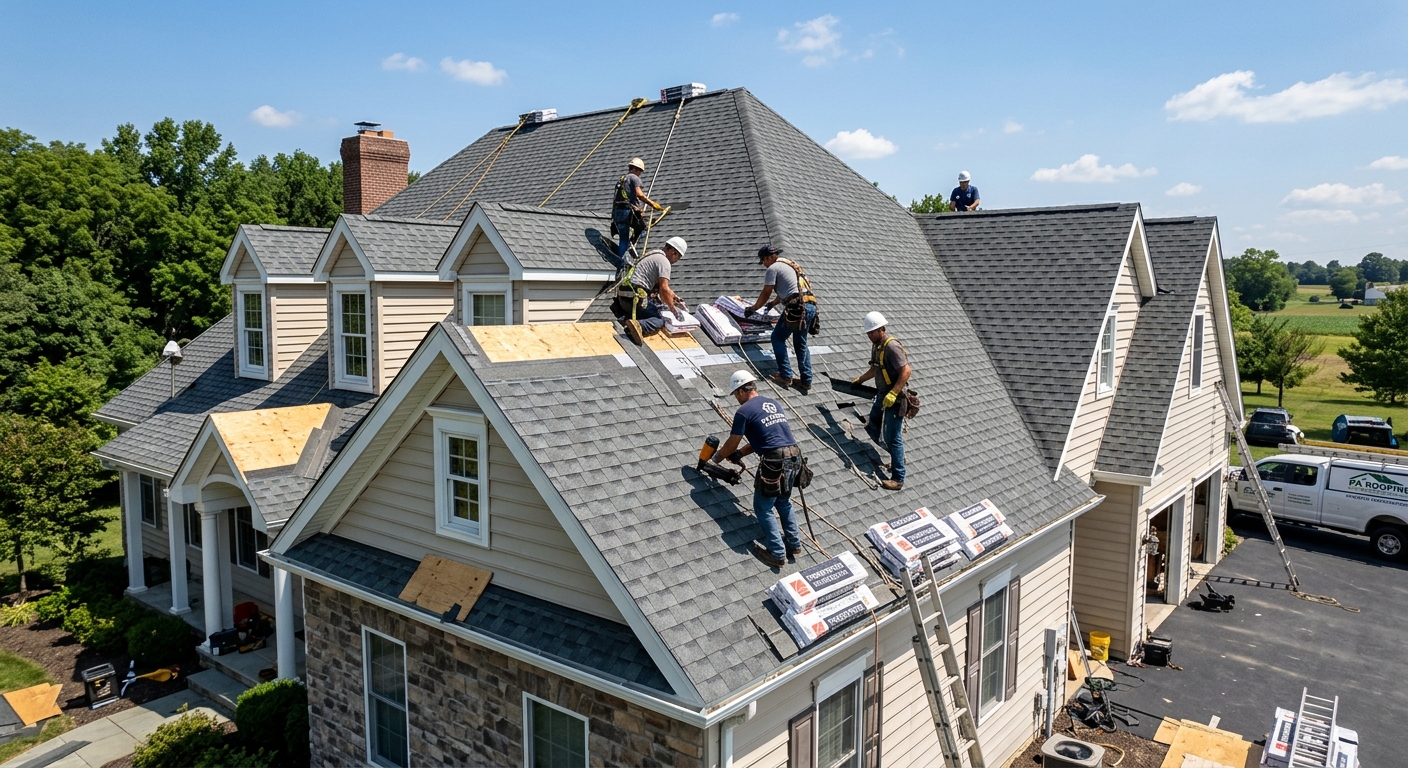
Carnegie roofing prices by material and scope — 2026
Carnegie, set in Allegheny County’s supply-rich roofing market, sees prices shaped by its older housing stock and the area’s mix of blue-collar and mid-income households. With a median household income of $61,875 and over 83% of homes built before 1980 (U.S. Census Bureau, ACS 2024), roof jobs here often involve more than just shingles—deck repairs and full tear-offs are frequent, especially when original materials must come off to reveal what’s underneath. If your home falls into that common 1900–1950 vintage, expect surprises with decking and carpentry. Labor isn’t easy to cut, as many Carnegie roofs are steep and complicated by hilly lots and freeze-thaw cycles that speed up deterioration. Suppliers stock architectural shingles because they stand up to these conditions without outpricing most local owners.
| Material / Scope |
Lifespan |
Best for |
Price range (installed) |
| Asphalt shingles — architectural (30-yr) |
25–30 yrs |
Most homes; solid value and code compliance |
$8,900–$19,000 |
| Asphalt shingles — impact-resistant (Class 4) |
30+ yrs |
West-facing slopes, wind-exposed areas |
$14,500–$19,000 |
| Metal standing seam |
40–70 yrs |
Long-term owners, snow control |
$21,500–$38,500 |
| Flat roof — TPO or EPDM |
15–25 yrs |
Row house additions, low-slope porches |
$11,500–$22,500 |
| Roof repair — leak or isolated section |
n/a |
Small leaks, flashing, tabs lost to wind |
$475–$1,800 |
Prices are estimates for a typical Carnegie home and vary with roof size, pitch, decking condition and material selection.
Timing a roof replacement in Carnegie
Carnegie’s roofing season is shaped by short springs, muggy summers, and the relentless freeze-thaw swings of southwestern Pennsylvania. Proper shingle installs depend on temperatures consistently above 40°F, usually April through early November. Asphalt shingles seal best when overnight lows are above 50°F, so early summer and September are the sweet spots for work—long daylight, less rain, and shingles that settle tight before winter. Fall is popular: everyone wants a watertight roof before Halloween storms hit. That popularity means the best local crews book out weeks ahead from late August through October in this saturated Greater Pittsburgh metro, so calling in mid-summer for a fall spot is smart.
Emergency jobs—like leaks in February—always cost more. Winter installs are slower: ice means hand-loaded shingles, patch repairs over full replacements, and crew safety precautions. Material deliveries get delayed, and shingle warranties can be void if installed too cold. By contrast, an early fall replacement might land you better scheduling and ideal weather—without paying premium “emergency” labor rates. Bottom line: if you want choice of contractor and best pricing, line up work between late spring and early fall and schedule a walk-through instead of calling last-minute after the first big storm.
How to compare roofing quotes in Carnegie
For a Carnegie homeowner, clear quoting is critical. Every estimate should start with the roof area in “squares”—each is 100 square feet—and state the pitch, as steep roofs run higher on labor. Make sure the tear-off (removal of old shingles or layers) and dumpster disposal are listed separately, since old homes here often have two or three layers that need to go. Underlayment and any ice and water protection should be named by brand and location (e.g., full eaves, valleys, dormers), and you should see a per-sheet price for any needed wood decking replacement. This matters in our area, where 80-year-old sheathing is common—repairs here add up fast.
Keep an eye on how warranties are written: the length of coverage for workmanship versus the shingle manufacturer’s policy. Payment schedules should favor the owner—a deposit of 15% or less is fair; don’t hand over most of the cost up front. If a quote bundles all work into a single lump sum or gives vague product specs (“synthetic felt”), it’s hiding potential gaps. The best quotes let you compare—square for square.
| Line item |
What to look for |
Red flag if… |
| Roof area |
stated in squares, with pitch |
no measurement given |
| Tear-off and disposal |
number of layers, dumpster included |
bundled into one figure |
| Underlayment |
product type and coverage |
listed only as 'felt' |
| Ice and water shield |
coverage height at eaves |
omitted entirely |
| Decking |
per-sheet contingency price |
no allowance at all |
| Warranty |
workmanship years stated separately |
only the shingle warranty |
| Payment |
deposit under 15%, balance on completion |
large upfront cash |
Asphalt, metal or membrane — what suits a Carnegie roof
Carnegie’s climate is classic southwestern Pennsylvania—winter design temperatures are 8°F and snow loads hit 30 pounds per square foot. Architectural asphalt shingles lead for a reason: reasonable install cost, good for the freeze/thaw cycles, and easily available from Pittsburgh-based suppliers. That’s why they cover most homes here, especially since older framing and deck can support their weight just fine. Class 4 impact-resistant shingles are an upgrade for wind-exposed homes but not a necessity unless your insurance gives a break; they don’t add much lifespan in normal local conditions.
Metal (standing seam) sheds snow fast, so it’s smart for low-pitch or unshaded north slopes, but the initial outlay runs about double asphalt. Unless you plan to stay for decades or have a snow-drifting porch that leaks each year, metal’s not a must-have in our market. Flat roofs—on porch add-ons and row house rear ells—take either TPO or EPDM membrane. These handle ponding water and cope with winter just fine but do need regular checkups to avoid seam failures.
| Material |
Installed cost |
Lifespan |
Cold-climate performance |
Maintenance |
| Asphalt architectural |
$8,900–$19,000 |
25–30 yrs |
Good; handles snow and freeze-thaw |
Annual gutter/flash inspection |
| Asphalt Class 4 impact-resistant |
$14,500–$19,000 |
30+ yrs |
Better resistance to hail/wind |
Same as above |
| Metal standing seam |
$21,500–$38,500 |
40–70 yrs |
Sheds snow exceptionally well |
Inspect fasteners every 5 yrs |
| TPO / EPDM membrane |
$11,500–$22,500 |
15–25 yrs |
Handles ponding; seams weakest point |
Annual surface check, seams resealed at 10 yrs |
Roofing permits in Carnegie: what you need before work starts
Roofing replacement in Carnegie follows the Pennsylvania Uniform Construction Code (UCC), which is based on the IRC and enforced locally. In Pittsburgh—the county seat and code authority for much of Allegheny County—the Department of Permits, Licenses, and Inspections oversees enforcement. Here’s what matters: if more than 50% of your roof’s surface is being replaced, a building permit is usually required. Small, like-for-like shingle repairs to minor areas may not need a permit, but if you’re re-roofing the whole house or a major portion, your contractor must pull one before work starts.
Contractors performing jobs over $500 must have Home Improvement Contractor (HIC) registration through the Pennsylvania Office of Attorney General. You can verify this at hic.attorneygeneral.gov, and you should ask to see proof during the bidding process. All employers in Pennsylvania must carry workers’ compensation insurance—verify via the WCAIS system at wcais.pa.gov before signing. These protections guarantee that contractors carry real coverage and are accountable, giving you documentation and peace of mind if anything goes wrong mid-project. No additional trade license beyond HIC registration is required for roofing work in this state.
Repair or replace? A decision guide for Carnegie roofs
Carnegie’s housing stock, mostly built before 1980, means many roofs are already on their second or third generation. If your architectural shingle roof is under 15 years old and there’s a single leak—say, a bad flashing or a branch puncture—repair is economical at $475–$1,800. But when a 20-year-old roof starts leaking in multiple spots, especially after freeze-thaw wear, repairs become false economy. For example, three small patched leaks over a year at $1,200 each quickly hit $3,600—money that would have gone toward a full $14,500 replacement, adding decades of peace of mind and solving hidden deck damage.
Active leaks at 25+ years almost always signal it’s time to replace. Storm, hail, or wind damage? Document and get a claim rolling—you’ll likely get a new roof, not just a patch. Flat roofs in town that show ponding or membrane blisters should get a full membrane replacement, not just surface sealer. The only time a band-aid is wise: an emergency winter leak, where a tarp buys you time to schedule a real fix come spring. Older roofs, especially in Carnegie’s 1900–1950 homes, often mask rot and hidden damage, which means a full tear-off is safer long term.
| Situation |
Recommendation |
Typical cost |
Reasoning |
| Under 15 years, one isolated leak |
Repair |
$475–$1,800 |
Roof still in its working life; repairs hold |
| 15–25 years, several leak points |
Replace |
$8,900–$19,000 |
Patching becomes recurring expense; system failing |
| 25+ years, any active leak |
Replace now |
$8,900–$19,000 |
Repairs seldom last on aged roofs |
| Storm damage, wind or hail |
Document, claim, replace |
$8,900–$19,000 |
Insurance may cover full replacement |
| Flat roof ponding or blistering |
Replace membrane |
$11,500–$22,500 |
Surface issues signal broader failure |
| Active leak entering winter |
Emergency repair, schedule replacement |
$475–$1,800 |
Quick fix now; plan for full work in warm weather |
What insurance covers on a Carnegie roof
When storms roll through Carnegie on their Ohio Valley tracks, insurance coverage kicks in for sudden and accidental roof damage—think wind tearing tabs or hail impacting asphalt. The first step is always documentation: take clear photos before cleanup, especially if tarps or emergency patching are needed. Don’t let a contractor remove debris until your insurer has seen the damage or an adjuster has done their inspection. The insurance company will produce a written “scope of loss,” which you should review line by line against your contractor’s estimate.
Most local policies pay “actual cash value” first—replacement cost minus depreciation. Once you show proof the roof is replaced and paid in full, you collect the balance (the “recoverable depreciation”) if you carry replacement cost coverage. You pay your deductible out of pocket. Pennsylvania law prohibits roofers from waiving or “eating” your deductible. If someone offers to do so, find another contractor—this is a violation of the Home Improvement Consumer Protection Act and a sign you’ll see further corners cut. Legitimate companies know the rules and do everything by contract, protecting both you and your claim. Prompt, accurate paperwork is your best bet for a fully funded, code-compliant new roof in Carnegie.
Frequently asked questions — roofing in Carnegie
How much does a new roof cost in Carnegie?
A new roof in Carnegie, using architectural asphalt shingles, typically runs $8,900–$19,000 installed, with most homes falling around $14,500. This range reflects the size and complexity of housing here, especially since over 83% of the homes were built before 1980 and may need deck repairs or full tear-off of old layers. More premium materials—like standing seam metal—start at $21,500 and can reach $38,500. Homes with steeper roofs, porches, or complex valleys tend toward the upper end. Comparing estimates line by line and asking about deck replacement is key, as older homes may have hidden issues that aren’t obvious until work begins.
Is a metal roof worth the extra cost in Carnegie?
Metal roofing, usually standing seam, costs significantly more upfront—$21,500–$38,500 installed versus $8,900–$19,000 for asphalt. In Carnegie’s climate, metal sheds snow very well and stands up to our freeze-thaw conditions. If you plan to stay in your home for 30 years, or if you deal with repeated snow and ice buildup on a low-pitch or exposed roof, metal can be worth the premium. But for most typical homes—especially those with older frames and no chronic ice damming—a good architectural shingle roof is more than capable. Most local owners lean toward asphalt and only rarely opt for metal unless longevity or specific snow issues justify the extra expense.
Does Carnegie get enough hail to justify Class 4 shingles?
Severe hail isn’t a frequent event in the Carnegie area, even though Allegheny County does see storms pass through. Class 4 impact-resistant shingles cost more, usually $14,500–$19,000 installed, and provide enhanced protection against hail impact and wind-driven debris. If your home is especially exposed—west-facing slopes, or if your insurer offers a substantial premium reduction—Class 4 makes sense. For most owners, standard architectural shingles are enough, as damage from hail is not a chronic issue. Insurance might pay for replacement after a covered event regardless of shingle rating, so upgrade only if the price is right for your specific situation.
How long do architectural shingles last compared to 3-tab?
Architectural shingles, which are standard in Carnegie today, offer a 25–30 year lifespan, sometimes more with quality ventilation and installation. Older-style 3-tab shingles—less common now—rarely last beyond 15–20 years, especially when exposed to our 30 psf snow loads and repeated freeze-thaw cycles. Price-wise, architectural shingles in Carnegie run $8,900–$19,000 installed, but they hold up much better against wind and weather than 3-tab. While 3-tab might save a little upfront, the need to re-roof sooner, along with more frequent repairs, means architectural shingles are a better value for local homes, especially given the housing era here.
Do I need a permit to replace a roof in Carnegie?
In Carnegie, which falls under Pittsburgh’s code authority in Allegheny County, a building permit is required for roof replacement if more than 50% of your roof area is being replaced. Small, like-for-like shingle repairs over limited areas usually do not require a permit. It’s your contractor’s job to pull the permit, which is enforced by the Department of Permits, Licenses, and Inspections. Make sure your contractor has HIC registration (verify this at hic.attorneygeneral.gov) and workers’ comp insurance (check at wcais.pa.gov). Permitting is more than red tape—permits guarantee inspections, which help protect you from substandard or out-of-code work.
How long does a roof replacement take in Carnegie?
Most Carnegie roof replacements take one to three working days for an average-sized home using architectural shingles, costing between $8,900–$19,000. Complexity, weather, and age can stretch this out: if decking repairs are needed (common in older homes around town), expect extra time for carpentry and inspections. Summer and fall are busiest, so crews can be scheduled out several weeks, especially after storms. In winter, remote scheduling and weather delays are common since safety slows everything down. Communicate closely with your contractor about timeline, but expect two days to be typical with cooperative weather.
Should I use a local roofer or a national company?
In Carnegie and greater Allegheny County, the market is saturated with both local outfits and chain brands, but there are advantages to staying local. A Carnegie-based roofer often knows the quirks of 1900–1950 homes, local code enforcement, and the right approach for our clay/shale subgrade and steep lots. Local contractors use reliable area suppliers and are easier to hold accountable if something goes wrong. National companies may sub out work, and warranty service can be harder to chase. Always check HIC registration and insurance regardless—local or national—and compare detailed bids line by line for prices in the $8,900–$19,000 range for shingles, to keep your comparison fair and region-specific.
Do I need my own inspection before the adjuster visits?
After a storm in Carnegie, having your roofer inspect and document damage before the insurance adjuster arrives is a solid move. A contractor familiar with local roofing—costs from $475–$1,800 for repairs—can spot less-visible issues and help you make a thorough claim. Bring in someone with HIC registration who knows local construction. Photos, written notes, and a professional’s summary mean you’re prepared to compare the adjuster’s “scope of loss” to what really needs doing. Just avoid any contractor who wants payment before work is done, especially on storm claims—a local pro will accept payment when you’re satisfied and the insurance check arrives.
Is a sagging roof line an emergency?
Yes, a sagging roof in Carnegie is an immediate safety concern, especially with our old housing stock (over 83% built before 1980). The cause could be rotted deck, broken rafters, or long-term water damage—all of which can lead to collapse, particularly with a 30 psf snow load coming. Emergency stabilization or tarping is usually in the $475–$1,800 range, but permanent repair or replacement can reach $8,900–$19,000 or more depending on structural fixes. Don’t delay: call a roofer with proper HIC registration and ask them to document everything for potential insurance involvement. Waiting only multiplies the damage and the cost.