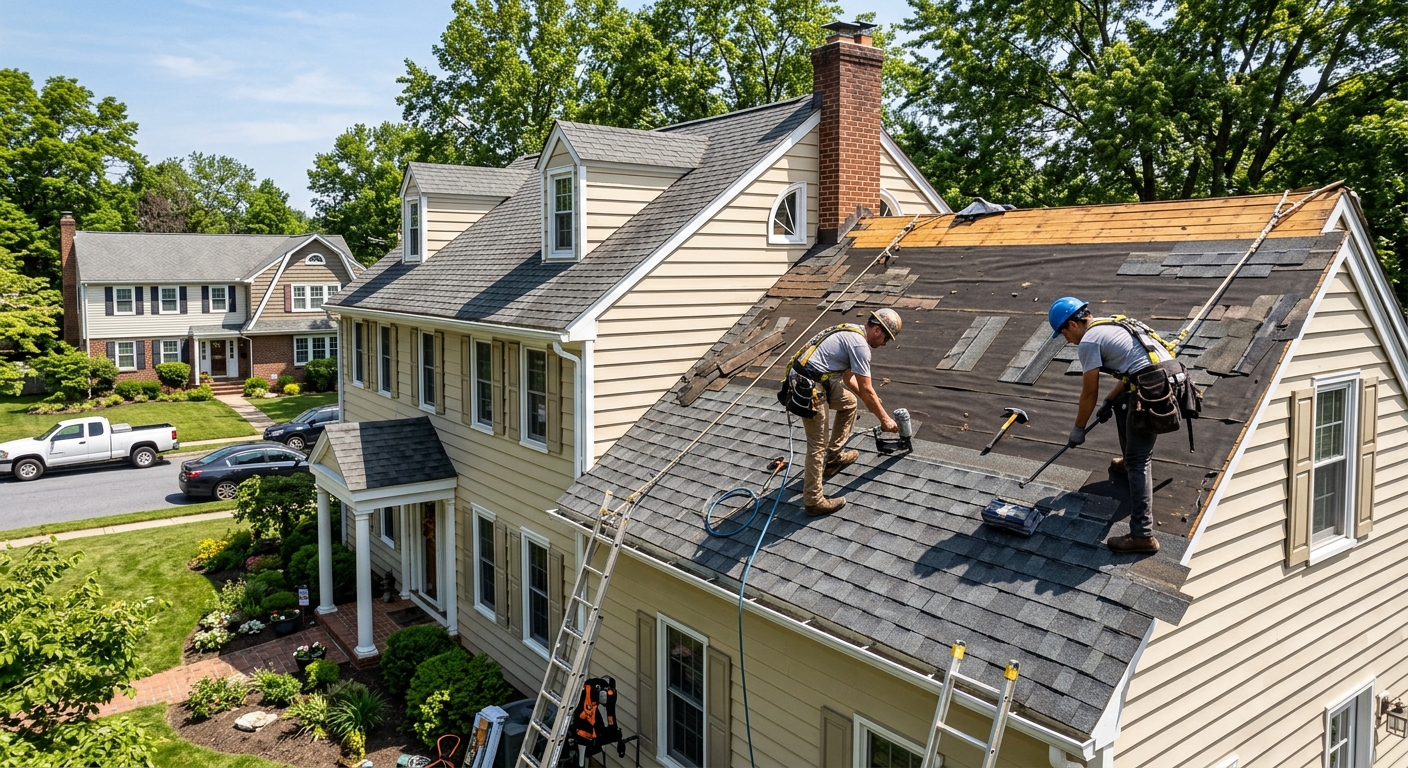
Roofing Replacement & Repair costs in Lower Allen — 2026
Homeowners in Lower Allen face distinct roofing costs because most properties here are single-family homes built before 1980 in large, postwar subdivisions (U.S. Census Bureau, ACS 2024). Not only does this mean that more than half the roofs are at, or approaching, their second or third replacement cycle, but the median household income of $84,511 supports investment in longer-lasting options where warranted.
The post‑1950 suburban tracts around Hampden and Silver Spring Townships shape the market in Lower Allen. These developments, built with composite asphalt shingles as the default, now need full tear-offs and upgrades—especially as original materials reach the end of their viable lifespan. This steady churn drives roofing demand and makes labor, supply, and pricing extremely predictable for contractors familiar with this area.
Storm-driven repairs are common—ridge-line winds funneled along the Cumberland Valley means isolated damage is frequent, but most properties still replace on a regular cycle. Below is what you can count on spending for different materials and job scopes in Lower Allen:
| Material / Scope |
Lifespan |
Best for |
Price range (installed) |
| Asphalt shingles — architectural (30-yr) |
25–30 yrs |
Standard single-family homes, updates from original 3-tab |
$9,600–$20,500 |
| Asphalt shingles — impact-resistant (Class 4) |
30+ yrs |
Locations with frequent wind or minor hail |
$15,500–$20,500 |
| Metal standing seam |
40–70 yrs |
Exposed ridge sites, longevity |
$23,500–$41,500 |
| Flat roof — TPO or EPDM |
15–25 yrs |
Low-slope sections, porch or addition roofs |
$12,000–$24,500 |
| Roof repair — leak or isolated section |
n/a |
Local damage, not full replacement |
$500–$1,950 |
Prices are estimates for a typical Lower Allen home and vary with roof size, pitch, decking condition and material selection.
When a Lower Allen roof is worth repairing — and when it isn't
The decision to repair or replace your roof in Lower Allen should hinge on the age of the current roof, type of leak, and the long-term cost curve. With more than half of homes here built before 1980, many roofs are on their second or third covering, making big patchwork or over-layering rare and rarely advisable.
For a roof under 15 years old with a single, isolated leak—often the result of flashing failure or a small puncture—repair makes sense. Once your roof is between 15 and 25 years old and developing multiple leaks, replacement is almost always the right choice. The cost of two repairs—let’s say $1,200 each for leak patching—quickly exceeds the value of investing that $2,400 toward a new, warrantied system (often from $9,600–$20,500).
Storm or wind damage may be covered by your insurance carrier if well documented. Flat roofs in particular, because of our freeze-thaw cycles and ponding risk, should be replaced, not patched, once blisters or membrane failure appear. If an active leak occurs right before winter, emergency repair can buy time until a replacement can be properly scheduled after snow season.
| Situation |
Recommendation |
Typical cost |
Reasoning |
| Under 15 years, one isolated leak |
Repair |
$500–$1,950 |
Roof should have remaining life; spot fix is cost-effective. |
| 15–25 years, several leak points |
Replace |
$9,600–$20,500 |
Multiple failures suggest system-wide fatigue. |
| 25+ years, any active leak |
Replace now |
$9,600–$20,500 |
Repair costs overtake new roof; risk of major water damage increases. |
| Storm damage, wind or hail |
Document, claim, replace |
$9,600–$20,500 |
Insurance may defray cost; shingle roofs rarely recover from torn sections. |
| Flat roof ponding or blistering |
Replace membrane |
$12,000–$24,500 |
Repairs rarely hold in freeze-thaw cycles and do not address underlying failure. |
| Active leak entering winter |
Emergency repair, schedule replacement |
$500–$1,950 |
Short-term safety until a full replacement can be performed in spring. |
Permits and code requirements in Lower Allen
Roofing work in Lower Allen Township is governed by the Pennsylvania Uniform Construction Code (UCC), which is based on the IRC and enforced by municipalities or by the PA Department of Labor & Industry in municipalities that have opted out. For residential roof replacements—removal of existing shingles and installation of new material—a permit is required. Overlay (roofing over existing shingles) requirements can vary, but most full tear-offs in Cumberland County subdivisions trigger inspections to ensure structural decking compliance, especially given the age profile of homes here.
Roofing contractors working on jobs over $500 must hold a Home Improvement Contractor (HIC) registration, issued by the Pennsylvania Office of Attorney General. Homeowners can and should verify their contractor’s HIC registration status at hic.attorneygeneral.gov. Proof of active workers’ compensation coverage is mandatory for all employers and must be checked via the WCAIS system at wcais.pa.gov. A written contract is required for projects above $500 under the Home Improvement Consumer Protection Act (HICPA), and homeowners have a three business-day right of cancellation.
There is no trade-specific roofing licence in Pennsylvania—only the HIC registration applies for roofers. For homes built before 1978, ensure your contractor is certified for work under the EPA’s Lead RRP Rule; certification can be verified at certifiedrenovatorsearch.epa.gov.
Reading a roofing estimate line by line
A proper roofing estimate in Lower Allen should lay every detail bare—anything less is a warning sign. Most homes in the township measure between 18 and 28 squares, but always look for a square count and exact pitch stated on the quote: this is your baseline for comparing contractors. Tear-off and disposal should be line-itemed, stating exactly how many layers are being removed and whether a dumpster is provided.
Underlayment, ice and water shield, and flashing types must be specified by product name or rating; a quote reading “felt” and nothing more hides the difference between a 15-pound builder grade and a real synthetic underlayment. Decking replacement should be priced as a per-sheet allowance, not a lump unknown—you can’t predict rot until the shingles are off. Warranties come in two forms: workmanship (the labor) and manufacturer (the shingle). These need to be listed separately. On payment, standard practice is a modest deposit (usually under 15%), with the remainder due on satisfactory completion.
If any of these details are missing or guessed at, the estimate cannot be trusted. A lump sum without a square count isn’t comparable and almost always covers hidden scope or unnecessary markup.
| Line item |
What to look for |
Red flag if… |
| Roof area |
stated in squares, with pitch |
no measurement given |
| Tear-off and disposal |
number of layers, dumpster included |
bundled into one figure |
| Underlayment |
product type and coverage |
listed only as 'felt' |
| Ice and water shield |
coverage height at eaves |
omitted entirely |
| Decking |
per-sheet contingency price |
no allowance at all |
| Warranty |
workmanship years stated separately |
only the shingle warranty |
| Payment |
deposit under 15%, balance on completion |
large upfront cash |
Choosing a roofer in Cumberland County
In Lower Allen and the wider Cumberland County market, due diligence is straightforward — skip it at your peril. Every roofer working a contract over $500 must have a current Home Improvement Contractor (HIC) registration, which you should check at hic.attorneygeneral.gov. Workers’ compensation insurance is legally required; verify the current policy at wcais.pa.gov. If your house is pre-1978, use certifiedrenovatorsearch.epa.gov to confirm that your contractor’s lead certification is current for the EPA Lead RRP Rule.
- Confirm HIC registration is valid and matches the company/owner name.
- Use wcais.pa.gov to verify active workers’ compensation coverage.
- Request written documentation of liability insurance.
- Demand a contract before any deposit; required by state law above $500.
- Look for local references from work in Lower Allen or nearby townships.
- Require manufacturer documentation on shingle or metal system to be installed.
- Request a written scope including number of squares, type of underlayment, flashing and vent details.
- Ask for itemized allowance for decking repair (per-sheet pricing).
- Review and compare warranty terms—labor and material detailed separately.
- Only pay a modest deposit (under 15%) with balance due after job passes inspection.
- Never sign anything from a company that cannot show their HIC card on-site.
- If your home is pre-1978, require proof of EPA Lead Renovator training for all crew leads.
Red flags in this highly competitive market include: roofers who solicit door-to-door right after storms, companies with no verifiable HIC registration, addresses that do not match the Harrisburg–Carlisle region, requests for large upfront or cash payments, or estimates with no address, no square count, or no warranty breakdown.
Asphalt, metal or membrane — what suits a Lower Allen roof
Lower Allen homes contend with a ground snow load of 30 psf and a winter design temperature of 12 °F, making ice dams and freeze-thaw cycles real concerns. Asphalt architectural shingles are by far the most common because the original tract homes were built to spec with these materials, and local crews are experts at fast, code-compliant replacements that fit the budget of most single-family homeowners. Metal roofing costs more up front, but outlasts everything and sheds snow completely—a benefit on exposed ridge sites, but an upside often lost on standard subdivisions where appearance and cost matter most.
Membrane roofs (TPO or EPDM) are confined to flat or low-slope porch and addition roofs. They are essential where shingles won’t seal reliably in freeze-thaw but are too expensive and fussy for typical pitched sections here.
Asphalt dominates because the postwar tract homes are built for its weight and fastening, supply is reliable from the Harrisburg–Carlisle metro, and newer impact-resistant options extend seasons between replacements. Metal is worth the extra up-front cost only if you absolutely need a 40+ year solution and can justify the investment—not for most homes here. Membrane should be reserved for flat sections where it’s functionally unavoidable.
| Material |
Installed cost |
Lifespan |
Cold-climate performance |
Maintenance |
| Asphalt architectural |
$9,600–$20,500 |
25–30 yrs |
Handles 30 psf snow; ice dams need barrier at eaves |
Annual visual check, clear gutters |
| Asphalt Class 4 impact-resistant |
$15,500–$20,500 |
30+ yrs |
Better granule retention, withstands wind gusts |
Fewer blow-offs; handles minor hail |
| Metal standing seam |
$23,500–$41,500 |
40–70 yrs |
Sheds snow entirely; zero freeze-thaw risk |
Paint touch-up every 20+ years |
| TPO / EPDM membrane |
$12,000–$24,500 |
15–25 yrs |
No granules to lose, good for flat roofs and ponding |
Annual seam check, patch if needed |
Why two Lower Allen roofing quotes can differ by 40%
It's common to see a swing of up to 40% between roofing quotes in Lower Allen, and the differences almost always trace back to clear, local factors. Most post-1950 homes in this township have roof areas between 18 and 28 squares. Material choice alone generates a massive span; architectural asphalt from $9,600–$20,500, while metal runs much higher. But that's just the starting point.
Roofing crews here know our Cumberland Valley ridge winds and 30 psf snow load call for more robust installation practices, especially on homes with older sheathing or visible sag in the decking. That means more ice barrier at the eaves (adding $300–$800 for the proper width), extra labor for steep pitches, or additional time and disposal for two layers of old shingles. A property on a higher ridge will often see upcharges in labor and sometimes require Class 4 impact-resistant upgrades.
Decking replacement is another surprise factor: at $75 to $150 per sheet, even an average-size roof can unexpectedly climb by more than $1,000 if rot is found. Some quotes hide these costs as contingencies; others bake them in expecting every sheet will be needed.
| Factor |
Why it matters here |
Cost impact |
| Roof size in squares |
each square is 100 sq ft of roof surface |
primary multiplier |
| Pitch and access |
steep pitches need harnesses and slow the crew |
+20–30% labour |
| Existing layers to tear off |
two or more layers means full tear-off and disposal |
$500–$1,500 per layer |
| Decking condition |
rot is found during tear-off, not before |
$75–$150 per sheet |
| Ice barrier at eaves |
required where ice damming has a history |
$300–$800 |
| Material grade |
3-tab vs architectural vs Class 4 impact-resistant |
$500–$2,500 |
Frequently asked questions — roofing in Lower Allen
What is the difference between replacement cost and actual cash value?
Replacement cost is the amount your insurance will pay to replace your roof with a new one of similar kind and quality—no depreciation deducted. Actual cash value, on the other hand, pays only what your old roof is worth today after years of use, which for many Lower Allen homes built before 1980, can be half or less of a new install. So, if your asphalt shingle roof costs $15,500 to replace but the current roof is 20+ years old, the insurer may offer actual cash value more around $7,500 or lower, which leaves you with a big out-of-pocket gap. Always review your homeowner’s policy (actual cash value is cheaper coverage for good reason), and confirm with your adjuster—especially after a hail or wind claim here in Cumberland County.
Does Lower Allen get enough hail to justify Class 4 shingles?
While direct hail claims are less frequent in Lower Allen than in the open fields west toward Carlisle, the township does see enough wind-driven hail and ridge-line gusts to justify Class 4 impact-resistant shingles in exposed sections. These shingles cost more upfront—typically $15,500–$20,500 vs standard architectural—but can help with insurance discounts and reduce repair frequency. If you have mature trees or a roof slope pointed East-West into storm tracks, consider Class 4. For tightly clustered subdivisions without major tree canopy or wind exposure, standard architectural shingles often suffice. In practice, most damage claims here are wind or blow-off related, not direct hail impact.
What underlayment should be used on a Lower Allen roof?
For a Lower Allen roof, especially one subjected to the freeze-thaw cycle and a 30 psf ground snow load, you’ll want a modern synthetic underlayment as the base—lighter, tougher, and more resistant to water than old asphalt felt. Code here (UCC) requires an ice and water barrier along the eaves—critical for homes prone to ice damming, particularly those with low-sloped eaves common in postwar tracts. The upgrade costs are modest: ice and water shield adds about $300–$800 for a typical roof. For older homes, never accept a quote that specifies only “felt”; ask for specific synthetic and the width of ice barrier coverage.
What should a roofing quote include in Lower Allen?
In Lower Allen, a compliant roofing quote should specify roof area in squares and pitch, detail the number of layers to tear off, and separately itemize underlayment type and coverage. Flashing, vent boots, and the scope of ice and water shield at the eaves must all be clearly named. There should be an explicit per-sheet decking replacement allowance—expect $75–$150 per sheet stated up front. Warranties should list both workmanship (install labor) and manufacturer (material) duration, and payment terms should call for a deposit under 15% with balance at completion. Quotes missing these specifics or lumping all costs without breakdown open the door to change orders and headaches.
How much does a new roof cost in Lower Allen?
A new asphalt shingle roof on a typical Lower Allen home will cost between $9,600–$20,500, with most running around $15,500 for an architectural 30-year system. Upgrades to Class 4 impact-resistant or metal standing seam will increase those numbers. Costs include tear-off, underlayment, ice and water shield at the eaves, new flashings, and disposal. Factors unique to our housing era—such as existing decking condition or steep pitches—can move a replacement toward the higher end of the local range, as does the presence of double shingle layers or porch/rear additions with flat membrane sections.
Why is my Lower Allen roofing quote higher than the online average?
Online roofing averages rarely factor in the specific climate and housing stock of Lower Allen. Our region’s pronounced freeze-thaw cycles, 30 psf snow load, and the average age of homes mean that local estimators will assume more ice barrier, higher labor for steep pitches, and contingency for fixing decking. Also, the region’s storm exposure—especially in open, ridge-built tracts—often results in above-average costs for code-compliant labor and materials. Quotes here for a full architectural shingle roof typically land between $9,600–$20,500, not including surprises from unknown decking or gutter repairs. If your roof is two layers or older sheathing is found, costs can climb quickly—numbers many national averages exclude.
How do I know if my Lower Allen roof needs replacing?
If your Lower Allen roof is showing curling shingles, missing tabs, or granules in the gutters—and especially if it’s more than 20–25 years old—replacement is likely due. Leaks at flashing, ceiling stains, or ice dams in winter are all warning signs for our climate. Repeated spot repairs (each around $500–$1,950) quickly add up, and if multiple leaks appear, it’s often more cost-effective to invest that money in a full replacement instead of patchwork. Original shingle roofs on the postwar homes in Lower Allen are well past their expected lifespan, so delaying only increases the risk of hidden water damage and costly deck repair.
Do I need to leave my house during a roof replacement?
In most cases, Lower Allen homeowners do not need to leave during a standard shingle or even metal roof replacement. Crews will start early, and there will be significant noise and vibration overhead, but you can remain inside if you’re comfortable with temporary disruption. For more complex jobs or if sensitive individuals are present (very young children, pets, anyone sensitive to noise), consider being out during working hours. For an average replacement (costing $15,500), the job is usually completed within two days, weather permitting. For flat roof or multiple materials, adding a day is common, but departures are never required by code or best practice.
Is ice barrier underlayment required in Lower Allen?
Yes—given Lower Allen’s pronounced freeze-thaw and a snow load design of 30 psf, code enforced under the Pennsylvania UCC requires ice and water shield at the eaves. This applies to all residential reroofs and especially to homes with roof valleys, low-slope sections, or a history of winter ice damming. Upgrading to a full-width ice barrier at all critical spots typically costs an additional $300–$800 for an average job, but is essential for preventing costly winter leaks and is required for permit and inspection sign-off in Cumberland County jurisdictions.