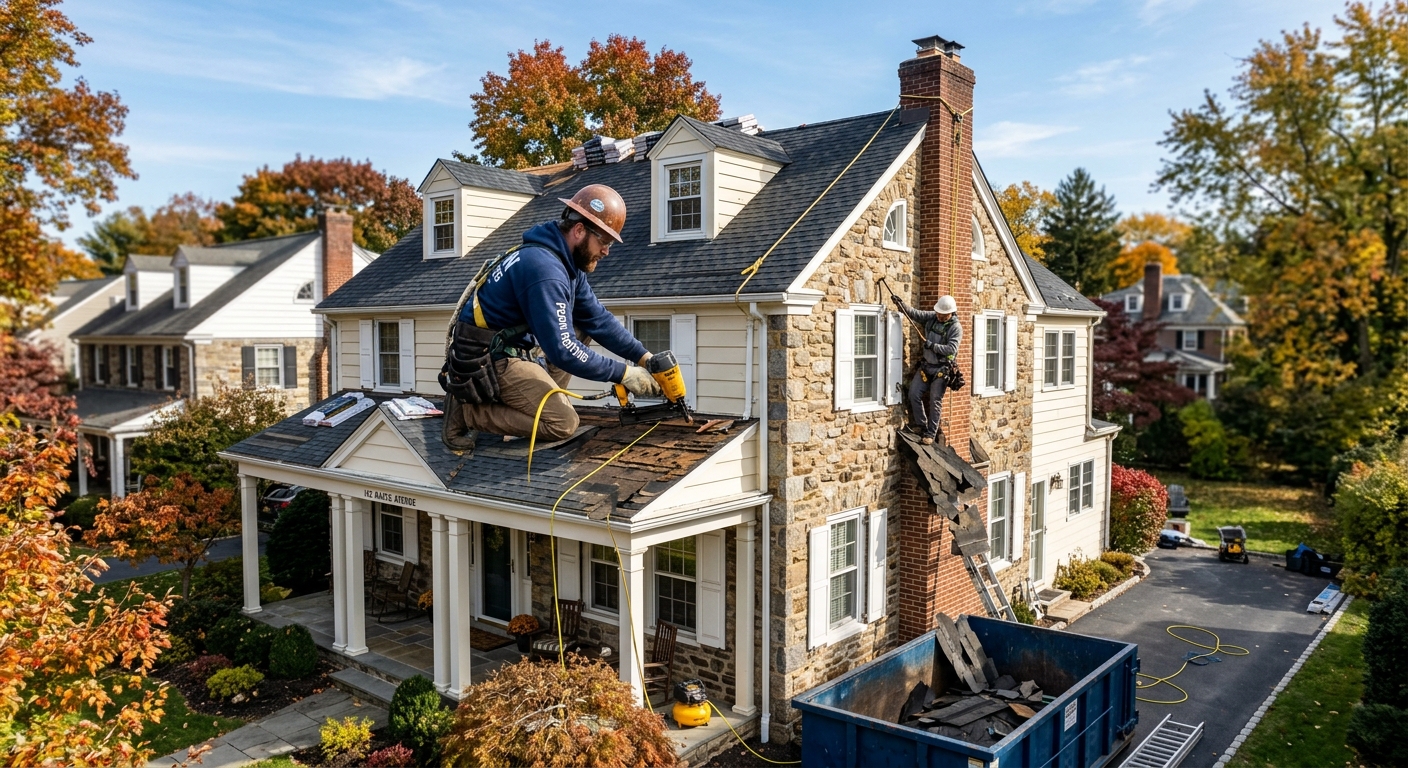
Roofing Replacement & Repair costs in South Park — 2026
For most homeowners in South Park, roofing decisions are shaped by the area’s older housing stock and local incomes. With 70.8% of homes built before 1980 and a median household income of $94,125 (U.S. Census Bureau, ACS 2024), many South Park residents face the reality that old roofs often hide issues beneath the shingles. In much of Allegheny County, including South Park, homes dating from 1900–1950 see frequent roof tear-offs and surprise deck repairs—especially where multiple layers have accumulated over decades. This makes the "typical" roof job less predictable and sometimes pricier than in neighborhoods with newer builds. Flat roof sections on mid-century homes and additions increase the use of TPO and EPDM membranes, which require a different cost structure than pitched shingle-over-wood work. Insurance claims also spike after storms, as the Ohio Valley storm track brings wind and the occasional hail, further taxing these older structures.
The sheer number of owner-occupied, single-family homes in South Park means asphalt shingles—architectural or Class 4 impact-resistant—are the most common re-roof. But as deck repairs under old layers are common, preparing a realistic budget is critical. Here are the price ranges you can actually expect to see in South Park for 2026:
| Material / Scope |
Lifespan |
Best for |
Price range (installed) |
| Asphalt shingles — architectural (30-yr) |
25–30 yrs |
Most South Park homes |
$10,000–$21,000 |
| Asphalt shingles — impact-resistant (Class 4) |
30+ yrs |
Areas with regular hail or wind claims |
$16,000–$21,000 |
| Metal standing seam |
40–70 yrs |
Long-term owners who want lower maintenance |
$24,000–$43,000 |
| Flat roof — TPO or EPDM |
15–25 yrs |
Sections over low-slope sunrooms, garages |
$12,500–$25,000 |
| Roof repair — leak or isolated section |
n/a |
Small leaks, localized flashing or blow-off |
$500–$2,000 |
Prices are estimates for a typical South Park home and vary with roof size, pitch, decking condition and material selection.
What moves the price of a roof in South Park
South Park’s roofing prices don’t just come down to the score footage or the choice of shingle. Many homes here are approaching — or well past — their third or fourth re-roof, thanks to the region’s long-standing housing stock. With an average full asphalt shingle replacement running $10,000–$21,000, some homeowners are surprised when their final invoice climbs due to deck rot discovered after tear-off, or because two or even three old shingle layers need to be removed. Each layer adds both dumpster costs and labor, commonly ringing up an extra $500–$1,500 per layer on top of the estimate.
Roof pitch also plays a bigger role here than most realize. South Park’s hilly terrain means access can be tricky, and steep roof angles—common in the area—demand crew harnessing, slower production, and higher labor cost. Expect a steeper roof to add 20–30% to the labor side of your bid. The region’s 30 psf ground snow load requires ice barrier at the eaves. Skipping this step is a false economy, as ice damming is an annual headache and proper eave protection typically adds $300–$800. Material grade is another driver. While a basic architectural shingle is standard, homeowners concerned with hail exposure from Ohio Valley storms often step up to impact-resistant Class 4 shingles, adding about $500–$2,500 more for a typical South Park home.
| Factor |
Why it matters here |
Cost impact |
| Roof size in squares |
each square is 100 sq ft of roof surface |
primary multiplier |
| Pitch and access |
steep pitches need harnesses and slow the crew |
+20–30% labour |
| Existing layers to tear off |
two or more layers means full tear-off and disposal |
$500–$1,500 per layer |
| Decking condition |
rot is found during tear-off, not before |
$75–$150 per sheet |
| Ice barrier at eaves |
required where ice damming has a history |
$300–$800 |
| Material grade |
3-tab vs architectural vs Class 4 impact-resistant |
$500–$2,500 |
Reading a roofing estimate line by line
The best roofing estimate for your South Park home lays out all the moving parts: total area in squares, roof pitch, number of old layers to remove, dump charges, specific brand and type of underlayment, width of ice and water shield at the eaves, even the price per sheet for decking if rot turns up. Flashings and vent boots must be explicitly named, not shrugged into a “materials” line. Both warranties belong—manufacturer for the shingles, workmanship for the installation—with clear years stated. Payment schedules should require a modest deposit (under 15%) and balance only after completion or final inspection.
Red flags are easy to spot: a lump sum quote that doesn’t tell you square footage or fails to mention what happens if the decking is rotten. If the “tear-off” line doesn’t specify how many layers, you have no way to compare what’s included against another quote. If “underlayment” just says “felt,” it probably means the lowest grade. Every listed item should be specific enough that you can compare line-for-line between bids.
| Line item |
What to look for |
Red flag if… |
| Roof area |
stated in squares, with pitch |
no measurement given |
| Tear-off and disposal |
number of layers, dumpster included |
bundled into one figure |
| Underlayment |
product type and coverage |
listed only as 'felt' |
| Ice and water shield |
coverage height at eaves |
omitted entirely |
| Decking |
per-sheet contingency price |
no allowance at all |
| Warranty |
workmanship years stated separately |
only the shingle warranty |
| Payment |
deposit under 15%, balance on completion |
large upfront cash |
Workmanship vs manufacturer warranty
Homeowners in South Park frequently confuse the two types of roofing warranties—a problem local contractors sometimes don’t rush to correct. A manufacturer’s warranty covers the shingle itself, protecting you if the material fails early due to a factory defect. This coverage is nearly always prorated decade-by-decade and generally does not apply if the roof is layered over old shingles or if the warranty isn’t registered on time. A workmanship warranty, on the other hand, is the contractor’s promise covering mistakes in installation—nail pattern, flashing, poorly set vents. These vary widely and are only meaningful if the roofer is established over the long haul. Frankly, a 25-year workmanship guarantee from a company that’s existed for two years is worth less than a 10-year promise from any South Park crew that’s lasted through multiple storm cycles. Both types of warranty usually state transferability restrictions at resale; some transfer free once, others charge a fee, and many don’t transfer after two years. Inadequate attic ventilation or ice damming can void every warranty, regardless of paperwork. Register your shingle warranty by the stated deadline—often within 60 days—or you could lose coverage entirely.
The scope items South Park homeowners don't budget for
Most South Park roof quotes look similar on the surface, but the real cost often comes from hidden scope that arises mid-job. The biggest surprise is usually rotted or delaminated roof decking, common on homes built before 1950. Once the old shingles come off, it’s routine to find 3–6 sheets needing replacement, adding $75–$150 per sheet. Poor attic ventilation, left unresolved, causes both ice damming and premature shingle failure in this climate—voiding warranties and multiplying long-term costs. Upgrading vents and soffits typically adds $500–$1,500 to your bill but can prevent thousands in future damage.
Chimney and sidewall flashing are critical: In South Park’s freeze-thaw cycle, water routinely works behind caulked flashing. Full re-flashing runs $600–$1,200, but is essential to prevent leaks. Vent boots and pipe flashings, often overlooked, are the source for many “mystery leaks” and cost $75–$200 each. Drip edge along rakes and eaves, required by current code, adds $250–$600 for most homes, and continuous ridge vent for proper attic airflow can be another $350–$950. Budget for these items or risk a second, larger invoice later.
Permits and code requirements in South Park
Roofing in South Park falls under the Pennsylvania Uniform Construction Code (UCC), which is based on the IRC and enforced locally by municipalities or, in some cases, by the PA Department of Labor & Industry. In Pittsburgh, which oversees code enforcement countywide, you typically need a building permit if you are replacing more than 50% of a structure’s roof area — precisely the case for most full reroofs. However, minor shingle repairs that match existing materials and fall below a small area threshold routinely proceed without a permit.
Pennsylvania requires all contractors working on home improvement projects over $500 to have a Home Improvement Contractor (HIC) registration, issued by the Pennsylvania Office of Attorney General. You can verify a roofer’s registration at hic.attorneygeneral.gov before signing any contract. For worker safety, employers must have workers’ compensation coverage. You can check a roofer’s insurance status directly via the state’s WCAIS system at wcais.pa.gov. Do not trust a bid unless both registration and insurance are produced in writing and checked in these official databases. All contracts over $500 in value must be in writing, and you have a three business-day right of cancellation under the Home Improvement Consumer Protection Act. Roofers are prohibited from waiving your insurance deductible.
How southwestern Pennsylvania's weather shapes roofing here
South Park homeowners face roofing realities that some neighboring counties don't. The 30 psf ground snow load for this part of Allegheny County isn’t just a design number—it drives the whole underlayment strategy. Roofs here use dedicated ice and water shield at the eaves because freeze-thaw conditions and the winter design temp of 8 °F produce regular ice damming. Ice dams occur when heat escaping from the attic melts snow, which then runs down to the cold eave, refreezes, and forces its way under shingles. The resulting slow leaks don’t show up until months later, usually costing $500–$2,000 per repair call after the ceiling stains are visible.
This region’s place on the Ohio Valley storm path adds another risk: strong wind and the occasional hail event. Hail here doesn’t always punch holes—often it just bruises or cracks shingle mats invisibly, reducing total life by years. South Park crews are accustomed to finding these soft-spot failures during inspections, and impact-resistant Class 4 shingles (at $16,000–$21,000 for a medium home) are often justified, especially after recent wind or hail storms. All these interconnected risks make code-required underlayment, ice barrier, and flashing upgrades a good investment, not an optional upgrade, in the South Park climate.
Frequently asked questions — roofing in South Park
What causes ice dams on South Park roofs?
Ice dams form on South Park roofs because snow melts over warm attic spaces, then refreezes at the colder eaves, blocking proper drainage. In homes built before 1980, it’s typical for insulation and ventilation to be subpar, which only adds to the problem. When the snow melts and water backs up behind the dam, it often makes its way under the shingles, leading to hidden roof leaks and water stains in ceilings. South Park’s 30 psf snow load and frequent freeze-thaw cycles mean this isn’t just an unusual event—it’s an annual risk for many homeowners. Adding or repairing eave ice barrier (at $300–$800 extra on a typical job) helps, but fixing attic ventilation—sometimes for $500–$1,500—is the long-term answer. Most insurance policies in the area don’t cover damage that results from chronic ice damming, so preventive work pays off.
What's the cheapest way to replace a roof in South Park?
The lowest-cost option for a South Park roof is an architectural asphalt shingle replacement, which typically lands between $10,000–$21,000. Sometimes, homeowners try to save further by re-roofing right over an old layer. However, due to the prevalence of aged, layered roofs (a leftover from South Park’s early-to-mid 20th century construction), full tear-off is usually needed to fix lurking deck rot and avoid voiding warranties. Skimping on tear-off or underlayment ends up costing more when leaks materialize. My advice is to get multiple quotes itemized line-by-line, prioritize jobs with clear square counts, and set aside a contingency for deck repair rather than gamble on a bare-minimum bid. That way, you aren’t caught off-guard mid-job if real structural issues come to light.
What warranty should a South Park roofer offer?
For South Park homeowners, a solid roofing contract should come with two clear warranties. First, a manufacturer warranty covering the shingles themselves—usually 25 to 30 years, but prorated—should always be in writing and registered within 60 days. Second, a workmanship warranty, covering the installation, should last at least 10 years from an established Allegheny County company. Remember, a 25-year “lifetime” labor promise from a new or fly-by-night roofer is barely worth the paper. If your job, for example, costs $16,000 for a mid-range shingle, insist that the years for labor and material are spelled out separately, and ask explicitly about what will void either (like improper attic ventilation or layering over old shingles). Clarifying these terms upfront is the only way to protect your investment during resale or when a storm hits.
Is a metal roof worth the extra cost in South Park?
In South Park, a standing seam metal roof will set you back $24,000–$43,000, easily twice what a typical shingle job costs. But for owners planning to stay in their home for the long haul—or those who are repeatedly dealing with wind and hail damage claims—that extra price may pencil out. Metal roofing stands up far better to the Ohio Valley storm track and offers a lifespan of 40–70 years with minimal maintenance. It also delivers a bump in resale value. However, if you are thinking about moving in under a decade, the return likely won’t justify the initial cost. For most South Park homeowners, a top-grade architectural shingle gives enough durability for half the price, unless the roof is particularly wind-exposed or you simply never want to re-roof again.
How can I tell if my roof decking is rotted?
Rotted or delaminated roof decking isn’t always visible from the outside, but in South Park’s older homes—often built before 1950—it’s more common than you’d think. You might notice a spongy feel when walking on the roof (leave this to pros), sagging between rafters, or dark stains in the attic. When tearing off old shingles, roofers often find that a few sheets need to be replaced; each sheet run between $75–$150. If your house has suffered leaks, or the roof has multiple shingle layers trapping trapped moisture, there’s a high chance of hidden rot. The best approach is to budget for at least several sheets of replacement on any full reroof in South Park and ensure your estimate lists “per sheet” deck prices as a contingency, not as an open-ended item.
Do I need a permit to replace a roof in South Park?
In South Park, replacing more than 50% of your roof area usually requires a building permit because of countywide enforcement under the Pennsylvania Uniform Construction Code (UCC). However, small like-for-like shingle repairs beneath the area threshold don’t trigger a permit. The code authority for enforcement is the PA Department of Labor & Industry or your local municipality. Before signing a contract, you should verify your roofer’s Home Improvement Contractor (HIC) registration at hic.attorneygeneral.gov and check their workers' compensation coverage using the WCAIS system at wcais.pa.gov. Full reroofs without permits can cause issues if you sell your house or need future insurance claims honored—so demand to see the permit copy before work starts, along with proof of registration and insurance.
Do I need my own inspection before the adjuster visits?
It’s not legally required, but South Park homeowners benefit from having a trusted roofer walk the roof before a claims adjuster visit. Many older homes—especially with storm claims after Ohio Valley weather—hide damage that’s easy to miss in a “drive-by” inspection. For around $500–$2,000 (if a small repair is warranted), a reputable contractor can flag issues in advance, document damage, and explain what’s storm-related versus normal wear. This prep puts you in a better position during insurance discussions, ensures nothing is missed, and may help avoid disputes over what’s covered under your policy. Provide the contractor’s findings to your adjuster—don’t simply rely on their verdict alone.
Do I need to leave my house during a roof replacement?
In South Park, most homeowners stay put during roof replacement, though it can be noisy and dusty. Local crews are used to working around dense neighborhoods and tight driveways, and jobs using architectural asphalt shingles (at $10,000–$21,000) usually wrap up in one to two days barring weather delays. The biggest disturbance is overhead noise and any necessary move of vehicles or patio furniture. Children and pets should be kept safely indoors or offsite during heavy tear-off and shingle installation, especially in older houses where nails and debris are likely to fall near entrances. Plan for high activity early in the morning, but there’s no legal or safety reason to leave the home unless you’re especially sensitive to noise or dust.
What is the best roofing material for South Park's climate?
Most South Park homeowners opt for architectural asphalt shingles—a combination of price point ($10,000–$21,000), proven durability, and performance against freeze-thaw and Ohio Valley winds. Metal standing seam roofs have longer lifespans and resist wind uplift and hail, but cost more upfront ($24,000–$43,000). Flat roof sections on older additions or balconies do best with TPO or EPDM membranes, which manage ponding and seasonal temperature swings better than rolled asphalt. In short, the best material here is one that can handle frequent ice damming, strong gusts, and still fit your budget. If you want a roof that is insurance-ready and up to code, choose a system with a dedicated ice barrier, well-installed flashing, and a local crew that stands behind their work.